
Every few months a new piece of technology gets called the thing that finally replaces human workers, and most of the time the claim outlives its own hype cycle. AI agents are having that moment right now, and the honest answer sits between the breathless demos and the dismissive eye-rolls: agents are a genuinely new category of software, capable of real, useful work today, and also nowhere near the autonomous employee some marketing suggests.
This guide explains what an AI agent actually is, the difference between an agent and the chatbot your business may already use, real examples of what agents do well right now, and the honest limits a small business should plan around before handing one a task and walking away.
What an AI Agent Actually Is
The simplest accurate definition: an AI agent is an AI system given a goal, a set of tools, and permission to take multiple steps toward that goal on its own, deciding along the way what to do next based on what it finds. That last part is the entire distinction. A chatbot answers the question in front of it and stops.
An agent can search for information, use that information to decide its next action, take that action, look at the result, and decide again, repeating the loop until the goal is met or it runs out of room to proceed.
The technology underneath is the same large language model powering modern chatbots; what changed is the scaffolding around it, the ability to call tools, remember intermediate steps, and chain decisions together instead of answering once and stopping.
Agent Versus Chatbot Versus Simple Automation, in One Table
Businesses often lump these three together, and the differences matter for what to expect:
Read the bottom row carefully, because it is the whole decision framework in one line: the more predictable and well-defined a task is, the less it needs an agent, and simple automation will do it more reliably and cheaply. Agents earn their complexity on tasks that genuinely vary enough that a fixed rule cannot cover them, but that a competent employee could still handle by following a sensible process.
The Practical Types of AI Agents
Most business-relevant agents fall into three overlapping categories, and knowing which one you are looking at clarifies both the value and the risk.
Research and Retrieval Agents
These agents are given a question and permission to search, read, and synthesize across multiple sources before answering, rather than answering from a single lookup. A research agent asked to summarize a prospective client's public information will search, open several pages, cross-check details, and return a synthesized answer instead of a single search result. The value is real: hours of manual research compressed into minutes.
The risk is also real, because a confident, well-written summary built on a misread source is just as confident and well-written as one built on a correct source, which is why anything the agent produces for external use still needs a human check before it goes out the door.
Workflow and Task Agents
These agents operate inside your own systems, given permission to read and write data across tools to complete a defined multi-step process: pull a new lead from a form, look up matching records in your customer database, draft a follow-up email, and create a task for the salesperson, all from a single trigger.
This is the category doing the most genuinely useful work in small businesses today, precisely because the steps, while multiple, are bounded and repeatable. The agent is not improvising a strategy; it is executing a known process across systems that used to require someone manually copying information from one screen to another.
Coding and Technical Agents
A more specialized category built for software and IT tasks: writing code, debugging an error, or working through a technical configuration across several attempts, checking its own output along the way. Most small businesses will not build these directly, but many will encounter them indirectly, inside developer tools their IT provider or software vendors use, and it is worth knowing this category exists so a vendor's mention of "agentic coding" makes sense in context.
What This Looks Like in an Actual Small Business
Grounded examples matter more than definitions here, so consider a few genuinely representative uses. A dental office's scheduling agent monitors the calendar for cancellations, checks a waitlist, and texts the next eligible patient automatically, a task that used to consume front-desk time in five-minute increments scattered across every single day the office is open.
A law firm's intake agent reads new inquiry emails, checks them against conflict-of-interest records, drafts a preliminary response, and flags anything ambiguous for a paralegal, cutting the delay between inquiry and first response from a day to minutes. An accounting firm's document agent watches a client upload folder, identifies the document type, renames and files it according to the firm's system, and alerts staff only when something does not match an expected category.
None of these day-to-day examples involve the agent making a judgment call that actually matters to the business; each one automates the mechanical middle of a process while keeping a human at the decision points that carry real consequences, which is the pattern behind every implementation that has actually worked well.
What Agents Still Do Not Do Reliably
The honest limits deserve equal space to the examples, because this is where businesses get burned.
Errors Compound Across Steps
A single AI answer that is ninety percent reliable is a good answer most of the time. An agent that takes five sequential steps, each ninety percent reliable, compounds that uncertainty with every step, and the chance the whole chain finished correctly drops faster than most people intuitively expect. This is the core reason agents fail more often on long, loosely defined tasks than on short, bounded ones, and it argues strongly for keeping agent tasks narrow and checkable rather than sprawling and open-ended.
Judgment Calls Still Need a Person
An agent can gather information and execute a known process; it should not be the one deciding whether to waive a client fee, how to word a sensitive client communication, or whether a security alert warrants shutting something down. The rule of thumb that holds up in practice: agents handle the gathering and the doing, people handle the deciding, especially anywhere the decision touches money, client trust, or regulatory exposure. Businesses in regulated industries in particular should treat this boundary as firm rather than aspirational.
Access Is the Real Risk, Not Intelligence
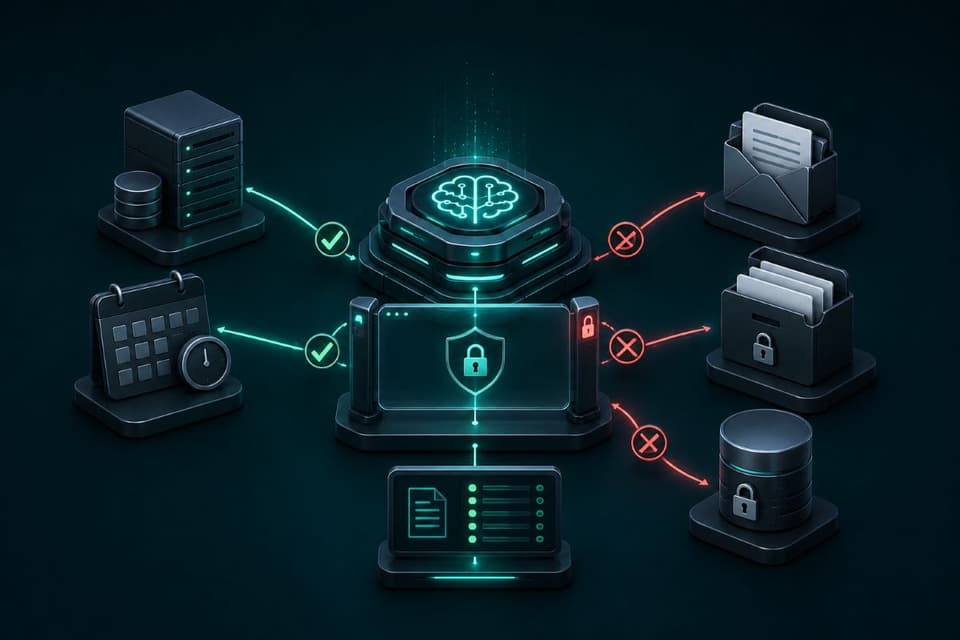
The scariest agent failures are rarely about the AI being wrong; they are about what the agent had permission to touch when it went wrong. An agent connected to email, calendars, files, or customer records can act on that access at agent speed, which means a bad decision propagates before anyone notices, the same category of exposure we cover in our broader look at AI security risks for small businesses.
The practical defense is the same principle that governs every other system access in your business: give the agent the minimum permissions its task actually requires, log what it does, and review that log, not just the outputs it hands you.
Piloting an Agent Without Regretting It
For a business ready to try one, the safe path is narrower than the vendor pitch suggests. Start with a task that is bounded, repeatable, and low stakes if it goes wrong, the scheduling reminder rather than the client contract review. Keep a human reviewing outputs for the first weeks even after the agent seems reliable, since drift and edge cases surface slowly.
Grant the minimum access the task needs and nothing more, resisting the convenience of a broad permission grant that saves five minutes of setup. And write down what the agent is and is not allowed to decide on its own, a one-paragraph boundary that prevents the scope from quietly expanding after it proves useful once.
This mirrors the broader discipline of adopting any new AI tool responsibly: judge a vendor by the specificity of their answers about access, logging, and failure handling, not by how impressive the demo looks.
Signs a Task Is Not Ready for an Agent Yet
Vendors selling agent platforms rarely volunteer this list, which is exactly why it belongs in a business decision rather than a purchase decision. Just as useful as knowing where agents fit is recognizing where they do not, at least not yet.
A task with no clear definition of done, where success is a matter of judgment rather than a checkable outcome, tends to disappoint, because an agent optimizes toward whatever it can measure, and vague goals produce vague or confidently wrong results.
A task touching systems your business cannot afford to have acted on incorrectly, billing, client communications with legal weight, anything feeding directly into a regulatory filing, deserves a human in the loop regardless of how well an agent performs elsewhere.
And a task nobody on staff currently understands well enough to check the agent's work is a bad first pilot, because the whole safety model depends on a person who can tell good output from confidently wrong output, and that person has to already exist before the agent does the work, not be trained after something goes sideways.
A New Tool, Not a New Employee
AI agents are a real, useful addition to a small business's toolkit for exactly the tasks that are repetitive enough to automate and varied enough that a rigid rule could not, and the businesses getting genuine value from them are the ones that started narrow, kept a human at the decision points, and treated access like the real risk it is.
Approached that way, an agent quietly returns hours of the week to people who were spending them on mechanical work. Approached as an autonomous replacement for judgment, it becomes the next expensive lesson in a folder of AI disappointments. The technology earns the first, better outcome when a business deliberately builds it that way on purpose from the start.
For businesses in the Conejo Valley, a partner providing IT services in Thousand Oaks can help identify which processes are genuinely ready for AI agents and which still need a person.
Companies across the metro can get the same locally through managed IT services in Los Angeles, from picking the first pilot task to setting the access limits around it.
A short consulting conversation before the first pilot goes live is usually enough to catch the access mistakes that are expensive to unwind afterward.
If your business is weighing where AI agents could actually help without creating new risk, GlobeVM can help you pick the first task worth automating and set the guardrails around it from day one.