
Ask almost any business owner what threatens its cloud environment today and most will picture a hacker breaking through a wall of defenses. The far more common reality is quieter and less cinematic: a storage bucket left open to the public internet by a setting nobody double-checked, an account with more permission than its job requires, logging switched off during a troubleshooting session and never switched back on.
None of these situations actually involve anyone breaking anything at all. They involve a configuration that was simply wrong, sitting there quietly, waiting for the wrong person to eventually find it. Cloud security posture management, usually shortened to CSPM, is the discipline built specifically to catch these gaps before someone else does, and this guide explains what it actually checks, why misconfiguration has become the dominant real-world cloud risk, and whether a small business needs a dedicated tool for it or can fold the discipline into existing cloud management.
What Cloud Security Posture Management Actually Is
Cloud security posture management is the continuous, automated practice of scanning a cloud environment's configuration against a known set of security best practices, flagging anything that deviates, and helping track the fix. The specific word posture is doing real, deliberate work in that name: it is not asking whether your cloud provider is secure, since the provider's own infrastructure almost always is, it is asking whether the way you have configured your slice of that infrastructure leaves anything exposed.
This distinction matters enormously and gets lost constantly in casual conversation about cloud security. Major cloud providers operate under a shared responsibility model, where the provider secures the underlying platform and the customer is responsible for how they configure and use it, and the overwhelming majority of real-world cloud incidents trace back to the customer side of that line, not the provider side.
CSPM exists because that customer-side configuration is large, constantly changing, and genuinely hard for a human to monitor by hand across every service in active use.
Why Misconfiguration Became the Real Threat
The shift toward configuration risk, rather than classic hacking, follows directly from how cloud environments actually get built in practice. A modern small business cloud footprint accumulates settings across storage, databases, user permissions, networking rules, and third-party integrations, often added incrementally by different people over months or years, each change reasonable in isolation and nobody responsible for the accumulated picture. Settings that were correct when a system launched drift as the environment grows around them.
A permission granted broadly for a one-time task outlives the task. A resource stood up for a quick test becomes permanent infrastructure nobody remembers to lock down. None of this requires an attacker doing anything clever; it requires only that someone eventually notices the exposed setting before someone else does, and the businesses that get hurt are almost always the ones where nobody was systematically looking.
This is precisely the blind spot CSPM is built to remove: not defending against a sophisticated attack, but catching the ordinary, human, entirely avoidable mistake before it becomes an incident.
What a CSPM Tool Actually Checks
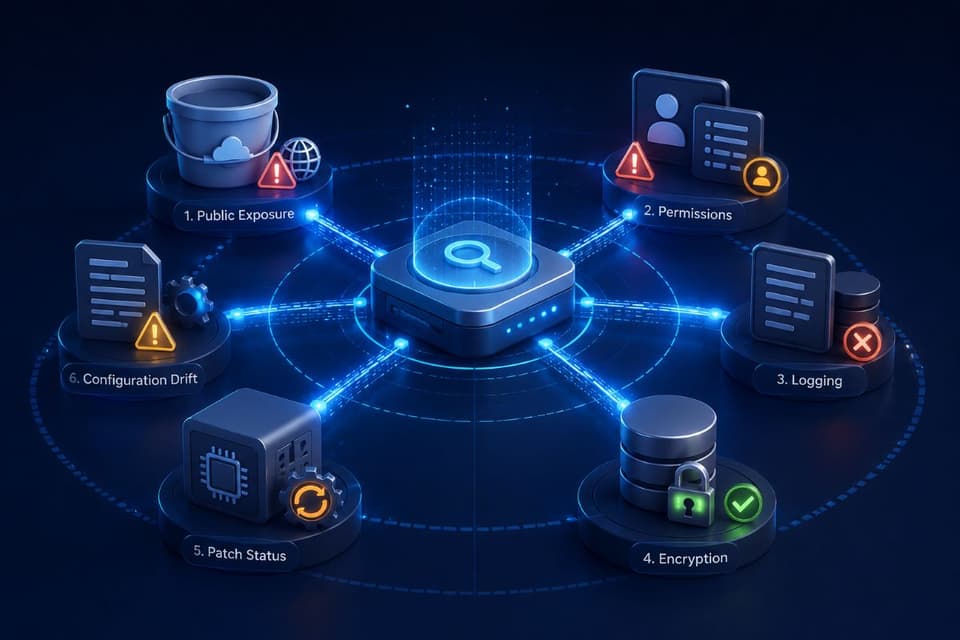
Stripped of vendor marketing, the actual checks a CSPM tool runs fall into a handful of recognizable categories that map directly onto where real incidents originate:
- Public exposure: storage, databases, or services accidentally reachable from the open internet when they should be restricted to internal or authorized access.
- Overly permissive access: user accounts, service accounts, or roles granted far more access than their actual function requires.
- Disabled or missing logging: activity that should be recorded for accountability and incident investigation, silently switched off or never configured.
- Unencrypted data: information at rest or in transit that should be encrypted, sitting in plain form because encryption was never enabled.
- Outdated or unpatched components: managed services and configurations running old, known-vulnerable versions that a routine update would have addressed.
- Drift from known-good baselines: any configuration that has quietly changed from an approved, secure starting state, flagged even before anyone can say whether the change was a mistake or intentional.
Notice the theme running through every item: these are not exotic attacks; they are ordinary settings that ordinary people get wrong under ordinary time pressure, at scale, across an environment too large for anyone to check by hand on a regular basis. A CSPM tool's entire value proposition is running that check continuously and flagging deviations the moment they appear, rather than during an annual audit that finds the exposure eight months after it happened.
Does a Small Business Actually Need a Dedicated CSPM Tool?
The honest answer depends more on the shape of the cloud footprint than the size of the business. A company running a handful of well-understood cloud services with infrequent changes may get adequate coverage from the built-in security recommendations most major cloud platforms already provide at no extra cost, paired with a periodic manual review.
A company running a more complex environment, multiple cloud services, frequent changes, several people with administrative access, several third-party integrations connected to cloud accounts, crosses a complexity threshold where manual review genuinely cannot keep pace, and a dedicated CSPM tool starts paying for itself in the incidents it prevents rather than the ones it merely helps investigate afterward.
The regulatory dimension matters too: businesses handling protected health information, financial records, or other regulated data face a meaningfully higher cost for the same misconfiguration than a business with lower-stakes data, which shifts the calculation toward proactive monitoring even at a smaller scale, a consideration we cover more broadly in our guide to compliance and risk management.
The Case for Folding This Into Managed Cloud Services
For most small and mid-sized businesses, the more practical path is not buying and configuring a standalone CSPM product, but ensuring the ongoing management of cloud infrastructure already includes this discipline as standard practice rather than an optional add-on.
The distinction that matters is not which specific tool runs the scans; it is whether anyone is actually looking at the results on a regular rhythm and closing the gaps that surface, which is exactly the kind of continuous, unglamorous oversight that belongs inside a genuine cloud security program rather than a separate project a business has to remember to run itself.
A tool nobody reviews produces a dashboard full of warnings and no actual improvement in posture, which is a worse outcome than not having the tool at all, since it creates a false sense that something is being handled.
Configuration Risk Is Not a One-Time Fix
The most important thing to understand about cloud posture is that it is never finished. Every new service, every new integration, every team member with new access, every quick fix made under deadline pressure is a fresh opportunity for the environment to drift away from its secure baseline, which is precisely why this is called posture management rather than a posture project.
A business that runs one thorough configuration review and considers the job done will find, a year later, that the environment looks nothing like it did on review day, with new gaps nobody was watching for.
The businesses that handle this well treat cloud posture the same way they treat any other ongoing operational discipline, monitored continuously, reviewed on a real schedule, and owned by someone specific, rather than as a box checked once and forgotten.
A Practical Starting Point
For a business that has never had its cloud configuration formally reviewed, the first useful step is smaller than it sounds: an initial audit against the categories listed above, public exposure, permission scope, logging, encryption, patch status, and drift, produces a prioritized list of what actually needs fixing right now versus what can wait.
This first pass typically surfaces more than owners expect, not because anyone did anything egregiously wrong, but because that is simply what happens to configuration in any environment that has been growing and changing for a while without a dedicated, continuous eye on it. From there, the ongoing discipline is lighter than the first cleanup, since maintaining a clean posture takes far less effort than establishing one from a drifted starting point.
What "Good" Actually Looks Like
It helps to know what success looks like before starting, since posture work can otherwise feel endless. A healthy cloud environment is not one with zero findings, which rarely happens and would be a suspicious result if it did; it is one where findings get triaged quickly, the genuinely dangerous ones close within days rather than months, and the same finding does not reappear repeatedly because nobody addressed its root cause.
Progress here looks like a shrinking backlog and a shorter average time to fix, not a permanently clean dashboard, and a provider who promises the latter is promising something no real, actively used cloud environment ever actually achieves in practice.
Who Should Actually Own This
A question worth answering before any tool or service enters the picture: right now, today, who at your business would know if a cloud storage bucket became publicly accessible tomorrow morning? For many small businesses the honest answer is nobody, not because anyone is careless, but because nobody was ever explicitly assigned the job.
Cloud posture tends to fall into the gap between whoever set the systems up originally, who may have moved on or moved to other priorities, and whoever manages day-to-day IT, who may not have visibility into cloud-specific configuration at all.
Naming an owner, whether an internal role or a managed cloud infrastructure provider, is a smaller step than it sounds and closes the single biggest gap behind most posture failures, which is rarely a missing tool and almost always a missing owner.
Security Is Also a Settings Problem
Every business that moves to the cloud inherits a genuinely secure platform underneath and a configuration layer on top that is entirely its own responsibility, and the gap between those two is where most real incidents actually happen.
Cloud security posture management is simply the practice of watching that configuration layer continuously instead of hoping nothing drifts, catching the open bucket, the overly broad permission, and the disabled log before an attacker finds them instead of after. Whether that discipline lives in a dedicated tool or inside a well-run managed cloud relationship matters less than whether someone is actually doing it, on a real schedule, with the authority to fix what it finds.
For businesses in the region, a partner providing IT support in Simi Valley can run the first configuration audit and assign real ownership going forward.
Companies across the Valley can get the same locally through IT services in the San Fernando Valley, from the initial review to ongoing monitoring.
If your business has never had its cloud configuration reviewed against a real cloud security posture management baseline, GlobeVM can run that first audit, name an owner, and build the ongoing monitoring that keeps the gaps from quietly reopening rather than closing once and drifting back over the following year.