

Disaster recovery proposals look remarkably similar to each other. Every provider promises rapid recovery, tested procedures, and expert support, and the differences that in fact determine whether a recovery succeeds are rarely visible in the marketing.
This guide covers what really separates disaster recovery providers, framed as the specific questions to put to each one, because the answers vary considerably more than the brochures suggest.
Advertised Recovery Time and Proven Recovery Time
Providers quote a recovery time objective, the target for how quickly systems come back. Treat that figure as a specification rather than a measurement until you have asked the follow-up: has this been achieved for a client environment of comparable size and complexity, and can you describe that test?
A quoted figure describes what the technology is capable of under favourable conditions. A demonstrated figure accounts for the parts that consume time in a real event: locating credentials, making decisions, coordinating people, and validating that recovered systems are usable rather than merely running.
Ask What the Figure Includes
Recovery time can be measured from the moment a disaster is declared, or from the moment the provider begins work, or from the point technical restoration starts. These are meaningfully different clocks, and the gap between them is often hours.
A provider willing to define precisely where their clock starts is describing something real. One that answers vaguely is quoting a number without a definition behind it.
Who Decides a Disaster Has Occurred
This question sounds procedural and turns out to be one of the most consequential. Some arrangements let the client declare and invoke recovery; others require the provider to agree, which introduces a conversation at the exact moment nobody wants one.
Ask specifically: who can invoke, what triggers qualify, how the declaration is made outside business hours, and whether there is any cost or penalty attached to invoking for something that turns out to be recoverable another way. Businesses that have never asked frequently discover their answer during an actual incident.
What Happens When Many Clients Invoke at Once
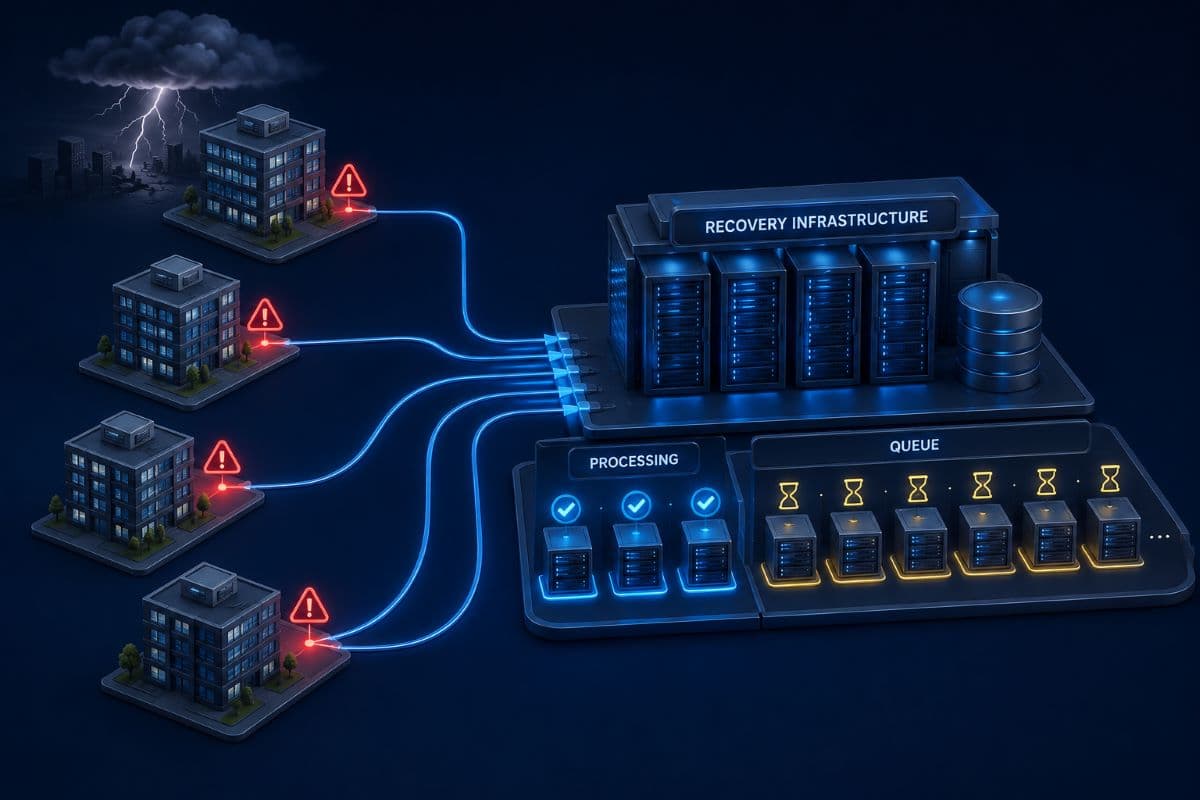
This is the question providers least expect and it reveals the most. Most disasters are individual events, a failed system or a ransomware incident affecting one business, and the provider has ample capacity.
A regional event is different: a wildfire, an extended power failure, a major weather event affecting an entire area at once. If a provider serves many clients in the same geography and all of them invoke simultaneously, capacity and attention are finite. Ask how they prioritize, whether contractual commitments hold under those conditions, and where their recovery infrastructure physically sits relative to yours. For businesses across Southern California, geographic concentration is a genuine consideration rather than a theoretical one, and a serious disaster recovery arrangement should have an answer ready.
Testing: Included, Billed, or Theoretical
Every provider says recovery is tested. The differences are in what a test actually consists of, how often it happens, whether it is included in the fee or billed separately, and whether the client receives documented results.
A test that verifies backups are readable is not the same as a test that brings systems up and confirms people can work. Ask which one is included, how frequently, and to see a sample report from a recent one. A provider producing a real report answers the question completely; a provider describing their testing philosophy has not answered it at all.
Who Participates in a Test Matters Too
A test the provider runs alone verifies their side. A test involving your staff verifies the part that really fails in real events: whether your people know what to do, whether contact information is current, and whether the recovered environment is usable for the work they need to do.
What the Provider Needs From You During a Real Event
Recovery is not something done to a business; it requires participation. Ask what the provider will need from you and how quickly: decisions about priority, access to systems or accounts, someone available to validate that recovered systems are correct, and communication with your own staff and clients.
A business that has not thought about this arrives at a recovery discovering it is the bottleneck. Knowing in advance which of your people need to be reachable, and having that documented outside the systems that might be down, closes a gap that no provider can close for you.
Where Your Data Physically Sits
Ask where the recovery copies are stored, in what jurisdiction, and how far from your primary location. Too close and a regional event affects both; too far and data transfer during a recovery becomes a timing problem.
Regulated businesses have a second layer here, since some obligations constrain where certain data may reside. Confirming this before signing rather than during an audit is straightforward and frequently skipped, and it belongs alongside the rest of a business's backup and disaster recovery planning.
Contract Terms Worth Reading Closely
Three provisions deserve attention beyond the headline price. What the provider owes you if they miss their committed recovery time, which is frequently a service credit rather than meaningful compensation. What happens to your data if the relationship ends, including the format it comes back in and what retrieval costs. And what notice period applies if they change the service or the price.
None of these matter until they matter enormously, and all three are considerably easier to negotiate before signing than after.
Judging the Answers
Across all of these questions, the useful signal is specificity rather than confidence. A provider who answers with named steps, real timeframes, and documented examples is describing a practice. One who answers with reassurance is describing a position.
The second useful signal is willingness to describe what they do not cover. Every recovery arrangement has boundaries, and a provider who names theirs unprompted is generally more trustworthy than one who implies there are none. That combination of specificity and honesty is what distinguishes a genuine partner from a vendor, and it is worth weighting heavily alongside any managed IT services arrangement you already have in place.
Compare on Substance, Not on Promises
Every provider's proposal claims fast, tested, reliable recovery, which makes those claims useless for choosing between them. Comparing disaster recovery providers usefully means asking who can declare, what the recovery clock in fact measures, what happens when a whole region invokes at once, and what the provider needs from you. The answers separate proposals that look identical on paper.
For businesses in the region, a partner providing IT support in Thousand Oaks can work through these questions against your specific recovery requirements.
Companies across the metro can get the same locally through managed IT services in Los Angeles, including a recovery test that involves your own team rather than only the provider's.
Frequently Asked Questions
Because it describes what the technology can do under favourable conditions rather than what has been achieved in practice. Ask whether that figure has been demonstrated for a comparable environment, and ask precisely where the clock starts, since recovery time can be measured from disaster declaration, from when the provider begins work, or from when technical restoration starts. Those are different clocks, often hours apart.
What happens when many clients invoke at the same time. Most disasters are individual events where the provider has ample capacity, but a regional event affecting an entire area at once tests that assumption directly. Ask how they prioritize, whether commitments hold under those conditions, and where their recovery infrastructure sits relative to yours.
Ask what a test consists of, how often it happens, whether it is included or billed separately, and to see a sample report from a recent one. Verifying that backups are readable is meaningfully different from bringing systems up and confirming people can work. A provider producing a real report has answered the question; one describing their testing philosophy has not.
More than most businesses expect: priority decisions, access to systems or accounts, someone available to validate that recovered systems are correct, and communication with your own staff and clients. Knowing in advance who needs to be reachable, and keeping that documented outside the systems that might be down, closes a gap no provider can close on your behalf.
If every proposal on your desk reads the same, GlobeVM can help you ask the questions that actually separate one disaster recovery provider from another.
Comments
0 Comments