

A financial advisory firm reaches a point where its regulatory obligations clearly exceed what anyone currently on staff can competently handle. The question that follows is uncomfortable and rarely discussed openly: hire someone, train someone, or bring in a firm.
This guide covers how to think about cybersecurity expertise for a financial firm as a staffing decision rather than a technology purchase, including what each option realistically costs and where each one tends to fail.
Why This Decision Arrives Sooner for Financial Firms
Most small businesses can defer this question for years. Financial firms usually cannot, because regulators expect a named accountable person for information security, and examinations ask who that person is.
An answer of nobody in particular is not merely a gap in capability; it is a finding. That regulatory pressure converts what would otherwise be a gradual staffing decision into one with a deadline attached.
The Obligation Does Not Scale Down With Firm Size
A three-advisor practice and a forty-person firm face substantially the same expectations around written policies, risk assessment, vendor oversight, and incident response. The smaller firm simply has fewer people across whom to distribute the work.
This is why the expertise question feels disproportionate at small financial firms compared to businesses of similar headcount in other industries, and why the regulatory framework behind compliance and risk management deserves to drive the decision rather than following it.
The Three Realistic Options
Hiring a dedicated security professional gives the firm someone whose entire job is this, which is really the strongest option when it is affordable. The difficulty is that qualified candidates command salaries that many small advisory firms cannot justify against a role generating no revenue directly.
Training an existing employee costs less and works when that person has both the aptitude and protected time. It fails when security becomes an addition to an already full role, which is the outcome most of the time.
Engaging an outside firm provides access to expertise the firm could not hire and continuity that does not depend on one person staying. The trade-off is less immediate familiarity with the firm's specific environment and the need to manage that relationship deliberately.
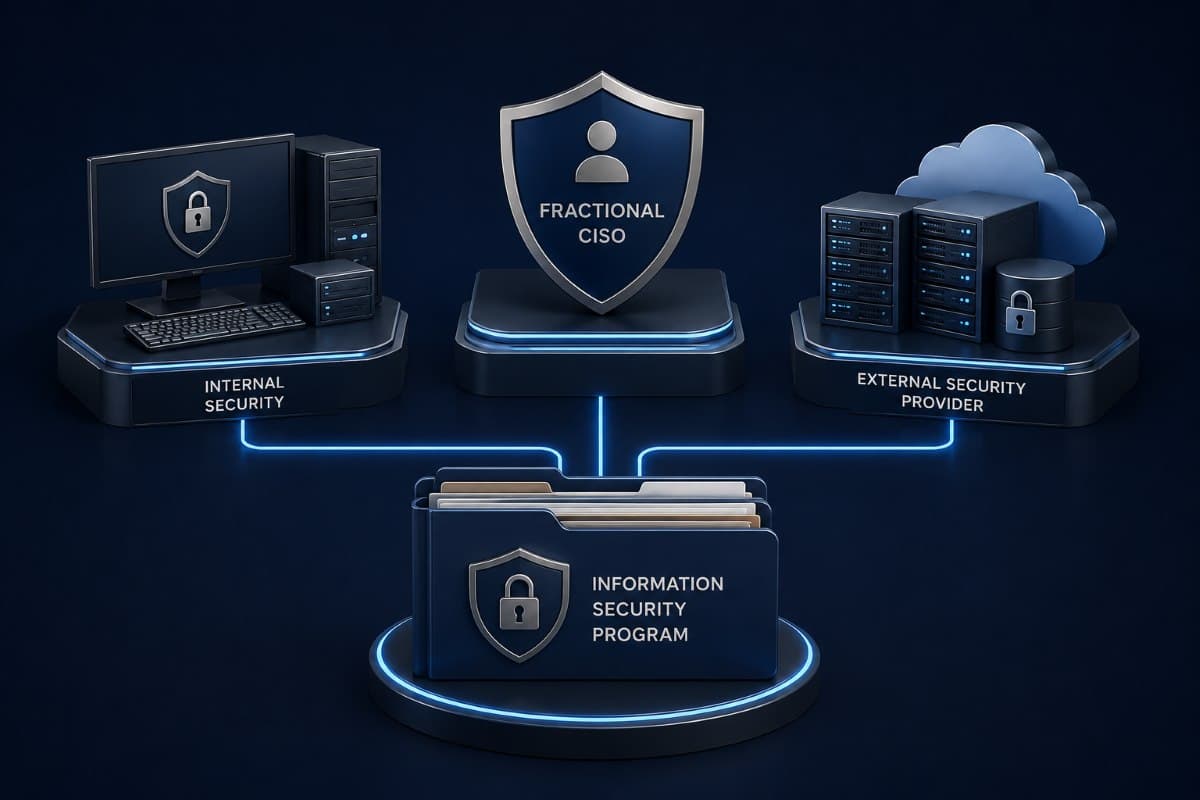
The Fractional Option Sits Between Hiring and Outsourcing
A fourth arrangement deserves naming because it fits small financial firms particularly well: engaging an experienced security leader part-time, often called a fractional or virtual chief information security officer.
This buys senior judgment, the ability to speak credibly to an examiner, and program ownership, without a full salary. It works when the firm needs decision-making authority and documentation quality more than daily technical hands, which describes most advisory firms accurately.
Most Firms End Up Combining Two of Them
The arrangement that works most often is an internal person who owns the relationship and understands the firm's operations, paired with an outside provider supplying depth and coverage. This is not indecision; it is a reasonable match between what each option is in fact good at.
What the Named Accountable Person Actually Does
Regulatory expectations here are more specific than firms assume. The accountable individual maintains the written information security program, ensuring risk assessments happen on schedule, overseeing vendors who touch client data, and confirming staff training occurred.
None of this requires deep technical skill. It requires ownership, consistency, and the judgment to know when something needs escalating to someone with genuine technical depth, which is exactly why this role can sit internally while the technical layer sits outside.
Documentation Is a Substantial Part of the Job
An examiner cannot observe security practices directly; they read records. A firm doing everything correctly with no documentation is, from an examination perspective, indistinguishable from one doing nothing at all.
Whoever holds this role needs to be someone who will maintain records, which is a different quality than technical ability and frequently the more limiting one in practice.
Where Each Option Tends to Fail
A dedicated hire at a small firm often becomes isolated, working without peers to consult and without the exposure to varied environments that keeps security knowledge current. Firms taking this route should budget for training and external community involvement rather than assuming the hire is self-sustaining.
A trained internal employee fails predictably when their protected time evaporates under operational pressure. The security work is always the thing that can wait one more week, until an examination or an incident reveals how many weeks accumulated.
An outside firm fails when the relationship is treated as a purchase rather than a partnership: nobody internally owns the relationship, recommendations go unimplemented, and the firm ends up paying for advice it never acted on.
What to Look For in an Outside Provider
Financial-sector experience is not optional here. A provider who has never worked with an advisory firm will not know what an examiner asks for, what the vendor oversight expectations look like, or how the recordkeeping requirements shape practical decisions.
Ask directly whether they have supported firms through an examination, what documentation they produce as a standard part of the engagement, and who specifically would hold access to client systems. A provider whose financial services experience is genuine will answer these without hedging.
Access to Client Data Deserves Its Own Conversation
Any provider working in a financial firm's environment will encounter client financial information, which makes their own security posture part of the firm's regulatory exposure. This is precisely the vendor oversight obligation the firm is expected to demonstrate, applied to the vendor helping with security itself.
Reviewing the provider's own access control practices, and confirming who at the provider can reach what, is a reasonable request that a serious provider expects.
A Reasonable Sequence for a Firm Starting Now
Name the accountable person first, even before deciding on external help, because that role is the one regulators ask about and everything else organizes around it. Then assess honestly what that person can realistically own given their other responsibilities.
The gap between what the role requires and what that person can deliver is the specification for outside help. Firms that work in this order buy the right amount of support; firms that engage a provider first often buy either more or less than they needed.
How Long This Takes to Stand Up
Firms consistently underestimate the timeline. Naming an owner happens in a week. Producing a written information security program that reflects the firm's actual practices, rather than a downloaded template, typically takes a month or two of real work.
The risk assessment, vendor inventory, and training records that support it take longer still, and none of it is finished in the sense of being complete forever, since each element needs periodic refresh. A firm starting now should plan in quarters rather than weeks, and should start with the pieces an examiner asks for first.
Expertise Is a Staffing Question Wearing a Technology Costume
Financial firms frequently approach cybersecurity expertise as a search for the right tools, when the more useful framing is a search for the right person and the right relationship. Name the accountable owner, be honest about their capacity, and fill the remaining gap deliberately rather than hoping a product will cover it.
For firms in the region, a partner providing IT support in Westlake Village can help define what your internal owner should hold and what genuinely needs outside depth.
Practices across the metro can get the same locally through managed IT services in Los Angeles, including the documentation an examiner will actually ask to see.
Frequently Asked Questions
Regulators expect a named individual accountable for the firm's information security program, and examinations ask who that person is. An answer of nobody in particular is a finding rather than merely a gap. The role does not require deep technical skill; it requires ownership of the program, the documentation, and the judgment to escalate technical matters appropriately.
It is the strongest option when affordable, and qualified candidates command salaries many small advisory firms cannot justify for a role that generates no revenue directly. Firms that do hire should also budget for ongoing training and external community involvement, since a lone security professional at a small firm can become isolated from the varied exposure that keeps the knowledge current.
It works when that person has both genuine aptitude and protected time that survives operational pressure. It fails when security becomes an addition to an already full role, which is the common outcome, because the security work is always the thing that can wait one more week until an examination reveals how many weeks accumulated.
Whether they have supported financial firms through an actual examination, what documentation they produce as standard, and who specifically at their organization would hold access to client systems. That last question matters because the provider's own security posture becomes part of the firm's vendor oversight obligation, which is the same duty the firm must already demonstrate for every other vendor touching client data.
If your firm cannot currently name who owns its information security program, GlobeVM can help define that role and build the cybersecurity expertise around it.
Comments
0 Comments