

A retailer running one store has a manageable technology problem. The same retailer running five stores has a different problem entirely, and it is rarely five times harder in a way anyone planned for.
The difficulty in multi-site retail IT is not scale so much as divergence: each location drifts toward its own configuration, its own workarounds, and its own version of what normal looks like. This guide covers multi-site retail IT as a standardization problem, which is what it in fact is once a business passes the second location.
Divergence Is the Default, Not the Exception
Locations diverge for entirely reasonable reasons. One store got a new point-of-sale terminal when the old one failed, so it runs a different version. Another had a connectivity problem and a local technician changed a setting to solve it. A third was acquired and came with its own equipment.
None of these decisions were wrong at the time. The accumulated result is that a problem appearing at one store cannot be diagnosed using knowledge of another, and every fix becomes bespoke.
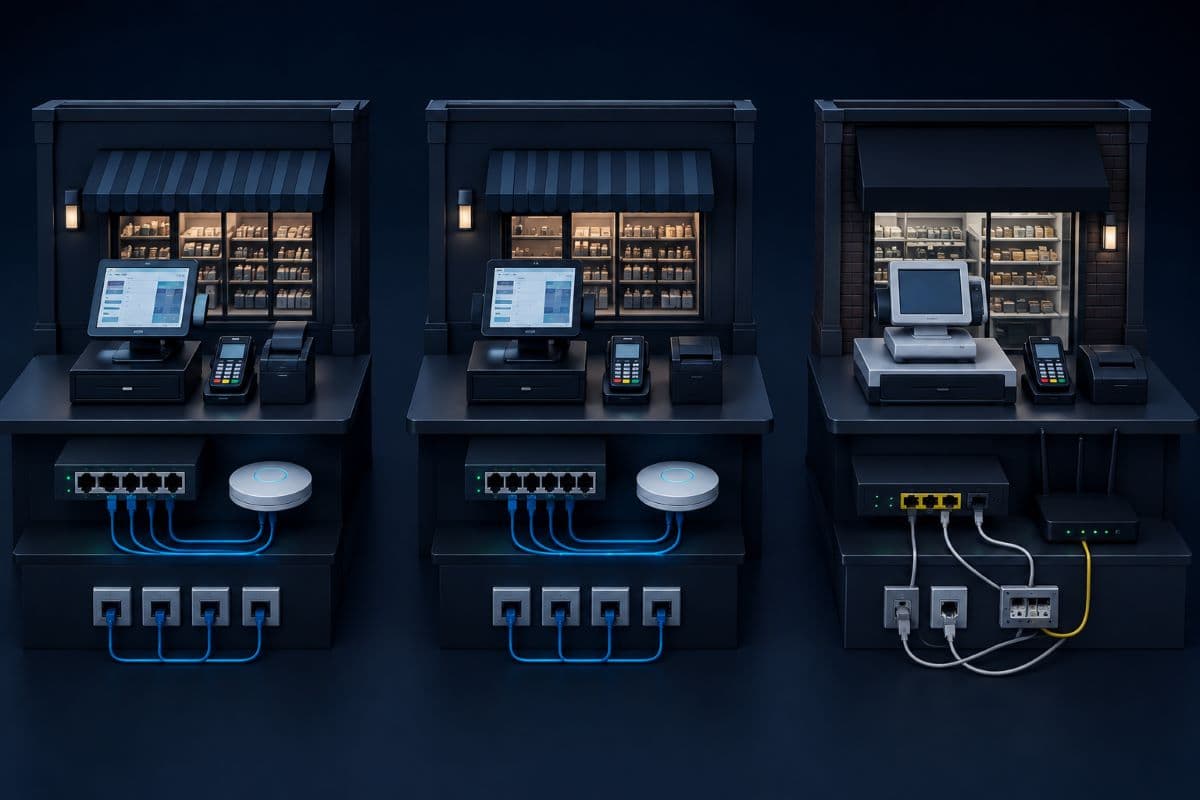
The First Symptom Is Usually Support Time
Businesses notice divergence through support rather than through any inventory. The same issue takes twenty minutes at one location and two hours at another, because the second one turns out to be running something nobody documented.
When that pattern appears, the underlying problem is not the individual fault; it is that no two locations are the same.
Standardization Is Cheaper Than It Looks
Bringing locations onto common equipment, common configuration, and a common support process has an upfront cost that businesses weigh against a benefit they find hard to quantify. The benefit is real and shows up in three places.
Support becomes faster because a technician who understands one store understands all of them, which is the compounding benefit behind multi-site retail IT standardization. Staff become transferable between locations without retraining on different systems. And opening the next location becomes a repeatable deployment rather than an improvisation.
Standardize in Waves, Not All at Once
The practical approach is replacing divergent equipment as it reaches end of life rather than replacing everything simultaneously. Each refresh moves one location onto the standard, and within a normal replacement cycle the estate converges without a disruptive project.
Franchise and Owned Locations Diverge Differently
A retailer operating owned locations can mandate a standard. A franchise model cannot, or not in the same way, since franchisees purchase their own equipment and make their own vendor decisions within whatever the agreement specifies.
The practical approach in a franchise structure is to define the standard as a requirement in the agreement where possible, and to make compliance the easier path everywhere else: a recommended equipment list, a preferred supplier, and support that is simpler to use than finding a local technician. Standards that are easier to follow than to ignore get followed.
Inventory Systems Cross Every Location at Once
Point-of-sale gets the attention, and inventory is the system that actually spans the estate. Stock levels, transfers between locations, and purchasing all depend on every store reporting accurately into the same system in near real time.
This makes inventory unusually sensitive to the connectivity and configuration differences described above: a store with an intermittent connection produces stale numbers, and stale numbers at one location distort purchasing decisions for the whole business. It is often the first place divergence becomes visible to someone outside IT.
Nobody Technical Is On Site, and That Is Fine
Retail locations are staffed by people hired to serve customers, not to troubleshoot networks, and any support model assuming otherwise fails during the busy periods when it matters most.
This makes remote support capability and remote device management the foundation rather than an add-on. A store manager should be able to describe a symptom and have someone resolve it without a site visit, and equipment should be configurable and updatable centrally, which is what proper network management across multiple sites is built to provide.
Define What Store Staff Should and Should Not Try
A short, specific list of what a store team can attempt, restarting a specific device, checking a specific cable, and what they should never attempt, changing settings or reconfiguring equipment, prevents both the delay of waiting for help on something trivial and the mess created by well-intentioned improvisation.
Payment Systems Multiply the Compliance Question
Every location processing card payments carries payment card industry obligations, and those obligations apply per location rather than once for the business. A retailer compliant at headquarters and inconsistent across stores is not compliant.
This is another argument for standardization, since demonstrating consistent controls across locations is considerably easier when the locations are consistent. The same logic applies to the network segmentation separating payment systems from guest and back-office traffic, which needs to hold at every site rather than at the flagship, and which sits squarely inside a retailer's PCI DSS obligations.
Opening a New Location Should Be Boring
The clearest test of whether a multi-site retailer has this right is what happens when it opens store number six. In a business with a standard, opening is a checklist: known equipment list, known configuration, known connectivity arrangement, known timeline.
In a business without one, each opening is a small project with its own decisions, its own surprises, and its own timeline risk, usually discovered close to a launch date that cannot move. Building the deployment standard while opening store four is considerably easier than doing it under pressure at store six.
Connectivity Lead Time Is the Usual Surprise
Business internet circuits frequently take weeks to install, and the requirement is often identified after a lease is signed and a launch date is set. Adding connectivity to the site-selection checklist, rather than the build-out checklist, removes the most common cause of a delayed opening.
Central Visibility Changes What You Can Manage
A retailer that can see, from one place, which locations are online, which systems are running current software, and where problems are recurring manages a different business than one that finds out by phone.
That visibility is also what makes patterns visible: the same failure at three stores is a supplier or configuration issue rather than three unlucky coincidences, and it is nearly impossible to notice without a central view. Pairing that with threat detection across every site means a security signal at one location is not treated as an isolated event.
Consistency Is the Whole Strategy
Nearly every difficulty in multi-site retail IT traces back to locations that are not the same as each other, and nearly every solution involves making them more alike. Standardize as equipment naturally refreshes, build remote support and central visibility as the foundation rather than an addition, and treat opening a new location as a repeatable deployment. The businesses that do this find their technology complexity stops growing faster than their store count.
For retailers in the region, a partner providing IT support in Thousand Oaks can map how far your locations have actually diverged before the next opening.
Frequently Asked Questions
Through entirely reasonable individual decisions: one store got replacement equipment when the old unit failed, another had a local technician change a setting to fix a connectivity problem, a third was acquired with its own systems. None was wrong at the time. The accumulated result is that a problem at one location cannot be diagnosed using knowledge of another, and every fix becomes bespoke.
The benefit shows up in three measurable places: support becomes faster because a technician who understands one store understands all of them, staff become transferable between locations without retraining, and opening the next location becomes a repeatable deployment rather than an improvisation. Standardizing in waves as equipment reaches end of life avoids the cost of replacing everything at once.
Remote support and remote device management need to be the foundation rather than an add-on, since retail staff are hired to serve customers and any model assuming otherwise fails during exactly the busy periods when problems hurt most. Pair that with a short, specific list of what store teams should and should not attempt themselves.
The obligations apply at every location processing card payments, which means a retailer compliant at headquarters but inconsistent across stores is not compliant. Network segmentation separating payment systems from guest and back-office traffic needs to hold at every site, which is considerably easier to demonstrate when the locations are really configured the same way.
If your locations have quietly drifted apart and every store problem feels like a new problem, GlobeVM can map the divergence and bring your multi-site retail IT back onto one standard.
Comments
0 Comments