

A retail business sits at an unusual intersection of risk. It processes card payments constantly, often at high volume during short, predictable windows. It manages inventory and pricing data that competitors would love to see. And it typically runs on thinner security staffing than almost any other industry handling this much sensitive transaction data.
This guide covers the specific cybersecurity risks for retail organizations that generic small-business advice tends to miss. We focus on the point-of-sale environment as the central risk, the seasonal traffic patterns that create predictable attack windows, and the employee turnover reality that most retail security plans never account for.
The Point of Sale Is Still the Center of Retail Risk
Retail security conversations have expanded to cover e-commerce, cloud systems, and remote work, and all of that expansion is genuinely relevant. But for most retailers, the point-of-sale environment remains the single highest-value target, because it is where card data actually gets captured, processed, and, if security is weak, exposed.
A compromised point-of-sale system can expose every card swiped through it for as long as the compromise goes undetected, which in many real incidents has meant weeks or months. This is not a hypothetical; it is the most common pattern behind large retail data breaches over the past decade, and small retailers are not exempt from it simply because their transaction volume is smaller.
Payment Card Security Obligations Apply Regardless of Size
Every retailer accepting card payments operates under payment card industry security requirements, and these obligations scale with transaction volume but never disappear entirely, even for a single small location. The specific technical requirements cover how card data is transmitted, processed, and stored, and a retailer that has never had its point-of-sale environment reviewed against these requirements through proper compliance and risk management is very possibly carrying exposure it does not know exists.
E-Commerce Adds a Second, Separate Attack Surface
A retailer running both a physical store and an online storefront is defending two genuinely different environments, not one environment with two doors. The online storefront carries its own risks: vulnerable shopping cart software, exposed customer accounts, and increasingly, automated attacks that test stolen card numbers against a checkout page to see which ones still work, a technique called card testing that can quietly run up processing fees and fraud flags long before anyone notices.
A retailer treating e-commerce security as an afterthought to the physical store, or vice versa, is leaving one of the two environments under-defended. Both deserve independent attention, because a strength in one does not compensate for a weakness in the other.
Seasonal Traffic Spikes Are Also Attack Windows
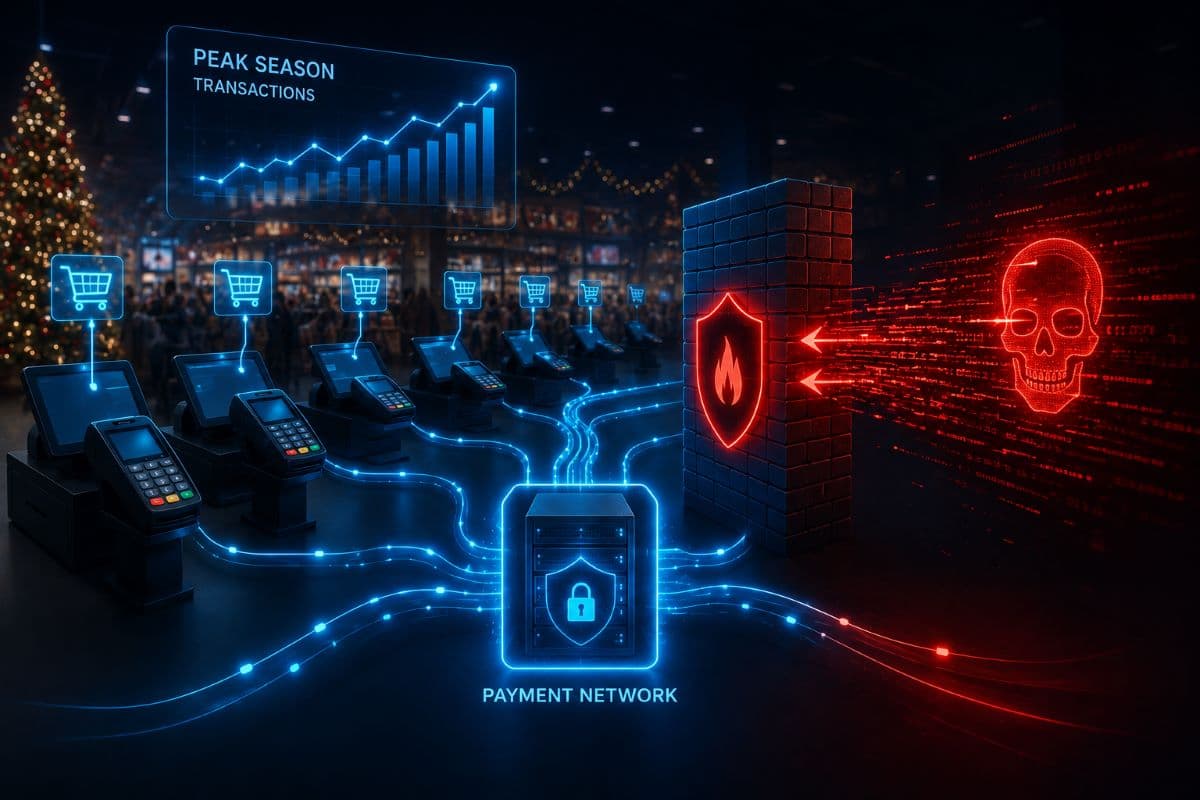
Retail has a rhythm most other industries do not: predictable, extreme spikes in transaction volume around specific dates. Attackers know this rhythm as well as retailers do, and they specifically time certain attacks to land during these high-volume windows, when unusual activity is harder to spot against the noise of legitimately high traffic and when a business is least willing to slow anything down to investigate.
This timing dynamic argues for a specific practice: security monitoring and incident response readiness should be strongest exactly when the business is busiest, not treated as something to revisit after the season calms down. A retailer that only reviews its security posture in a quiet month is reviewing it at exactly the wrong time relative to when attackers are most active.
Seasonal and Temporary Staff Create a Real Access Gap
Retail's seasonal hiring pattern creates a genuine security challenge: a wave of temporary employees needs point-of-sale and system access quickly, and that same wave needs its access removed cleanly once the season ends. A business without a formal process for this accumulates exactly the kind of stale access that becomes a liability, former seasonal staff with credentials nobody remembered to revoke.
Building seasonal onboarding and offboarding into a repeatable checklist, rather than handling it informally under hiring-season pressure, closes this gap at essentially no cost.
Inventory and Supply Chain Systems Are Valuable Targets Too
Beyond payment data, a retailer's inventory, pricing, and supplier systems hold information that carries real competitive value and real disruption potential if compromised. A ransomware attack that locks inventory management during a peak selling period does not just threaten data; it threatens the ability to fulfill orders and restock shelves at the exact moment the business depends on both, which is why threat detection should cover these systems and not only the payment environment.
These systems deserve the same backup and access-control discipline as payment systems, even though they rarely get discussed with the same urgency in general retail security conversations.
Third-Party Delivery and Marketplace Integrations Expand the Risk
Retailers increasingly sell through third-party marketplaces and delivery platforms in addition to their own systems, and each integration is a data connection most retailers never formally review after initial setup. An API connection to a marketplace platform that was configured once during onboarding and never revisited can quietly hold more access than the current relationship actually requires.
Treating these integrations with the same access-review discipline as employee accounts, checked periodically rather than assumed permanent, closes a gap that grows every time a new sales channel gets added without a corresponding security review.
Loyalty Programs and Gift Cards Are a Frequently Overlooked Fraud Target
Customer loyalty accounts and gift card systems hold real monetary value, and attackers have increasingly targeted them directly, since a compromised loyalty account or a cloned gift card can be converted to cash or merchandise with less friction than stolen card data alone. Retailers running loyalty programs should apply the same account security thinking, strong authentication, monitoring for unusual redemption patterns, that they apply to payment systems, rather than treating loyalty as a marketing feature disconnected from security.
Returns and Refund Fraud Ride the Same Systems as Payments
Return and refund processes touch the same payment systems as the original sale, and attackers, sometimes external, sometimes an employee acting alone, have learned to exploit weak controls around this specific process. A refund issued to a different card than the original purchase, or a pattern of returns processed without a matching original transaction, is a signal worth flagging automatically rather than catching only during a manual audit weeks later.
Retailers should treat refund controls as part of the same security conversation as payment acceptance, with clear approval limits and a paper trail for anything outside the ordinary pattern.
Vendor and Supplier Portals Are Often the Weakest Link
Many retailers grant suppliers and vendors direct access to inventory or ordering systems, and this access is frequently set up once and never reviewed again. A compromised vendor account can be used to manipulate orders, view competitive pricing data, or serve as a foothold into the retailer's broader network.
Reviewing vendor access on the same schedule as employee access, rather than treating it as a separate, forgotten category, closes a gap many retailers have never specifically considered.
A Practical Checklist for Retail Security
For a retailer taking stock of where things actually stand:
- Verify point-of-sale compliance against current payment card industry requirements, not an assumption that it was handled at setup.
- Treat e-commerce and physical store security independently, since neither compensates for weakness in the other.
- Strengthen monitoring before peak season, not after it, since attackers time activity to the same calendar retailers do.
- Build seasonal staff onboarding and offboarding into a formal checklist rather than informal habit.
- Apply real security discipline to loyalty and gift card systems, not just to payment processing.
Mobile Point-of-Sale Adds Its Own Wrinkle
Tablet-based and mobile point-of-sale systems have become common on retail floors, offering flexibility that traditional fixed registers do not. That same mobility introduces new questions: how the device connects to payment processing, whether it locks automatically when idle, and what happens if the tablet itself is lost or stolen during a busy shift.
These devices deserve the same device-management discipline as any other business laptop or phone, not an exception carved out because they look more like consumer tablets than traditional registers.
Employee Discount Abuse Sits at the Overlap of Fraud and Security
Employee discount and price-override permissions in point-of-sale systems are a frequent source of loss that businesses often categorize as a management problem rather than a security one, even though the underlying issue, unmonitored system permissions, is exactly the same pattern seen elsewhere in this guide. Logging and periodically reviewing who can apply discounts and overrides catches this pattern the same way access reviews catch stale system permissions.
Choosing Security Support That Understands Retail
A retailer evaluating security support should look for a provider who treats point-of-sale compliance, seasonal traffic patterns, and high staff turnover as familiar, central concerns. That familiarity shows up most clearly during the exact moments this guide has described: a suspicious pattern spotted during the holiday rush, a seasonal hire's access needing fast, clean removal, a loyalty account showing signs of takeover.
This is the kind of operationally specific understanding that belongs inside real managed IT services built around how a retail business actually operates through its full calendar year.
Loss Prevention and Cybersecurity Teams Should Talk to Each Other
Retail loss prevention has traditionally focused on shoplifting and physical theft, while cybersecurity has focused on systems and data, and these two functions often operate without much communication even though the patterns behind them, unauthorized access, unusual activity, insider risk, overlap considerably. A retailer that connects these two conversations, even informally, catches patterns that either function alone would miss.
Physical and Digital Security Increasingly Overlap in Retail
A retail store's physical security, door access, alarm systems, and its digital security increasingly run on the same underlying network infrastructure, which means a weakness in one can become a weakness in the other. A door access system with a default password is the same category of risk as a point-of-sale terminal with one, even though they sit in different parts of the store.
Chargebacks Are a Security Signal, Not Just a Cost of Doing Business
Retailers often treat chargebacks purely as an operational cost to absorb, but a sudden spike in chargebacks tied to a specific time window or product category can be an early signal of a broader card-data compromise happening somewhere in the business's systems. Reviewing chargeback patterns with security in mind, not just as part of the finance team's usual monthly review, can surface a compromise weeks before it would otherwise be discovered through any other means available to a typical small retailer.
Protect the Business During the Weeks That Matter Most
Retail's risk profile is shaped by patterns other industries do not share: concentrated payment activity, predictable seasonal spikes, and a workforce that turns over faster than almost anywhere else. Cybersecurity risks for retail organizations that ignore these patterns end up protecting the business during its quiet months while leaving it exposed during the exact weeks that matter most to revenue.
For retailers across the metro, a partner providing managed IT services in Los Angeles can review your point-of-sale compliance and strengthen monitoring before your next peak season arrives.
Businesses across the Valley can get the same locally through IT services in the San Fernando Valley, from e-commerce security to a seasonal staff access process that actually holds up.
Frequently Asked Questions
Because it is where card payment data is actually captured and processed, and a compromised point-of-sale system can expose every transaction that passes through it for as long as the compromise goes undetected, often weeks or months in real incidents. Every retailer accepting card payments operates under payment card industry security obligations regardless of size, and many small retailers have never had their environment specifically reviewed against these requirements.
Yes. A retailer running both channels is defending two genuinely different environments with different risks: the physical store faces point-of-sale and network risks, while e-commerce faces vulnerable shopping cart software, account takeover, and automated card-testing attacks against the checkout page. Treating one channel's security as sufficient coverage for both leaves the neglected channel under-defended.
Because attackers time certain activity to land during high-volume periods, when unusual behavior is harder to detect against legitimately heightened traffic and businesses are least willing to slow anything down to investigate. Security monitoring and incident readiness should be strongest heading into peak season, not reviewed only after the season calms down, since that is exactly when attackers are least active and least useful to focus on.
Through a formal, repeatable onboarding and offboarding checklist rather than informal handling under hiring-season pressure. Seasonal staff need point-of-sale and system access quickly, and that access needs to be removed cleanly once the season ends; without a formal process, retailers accumulate stale credentials from former seasonal employees that nobody remembered to revoke.
A capable partner can also confirm your refund controls and vendor access reviews meet the same standard as your payment systems.
Reviewing coverage across every sales channel rounds out the picture for a business selling through several channels at once.
If your retail business has never had cybersecurity risks for retail organizations reviewed against your specific point-of-sale environment, or your seasonal staff access process is informal at best, GlobeVM can close both gaps before your next peak season arrives.
Comments
0 Comments