
Wealth management firms hold exactly what cybercriminals want: detailed financial records, account access, and the personal information of clients who trust the firm to protect it. Regulators know this, which is why the rules governing how these firms secure their technology have grown sharper and more demanding. For any broker-dealer or advisory firm, FINRA cybersecurity compliance is not a box to tick once a year. It is an ongoing obligation woven through several rules, enforced through examinations, and recently tightened by a major regulatory update with deadlines that are arriving right now. This guide explains what these requirements actually mean for your IT environment, where the most common gaps appear, and what a firm needs to have in place. A practical note before we start: this is an explanation of the technology requirements, not legal advice, and firms should pair it with guidance from their own compliance counsel.
GlobeVM provides IT support for financial firms in Los Angeles: client data security, recordkeeping and the controls regulators ask about.
How FINRA actually regulates cybersecurity
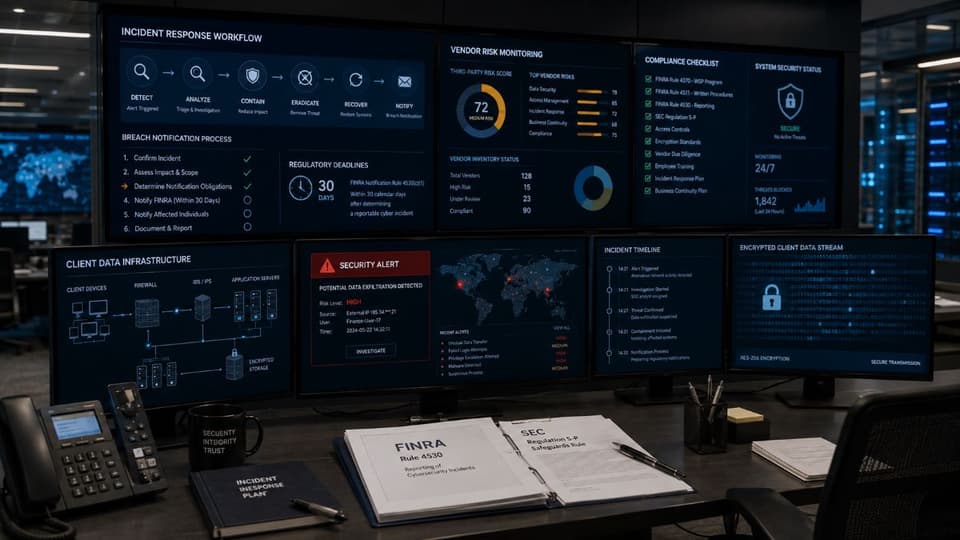
The first thing to understand is also the most misunderstood. FINRA does not have a single, standalone cybersecurity rule. There is no one document titled "the cybersecurity rule" that a firm can read and check off. Instead, FINRA enforces cybersecurity expectations through a web of existing rules, supported by Securities and Exchange Commission regulations that sit alongside them. Understanding which rules apply is the foundation of genuine compliance.
The rules most relevant to a wealth management firm's technology include:
- FINRA Rule 3110 (Supervision). Requires firms to establish and maintain a supervisory system, which examiners read to include reasonable supervision of cybersecurity risks and the vendors that introduce them.
- FINRA Rule 4370 (Business Continuity Plans). Requires a written plan to continue operations during a significant disruption, which now plainly includes a ransomware attack or a major system outage.
- FINRA Rule 4530 (Reporting Requirements). Can obligate a firm to report certain events, including some that arise from a cybersecurity incident.
- SEC Exchange Act Rules 17a-3 and 17a-4 (Books and Records). Govern how firms create, store, and protect required records, including the integrity and retention of electronic communications and data.
- Regulation S-P. The privacy rule governing how firms safeguard nonpublic personal information about customers. This is the rule that changed most significantly in 2024, covered in detail below.
- Regulation S-ID (Identity Theft Red Flags). Requires programs to detect and respond to identity theft indicators.
Because the obligations are spread across these rules rather than collected in one place, firms that look for a single checklist often miss requirements entirely. Real FINRA cybersecurity compliance means addressing the cumulative expectation these rules create, not any one of them alone.
An honest point about who FINRA actually covers
The term wealth management firm is broad, and precision matters here. FINRA regulates broker-dealers and their associated persons. Many wealth management firms are FINRA member broker-dealers, but a large number operate as registered investment advisers, which are overseen primarily by the SEC or state regulators rather than FINRA, and many firms are dually registered. The practical takeaway is that the exact rule set depends on how your firm is registered. What unites nearly all of them is Regulation S-P, which applies to broker-dealers and registered investment advisers alike. So even a pure advisory firm that is not a FINRA member faces closely related cybersecurity obligations.
The 2024 Regulation S-P amendments: the change that matters most now
The most important recent development in this area is the SEC's overhaul of Regulation S-P, adopted in May 2024. These amendments turned what had been general safeguarding expectations into specific, enforceable obligations with firm deadlines, and the timing is urgent.
The compliance dates are staggered by firm size. Larger entities, including registered investment advisers with $1.5 billion or more in assets under management, were required to comply by December 3, 2025, a deadline that has already passed. Smaller entities must comply by June 3, 2026. For a smaller firm reading this, that deadline is effectively here, and the time for preparation has nearly run out.
What the amended rule requires your firm to have
The updated Regulation S-P imposes several concrete requirements that translate directly into IT work:
- A written incident response program. Firms must have documented policies and procedures to detect, respond to, and recover from unauthorized access to or use of customer information. This is not a one-page statement. It must address how the firm assesses the scope of an incident, contains it, and recovers from it.
- Customer breach notification within 30 days. When sensitive customer information has been, or is reasonably likely to have been, accessed without authorization, the firm must notify affected individuals as soon as practicable and no later than 30 days after becoming aware of the incident.
- Service provider oversight. Firms must take steps to oversee vendors that receive customer information, including arranging for those vendors to notify the firm of a breach, generally as soon as possible and no later than 72 hours after the vendor detects it.
- Recordkeeping. Firms must maintain written records documenting their compliance with these requirements.
Each of these has a direct technology dimension. An incident response program is only credible if the firm has the monitoring to detect an incident in the first place. Breach notification within 30 days depends on being able to determine quickly what data was actually affected, which requires good logging and visibility. Vendor oversight requires knowing exactly which third parties touch your client data. These are IT capabilities, not just policy documents.
The IT controls that underpin compliance
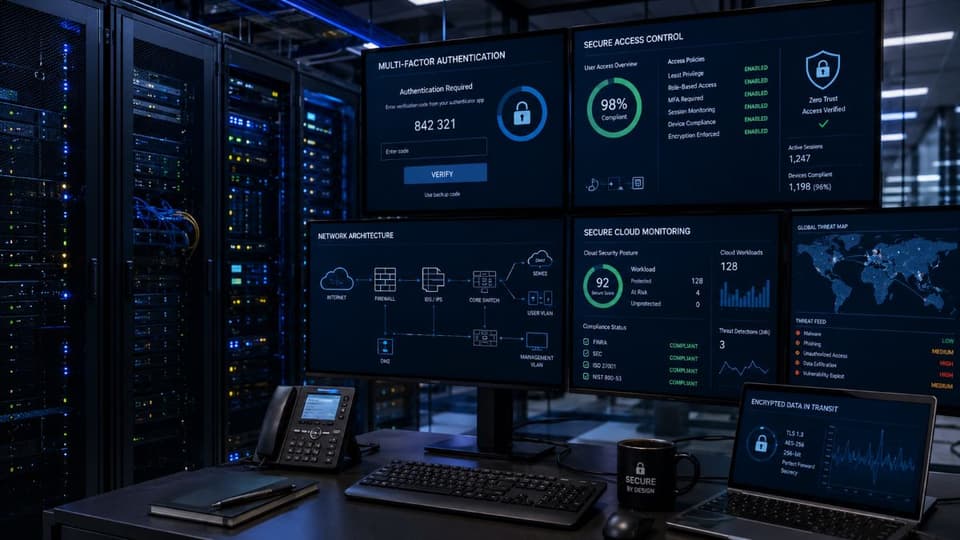
Regulators do not certify specific products, but examinations and enforcement actions consistently focus on a recognizable set of controls. A wealth management firm serious about meeting its obligations should have these in place and be able to demonstrate them.
Access control and strong authentication
Every user should have a unique account, access should be limited to what each role genuinely needs, and multi-factor authentication should protect access to systems holding client data. Account takeover is one of the most common ways client assets and information are compromised, and weak authentication is the door most attackers walk through. Strong access control is among the first things an examiner looks for and a core part of any credible cybersecurity solution for a financial firm.
Continuous monitoring and detection
You cannot respond to what you cannot see. The incident response and breach notification requirements assume a firm can actually detect unauthorized access, which means continuous monitoring of systems and networks rather than discovering a problem weeks later. This is where remote monitoring and management becomes a compliance asset, not just an operational convenience, because it shortens the gap between a breach occurring and the firm knowing about it.
Data protection, backups, and recovery
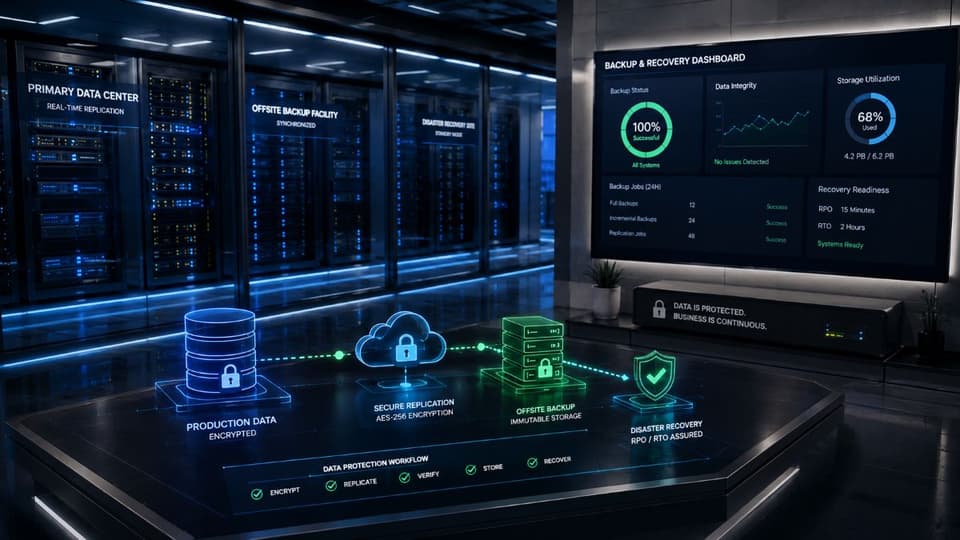
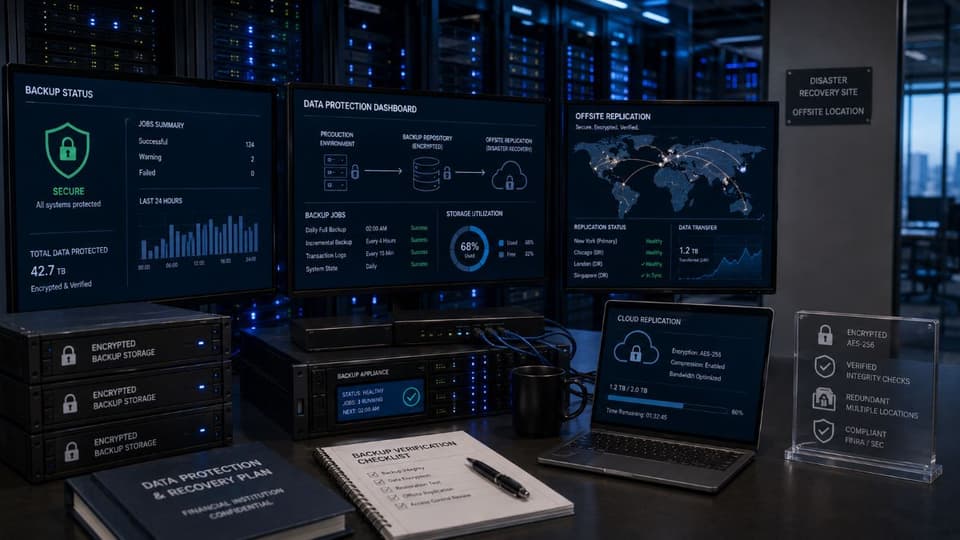
FINRA's business continuity expectations and the broader push toward resilience mean a firm must be able to recover from a destructive incident such as ransomware. Backups should be encrypted, stored off the network so an attacker cannot destroy them along with the primary systems, and tested regularly to confirm data can actually be restored. A backup that has never been test-restored is an assumption, not a safeguard, which is why disciplined data backup and disaster recovery sits at the center of continuity compliance.
Vendor and third-party risk management
The amended Regulation S-P makes vendor oversight explicit, and FINRA's supervision expectations reinforce it. A firm needs a current inventory of every third party that handles client data, contractual breach-notification commitments from those vendors, and ongoing monitoring of their security posture. A breach at a vendor is, for regulatory and reputational purposes, often treated as a breach at your firm.
Regular testing
Controls that are never tested tend to fail when they matter. Periodic vulnerability scanning and, for many firms, penetration testing help identify weaknesses before an attacker does, and they provide documented evidence of due diligence that supports the firm's compliance position during an examination.
Where firms most often fall short
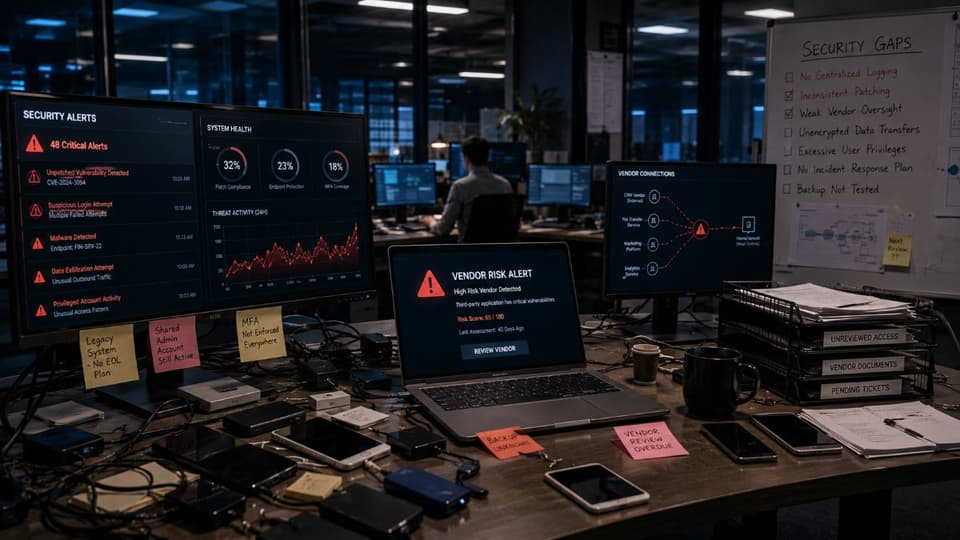
Examination findings and enforcement actions reveal the same gaps repeatedly. Checking your firm honestly against these is a useful exercise.
- Policies that exist only on paper. A written incident response plan that no one has tested, or that does not match how the firm actually operates, offers little protection and tends not to satisfy examiners.
- Unknown data sprawl. Client data lives in more places than firms expect, including email, personal devices, and cloud tools. Firms that cannot map where their data is cannot protect or account for all of it.
- Weak vendor oversight. Many firms have no complete list of vendors with access to client data and no breach-notification terms in those contracts.
- Inadequate detection. Without monitoring, a firm may not learn of a breach until well past any reasonable notification window, turning one failure into a compliance failure as well.
- Treating compliance as a one-time project. Cybersecurity obligations are continuous. A firm that achieves compliance once and then stops maintaining it drifts out of compliance as its systems and threats change.
Building a sustainable compliance posture
The firms that handle this well stop treating cybersecurity and regulatory compliance as separate efforts and start treating them as one program. The technical controls that protect client data are the same controls that satisfy regulators, so building genuine security is the most reliable path to demonstrable compliance. That program needs an owner, documentation, regular testing, and a way to keep current as rules evolve. The FINRA 2026 oversight priorities make clear that cybersecurity, vendor oversight, and emerging risks such as generative AI remain front and center, so this is not a settled area.
For most small and mid-sized wealth management firms, building and maintaining all of this internally is impractical. They lack a dedicated security team, and the regulatory environment moves faster than a generalist can track. This is where specialized support matters. A provider experienced with financial services can align your technology with the relevant rules, and GlobeVM's work with regulated firms is built around exactly that intersection of compliance and risk management and day-to-day IT. Firms looking for a partner that understands the sector can review GlobeVM's approach to IT for financial services and how those controls map to regulatory expectations.
If your firm needs to confirm that its technology genuinely meets these obligations before an examiner or an incident tests it, the team at GlobeVM can assess your current controls against the relevant requirements and give you a clear, prioritized plan to close any gaps.