If you run a medical practice, a law office, or a financial firm in the Los Angeles area, there is a good chance the term NIST has already landed on your desk. It might have come from a cyber insurance application that asked whether you follow a recognized security framework, from a larger client whose vendor questionnaire referenced it, or from an auditor who mentioned it in passing. The NIST Cybersecurity Framework is the document behind that term, and for a non-technical owner it can feel like one more piece of jargon written for someone else. It was not. The current version was rebuilt specifically so that a small business with no security staff can use it, and understanding what it is takes far less time than most owners expect.
A Business Guide to NIST CSF Explained: a Guide to Stronger Cybersecurity

By George
24 June 2026

This guide explains the NIST Cybersecurity Framework in plain language: what it is, what its six parts cover, what changed in the latest version, and how a business your size can actually put it to work without hiring a team or buying expensive software. None of it requires you to become technical. It only requires you to understand how the pieces fit, so you can ask the right questions and make informed decisions about where your money and attention should go.
What the NIST Cybersecurity Framework Actually Is
NIST stands for the National Institute of Standards and Technology, a United States government agency that publishes technical standards across many fields. In 2014 it released the first version of its cybersecurity guidance, originally aimed at the operators of critical infrastructure such as power and water systems. A minor update followed in 2018. The most significant revision, version 2.0, arrived in February 2024 and reshaped the framework into something built for every kind of organization, from a two-person office to a national agency.
Two things make the framework easier to grasp once you know them. First, it is voluntary for private businesses. There is no law that forces a dental office or an accounting firm to adopt it, and there is no government inspector who shows up to check. Second, it is not prescriptive. The framework describes the outcomes a sound security program should achieve, but it does not tell you which products to buy or exactly how to configure them. That flexibility is the point. It lets a small practice and a large hospital use the same common language while putting very different controls in place suited to their size and budget.
That common language is the real value for a small business. When your cyber insurer, a prospective client, and your IT provider all reference the same framework, conversations that used to be vague become concrete. Instead of arguing about whether you are secure enough, which no one can truly answer, you can point to specific areas the framework names and show what you have done in each. This is also where working with a provider that handles compliance and risk management day to day saves time, because mapping your current setup to the framework is something they do regularly.

Why a Framework Built for Everyone Now Includes You
The 2014 framework was written for critical infrastructure, so for years many small businesses reasonably assumed it did not apply to them. Version 2.0 changed that on purpose. NIST broadened the stated audience to all organizations regardless of size, sector, or how advanced their security happens to be, and it added a set of plain-language quick start guides aimed at smaller organizations that do not have a security department. The framework you might have dismissed a few years ago is now one of the few major security references that explicitly expects a small business to be reading it.
The reasons this matters are practical rather than theoretical. Cyber insurance carriers increasingly ask applicants whether they align with a recognized framework, and a clear answer can affect both your eligibility and your premium. Vendor security questionnaires from larger partners often map their questions to framework categories. And in regulated fields, the structure helps you organize the security work that rules like HIPAA already require. For a medical or financial business weighing managed cybersecurity, the framework gives you a clearer way to see what you are actually buying.

The Six Core Functions, in Plain Language
The heart of the NIST Cybersecurity Framework is a set of six functions. Think of them as six plain questions every organization has to answer about its security, arranged so that nothing important falls through the cracks. The first five have been in use for a decade. The sixth, Govern, was promoted to a core function in version 2.0 and now sits at the center, shaping how the other five are run.

Govern: Who Owns the Risk
Govern is about decisions and accountability rather than technology. It asks who in your organization is responsible for cybersecurity, how those decisions get made, what your risk tolerance is, and how security fits alongside other business risks like cash flow and reputation. It also covers the security of your supply chain, meaning the vendors and software providers who can affect you. For a small business, Govern often comes down to a few honest answers: someone is clearly named as responsible, there is a basic written policy, and leadership treats security as a business issue rather than something the computer person handles alone.
Identify: Know What You Have
You cannot protect what you do not know exists. The Identify function is about taking stock: the devices, the software, the data you hold, where that data lives, and which vendors touch it. It also includes understanding your specific risks, since a law firm holding privileged client files faces different exposure than a retail shop processing card payments. An honest inventory is the foundation for everything that follows, and it is also the step most small businesses skip, which is why so many discover forgotten accounts and unmanaged devices only after something goes wrong.
Protect: Put Safeguards in Place
Protect covers the safeguards that lower the chance of an incident. This is where the controls most people picture live: access control so the right people reach the right systems, multi-factor authentication, staff awareness training, data encryption, and routine maintenance like applying updates. The framework does not dictate brands here. It expects you to have these protections in some form appropriate to your size, and a sensible program for a small office looks very different from one at a large enterprise while still satisfying the same function.
Detect: Notice When Something Is Wrong
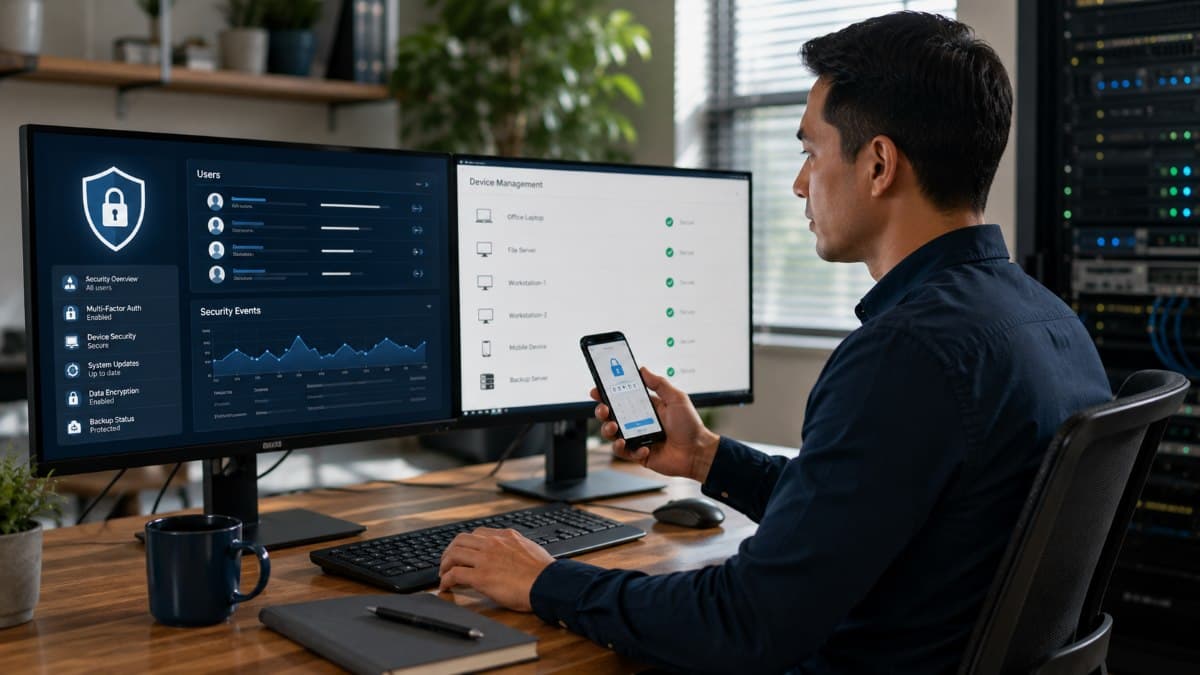
Detection is the difference between catching an intruder in hours and discovering them months later. The Detect function covers monitoring your systems and network so unusual activity surfaces quickly, whether that is a login from an unexpected location or a sudden spike in data leaving your network. Many small businesses have strong locks on the front door under Protect but no alarm system under Detect, which is part of why attacks so often go unnoticed until real damage is done. Continuous monitoring, often delivered through around-the-clock monitoring rather than built in-house, is what fills this gap.
Respond: Have a Plan for the Bad Day
When something does happen, the Respond function is your plan for handling it: who you call, how you contain the problem, how you communicate with staff and affected clients, and how you keep the situation from spreading. A written incident response plan that people have actually read turns a chaotic event into a managed one. NIST even publishes a dedicated profile for ransomware that translates the framework into specific steps for that common scenario, and having thought through responding to a ransomware attack before it occurs is far cheaper than improvising during one.
Recover: Get Back to Work
Recover is about resilience: restoring systems and data after an incident and getting the business operating again. This function leans heavily on tested backups and a recovery plan, because a backup nobody has verified is just a hope. It also includes learning from the event so the same gap does not reopen. For most small businesses this is where data backup and disaster recovery earns its keep, since the speed and completeness of your recovery depend entirely on work done long before the incident.
What Changed in Version 2.0
If you read about the framework from a few years ago, three changes are worth knowing. The first is the addition of Govern as a full function, which formally recognizes that cybersecurity is a leadership and risk decision, not only a technical one. The second is the broadened scope, moving the framework's stated audience from critical infrastructure to organizations of every size and sector. The third is a stronger focus on supply chain risk, reflecting how often incidents now arrive through a trusted vendor or a piece of software rather than a direct attack.
Alongside the guidance itself, NIST released a set of free companion resources meant to make the framework usable rather than abstract. These include quick start guides written for specific audiences, implementation examples that show concrete ways to achieve an outcome, and online reference tools that connect the framework to other standards. For a business owner, the practical takeaway is that you are not expected to interpret a dense document alone, and much of the supporting material is aimed squarely at smaller organizations getting started.

Tiers and Profiles, Without Overcomplicating Them
Two other parts of the framework cause unnecessary confusion, so it helps to demystify them. They are the Tiers and the Profiles, and neither is as complicated as the names suggest.

The Four Tiers
Tiers describe how rigorous and consistent your approach to managing cyber risk is, on a scale of four: Partial, Risk Informed, Repeatable, and Adaptive. A common mistake is to treat these like a ladder where every business should climb to the top. NIST is explicit that they are not a maturity model to ascend automatically. A small practice with modest risk may sensibly sit at a middle tier, because reaching the highest tier costs real money and effort that might be better spent elsewhere. The right tier is the one that matches the risk you actually carry.
Current and Target Profiles
A Profile is simply a snapshot of your security outcomes. You create a Current Profile describing where you stand today and a Target Profile describing where you want or need to be, then the gap between them becomes your to-do list, prioritized by what matters most. NIST also publishes Community Profiles, which are ready-made baselines for a particular sector or threat, such as the ransomware profile mentioned earlier. A small business can adopt a relevant Community Profile as a starting Target rather than building one from a blank page.
How a Small Business Actually Starts
The fastest way to stall is to open the full framework, see six functions broken into dozens of categories and more than a hundred detailed outcomes, and conclude it is too much. No small business implements all of it at once, and the framework does not ask you to. A workable path starts with Govern and Identify: name who is responsible, write down a basic policy, and build an honest inventory of your systems, data, and vendors. Those two steps alone surface most of the obvious gaps.
From there, a Current Profile shows where you stand, and you can borrow a sector baseline as your Target. Closing the gaps is then a matter of priority, handling the highest risks first within a budget you control. This is the stage where many owners bring in a local partner, since a provider offering managed IT services in Los Angeles can run the assessment, map your environment to the framework, and turn the result into a plan rather than a binder that sits on a shelf.
Part of an honest assessment is testing rather than assuming. A review such as network security audits checks whether the protections you believe are in place actually work, feeding directly into the Identify function by replacing guesswork with evidence about where you truly stand.
For businesses that want to go further, a penetration testing engagement safely attempts to break in the way a real attacker would, which exposes the gaps a checklist alone can miss. The findings map naturally onto the Detect and Protect functions and help you prioritize the fixes that matter most.

How the Framework Connects to HIPAA, PCI, and Cyber Insurance
For regulated businesses, a fair question is whether adopting the framework duplicates work you already do for HIPAA, PCI DSS, or similar rules. It does not, and in practice it organizes that work. The framework was designed to map onto other standards, so the controls you implement for the HIPAA Security Rule, for example, can be expressed as outcomes within the relevant functions. Using the framework as your overarching structure means a single security program can satisfy several obligations at once instead of running them as separate, overlapping projects.
It is important to be clear about what the framework is and is not in this context. Following the NIST Cybersecurity Framework does not by itself make you HIPAA compliant or PCI compliant, because those have their own specific requirements. What it does is give you a coherent way to manage security that covers most of what those rules expect, and a common vocabulary your auditors and your cyber insurer already understand. For many small firms that combination is exactly what turns a pile of disconnected security tasks into something defensible.

An Honest Look at the Limits
No framework is a finished answer, and it is worth being candid about what this one cannot do. Because it is not prescriptive, it will not hand you a configuration or tell you which firewall to buy; you still have to make those decisions or rely on someone who can. Because it is voluntary and based on outcomes rather than a pass or fail test, there is no official NIST certification for a business to earn, and any vendor claiming to make you NIST certified is overstating things. And the framework is a structure for ongoing work, not a one-time project, since the risks it helps you manage keep changing.
None of that lessens its usefulness. A structure that helps a non-technical owner see the whole picture, ask sharper questions, and direct limited resources to the right places is genuinely valuable, especially when insurers, clients, and regulators are increasingly speaking its language. Treated as a map rather than a destination, the framework gives a small business a credible, organized way to handle security that holds up to outside scrutiny.
Frequently Asked Questions
For private businesses it is voluntary. No law requires a private medical, legal, or financial practice to adopt it, and there is no inspection or penalty for not using it. Federal agencies are required to use it, and some contracts or larger clients may ask you to align with it, but for most small businesses adoption is a choice driven by insurance, client expectations, and the practical benefit of an organized security program.
Not on its own. HIPAA, PCI DSS, and similar regulations have their own specific requirements that you still must meet. The framework helps by organizing your security work and mapping to those standards, so a single program can address much of what they require, but it is a management structure rather than a substitute for the regulations themselves.
Yes, and version 2.0 was revised with exactly that audience in mind. NIST publishes free quick start guides for smaller organizations, and you do not implement everything at once. Most small businesses begin with the Govern and Identify functions, then close the highest priority gaps over time, often with help from an outside IT provider who maps the work to the framework.
No. The framework is built around outcomes rather than a pass or fail exam, so there is no official certificate that declares a business NIST certified. You can document how your program aligns with the framework and have that reviewed, but be cautious of any vendor selling a NIST certification, since that is not something the framework offers.
If you want to see where your business stands against the NIST Cybersecurity Framework and turn it into a clear, prioritized plan, GlobeVM can assess your current setup and map out the practical next steps.
Comments
0 Comments