
A property management company sits in an unusual position: it operates like a small business internally while functioning as the technology backbone for dozens or hundreds of housing units it does not own, collecting rent, coordinating maintenance, and holding the personal and financial information of tenants who never chose the company and cannot simply take their business elsewhere if something goes wrong.
That combination, real financial transactions, sensitive personal data, and units scattered across many physical locations, makes property management technology a genuinely distinct challenge from either a typical office business or a real estate brokerage focused on sales.
This guide covers what property management companies actually need from their technology: the software stack holding operations together, the tenant data question most companies underestimate, the fraud pattern specific to this industry, and how to think about a company managing not one location but many.
Not the Same Business as a Real Estate Brokerage
It is worth separating this clearly from the outset, since the two get lumped together constantly. A real estate brokerage facilitates transactions, closing sales that end once the deal is done. A property management company runs ongoing operations, collecting rent every month, coordinating maintenance year-round, and maintaining a continuous relationship with tenants and property owners that can last for years.
The software, the data patterns, and the risks that follow from ongoing operations are meaningfully different from those built around one-time transactions, which is exactly why property management technology deserves its own treatment rather than borrowing wholesale from real estate IT advice built for a different business model.
The Software Stack Behind Day-to-Day Operations
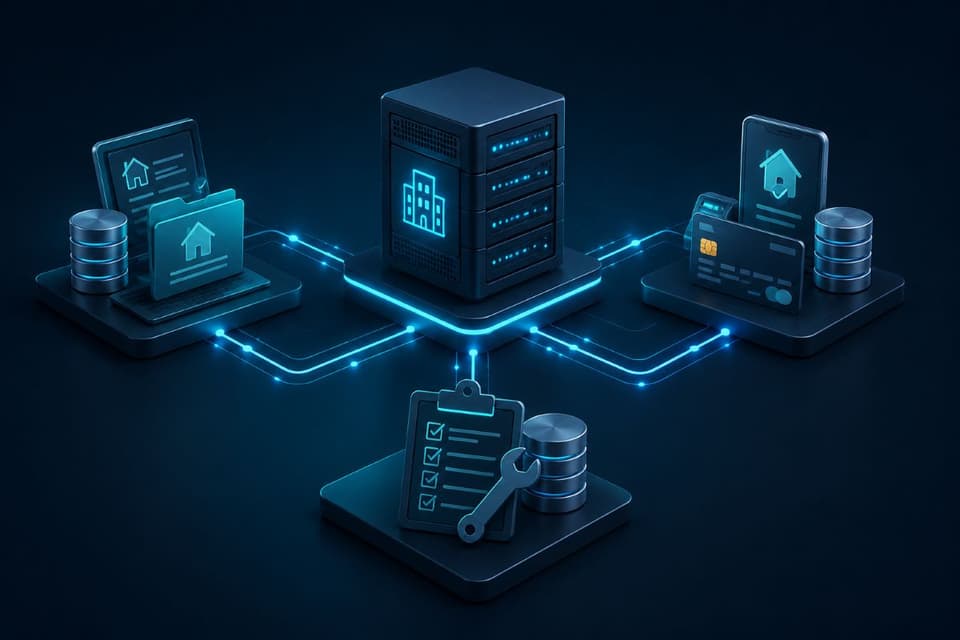
Property management runs on purpose-built platforms that handle the specific rhythm of the business: tenant and lease management tracking who lives where under what terms and when it renews, rent collection and accounting systems processing recurring payments and reconciling them against what every unit actually owes, and maintenance request and vendor coordination systems routing issues from a tenant's complaint to a scheduled repair and back to a closed ticket.
These systems typically need to talk to each other constantly, a maintenance request tied to a specific unit and lease, a payment reconciled against that same unit's running ledger, and an integration failure between any two of them creates exactly the kind of quiet, compounding operational drag that shows up later as late fees charged incorrectly or maintenance requests that simply fall through the cracks unnoticed.
A provider supporting this industry needs to understand not just each individual system, but how they are supposed to work together.
Rent Collection Is a Payment Processing Business Too
Online rent collection has become the standard expectation, which means a property management company is, functionally, running a recurring payment processing operation whether it thinks of itself that way or not. That framing matters because it brings payment card industry obligations into scope, the same standards that govern any business accepting card or bank payments, and it means the platform handling rent collection deserves the same security scrutiny a retail business would apply to its checkout system.
Companies that treat their rent collection platform as just another piece of software, rather than as the financial infrastructure it actually is, tend to discover the gap only after a payment dispute or a security incident forces a closer look.
The Tenant Data Question Most Companies Underestimate
A property management company accumulates a genuinely large amount of personal information across every unit it manages: applicant screening data including credit and background check results, social security numbers, income verification and employment history, and payment records spanning the entire length of every tenancy.
Multiply that by dozens or hundreds of units, often across multiple properties and years of tenant turnover, and the resulting dataset is significant, sensitive, and rarely protected with the rigor its scale deserves. Screening data in particular carries specific handling obligations, since background and credit information used in tenant screening decisions falls under consumer reporting regulations that govern how such data can be collected, used, and retained.
A company that has never audited how long it keeps former tenants' screening files, or who inside the organization can access them, is carrying more regulatory exposure than most owners realize.
The Fraud Pattern Specific to This Industry
Property management has its own version of the payment-redirect scheme that plagues real estate and construction: an attacker compromises or spoofs an email account, either the management company's or a vendor's, and inserts fraudulent payment instructions into routine correspondence, redirecting rent payments, owner distributions, or vendor payments to an account the attacker controls.
Because rent collection and owner payouts happen on a predictable monthly schedule, the scheme can persist for a full cycle before anyone notices funds went to the wrong place, unlike a one-time transaction where the loss is discovered immediately.
The same defense that works across every version of this scam applies here: any change to payment or deposit instructions, from a tenant, an owner, or a vendor, gets verified by a phone call to a previously known number before it is acted on, with no exceptions for how urgent or routine the request appears.
Managing Technology Across Many Locations at Once
A property management company's technology footprint is inherently distributed: on-site staff at larger properties need reliable local systems, off-site staff need consistent remote access to the same tenant and financial records regardless of which property they are working on, and physical security systems, entry access, cameras, increasingly run as networked technology in their own right rather than standalone hardware.
This distributed reality means standardization matters more here than in a typical single-location small business: the same software, the same security settings, and the same support arrangement across every property, so that a technology problem at one location does not become a unique, unsolved case study every time it happens.
Companies managing a growing number of properties without this standardization tend to find their technology complexity growing meaningfully faster than their actual portfolio, which is precisely the opposite of what healthy, sustainable scaling is supposed to feel like for an owner watching the business grow.
Applicant Screening Vendors Are Part of Your Data Chain
Most property management companies outsource tenant screening, credit checks, and background verification to a third-party vendor rather than running it in house, which means a meaningful slice of the most sensitive data in this business, financial and criminal history on prospective tenants, passes through a system the management company does not directly control.
Reviewing what that vendor actually does with the data after a screening decision is made, how long they retain it and whether it is shared further, is a question worth asking directly rather than assuming the vendor's privacy policy covers it adequately.
Insurance Claims Move Faster With Better Records
Property damage claims, whether from a burst pipe, a storm, or a tenant incident, move through the insurance process considerably faster when the property management company can produce clean, timestamped maintenance records and photos tied to the specific unit and date in question.
Companies whose maintenance history lives in scattered emails and paper work orders routinely struggle to assemble this documentation quickly, which delays claims and, in disputed cases, weakens the company's position when an owner or a tenant challenges what actually happened and when. A maintenance system that captures this record automatically as work happens, rather than reconstructing it after a claim is filed, turns a stressful documentation scramble into a straightforward export.
A Practical Checklist for Property Management Technology
For a company ready to take stock of where it actually stands:
- Map the integration points: where tenant, lease, payment, and maintenance systems are supposed to talk to each other, and confirm they actually do.
- Review payment platform security: treat rent collection as the payment processing operation it is, not an incidental software feature.
- Audit tenant screening data retention: how long former tenants' sensitive information is kept, and who can access it.
- Establish a payment-verification policy: for any change to where rent, owner distributions, or vendor payments are sent.
- Standardize across properties: the same systems and security baseline at every location, not a patchwork that grew ad hoc.
Choosing Support That Understands This Business
The right technology partner for a property management company should be comfortable discussing lease and payment system integration, tenant screening compliance, and the specific payment-fraud pattern this industry faces as familiar territory, not concepts they are encountering for the first time on your account.
That familiarity tends to matter most exactly when something goes wrong, a payment dispute, a maintenance system outage affecting several properties at once, a suspicious change to owner payout instructions, and it is worth confirming during the selection process rather than discovering during an actual incident. This is the kind of vertical-specific judgment that separates managed IT services genuinely built around your business from a generic package applied to it.
The Owner Reporting Problem
Property owners who hire a management company expect transparency into how their asset is performing, and increasingly expect that transparency delivered through an owner portal or regular digital reporting rather than a phone call or a mailed statement.
A management company whose reporting systems are unreliable or inconsistent across properties creates a specific kind of reputational risk: owners comparing notes, as they often do, quickly notice when one property's numbers arrive on time and clean while another's are late and full of discrepancies.
Reliable, standardized owner reporting is not just a customer service nicety; it is increasingly the visible proof point owners use to judge whether the technology behind their investment is being handled competently, and it is usually the first thing a prospective new owner client asks to see.
Trusted With Homes That Are Not Your Own
A property management company holds a position of real trust, tenants who never chose the company depending on it to handle their money and their personal information responsibly, and owners depending on it to protect an asset they cannot personally watch every day.
Property management technology done well makes that trust easy to keep: systems that actually talk to each other, rent collection treated with the security scrutiny a payment operation deserves, tenant data handled with real retention discipline, and a payment-verification habit that closes the industry's most common fraud pattern before it starts.
For property management companies across the metro, a partner providing managed IT services in Los Angeles can standardize your systems across every property and close the gaps in your payment-verification process.
Companies in the Conejo Valley can get the same locally through IT support in Thousand Oaks, from tenant data audits to a security standard that travels with every new property you add.
Firms across the Valley can also reach a partner offering IT services in the San Fernando Valley, from owner-reporting reliability to the same standard applied at every location.
A conversation about the industries we support regularly is a useful starting point for any company weighing whether its current setup fits how the business actually runs.
If your company manages properties without a formal payment-verification policy or a clear picture of how long tenant screening data is retained, GlobeVM can close both gaps and standardize your property management technology across every location you manage.