

If your medical practice has ever been handed a vendor's SOC 2 report and asked to confirm it satisfies your HIPAA obligations, you have run into one of the most common and most costly sources of confusion in healthcare compliance. SOC 2 and HIPAA are both built to protect sensitive data, they share a great deal of underlying security logic, and they are frequently discussed together. But they are not the same thing, and one does not replace the other. Understanding the real relationship in the SOC 2 vs HIPAA question is not an academic exercise. It directly affects which vendors you can safely trust with patient data, what you must verify before signing a contract, and where your own legal exposure begins and ends. This guide explains what each one actually is, where they overlap, where they sharply differ, and how a practice can use both together to build a stronger, more defensible approach to patient data protection. Practices across the Los Angeles area run into it most often when a new vendor arrives with a report in hand, which is where managed IT services in Los Angeles that review vendors as part of the job earn their keep.
What HIPAA Is, in Plain Terms
The Health Insurance Portability and Accountability Act is a United States federal law. That single fact shapes everything else about it. Because it is law, HIPAA is mandatory for the organizations it covers, it is enforced by a government regulator, and failing to comply carries legal penalties rather than merely commercial ones.
HIPAA applies to two categories of organization. The first is the covered entity, which includes healthcare providers such as medical and dental practices that transmit health information electronically. The second is the business associate, which is any outside vendor that creates, receives, maintains, or transmits protected health information on a covered entity's behalf. The information being protected is protected health information, or PHI, meaning any information that identifies a patient and relates to their health, their care, or payment for that care. In electronic form it is called ePHI.
HIPAA is enforced by the Office for Civil Rights, part of the Department of Health and Human Services. When OCR finds serious non-compliance, it can impose financial penalties organized into tiers based on culpability, with the most serious tier reaching well over two million dollars per category of violation per year. The key point for the SOC 2 vs HIPAA comparison is simple: HIPAA is not optional, and the consequences of ignoring it are legal.
What SOC 2 Is, in Plain Terms
SOC 2, which stands for System and Organization Controls 2, is something quite different. It is not a law. It is a voluntary auditing framework developed by the American Institute of Certified Public Accountants, the professional body for CPAs. A SOC 2 report is the output of an independent audit in which a CPA firm examines how well an organization protects the data it handles.
SOC 2 is built around five Trust Services Criteria. Security is the only one that every SOC 2 report must include. The other four, availability, processing integrity, confidentiality, and privacy, are optional and are included based on what the organization does. In brief, security covers protection against unauthorized access, availability covers whether systems are operational when needed, processing integrity covers whether data is processed accurately and completely, confidentiality covers protection of sensitive information, and privacy covers how personal information is collected, used, and disposed of.
There are also two types of SOC 2 report, and the difference matters when you evaluate a vendor:
- SOC 2 Type I examines whether an organization's controls are well designed at a single point in time. It is a snapshot.
- SOC 2 Type II examines whether those controls actually operated effectively over a period of time, usually six to twelve months. It is a track record.
A Type II report is significantly more meaningful, because it shows the controls worked in practice over months, not just that they looked good on paper one day. SOC 2 is most common among technology and service companies, such as software vendors, cloud hosts, and data centers, that want to prove to their customers that data is safe in their hands.
SOC 2 vs HIPAA: The Core Differences
The clearest way to understand the relationship is to compare the two frameworks directly across the dimensions that matter most to a healthcare decision maker.
Legal Status
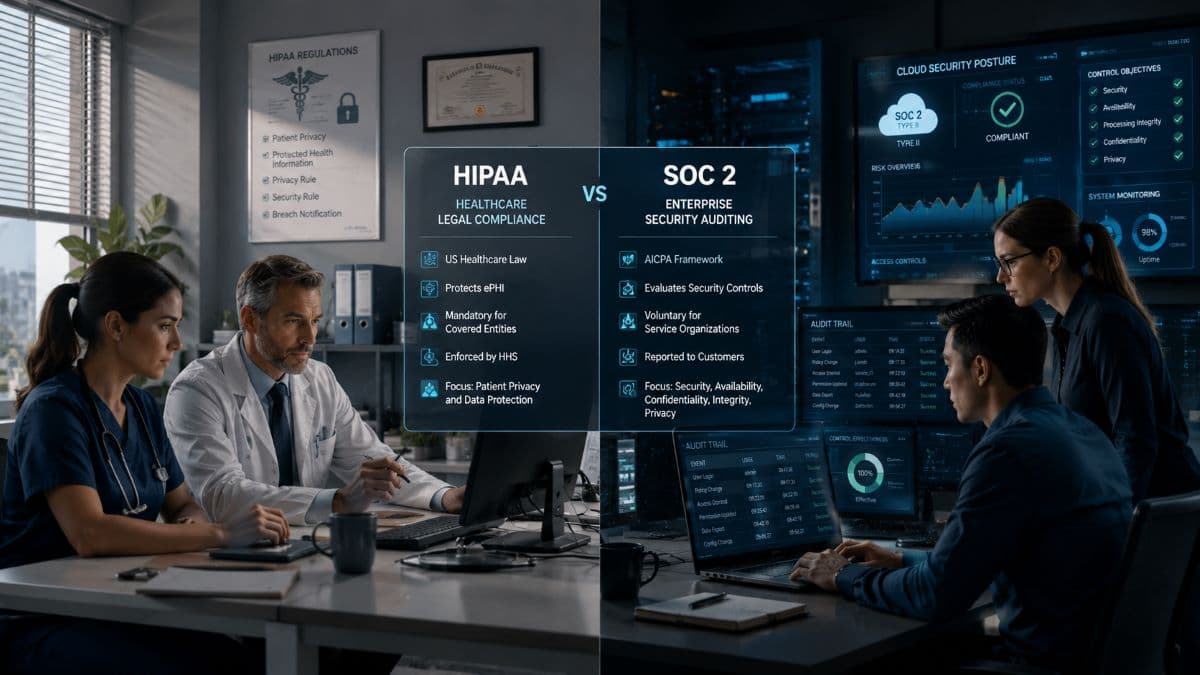
HIPAA is a federal law and compliance is mandatory for covered entities and business associates. SOC 2 is a voluntary framework, and no law requires any organization to obtain it. This is the single most important distinction.
Who They Apply To
HIPAA applies specifically to healthcare data and the organizations that handle it. SOC 2 is industry-agnostic and applies to any service organization that wants to demonstrate strong data controls, whether it works in healthcare, finance, retail, or anything else.
What Failure Costs You
HIPAA non-compliance creates legal risk, including government investigations and substantial financial penalties. The consequences of not having SOC 2 are commercial rather than legal. A company without a SOC 2 report faces no fine, but it may lose deals, because business customers increasingly refuse to work with vendors who cannot produce one.
How Compliance Is Demonstrated
This is a practical difference that surprises many practice owners. There is no official HIPAA certificate. HIPAA compliance is demonstrated through internal and external reviews, documented policies, a security risk analysis, and supporting safeguards such as dependable data backup and disaster recovery, but no government body issues a certification that says you passed. SOC 2 is the opposite. It results in a formal report produced by an independent CPA firm, a tangible document a vendor can hand to you.
What They Primarily Govern
HIPAA includes detailed rules covering the privacy of patient information, security safeguards, breach notification, and patients' rights over their own records. SOC 2 focuses on the design and operating effectiveness of security controls. HIPAA is broader in its patient-rights and privacy obligations, while SOC 2 goes deep on demonstrable, audited control performance.
Where SOC 2 and HIPAA Overlap
Despite those differences, the two frameworks share a great deal of common ground, because good data protection looks similar regardless of which framework asks for it. Both expect an organization to implement and maintain a recognizable core set of controls. The significant overlaps include:
- Access controls that restrict who can reach sensitive data, based on job role and the principle of least privilege.
- Risk assessment as a foundational, recurring activity rather than a one-time task.
- Encryption and data protection for information at rest and in transit.
- Audit logging and monitoring so that access to sensitive systems is recorded and reviewable.
- Incident response processes for detecting, handling, and documenting security events.
- Workforce policies and training that govern how staff handle protected data.
- Vendor oversight, since both frameworks expect an organization to manage the risk introduced by its own suppliers.
This overlap is the practical reason the two are so often discussed together. An organization that has built a SOC 2 control environment has already done much of the security work that HIPAA's Security Rule requires, and the reverse is also true. The effort is not duplicated so much as shared, and layered cybersecurity solutions give an organization the single technical foundation that both frameworks draw on.

The Critical Point: One Does Not Replace the Other
Here is the misconception that causes real harm, and it deserves to be stated as plainly as possible. A SOC 2 report does not make an organization HIPAA compliant, and being HIPAA compliant does not produce a SOC 2 report. They are not interchangeable, and neither one satisfies the other's requirements automatically.
The reasons are concrete. SOC 2's scope is defined by the organization being audited, so a SOC 2 report might not cover the specific systems that handle PHI, and its security criteria do not include HIPAA-specific obligations such as the Breach Notification Rule or the requirement to provide patients access to their records. HIPAA, for its part, does not require the independent, audited, point-in-time-tested format that gives a SOC 2 report its commercial value. A vendor can hold a clean SOC 2 Type II report and still not be a compliant HIPAA business associate, and a fully HIPAA-compliant practice will not have a SOC 2 report unless it specifically chose to undergo that audit.
Treating one as a substitute for the other is how practices end up exposed. The correct mental model is that they are complementary layers, not alternatives. The same logic applies to other healthcare security frameworks, and our guide to HITRUST and HIPAA explains another path that builds on the same foundation.

What This Actually Means for a Medical Practice
For most medical and dental practices, the practical reality of the SOC 2 vs HIPAA question is not about getting SOC 2 for yourself. A typical practice is a covered entity, and its legal obligation is HIPAA. Pursuing a SOC 2 audit for your own practice is usually unnecessary and is not how your compliance is judged. Everything a practice itself must do is laid out in our HIPAA compliance checklist.
Where SOC 2 becomes directly relevant to you is in evaluating your vendors. Your practice depends on outside companies that handle PHI on your behalf, your electronic health record platform, your billing company, your cloud and email host, your backup provider. Every one of those is a HIPAA business associate, and a weak vendor is one of the most common ways patient data is breached. This is where a vendor's SOC 2 report becomes a useful tool. It is independent, third-party evidence that the vendor's security controls were examined and found to be working.
So the practical approach for a practice is twofold. First, meet your own HIPAA obligations directly and completely. Second, use SOC 2 reports as a vendor due-diligence instrument, asking your business associates to produce one as part of how you vet them. Strong compliance and risk management services can help a practice run this kind of structured vendor review rather than relying on a vendor's marketing claims.

How to Use a Vendor's SOC 2 Report Correctly
Receiving a SOC 2 report from a vendor is not the end of due diligence. It is the start of it. A report is only useful if you read it correctly, and most practices never open past the cover page. When a business associate gives you a SOC 2 report, check the following:
- Confirm it is Type II, not Type I. A Type II report shows controls worked over time. A Type I report only shows they were designed on one day, which is far weaker evidence.
- Check the report date and period. A SOC 2 report covers a defined window. If that window ended eighteen months ago, the report is stale and you should ask for the current one.
- Read the scope section. Confirm the report actually covers the system or service your practice uses, and that it includes the systems that touch PHI. A report scoped to an unrelated product tells you nothing.
- Look at the exceptions. The auditor lists control failures, called exceptions or deviations. A report with serious unresolved exceptions in areas like access control deserves hard questions.
- Verify the Trust Services Criteria included. Confirm that confidentiality, and ideally availability, are in scope, not security alone, given that the vendor handles sensitive health data.
- Remember it does not replace the BAA. A SOC 2 report is evidence of security maturity. It is not a Business Associate Agreement, and HIPAA still requires you to have a signed BAA with that vendor regardless of how strong their report is.
A vendor that produces a current, well-scoped Type II report and signs a BAA without friction is showing you two different and complementary kinds of assurance. That combination is far stronger than either signal alone.
The Unified Approach: Using Both Together
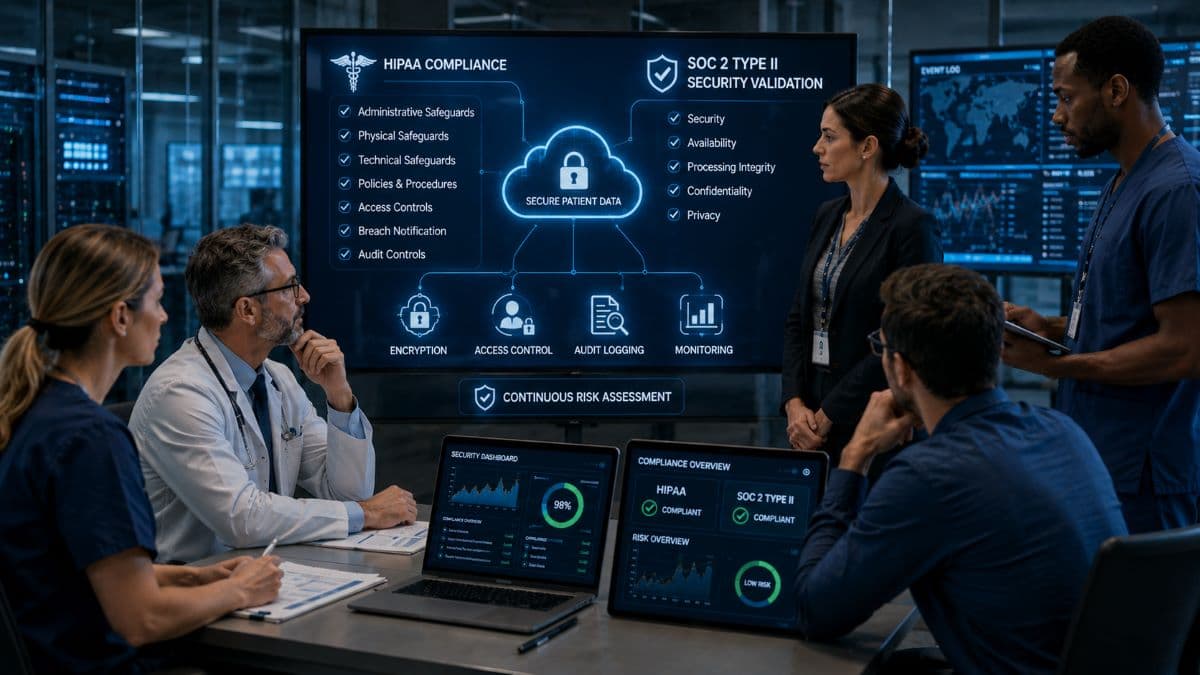
The most resilient approach to patient data protection does not treat SOC 2 and HIPAA as competing options. It treats them as two layers that reinforce each other. HIPAA defines the legal baseline your practice must meet and the obligations your vendors must contractually accept. SOC 2 provides independent, audited proof that a service organization's security controls actually function as claimed. Used together, they cover a gap that neither closes alone: HIPAA tells you what is required, and a SOC 2 report helps you verify that a vendor is delivering it.
For a healthcare organization that also provides technology services to others, or for the technology partners that serve healthcare, pursuing both can be a deliberate strategy. It satisfies the legal mandate and the commercial expectation at the same time, and because the two frameworks share so many underlying controls, the combined effort is far less than twice the work. Building one strong control environment, with solid access management, encryption, monitoring, and incident response, supports both at once.

How GlobeVM Helps Healthcare Organizations Use Both
Compliance frameworks are easier to understand than they are to operate. The day-to-day work of maintaining the controls that SOC 2 and HIPAA both expect, the monitoring, the patching, the access reviews, the documentation, sits at the intersection of regulation and information technology, and it benefits from specialist attention. For practices across the Los Angeles area that is delivered through our HIPAA compliance services.
GlobeVM is a managed IT and cybersecurity firm serving small and mid-sized businesses across the Los Angeles area, with CCSP-certified expertise and a practical focus on HIPAA compliance for medical and dental practices. That local presence matters, because California's Confidentiality of Medical Information Act adds a layer of state-level exposure on top of HIPAA that a national vendor may overlook.
Frequently Asked Questions
If you want a clear picture of whether your own HIPAA obligations are met and whether your vendors can actually be trusted with patient data, a compliance-focused assessment from a knowledgeable local partner is the most direct way to settle the SOC 2 vs HIPAA question for your own vendors and find the gaps before they become a breach.
Comments
0 Comments