

The term shows up on vendor slides and provider websites, usually next to promises about intelligence and transformation. AIOps is short for artificial intelligence for IT operations, and underneath the branding sits a practical idea worth understanding, because a version of it is probably already watching your systems, or should be. This guide explains what AIOps actually is, what it looks like in daily operation rather than in a demo, where a small business realistically encounters it, and the honest limits that the marketing leaves out, ending with the questions worth asking whoever manages your IT.
What AIOps Actually Is
AIOps is the application of machine learning and analytics to the data IT systems constantly produce, so that problems get noticed, diagnosed, and often fixed faster than humans reading alerts could manage. The recipe has three ingredients. First, the raw data: the logs, metrics, and alerts every device and application emits, the layer we covered in our guide to telemetry. Second, models that learn what normal looks like in a specific environment and flag deviations from it. Third, actions: from suggesting a likely root cause to executing a fix automatically.
The reason the category exists is volume. Even a modest business environment produces far more operational signals than any person can read, and traditional monitoring answers this with static thresholds that either fire constantly or miss quietly. Learning systems answer it by finding the patterns, which is a genuinely better approach when it is fed well.
What It Looks Like in Practice
A composite from real environments sets the scene. An office suffers slowness every Monday around 9:15, and for months it gets shrugged off as Mondays. Correlated monitoring sees what no single alert showed: the weekend backup verification job overrunning into the morning logon surge, two normal events colliding into one abnormal experience. The fix is a schedule change that takes five minutes, and the point is that the pattern, not any individual alarm, was the problem. That pattern-finding is the whole product, and it comes in three flavors.
One Incident Instead of Forty Alerts
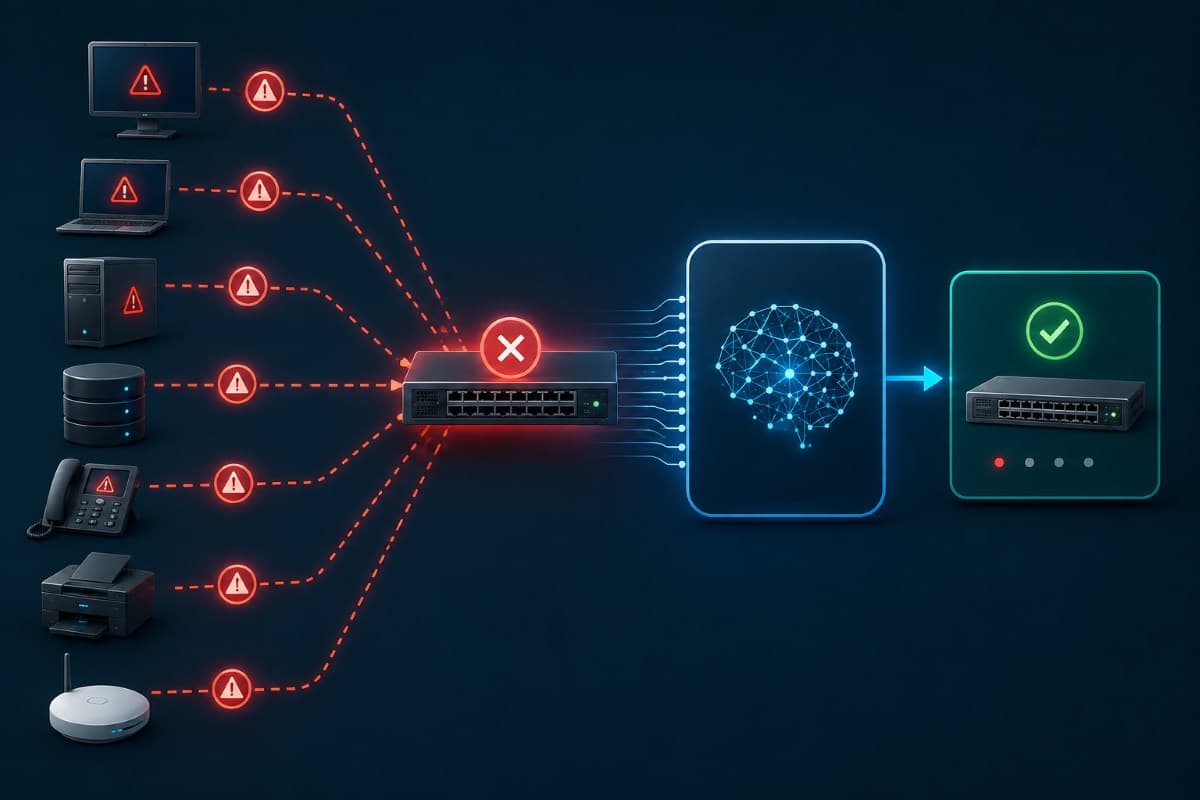
The first job is noise reduction. When a switch fails, everything behind it screams at once, and a human sees forty separate alerts. Correlation groups them into one incident with the probable cause on top, which is the difference between a technician starting at the answer and starting at a haystack. For the business, this shows up as faster fixes and fewer things missed in the flood.
Catching Problems Before They Are Problems
The second job is anomaly detection against a learned baseline. A server's disk filling at an unusual rate, a backup window stretching a little longer each night, memory climbing in a pattern that historically precedes a crash: none of these trips a classic threshold until it is nearly too late, but each is a visible trend to a system that knows this environment's normal. Prediction here is not magic; it is arithmetic on trends, done tirelessly.
Fixes That Happen at Three in the Morning
The third job is automated remediation for the well-understood failures: restart the stuck service, clear the temp files filling a disk, re-establish the dropped tunnel. This is the same discipline as the scripted maintenance in our guide to IT process automation, with the learning layer deciding when to trigger it. Done well, a meaningful share of routine incidents open, resolve, and close while everyone sleeps, with a log entry as the only evidence.
Where a Small Business Actually Meets AIOps
Here is the part enterprise-focused articles skip: a twenty-person company will never buy an AIOps platform, hire the data engineers it assumes, or feed it from a dozen enterprise tools. And it does not need to, because the realistic way a small business gets these capabilities is embedded inside the tooling a competent provider already operates. Modern monitoring and endpoint platforms ship with learned baselines, alert correlation, and scripted self-healing built in, which means the meaningful question is not whether to adopt AIOps but whether the monitoring your provider already runs actually uses these capabilities or just forwards raw alerts with a smarter label.
The same learning approach is spreading through neighboring layers you may also already pay for: security tools baselining login behavior, helpdesk systems routing tickets by content, and the broader business uses covered in our guide to artificial intelligence. The security version deserves one clarifying sentence, because it uses the same mathematics on different data: baselining user logins and network behavior to catch intruders is the detection world's cousin of AIOps, run by security operations rather than IT operations, and a mature provider runs both without confusing them.
One practical reassurance: the data this all feeds on usually requires nothing new. The monitoring agents a managed provider installs already collect the metrics and logs involved, so for an office in Woodland Hills or Westlake Village, gaining these capabilities is typically a matter of the provider's platform maturing or being configured properly, not a new deployment project on your side.
The Honest Limits
Three cautions keep expectations calibrated. First, learning systems are only as good as the data and the tuning they get; an environment with messy monitoring produces confident-sounding nonsense, and the tuning is ongoing work someone must own. Second, automated actions need guardrails, because a system empowered to restart services can also restart the wrong thing at the wrong moment. Sensible deployments keep humans approving anything consequential, log every automated action, and expand autonomy only as trust is earned, exactly the monitor-first discipline that applies to any enforcement technology.
Third, and most fundamentally, AIOps optimizes operations that exist; it does not create them. It will not compensate for absent backups, unpatched systems, or an environment nobody documented. A provider leading with AI language while the fundamentals are shaky has the order backward, and the order matters.
Questions to Ask Your IT Provider
You do not need to evaluate algorithms; you need to ask four plain questions and listen for specific answers. Does your monitoring learn our environment's normal, or does it run on fixed thresholds? What happens automatically when something fails, and what waits for a human? Can you show an example from our environment where a problem was caught or fixed before we noticed? And where are automated actions logged, so there is a record of what the machinery did on our systems?
A provider genuinely using these capabilities answers with examples in minutes. Vague gestures at AI-powered everything, with no examples and no logs, tell you the label is doing the work the technology should be doing.
Frequently Asked Questions
AIOps stands for artificial intelligence for IT operations. It is the use of machine learning and analytics on the logs, metrics, and alerts IT systems produce, in order to cut alert noise, detect problems against a learned baseline, diagnose likely root causes, and in many cases fix routine issues automatically. The goal is operations that respond in minutes to things humans would catch in hours, or not at all.
The platforms marketed under the name are enterprise products, but the capabilities are not. Small businesses meet AIOps embedded inside the monitoring, endpoint, and helpdesk tools a managed provider operates: learned baselines, correlated alerts, and scripted self-healing. The practical question for an SMB is whether its provider's tooling actually uses those features, not whether to buy a platform.
Traditional monitoring compares readings to fixed thresholds someone set once: alert if the disk passes ninety percent. AIOps learns what normal looks like for each system and flags meaningful deviations and trends, then correlates related alerts into single incidents and can trigger automated fixes. The difference in practice is fewer false alarms, earlier warnings, and routine failures that resolve without a human.
No, and providers claiming otherwise are overselling. It removes the repetitive layer, reading alert floods, restarting stuck services, chasing false alarms, which frees people for the work that actually needs judgment: planning, security decisions, and the problems automation has never seen before. Someone also has to tune the models, review the automated actions, and own the outcomes, so the human role shifts rather than disappears.
No. AIOps is the analytics-and-automation layer applied specifically to IT operations data: noticing, diagnosing, and remediating infrastructure issues. AI agents are a broader category of software that carries out multi-step tasks toward a goal. The two increasingly meet, since operations tooling is beginning to adopt agent-style capabilities, but asking what a tool actually does, on what data, with what permissions, matters more than which label is on it.
Stripped of its branding, AIOps is a simple bargain: let machines read the operational data no human can keep up with, so problems shrink from outages into log entries, and hold whoever runs it to examples rather than adjectives. If you would like to know whether the monitoring on your systems is actually learning your environment or just forwarding alerts, GlobeVM will show you, with your own data on the screen.
Comments
0 Comments