

Few topics have generated as much noise as artificial intelligence. Every software product now claims to use it, headlines swing between promises of transformation and warnings of disaster, and business owners are left trying to work out what is real and what matters for them. The good news is that the fundamentals of artificial intelligence are not as complicated as the hype suggests, and understanding them does not require a technical background. This guide explains what artificial intelligence is, the key terms you keep hearing, how businesses are using it today, and what it can and cannot do well. It ends with what sensible AI for small business looks like in practice, so you can adopt it where it helps rather than chasing every trend.
What artificial intelligence is
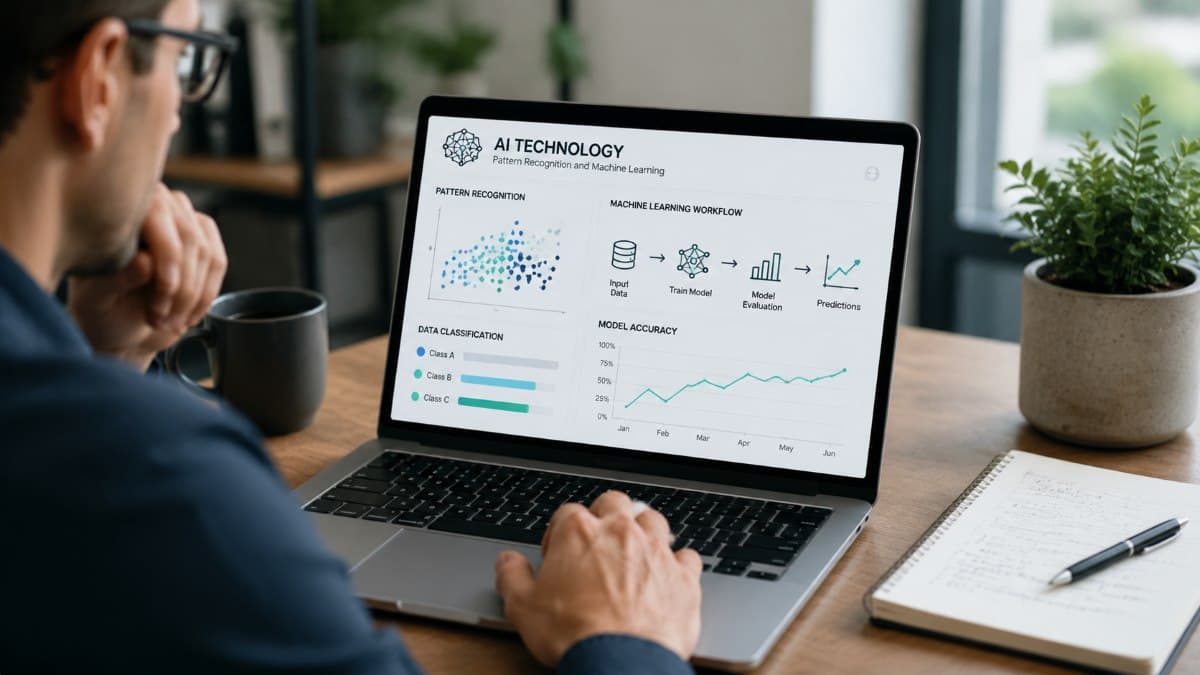
At its simplest, artificial intelligence is software that performs tasks we would normally associate with human intelligence, such as recognizing patterns, understanding language, making predictions, or generating content. Rather than following a fixed set of instructions written out by a programmer for every situation, AI systems learn patterns from large amounts of data and use those patterns to handle new inputs. That ability to learn from examples, rather than being told exactly what to do in every case, is what sets AI apart from ordinary software.
Cutting through the hype
It helps to separate what AI is from what it is often made out to be. The AI in use today is a powerful tool for specific kinds of work, not a thinking machine with understanding or intent. It can produce remarkably useful results and make confident mistakes in the same breath, because it is recognizing and reproducing patterns rather than reasoning about the world the way a person does. Holding both of those truths at once, that AI is useful and also limited, is the most practical mindset a business owner can bring to it.
Narrow AI versus general AI
Almost every AI a business will encounter is what experts call narrow AI, meaning it is built to do one kind of task, such as answering questions, sorting images, or drafting text. It may do that task impressively, but it cannot step outside it. General AI, often called AGI, would be a system that could understand and learn any task the way a person can. Some technology executives say it is close, but most researchers do not consider today's systems to be general AI, and there is no agreed test for when that line is crossed. Knowing this distinction keeps expectations grounded: the tools you can buy now are specialized assistants, not all purpose problem solvers.
The key concepts and terms you will keep hearing
A handful of terms come up constantly in any conversation about AI, and knowing roughly what each one means makes the whole subject far less intimidating. None of them require math to understand at a working level, and the table below gives the short version before each one is explained.
Machine learning
Machine learning is the engine behind most modern AI. Instead of a programmer writing rules for every situation, a machine learning system is shown many examples and learns the patterns within them, then applies what it learned to new data. A system trained on thousands of examples of spam email, for instance, learns the characteristics of spam well enough to flag new messages it has never seen. Most of what people call AI today is, underneath, machine learning of one kind or another.
Neural networks and deep learning
Neural networks are a type of machine learning loosely inspired by how the brain processes information, using layers of connected units to recognize increasingly complex patterns. When these networks have many layers, the approach is called deep learning, and it is what powers many of the most capable AI systems, including those that recognize speech and images. The practical point for a business is that deep learning is why AI has become so much more capable in recent years, not a detail you need to manage yourself.

Natural language processing
Natural language processing, or NLP, is the branch of AI focused on understanding and working with human language. It is what allows software to read text, interpret what someone is asking, and respond in plain language. Every time a system summarizes a document, answers a typed question, or powers a chatbot that understands the question, natural language processing is doing the work. For most businesses, this is one of the most immediately useful areas of AI.
Generative AI and large language models
Generative AI is the category that brought the technology into everyday conversation. Rather than only classifying or predicting, generative AI creates new content, such as text, images, or code, based on patterns learned from enormous amounts of data. The text based versions are built on large language models, systems trained on vast quantities of writing that can produce fluent, relevant responses to almost any prompt. These tools can draft an email, summarize a report, or answer a question in seconds, which is why they are so widely used. It is also why their tendency to sound confident even when wrong needs to be understood.
AI agents
A newer development is the AI agent, which goes a step beyond generating a single response. An agent can be given a goal and then take a series of steps toward it, such as looking up information, using other software tools, and acting on the results, with less human prompting at each stage. Agents are still maturing and need careful oversight, but they point toward where business AI is heading: not just answering questions, but carrying out multi step tasks. For now, treating them as capable but supervised assistants is the realistic stance, and our guide to AI agents for business shows what that looks like in a small office.
How AI is being used in business today
Beyond the headlines, businesses are putting AI to work in fairly practical ways. The most valuable uses tend to be unglamorous: taking time consuming work off people’s plates so they can focus on what needs human judgment.
Customer service and communication
AI powered chatbots and assistants can handle common customer questions at any hour, draft responses for staff to review, and route more complex issues to a person. Used well, this means faster answers for customers and less repetitive work for employees, as long as there is a clear path to a human when the AI reaches its limits.
Content and marketing
Generative AI is widely used to draft marketing copy, social posts, product descriptions, and email campaigns, giving a small team a faster starting point. The important word is starting point, because the output still needs a human to check facts, adjust tone, and make sure it reflects the business accurately rather than publishing whatever the tool produces.
Data analysis and decision support
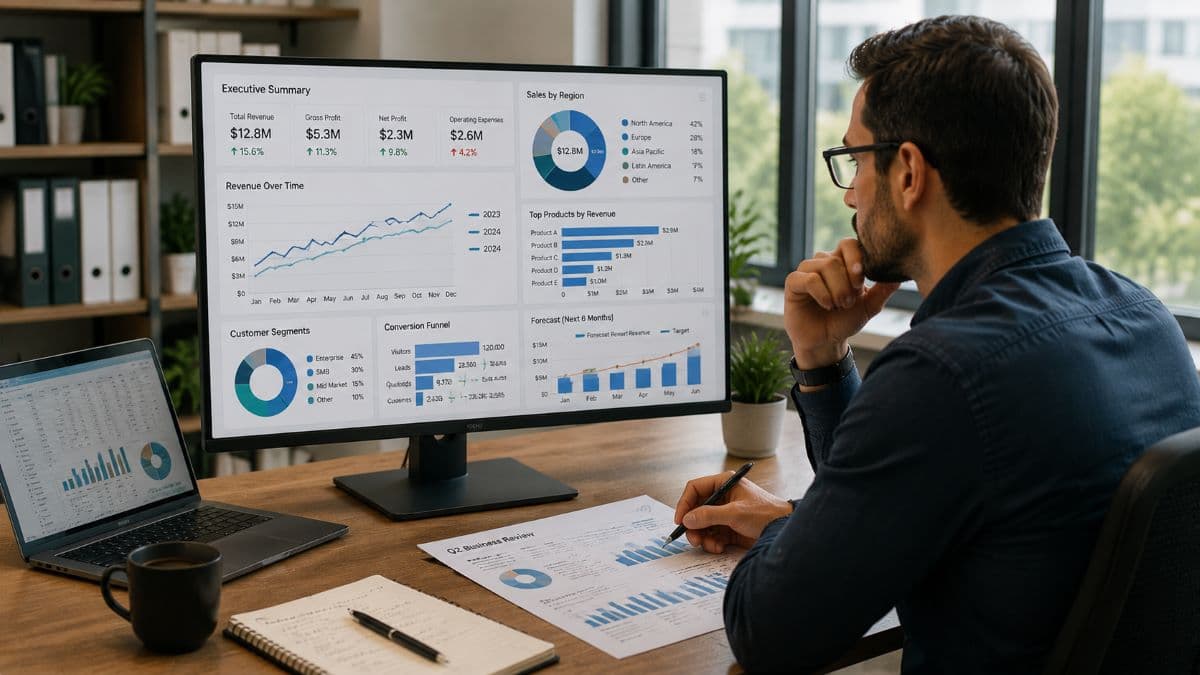
AI is good at finding patterns in large amounts of information that a person would struggle to spot, from sales trends to unusual activity in financial data. This can help a business understand its numbers, forecast demand, or flag something that deserves a closer look. The AI surfaces the pattern, but a person still decides what it means and what to do about it.
Automating routine work
Many businesses use AI to handle repetitive tasks such as sorting and tagging documents, extracting information from forms, scheduling, and other steady administrative work. Automating this kind of work reduces errors and frees staff for higher value tasks, which is often where AI delivers the clearest return without much risk.
Security and IT operations
On the technology side, AI is increasingly built into security and IT tools, where it helps detect unusual activity and respond to threats faster than manual review alone. It is worth knowing that the same capabilities are also being used by attackers, which is one reason AI cuts both ways and is a subject we cover in our look at the AI security risks facing small businesses.
What AI can and cannot do well
Using AI sensibly means knowing where it shines and where it falls short, because the same tool can be excellent at one task and unreliable at another. A clear view of both prevents both wasted effort and costly mistakes.
Where AI helps most
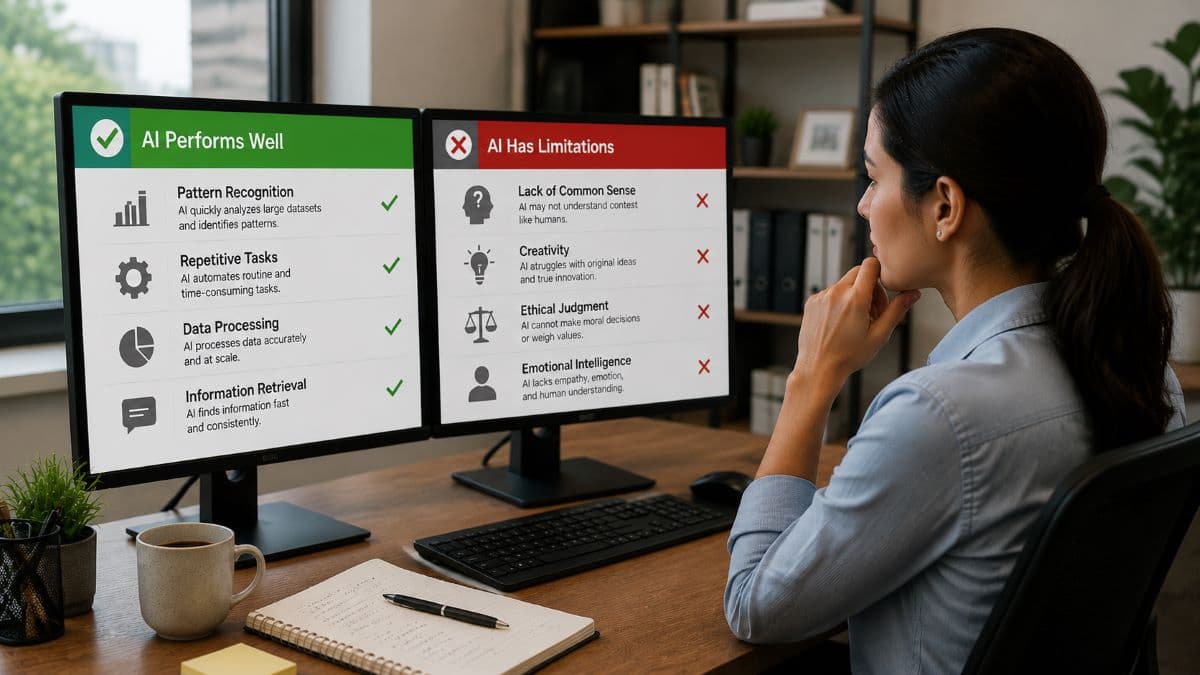
AI is strong at tasks that involve recognizing patterns, working with language, and producing a first draft quickly. Summarizing long documents, generating ideas, handling routine questions, spotting patterns in data, and speeding up repetitive work are all areas where it can save real time. In these uses, AI acts as a capable assistant that handles the heavy lifting while a person directs and reviews.
The limitations to keep in mind
AI also has clear weaknesses. It can produce information that sounds authoritative but is wrong, a tendency sometimes called hallucination, because it generates plausible patterns rather than verified facts. It has no real understanding or common sense, struggles with situations unlike anything in its training, and can reflect biases present in the data it learned from. It is also only as current as the information it was built on. None of this makes AI useless, but it does mean its output needs human checking, especially for anything that affects customers, money, or compliance.
The risks and responsibilities of using AI in your business
Adopting AI is not only a matter of capability but of responsibility, and the risks are manageable when they are taken seriously from the start. The most important concern for most businesses is data. Information typed into a public AI tool may be stored or used in ways the business does not control, so feeding sensitive customer records, financial details, or confidential documents into the wrong tool can create a privacy or compliance problem. OpenAI, for example, may use conversations from personal ChatGPT accounts to train its models unless the user opts out, while its business plans and API are excluded from training by default.
Accuracy is a second concern, since acting on a confident but incorrect AI answer can cause real harm. Over reliance is a third, where staff lean on AI for decisions that need human judgment. Handling these well means choosing tools carefully, understanding where data goes, and protecting the systems AI touches. That work ties closely to a business’s broader cybersecurity solutions rather than sitting apart from them.

California rules that already apply to AI in hiring
If your business is in Los Angeles or anywhere else in California and uses software to screen resumes, rank applicants, or inform promotions, state rules already cover it. Regulations from the California Civil Rights Council took effect on October 1, 2025. They make clear that an automated decision system can violate the Fair Employment and Housing Act if it disadvantages people based on protected characteristics such as race, gender, or disability. The same rules require employers to keep the related records, including the data behind automated decisions, for at least four years.
For a small employer, the practical steps are modest. Find out which of your hiring tools use AI, ask each vendor how it tests for bias, and make sure the records are being kept somewhere you can retrieve them.
Getting started with AI for small business
For a business that is not a technology company, the smart path is neither to ignore AI nor to chase every new tool, but to adopt it deliberately where it solves a real problem. It is the same practical approach behind our managed IT for San Fernando Valley businesses, from Woodland Hills to Encino, and a few principles keep it on track.
Start with a problem, not the technology
The most common mistake is adopting AI because it is the trend rather than because it addresses a specific need. The better approach is to identify a real bottleneck, such as slow customer responses or hours lost to paperwork, and then ask whether AI can help with it. For a dental office that might be appointment reminders and insurance paperwork; for a law firm, first drafts of routine letters that an attorney then reviews. Starting from the problem keeps the focus on value rather than novelty, and it makes the result easy to judge. If you want a second opinion before committing to a tool, vendor-neutral IT consulting exists for exactly that kind of decision.
Mind your data and where it goes
Before putting any business information into an AI tool, a business should understand what happens to that data and whether the tool is appropriate for sensitive material. This is especially important for businesses handling regulated information, and it often means using business grade tools with clear data protections rather than free consumer versions. Microsoft 365 Copilot Chat, for instance, applies Microsoft's enterprise data protection when staff sign in with their work account, so their prompts are not used to train the underlying models. For medical and dental practices, patient information should only go into a tool whose vendor has signed a HIPAA business associate agreement. Writing these rules down in a short AI policy tells staff which tools are approved and what must never be pasted into them.
Keep a human in the loop
The safest and most productive way to use AI is to treat it as an assistant whose work is always reviewed, not as a replacement for judgment. A person should check AI generated content for accuracy, oversee any decision that carries weight, and stay accountable for the result. AI features are increasingly built into everyday tools, including the ones inside platforms many businesses already use, so the same caution applies whether the AI is a standalone product or part of something like Microsoft 365. Getting this balance right is what turns AI into a real advantage rather than a source of new problems.
Frequently Asked Questions
Artificial intelligence is the broad idea of software performing tasks that resemble human intelligence, while machine learning is the most common method used to achieve it. Machine learning systems learn patterns from data rather than following fixed rules, and most of what is called AI today is built on machine learning underneath. In short, machine learning is one of the main techniques that makes modern AI work.
Artificial intelligence is safe for a small business when it is used thoughtfully. The main risks are around data privacy, accuracy, and over reliance, all of which can be managed by choosing appropriate tools, being careful about what information you put into them, and keeping a person in charge of important decisions. The technology itself is a tool, and like any tool it is safe when used with the right precautions.
Most practical uses of AI for small business need no technical skills. Many AI tools are designed to be used in plain language, so an employee can ask a question or request a draft without any technical knowledge. What does help is understanding what AI is good and bad at, so you use it where it adds value and review its output where accuracy matters. Guidance on choosing and securing the right tools is where outside help is often worthwhile.
Whether ChatGPT is safe for business data depends on the plan. On personal ChatGPT accounts, OpenAI may use conversations to train its models unless the user turns that setting off. ChatGPT Business, ChatGPT Enterprise, and the API are excluded from training by default. Even on a business plan, regulated information such as patient records needs a tool covered by the right agreements.
For most businesses, AI is currently better understood as a tool that handles parts of jobs rather than whole roles, taking on repetitive tasks so people can focus on work that needs judgment, relationships, and creativity. It changes how some work gets done more than it eliminates the need for people. The businesses that benefit most tend to use AI to make their teams more effective rather than to remove them.
If you want to know where AI for small business makes sense in your office without putting your data at risk, GlobeVM can help through managed IT services in Los Angeles and across Southern California.
Comments
0 Comments