
Few terms in technology are mixed up as often as business continuity and disaster recovery. They appear in the same sentences, the same plans, and the same vendor pitches, and they are frequently treated as if they mean the same thing. They do not. The business continuity vs disaster recovery distinction matters because the two answer different questions, demand different planning, and protect different things. Confusing them is how businesses end up with a recovery plan that restores their data while their operations sit paralyzed for days, or with a continuity plan that keeps employees calm while their systems remain irretrievably lost. This guide explains exactly what each one is, where they differ, where they overlap, and how the two fit together in a plan that actually protects a small or mid-sized business when the worst happens.
The Core Distinction in One Paragraph
Here is the cleanest way to keep them straight. Business continuity is about the whole business continuing to operate during and after a disruption: people, processes, communications, customers, suppliers, and revenue. Disaster recovery is the technology subset of that effort: restoring the IT systems and data the business depends on. Business continuity is broader, more strategic, and more human. Disaster recovery is narrower, more technical, and more measurable. A business continuity plan tells you how the company keeps running. A disaster recovery plan tells you how IT comes back online.

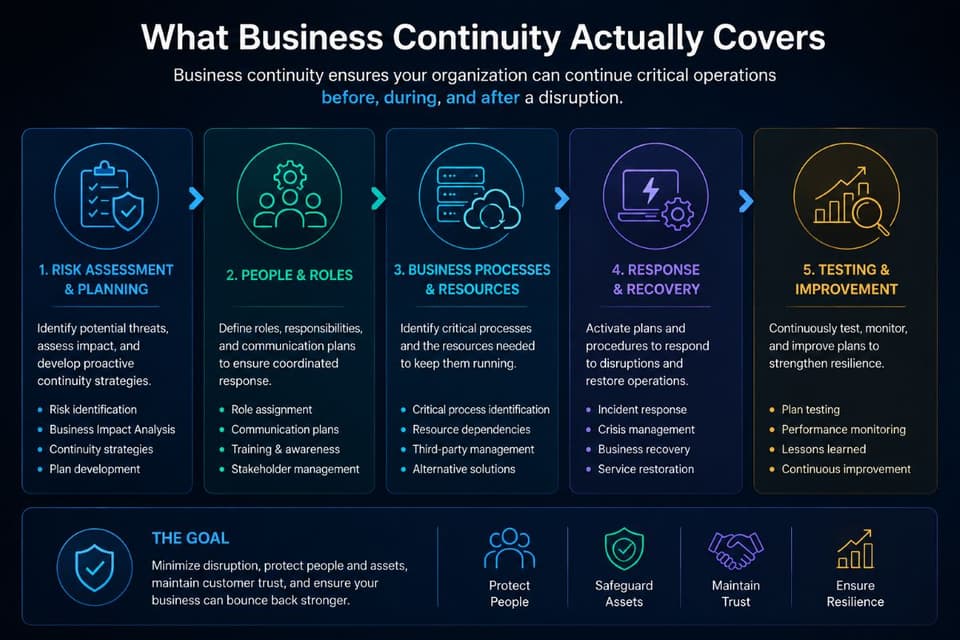
What Business Continuity Actually Covers
Business continuity planning is the discipline of preparing for any disruption that could threaten an organization's ability to function. The scope is deliberately wide, because the threats are wide: a cyberattack, a natural disaster, an extended power outage, the sudden loss of a key supplier, a fire, a flood, a pandemic. The plan does not focus on the specific threat. It focuses on the operations the business must protect, regardless of what is causing the disruption.
A business continuity plan typically addresses several connected questions. What are the critical business processes that absolutely must continue, even at reduced capacity? Who needs to do what in the first hours and days of a disruption? Where will people work if the office is unavailable? How will the business communicate with employees, customers, and suppliers when normal channels are down? What is the chain of command, and who has the authority to make consequential decisions during a crisis? What are the financial reserves, insurance positions, and contractual obligations the business must navigate? These are operational and strategic questions, and most of them have little to do with technology.
The proactive nature of business continuity is its defining feature. The plan is built before any specific disruption, so that when one arrives, the response is structured rather than improvised. A business that has done this work survives disruptions that flatten unprepared competitors, often not because the disruption was smaller but because the response was faster and more deliberate.
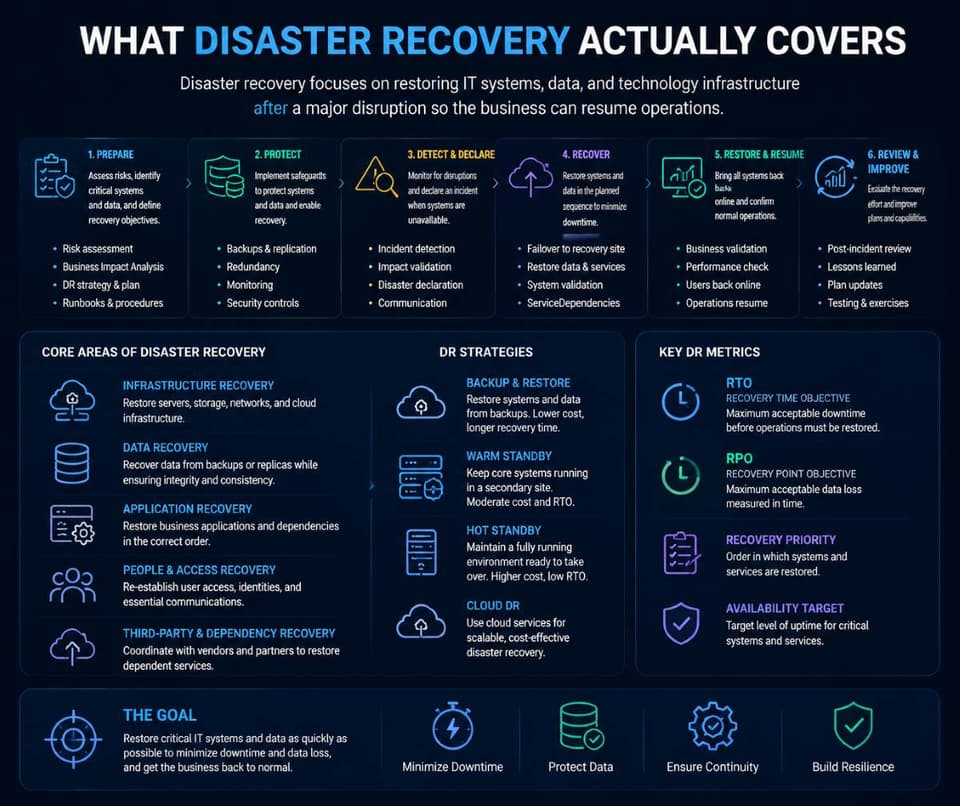
What Disaster Recovery Actually Covers
Disaster recovery is the technology component of business continuity. Its scope is narrower and more concrete: restoring the IT systems, applications, and data that the business runs on, as quickly and completely as possible after an incident. A disaster recovery plan answers very specific questions. Which systems must come back online first? How long can each system be down before the business is in real trouble? How much data can the business afford to lose? Where are backups stored, and how are they restored? Who is responsible for the technical recovery work? What infrastructure, cloud services, or alternate locations support the recovery? This is the work that backup and disaster recovery services exist to deliver.
Where business continuity is mostly about people and process, disaster recovery is mostly about systems and data. It is governed by measurable technical objectives, most notably the Recovery Time Objective and Recovery Point Objective, which together define how fast IT must come back and how much data the business can lose. The plan is reactive in character: it activates when an incident occurs and guides the technical response. Reliable data backup and disaster recovery is what turns a disaster recovery plan from a document into an actual capability, because the plan only matters if the backups behind it are real, current, and recoverable.
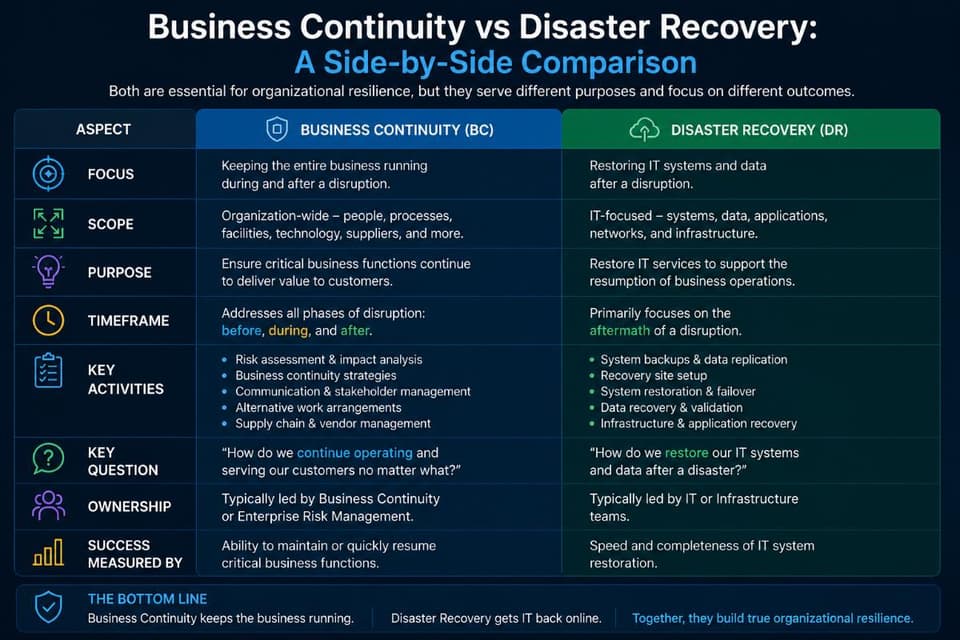
Business Continuity vs Disaster Recovery: A Side-by-Side Comparison
The distinctions become clearer when laid out directly. Each row below shows where the two practices part ways.
| Business continuity | Disaster recovery | |
|---|---|---|
| Scope | The whole organization: people, processes, suppliers, premises | IT systems, data, and infrastructure |
| Posture | Proactive: keep operating through and after a disruption | Reactive: restore technology after an incident |
| Primary focus | Critical business functions continuing | Systems and data coming back |
| Who owns it | Leadership across operations, HR, communications, finance, legal | IT and security, often with an outside provider |
| Key measures | Maximum tolerable downtime per business function | Recovery Time Objective and Recovery Point Objective per system |
| Typical output | Alternate work arrangements, manual workarounds, communication plan | Backup and restore procedures, failover, tested recovery runbook |
| What failure looks like | Systems are back but nobody knows how to serve customers | Staff know what to do but the data is gone |
Scope. Business continuity covers the entire organization, all functions and dependencies. Disaster recovery covers IT systems and data specifically.
Reading the table
Posture. Business continuity is proactive, designed to keep the business operating through and after a disruption. Disaster recovery is reactive, focused on restoring technology after an incident occurs.
Primary focus. Business continuity focuses on people, processes, and the continuation of critical functions. Disaster recovery focuses on systems, data, and infrastructure.
Who is involved. Business continuity involves leadership across the business, including operations, HR, communications, finance, and legal. Disaster recovery is led primarily by IT and security, often supported by an outside provider.
Key metrics. Business continuity is measured by operational tolerance windows, by Maximum Tolerable Downtime for whole processes, and by the success of business impact analyses. Disaster recovery is measured by Recovery Time Objective and Recovery Point Objective for individual systems.
Documents produced. Business continuity produces a Business Continuity Plan, a Business Impact Analysis, and crisis communication plans. Disaster recovery produces a Disaster Recovery Plan, runbooks, and technical recovery procedures.
Time horizon. Business continuity addresses the disruption window from the first hour through full normalization, which can stretch weeks. Disaster recovery focuses on the technical restoration window, usually hours to days.
The relationship. Disaster recovery is part of business continuity. A continuity plan that ignores IT is incomplete, and a recovery plan that exists outside any broader continuity framework restores systems into an organization that may still be unable to use them.
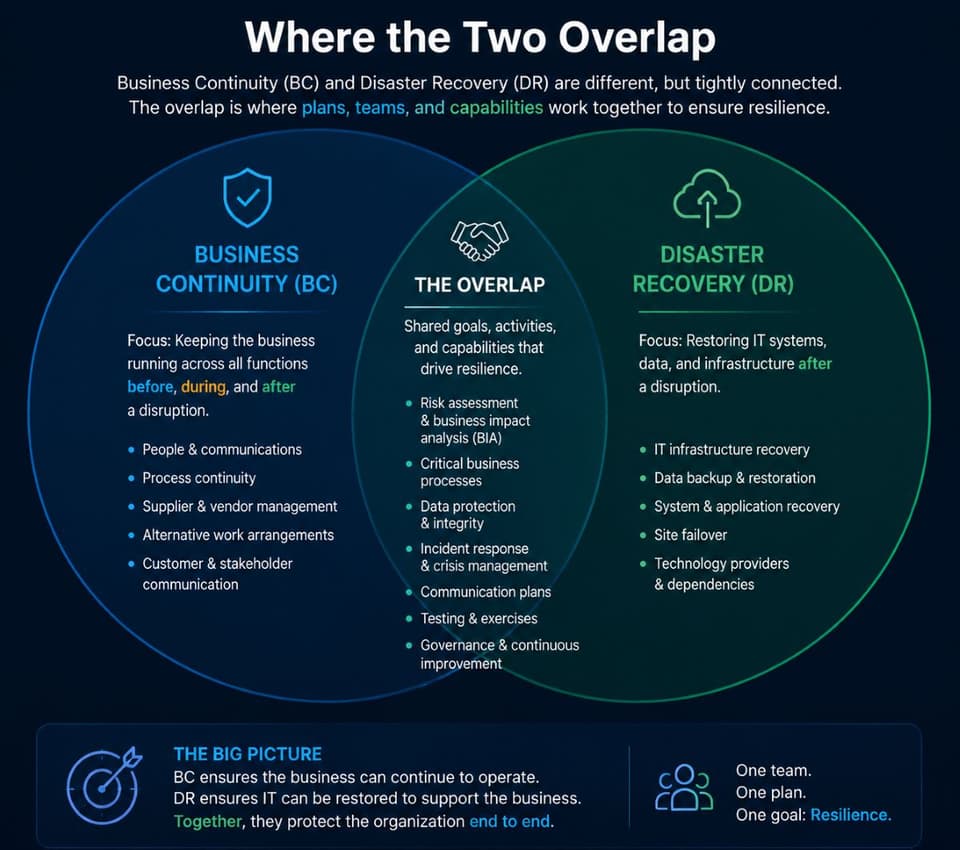
Where the Two Overlap
Despite the distinctions, business continuity and disaster recovery share a meaningful common foundation, which is part of why they get confused in the first place. Both require the business to know what is critical before a crisis, both depend on tested plans rather than untested intentions, and both fail in the same predictable ways when they are built once and never revisited.
The most important shared element is the Business Impact Analysis. This is the exercise of identifying the business's critical functions, the systems and resources they depend on, and the consequences if they are unavailable for given periods. A good BIA feeds both the business continuity plan and the disaster recovery plan, because the question "what can we not lose, and for how long" sits at the heart of both. Layered cybersecurity solutions also span both, because they reduce the frequency and severity of the incidents that either plan would have to respond to.
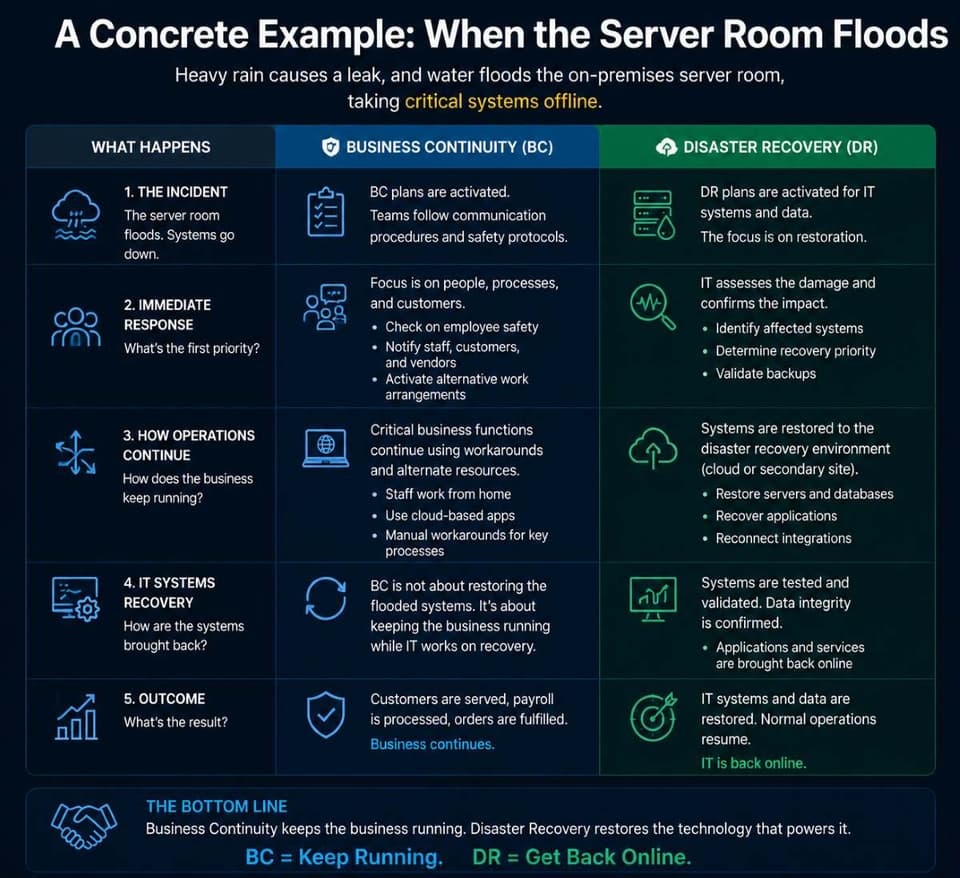
A Concrete Example: When the Server Room Floods
A ground-floor server room takes on water from a burst pipe over a holiday weekend. Two on-premises servers and a network switch are destroyed. Without preparation, the business is now juggling everything at once. Here is how a well-built program splits the response.
The disaster recovery side handles the technical restoration. Backups are verified, replacement infrastructure is provisioned (often in the cloud or at a secondary location), data is restored from the most recent clean backup, and systems are brought back online in priority order. The objectives that drive this work are the RTO and RPO defined in the plan: how fast each system must come back, and how much data was acceptable to lose.
The business continuity side handles everything else. Where do staff work this week? How do customers get reached and reassured? Which manual workarounds keep orders flowing while systems are down? Who is authorized to approve emergency spending? What does the insurance carrier need, and when? How is the situation communicated internally without panic? The continuity plan addresses these decisions before the flood, so they are made calmly rather than improvised at 2 a.m.
Both sides run in parallel, and both are needed. Restoring IT into an organization that has not figured out how to operate is incomplete. Keeping people calm while the technology never comes back is also incomplete. The two halves are designed to work together.
Setting Recovery Targets You Can Defend
Knowing the difference is only useful if it turns into numbers. Two questions decide most of both plans. How quickly does each critical function need to be back, and how much recent work can the business afford to lose? The first becomes the Recovery Time Objective, the second the Recovery Point Objective, and the honest answers are rarely the same for every system. A dental practice may need imaging and scheduling back within an hour but can live with the marketing site being down for a day. A firm that bills hourly may tolerate two hours of downtime but not two hours of lost time entries.
Set these per function rather than as one number for the whole company, because a single target forces you to buy the most expensive protection for everything. Write them down, check that the technology can actually meet them, and revise them when the business changes. A recovery objective the technology cannot deliver is not a target, it is a wish, and the gap between the two only becomes visible during an incident.
Who Does What, and How People Find Out
A disruption is the worst time to work out who is in charge. Both plans need named roles: who declares an incident, who decides whether to fail over, who speaks to customers, who contacts the insurer, and who keeps staff informed. In a small business these are usually the same few people wearing different hats, which is fine as long as it is written down and someone has a deputy.
Communication is the part most often left out. Decide in advance how staff will be reached if company email is down, what customers are told and by whom, and which suppliers need to know. A response that is technically competent but silent looks, from the outside, exactly like a business that has collapsed.
Testing Turns a Document Into a Capability
The most common failure is writing a plan and never touching it again. An untested plan is full of assumptions: backups that turn out not to restore, contact details that are out of date, steps that do not work as imagined, dependencies nobody mapped. A walkthrough of a realistic scenario finds these while they can still be fixed.
Two kinds of testing matter. A technical restore proves the data comes back within the recovery point you set. A tabletop exercise, where the team talks through a scenario hour by hour, proves the people side works: who was called, what was decided, what customers heard. Run both at least once a year and after any significant change in systems or staff, and confirm who answers at 2 a.m., which is what 24/7 IT services for business continuity are built to cover. Businesses that rely on an outside IT provider should make them part of the exercise, because the first hour of a real incident is usually spent on the phone with them.
What this looks like in a real week
Picture ransomware encrypting files on a Monday morning. With both plans in place, the business knows which systems are critical, restores from backups it has tested, follows a written response process, and tells staff and customers what is happening; the week is bad but the business keeps running. Without them, the same event becomes days of confusion about what can be recovered and when.
Now picture a burst pipe that makes the office unusable for a week. Disaster recovery barely applies, because the servers are fine. Continuity is everything: where people work, how they reach the systems, what customers are told. That contrast is the clearest illustration of why one plan cannot cover for the other.
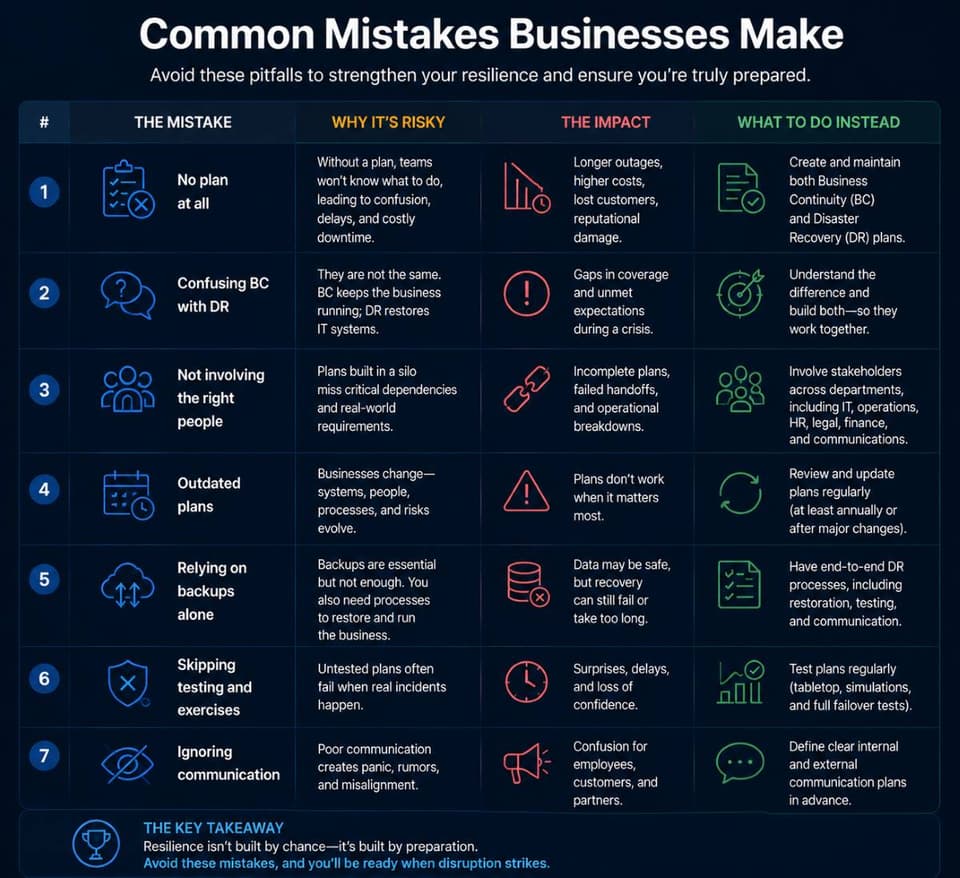
Common Mistakes Businesses Make
The patterns that cause real damage are familiar across small and mid-sized businesses. Knowing them is the fastest way to find your own gaps.
The most common is confusing the two and ending up with only one. A business invests in good backups and a disaster recovery plan, declares itself prepared, and has no plan for how the company operates while IT is being restored. The reverse is equally common: a polished continuity plan exists on paper, while the actual backups have never been tested and the recovery objectives are aspirational. Another frequent mistake is building either plan once and never updating it as the business, systems, and threats evolve. A plan from three years ago describes a company that no longer exists. A related mistake is failing to test. An untested plan is a hypothesis, not a capability. Finally, many businesses leave the work to IT alone, when business continuity in particular requires leadership ownership and cross-functional involvement to be real.
How to Build Continuity and Recovery Together
The two plans are best built as a connected program rather than as separate documents. A practical order of operations looks like this. For most small businesses the practical division is simple: an outside provider runs the technical half and keeps it tested, while leadership owns the business half.
- Conduct a Business Impact Analysis. Identify the critical functions of the business, the systems and resources they depend on, the maximum tolerable downtime for each, and the consequences of unavailability. This is the foundation that both plans build on.
- Set technical recovery objectives. For each critical system, define a Recovery Time Objective and Recovery Point Objective based on what the business actually requires, not what the technology can easily deliver. These objectives drive the disaster recovery plan.
- Build the business continuity plan. Document how the business operates during and after a disruption, including alternate work arrangements, communications, leadership decisions, and manual workarounds.
- Build the disaster recovery plan. Document how IT systems are restored, in what order, from what backups, by whom, and to meet which objectives. Tie this directly to the continuity plan rather than treating it as a separate document.
- Test both, on a schedule. Run tabletop exercises for the continuity plan and real recovery tests for the disaster recovery plan. Untested plans almost always fail their first real activation.
- Review and update annually. The business, the systems, and the threats all change. The plans must move with them, or they quietly become fiction.
For most small businesses, this work spans more capability than the in-house team has time for, and an outside partner who can build, test, and maintain the technical recovery layer is often essential. Ongoing managed IT services carry the day-to-day work of keeping backups current, infrastructure recoverable, and the disaster recovery plan operational, so the business can focus on the continuity side it is uniquely positioned to own.
If you are not confident your business could keep operating and recover its systems after a serious disruption, talk to GlobeVM about a readiness review. It is the most direct way to find the gaps in your business continuity vs disaster recovery planning before an incident finds them for you.