Business Email Compromise is a sophisticated form of cyHow to Stop Targeted Attacks: Business Email Compromise Prevention
How to Stop Targeted Attacks: Business Email Compromise Prevention

By nazy rafaeil
19 May 2026

Business Email Compromise (BEC) is a highly targeted cyber attack where criminals impersonate trusted identities to steal money or sensitive business data. Implementing strict Business Email Compromise Prevention measures is critical for safeguarding your company’s finances, communications, and long-term reputation.
What Is Business Email Compromise?
Business Email Compromise is a sophisticated form of cybercrime where an attacker compromises legitimate business email accounts or uses spoofing techniques to conduct unauthorized transfers of funds. Unlike random spam or obvious malicious attachments, BEC relies heavily on social engineering, deception, and trust.
In a typical BEC attack, a cybercriminal impersonates someone with authority or a trusted partner. This could be a chief executive officer (CEO), a primary vendor, an attorney, or a human resources director. The attacker studies the organization's structure, communication style, and vendor relationships. Once they have enough context, they send an email that appears completely normal, requesting an urgent wire transfer, a change in payment details, or access to sensitive employee data.
Because these emails do not contain obvious malware or malicious links, they frequently bypass standard spam filters. The danger of BEC lies in the fact that it exploits human psychology rather than software vulnerabilities. It is not just a technical problem; it is a fundamental flaw in business processes, human behavior, and financial controls. When an employee believes they are following a direct order from their boss or a trusted vendor, they bypass normal skepticism.
To effectively stop these threats, organizations must view security through a multi-layered lens. Relying solely on a firewall or an antivirus program is no longer sufficient. Companies need a combination of modern email security protocols, strict financial verification processes, and continuous employee education to recognize the subtle manipulation tactics used by modern cybercriminals.

Why Business Email Compromise Prevention Matters for Businesses
The financial impact of a successful BEC attack can be devastating. According to reports from the FBI’s Internet Crime Complaint Center (IC3), Business Email Compromise consistently ranks as the most financially damaging cybercrime, costing businesses billions of dollars annually. For small and mid-sized businesses, law firms, CPA firms, healthcare offices, and real estate companies, a single successful attack can mean the difference between remaining profitable and facing bankruptcy.
Financial Loss and Wire Fraud
The most immediate consequence of a BEC attack is the direct loss of capital. Attackers often request wire transfers to offshore accounts or cryptocurrency wallets, making the funds nearly impossible to recover once the transaction clears. Small to mid-sized businesses are prime targets because they often lack the strict financial approval hierarchies found in large corporate enterprises.
Reputational Damage
Trust is the foundation of any professional service firm. If a CPA firm’s compromised email account is used to solicit fraudulent payments from its clients, the firm’s reputation will suffer severe damage. Clients expect their financial and personal data to be handled with the highest level of security. A breach indicates a failure in professional duty, often leading to lost clients and negative industry word-of-mouth.
Operational Disruption
When an attack occurs, normal business operations come to a halt. IT teams must isolate the network, investigate the breach, and ensure no other systems are compromised. Legal teams must be consulted, and employees are distracted from their daily tasks. This downtime translates to lost productivity and missed deadlines.
Legal Exposure and Compliance Issues
Many industries are governed by strict data protection regulations. Healthcare providers must comply with HIPAA, financial firms face FINRA and SEC regulations, and any company handling consumer data must navigate state-level privacy laws. A BEC attack often exposes sensitive data, triggering mandatory breach notifications, regulatory fines, and potential lawsuits from affected clients or partners.
Implementing strict prevention strategies is not just an IT responsibility; it is a core business necessity. Professional service firms and small businesses must prioritize email security to protect their assets, maintain compliance, and preserve the trust they have worked hard to build with their clients.
BEC vs. Traditional Phishing: What Is the Difference?
While both Business Email Compromise and traditional phishing use email as the primary attack vector, their methods, targets, and end goals differ significantly.

Traditional Phishing
Traditional phishing is typically a "spray and pray" approach. Cybercriminals send thousands or even millions of generic emails hoping a small percentage of recipients will click a link or download an attachment. These emails often impersonate well-known consumer brands like Netflix, Amazon, or large banks. The goal is usually to steal login credentials or distribute ransomware. The language is often generic (e.g., "Dear Customer") and may contain noticeable spelling or grammatical errors. The attack relies entirely on volume.
Business Email Compromise
In contrast, BEC is highly targeted and extensively researched. Before sending a single email, the attacker may spend weeks monitoring a company’s social media, public website, and even compromised email inboxes to understand the corporate hierarchy. They learn the tone the CEO uses, the regular billing cycles of external vendors, and the names of the finance team members.
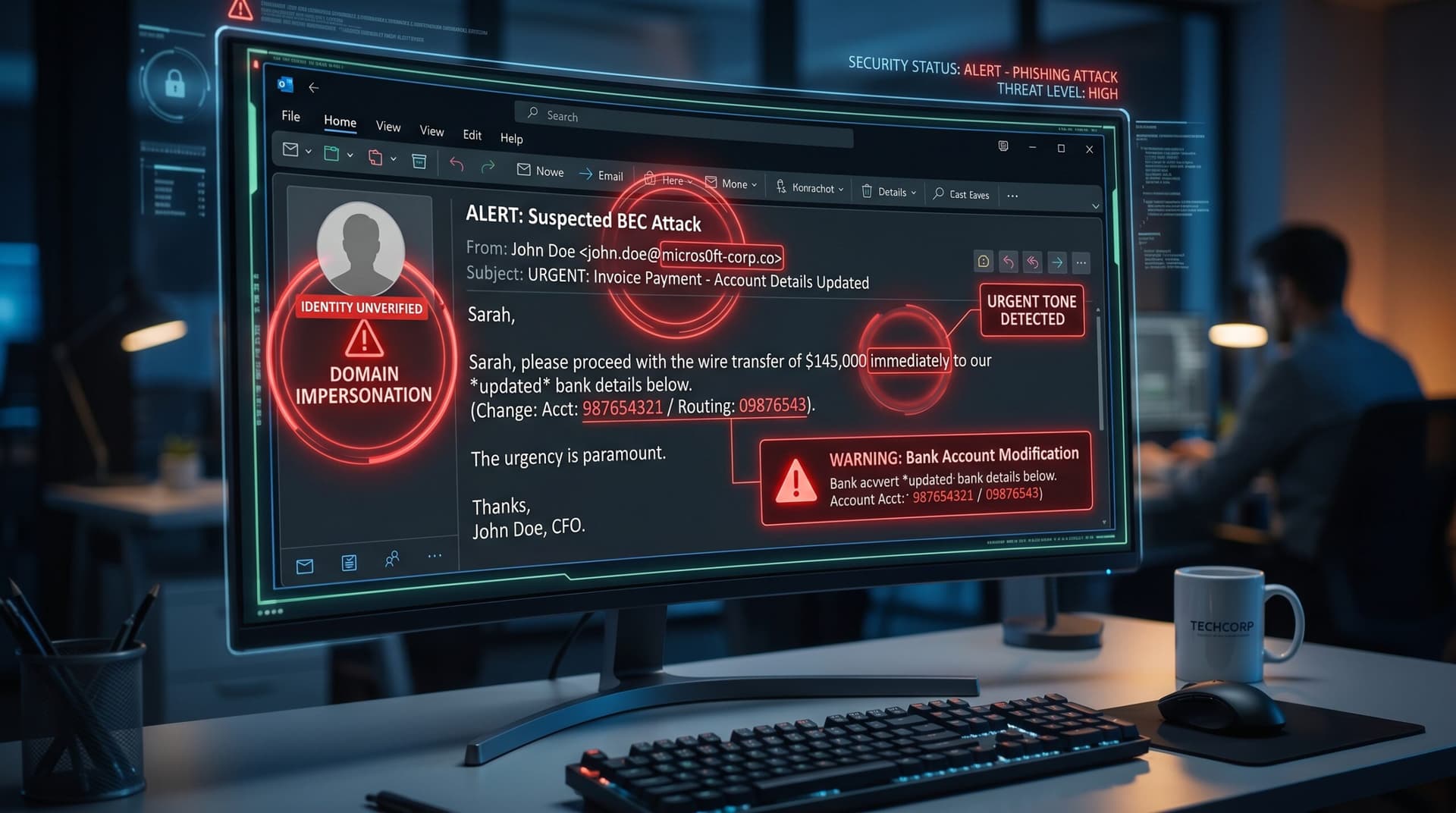
Instead of a fake login page, a BEC email is usually a plain text message. For example: "Hi Sarah, I am in a confidential meeting and cannot take calls. I need you to process an urgent wire transfer for the new acquisition by 2 PM. Please see the attached updated wire instructions."
Because the email is highly personalized, contextually relevant, and free of malicious software payloads, traditional antivirus solutions often fail to detect it. The distinction is clear: traditional phishing tricks you into installing malware or giving up a password, while BEC tricks you into willingly handing over the company’s money.
Common Types of Business Email Compromise Attacks
Cybercriminals constantly adapt their methods to exploit specific business processes. Understanding the different variations of BEC is a vital part of protecting your organization.
CEO Fraud
In CEO fraud, attackers spoof or compromise the email account of a high-ranking executive, such as the CEO or President. They send an email to a lower-level employee, usually in the finance or accounting department, requesting an urgent and confidential wire transfer. The email uses high-pressure language, insisting the matter must remain secret to avoid disrupting a pending business deal.
Vendor Invoice Fraud
Also known as the "Bogus Invoice Scheme," this tactic involves impersonating a trusted supplier or vendor. The attacker emails the company's accounts payable department, claiming that the vendor has recently changed their banking details. They provide a new account number for future payments. Because the company regularly pays this vendor, the request seems plausible, and funds are unknowingly routed to the attacker.
Payroll Diversion
Attackers target the human resources or payroll department by impersonating an existing employee. The attacker sends a casual email stating, "I recently changed my bank, please update my direct deposit information for the next payroll cycle." If HR updates the system without verifying the request directly with the employee, the employee's next paycheck goes directly to the criminal.
Account Takeover
This is one of the most dangerous forms of BEC. The attacker successfully gains access to a legitimate employee email account, often through a previous phishing campaign or credential stuffing. Once inside, they monitor communications to understand billing processes. They then insert themselves into existing email threads, altering invoice documents or intercepting payments. Because the email comes from a completely legitimate internal account, it is incredibly difficult to detect.
Attorney or Legal Impersonation
Law firms and attorneys handle large sums of money, making them frequent targets. Attackers impersonate a company's outside legal counsel or an internal attorney handling a confidential transaction. They demand urgent funds to settle a dispute, pay a fine, or finalize a corporate real estate purchase. The perceived authority of the legal profession often causes employees to act quickly without questioning the request.
Gift Card and Urgent Payment Scams
Targeting entry-level employees or executive assistants, the attacker (impersonating a manager) asks the employee to purchase physical or digital gift cards for an "urgent client presentation" or "employee reward program." They then ask the employee to scratch off the backs and email the codes. This method is popular because gift cards are practically untraceable and immediately converted to cash.
Real Estate Wire Transfer Fraud
Real estate transactions involve massive, predictable wire transfers. Attackers compromise the email accounts of real estate agents, title companies, or escrow officers. Just before the closing date, the buyer receives an email with "updated" wire instructions for their down payment. The buyer wires their life savings directly to the cybercriminal, often discovering the fraud only when they arrive at the closing table.
How Advanced Phishing Makes BEC More Dangerous
The effectiveness of BEC has dramatically increased due to the evolution of advanced phishing techniques. Attackers no longer rely on simple spoofing; they use highly sophisticated methods to make their deceptive emails appear authentic.
Spear Phishing and Whaling
Spear phishing targets specific individuals within an organization, using personal details gathered from LinkedIn or corporate websites to build trust. Whaling is a specific type of spear phishing aimed exclusively at high-profile targets like CEOs, CFOs, or board members. Because these individuals have significant authority and access to sensitive data, compromising their accounts yields the highest return for the attacker.
Clone Phishing and Thread Hijacking
In clone phishing, an attacker intercepts a legitimate, previously delivered email containing an attachment or link. They create an exact replica of the email, replace the safe attachment with a malicious one, and resend it from a spoofed address. Thread hijacking takes this a step further. If an attacker gains access to an inbox, they reply to an ongoing, legitimate email thread with fraudulent payment instructions. The existing context makes the recipient highly likely to trust the message.
Lookalike Domains
Attackers frequently register domains that are visually identical to the target company's actual domain. For example, if your company is "globecapital.com," the attacker might register "gIobecapital.com" (using an uppercase 'i' instead of a lowercase 'L') or "globecapita1.com". At a quick glance, the email address appears legitimate, allowing the attacker to bypass basic visual checks by employees.
Fake Microsoft 365 Login Pages and Quishing
To execute an account takeover, attackers often send emails claiming that a password has expired or a document requires review. Clicking the link takes the user to a perfectly replicated Microsoft 365 or Google Workspace login page. When the user types their credentials, the attacker captures them. Recently, attackers have started using QR codes in emails (known as Quishing) to bypass email security scanners. The user scans the code with their mobile phone, directing them to a credential-harvesting site outside the company's network protection.
AI-Assisted Social Engineering
The rise of generative artificial intelligence has eliminated the spelling and grammatical errors that used to be the hallmark of phishing emails. Attackers now use AI to draft perfectly written, contextually accurate, and highly persuasive emails in multiple languages. They can feed AI models examples of a CEO's past emails to perfectly mimic their tone, vocabulary, and communication style, making detection incredibly difficult.
Warning Signs of a Business Email Compromise Attack
Early detection is the best defense against wire fraud. Employees must be trained to recognize the subtle red flags that indicate an email may not be legitimate. Watch for these common warning signs:
- Unexpected Payment Requests: Any request for a wire transfer or payment that falls outside of the normal billing cycle or involves an unknown vendor.
- Changed Bank Account Details: A vendor or employee suddenly requesting funds be sent to a new bank, especially if the new bank is in a different state or country.
- Urgent or Secretive Language: Phrases like "I need this handled immediately," "Do not discuss this with anyone else," or "I am unavailable by phone, only reply via email."
- Requests to Bypass Normal Approvals: An executive asking an employee to ignore standard dual-approval processes or purchasing guidelines due to an "emergency."
- Slightly Misspelled Domains: An email coming from
@yourc0mpany.cominstead of@yourcompany.com, or an unusual reply-to address that does not match the sender's actual address. - New Invoice Instructions: Invoices attached to emails that have different routing numbers or payment addresses than previous invoices from the same vendor.
- Unusual Login Alerts: System alerts indicating that an employee's email account was accessed from an unusual geographic location or an unfamiliar device.
- Hidden Forwarding Rules: Rules set up inside an email account to automatically forward messages containing words like "invoice," "wire," or "bank" to an external email address.
- Out-of-Character Communication: A CEO who rarely communicates directly with the accounts payable clerk suddenly sending them direct instructions at 3:00 AM on a Sunday.
Business Email Compromise Prevention: Practical Steps Every Company Should Take
Protecting your organization requires a strategy that combines technology, strict financial processes, and security awareness. The following measures form the core of effective Business Email Compromise Prevention.
Multi-Factor Authentication (MFA)
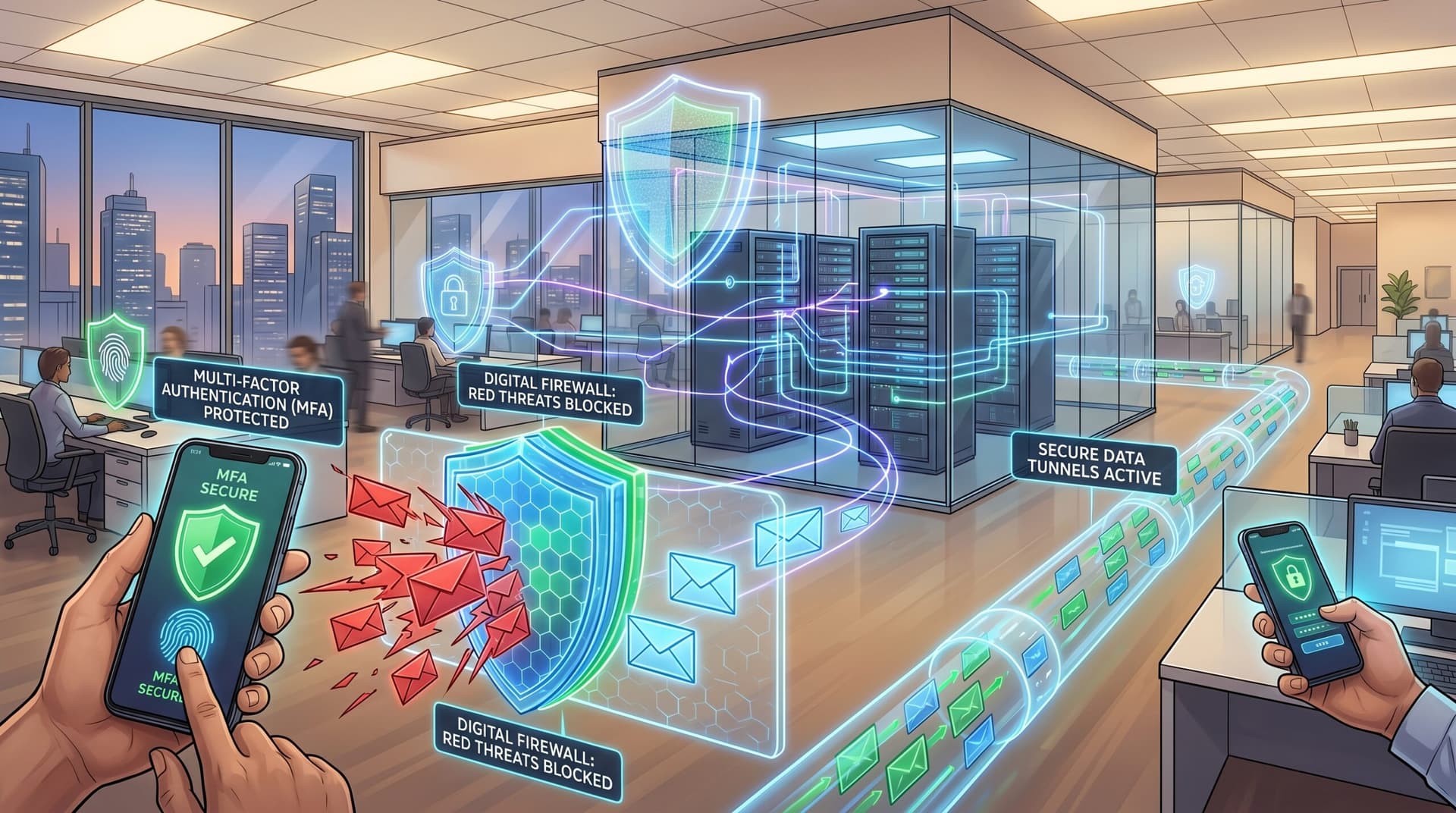
Implementing MFA is the single most effective technical control against account takeovers. Even if an attacker successfully steals an employee's password through a phishing site, they cannot access the email account without the secondary authentication method, such as a push notification to the user's mobile device or a hardware token. MFA should be mandatory for all accounts, with no exceptions for executives.
Strong Password Policies and Management
Move away from requiring complex, frequently changed passwords, which often lead to employees writing them on sticky notes. Instead, encourage the use of long passphrases. Utilize enterprise password managers so employees do not reuse the same passwords across multiple platforms.
Conditional Access Policies
Modern email platforms allow administrators to restrict access based on specific conditions. For example, you can implement geographic blocking (geo-blocking) to prevent logins from countries where you do not conduct business. You can also restrict access to recognized corporate devices or require secure VPN connections when accessing email from public Wi-Fi networks.
Advanced Email Filtering
Basic spam filters are not enough. Organizations must deploy advanced email security gateways that use machine learning to analyze the content, context, and sender reputation of incoming emails. These systems detect anomalies, flag emails coming from newly registered domains, and quarantine messages that exhibit characteristics of BEC before they reach the user's inbox.
Domain Protection (DMARC, SPF, and DKIM)
To prevent attackers from spoofing your company's actual domain, you must implement three critical DNS records:
- SPF (Sender Policy Framework): Lists the specific servers and IP addresses authorized to send email on behalf of your domain.
- DKIM (DomainKeys Identified Mail): Adds a digital signature to emails, ensuring the message was not altered in transit.
- DMARC (Domain-based Message Authentication, Reporting, and Conformance): Tells receiving email servers what to do (quarantine or reject) if an email fails SPF or DKIM checks. Proper DMARC enforcement ensures that attackers cannot send emails that appear to originate from your exact domain.
Payment Verification Procedures
Technology cannot stop an attacker who has successfully compromised a vendor's legitimate email account. Therefore, internal financial controls are crucial. Implement a strict "call back" procedure. If a vendor requests a change in payment details via email, an employee must call the vendor using a known, trusted phone number from the company directory—never the phone number listed in the new email request.
Separation of Duties
No single employee should have the authority to both create and approve a large financial transaction. Require dual approvals for all wire transfers above a certain threshold. One employee initiates the request, and a second, independent employee or manager must verify and approve it.
Executive Account Protection
Executives are high-value targets. Implement stricter monitoring and security policies for their accounts. Consider adding external email warning tags (e.g., "[EXTERNAL]") to the subject lines of all emails originating from outside the organization, helping executives and staff quickly identify potential spoofing attempts.
Monitoring Inbox Rules
Cybercriminals often create hidden rules inside compromised accounts to forward sensitive emails to outside addresses or move replies into the "Deleted Items" folder so the legitimate user doesn't see them. IT teams should regularly audit and monitor for the creation of new, suspicious forwarding or deletion rules across all accounts.
Security Audits and Vulnerability Testing
Regularly test your defenses. Work with a managed IT provider to conduct comprehensive security audits. This includes evaluating Microsoft 365 configurations, testing firewall rules, and identifying potential vulnerabilities in your network infrastructure before attackers can exploit them.
Endpoint Protection
Ensure all corporate devices (laptops, desktops, mobile phones) are protected with next-generation endpoint detection and response (EDR) software. This provides an additional layer of security if a BEC attack attempts to deliver malware or ransomware as part of a secondary attack phase.
Backup and Disaster Recovery Planning
In the event that an email account is compromised and data is deleted or encrypted, having secure, off-site, and immutable backups is critical. Ensure that your data backup and disaster recovery strategies are tested regularly so business operations can be restored quickly.
How to Protect Microsoft 365 and Business Email Accounts from BEC
Microsoft 365 is the dominant platform for business email, making it the primary target for attackers. Securing this environment requires specific administrative actions.
First, enforce MFA across the entire tenant using Azure Active Directory conditional access policies. Disable legacy authentication protocols (like POP3 and IMAP) that bypass modern MFA requirements.
Administrators must actively monitor login activities. Set up automated alerts for "impossible travel" scenarios—for instance, if an employee logs in from Los Angeles at 9:00 AM and then there is a login attempt from Eastern Europe at 9:15 AM, the system should immediately block the access and alert the IT team.
Restrict user permissions by applying the principle of least privilege. Regular employees should not have administrative rights over their local machines or the email environment. Furthermore, disable the ability for end-users to set up auto-forwarding rules to external domains. If an employee legitimately needs to forward emails, it should require explicit IT approval. Regular training specific to the Microsoft 365 environment, including how to identify fake SharePoint or OneDrive file-sharing links, is also essential for maintaining a secure network.
What to Do If Your Business Is Targeted by a BEC Attack
If you suspect your organization has fallen victim to a Business Email Compromise attack, immediate and decisive action is required to minimize the damage.
1. Stop the Transaction if Possible
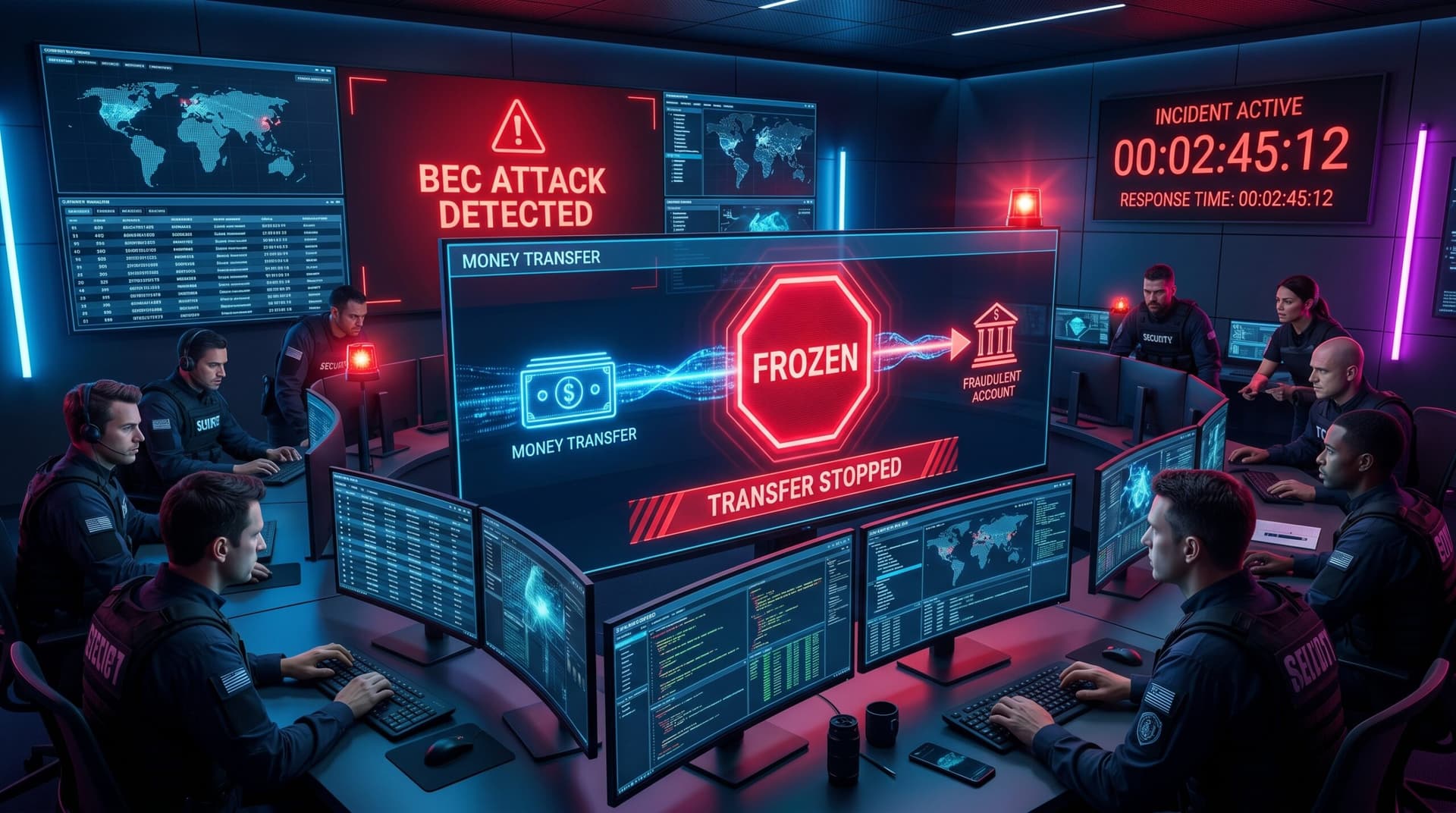
If a wire transfer or payment was recently initiated, contact your internal finance team immediately to halt the process. If the attack involves digital gift cards, do not send the codes.
2. Contact the Bank Immediately
Time is the most critical factor in recovering stolen funds. Contact your bank's fraud department immediately. Request a "Swift Recall" or a "Kill Chain" request to stop the funds from clearing the recipient bank. The sooner the bank is notified, the higher the chances of freezing the funds.
3. Report the Incident
In the United States, immediately file a detailed report with the FBI’s Internet Crime Complaint Center (IC3.gov). The IC3 has specialized teams that work directly with banks to freeze fraudulent international wire transfers. You should also notify local law enforcement.
4. Secure the IT Environment
If an account takeover is suspected, immediately reset the compromised user's password. More importantly, revoke all active session tokens in the email administration panel to forcefully log the attacker out of the account.
5. Review Mailbox Rules
Check the compromised account for hidden forwarding rules, delegates, or altered permissions that the attacker may have left behind to maintain access or monitor ongoing communications.
6. Preserve Evidence
Do not delete the malicious emails. Save them as attachments or export the logs. IT forensics teams and law enforcement will need the email headers, IP addresses, and exact timestamps to investigate the breach.
7. Notify Affected Parties
If the attacker used your system to target clients or vendors, notify them immediately so they do not fall victim to secondary attacks. Consult with legal counsel to ensure compliance with relevant data breach notification laws.
8. Investigate and Improve Controls
Conduct a thorough post-incident review to determine exactly how the breach occurred. Was it a lack of MFA? A failed financial approval process? Identify the gaps and implement stricter controls, such as mandated cybersecurity solutions and better employee training, before resuming normal operations.
Why Employee Training Is Critical for BEC Prevention
Technology alone cannot stop every threat. Because BEC targets human psychology, your employees are your most important line of defense—the human firewall.
Investing in high-end spam filters is pointless if a finance manager willingly bypasses protocols because they believe the CEO is demanding an urgent wire transfer. Regular, mandatory security awareness training is critical. This training must go beyond basic "don't click bad links" advice.
Finance teams and executive assistants require specialized training focusing on social engineering tactics, the importance of verification callbacks, and the latest trends in invoice fraud. Conduct simulated phishing campaigns regularly to test employee awareness in a safe environment. If an employee fails a simulation, use it as a constructive teaching moment rather than a punishment. When employees understand how attackers manipulate urgency and authority, they are far more likely to pause, verify, and prevent a massive financial loss.
How GlobeVM Helps Businesses Prevent BEC and Advanced Phishing
Navigating the complexities of modern email security can be overwhelming for business owners and office managers. GlobeVM provides the expertise and technology necessary to protect your organization from sophisticated cyber threats.
Through our comprehensive managed IT services, we implement strict security controls tailored to your business operations. We secure your Microsoft 365 or Google Workspace environments, enforce Multi-Factor Authentication, configure DMARC/SPF/DKIM records to prevent domain spoofing, and deploy advanced threat protection systems that analyze email behavior in real-time.
Furthermore, we understand that technology is only half the battle. GlobeVM assists organizations in establishing secure operational policies, conducting ongoing employee security awareness training, and performing regular network security audits to identify vulnerabilities before attackers do. Whether you need proactive monitoring, cloud security configuration, or rapid incident response support, GlobeVM acts as your dedicated technology partner, ensuring your business communications and financial assets remain secure.
Frequently Asked Questions
Business Email Compromise Prevention involves implementing technical security measures (like MFA, DMARC, and email filtering), strict financial verification processes, and continuous employee training to stop cybercriminals from impersonating trusted individuals and stealing company funds.
Regular phishing uses mass emails with malicious links or attachments to steal passwords or install malware. BEC is highly targeted, heavily researched, and relies on social engineering (using plain text emails) to trick employees into voluntarily authorizing fraudulent wire transfers or changing payroll details.
The most effective methods include enforcing Multi-Factor Authentication (MFA) on all email accounts, implementing a strict voice-verification "call back" procedure for any changes to payment instructions, utilizing advanced email security filtering, and continuously training employees to recognize manipulation tactics.
Immediately contact your bank's fraud department to attempt a wire recall, halt any pending transactions, reset passwords and revoke active sessions for affected email accounts, preserve the email evidence, and report the crime to the FBI's IC3 and local authorities.
Conclusion
The threat of email-based financial fraud is growing more sophisticated every day. Relying on outdated security software is no longer a viable strategy for protecting your company's assets. Effective Business Email Compromise Prevention requires a unified strategy that combines advanced technology, strict financial controls, and an educated workforce. By securing your email infrastructure, verifying all financial requests, and partnering with experienced IT professionals, you can significantly reduce your risk of falling victim to wire fraud and data breaches. Take proactive steps today to secure your digital environment. Contact GlobeVM to discuss how our customized cybersecurity and IT support services can protect your business from advanced threats.
Comments
0 Comments