
Every disaster recovery plan rests on a single underlying question: which parts of the business absolutely cannot be lost, and for how long? Most plans answer this with assumptions, gut feeling, or the loudest voice in the room. A Business Impact Analysis answers it with evidence. A BIA is the structured exercise of identifying the functions that matter most to the business, measuring the consequences of losing them, and producing the numbers that the rest of disaster recovery and business continuity planning depend on. Without it, recovery targets are guesses, technology spending is misaligned, and the plan that looks reasonable on paper falls apart at first contact with a real incident. This guide walks through the business impact analysis steps end to end, explains how each piece feeds into a disaster recovery plan, and describes the practical pitfalls that turn a BIA from a useful document into a checkbox no one reads.
What a Business Impact Analysis Is, and What It Is Not
A Business Impact Analysis is a systematic process for identifying critical business functions, the resources they depend on, and the consequences of their disruption. The output is a written analysis that quantifies, as far as possible, what the business loses per hour, per day, and per week when a particular function is unavailable, and what would be required to restore it.
It is worth being precise about what a BIA is not, because the term is sometimes used loosely. A BIA is not a risk assessment, although the two are closely related. A risk assessment identifies the threats a business faces and the likelihood of each occurring; a BIA looks at the consequences if a disruption happens, regardless of the specific cause. A BIA is also not a disaster recovery plan or a business continuity plan; it is the analysis that informs both. And it is not a one-time project, because the business changes and the analysis must change with it.
The reason the BIA matters so much is that almost every other element of business continuity and disaster recovery, from setting recovery objectives to deciding what to spend on technology, traces back to its findings. A weak BIA produces weak plans no matter how polished those plans look. A strong BIA gives leadership a clear, defensible basis for the choices that follow.

Why the Business Impact Analysis Steps Matter
Several practical outcomes come out of running a good BIA, beyond the document itself. The most direct is that recovery objectives, the Recovery Time Objective and Recovery Point Objective for each system, become evidence-based rather than guessed. Without that grounding, recovery targets tend to be either uniformly aggressive (which is expensive) or uniformly relaxed (which is risky), and neither matches what the business actually needs.
A BIA also produces a defensible basis for technology investment. When leadership asks why a particular backup or recovery solution costs what it does, the answer is the impact figures the BIA documented. It aligns technology spending with business value rather than with whichever vendor presented most recently.
Finally, a BIA exposes dependencies that the business may not have recognized. A function that seemed independent often turns out to rely on a system, a vendor, or a person that, if disrupted, would propagate damage well beyond its apparent scope. Surfacing those dependencies before a crisis is one of the most valuable products of the exercise.

The Business Impact Analysis Steps
The work itself follows a recognizable sequence. The exact methodology varies by organization, but the substance does not change much. The business impact analysis steps below reflect how the analysis is typically run in a small or mid-sized business, scaled appropriately.
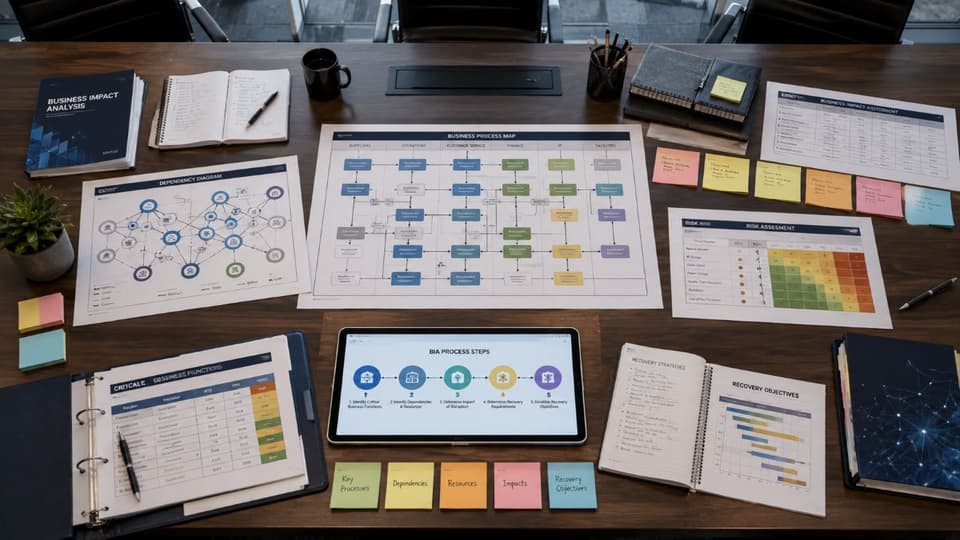
Step One: Define the Scope and Get Leadership Sponsorship
The BIA needs an executive sponsor with the authority to drive participation across departments. Without that backing, the analysis stalls when middle managers are asked to spend time on it. Decide whether the BIA will cover the entire business or a defined subset, and confirm the scope in writing before the work begins. Identify the team that will run the analysis, including someone with subject-matter expertise in business operations and someone with technical knowledge of the systems involved.
Step Two: Identify Business Functions and Processes
Before consequences can be measured, the functions that produce them must be inventoried. List every meaningful business function, the work that produces value for customers, generates revenue, or fulfills legal obligations. Functions are usually broader than systems; one function may rely on several systems, and one system may support several functions.
This step is often longer than expected, because businesses rarely have a current map of all the work they do. Done well, it produces a catalog of functions that the rest of the analysis can attach to.
Step Three: Determine the Impact of Disruption for Each Function
For each function, ask what happens, and how badly, if the function is unavailable, measured across several dimensions and time horizons. The dimensions typically include:
- Financial impact: lost revenue, contractual penalties, idle staff costs, and recovery expenses.
- Operational impact: the work that cannot be done, the backlog that builds, and the downstream functions that are affected.
- Customer impact: service failures, missed commitments, and reputational damage.
- Regulatory and legal impact: compliance obligations breached, notification duties triggered, and potential penalties.
- Safety impact: in regulated or clinical environments, the physical risks a disruption creates.
The time horizon dimension matters as much as the categories. Impact is rarely linear; some functions tolerate an hour of disruption with little harm but compound into severe damage if down for a day. Others are immediately and catastrophically painful from the first minute. Measuring impact at several time intervals, for example one hour, four hours, twenty-four hours, and one week, produces a curve that tells the rest of the planning where the cliffs are.

Step Four: Identify Dependencies
For each critical function, document what it depends on to operate. Dependencies typically span:
- Technology: the applications, databases, servers, network, and cloud services the function uses.
- People: the specific roles or individuals whose work the function relies on.
- Vendors and third parties: the outside providers whose services or supplies are part of the function.
- Facilities: the physical locations, equipment, or utilities the function requires.
- Information: the data the function uses, where it lives, and how current it must be.
Mapping dependencies is where most of the surprises emerge. A revenue-critical function frequently turns out to depend on a single overlooked vendor, a single employee, or a single piece of infrastructure that was never flagged as important. Discovering this in a BIA rather than during an incident is the entire point of the exercise.
Step Five: Establish Recovery Objectives
With impact and dependencies documented, the BIA can produce the recovery objectives that disaster recovery planning needs. For each critical function and the systems supporting it, define:
- Recovery Time Objective (RTO): the maximum acceptable downtime before consequences become unacceptable.
- Recovery Point Objective (RPO): the maximum acceptable amount of data loss measured in time.
- Maximum Tolerable Downtime (MTD): the absolute outer limit beyond which the business cannot recover even with full effort.
These targets should come directly from the impact analysis, not from what current technology happens to deliver. If current technology cannot meet a justified target, that is a finding the BIA exposes, not a constraint that should reshape the target. The point of the analysis is to identify the gap, not to hide it.

Step Six: Prioritize Functions for Recovery
Not everything can be restored at once after a serious incident. The BIA ranks functions by criticality so the recovery sequence is defined in advance. A common approach is to group functions into tiers: those that must be restored within minutes or hours, those that can wait a business day or two, and those that can tolerate a longer outage. Recovery resources, both technology and people, are then allocated according to those tiers.
Step Seven: Document and Present the Findings
The BIA's value depends on its findings reaching the people who make decisions. Produce a written report that documents the scope, methodology, findings, and recommendations, with the impact analyses and dependency maps as supporting detail. Present the conclusions to leadership in a form they can act on, including the recovery objectives that should drive the disaster recovery plan, the dependencies that require attention, and the investments the analysis justifies.
Step Eight: Review and Update Periodically
A BIA conducted once and filed away quickly becomes fiction, because the business it describes changes faster than the document does. New products, new locations, new systems, new vendors, all change what is critical and what depends on what. Review the BIA at least annually, and update it more often when major changes occur. Layered cybersecurity solutions shift the threat picture too, which can change which disruption scenarios deserve the most weight.
How the BIA Feeds the Disaster Recovery Plan
The connection between a BIA and a disaster recovery plan is direct and concrete. The disaster recovery plan answers the question, "How do we restore systems after an incident?" The BIA answers the prior question, "Which systems, in what order, and to what targets?" Without that prior answer, the disaster recovery plan is making it up.
Specifically, the BIA tells the disaster recovery plan which systems are tier-one critical and need the fastest recovery, which can wait, and which can tolerate a longer outage. It sets the RTOs and RPOs that drive backup architecture, replication strategy, and the level of investment in recovery infrastructure. It identifies the dependencies that the recovery plan must account for, so that restoring system A also accounts for the vendor, person, or piece of infrastructure that A requires to function. Dependable data backup and disaster recovery is what actually delivers on those recovery objectives, but the BIA is what makes the objectives realistic in the first place.

Common Mistakes That Weaken a BIA
The patterns that produce weak BIAs are familiar across small businesses. Recognizing them is the fastest way to keep the analysis useful.
The most common is leaving the exercise entirely to IT. A BIA that asks only technical questions misses operational, financial, and regulatory impacts that only business leaders can speak to. Cross-functional involvement is what makes the analysis honest. A related mistake is the absence of leadership sponsorship, which usually results in partial participation, missed deadlines, and a final document with gaps.
Another frequent error is estimating impact in vague qualitative terms only. A function described as "very important" tells the recovery plan nothing useful. Quantitative figures, even rough ones, are far more actionable than adjectives. Where exact numbers are unavailable, defensible ranges are still better than impressions.
A persistent mistake is treating the BIA as one-time work. The business changes, and a three-year-old BIA describes a company that no longer exists. The analysis must be alive, with periodic refresh built into the schedule. Finally, many BIAs ignore third-party dependencies, focusing only on internal systems. Vendors and outside services are often the source of the surprises an actual incident exposes, and a BIA that does not map them is missing a critical layer.

Building a Sustainable BIA Practice
For a small or mid-sized business, a useful BIA does not have to be a multi-month project. Scaled to the size of the organization, it can be completed in a few weeks, with the right participation. What it requires is leadership commitment, a defined methodology, and willingness to surface findings honestly, including the ones that imply unwelcome investment.
Most businesses also benefit from outside help in running the analysis, because the methodology is more familiar to people who have done it before than to internal teams encountering it for the first time. Ongoing managed IT services are where the technical side of the resulting plan lives, with the BIA driving the priorities that the operational work then delivers.
If your business is overdue for a real Business Impact Analysis, or has never conducted one, a structured engagement with a knowledgeable local partner is the most direct way to produce the analysis your disaster recovery and continuity plans should have been built on from the start.