

In the high-stakes world of enterprise cybersecurity, the greatest vulnerability is often the most overlooked: the digital identity of the employee. While organizations invest millions in perimeter defense, fIn the high-stakes world of enterprise cybersecurity, the greatest vulnerability is often the most overlooked: the digital identity of the employee. While organizations invest millions in perimeter defense, firewalls, and advanced encryption, the harsh reality is that over 80% of enterprise data breaches are directly attributable to weak, reused, or compromised passwords. For decades, the "complexity myth"—the belief that a mix of uppercase letters, symbols, and numbers would guarantee safety—governed IT policies worldwide. However, in the modern threat landscape, these traditional defenses are not just failing; they are being dismantled by sophisticated adversaries using automated tools.
Today, cybercriminals utilize AI-driven brute-force tools and massive, cloud-scale credential-stuffing databases to bypass static passwords in mere seconds. This evolution in cybercrime means that a password is no longer a "wall" but a "paper-thin door." The rapid transition to hybrid work models and the proliferation of SaaS applications have moved the "security perimeter" from the physical office to the user's individual login screen. This "Identity-is-the-Perimeter" shift means that if an identity is compromised, the entire network is at risk. To survive this fundamental shift, businesses must adopt a consultative, multi-layered security posture that prioritizes identity governance. This guide explores why Enterprise Password Management and the systematic adoption of Multi-Factor Authentication Best Practices represent the absolute frontline defense for protecting corporate intellectual property, client data, and organizational reputation in an increasingly hostile digital environment.
Why Traditional Password Policies Fail
To build a resilient security strategy, organizations must first acknowledge a painful truth: traditional password policies have transitioned from being a defense mechanism to a significant liability for organizational health. For decades, the industry followed NIST (National Institute of Standards and Technology) guidelines that advocated for frequent, periodic password rotations—typically every 60 to 90 days. However, recent forensic evidence and behavioral psychology studies have debunked this approach, proving that forced rotations actually lead to weaker security as users opt for predictable transformations (like changing "Spring2024!" to "Summer2024!").
This has created a massive "security debt"—a backlog of vulnerabilities born from years of enforced bad habits. By adhering to outdated complexity rules that prioritize machine-readability over human memorability, staff are inadvertently trained to lower the security bar. This creates gaps that modern automated attack tools exploit with surgical precision. The shift in NIST 800-63 guidelines reflects this reality, moving away from forced expiration toward a more risk-based, user-centric model that prioritizes the prevention of credential reuse and the implementation of phishing-resistant authentication over arbitrary character requirements.
Password Fatigue and Workarounds
When employees are forced to create complex strings that offer no immediate functional reward, they experience "Password Fatigue." This is not just a nuisance; it is a critical security flaw. The human brain is not optimized for memorizing dozens of unique, random 16-character strings that change every three months. This leads to predictable patterns that are trivial for modern cracking algorithms to predict once a single password is leaked in a breach.
Furthermore, the immense cognitive load of remembering dozens of unique passwords leads to dangerous "Shadow IT" habits. Organizations frequently find that strict complexity requirements lead to physical documentation of secrets. This manifests as passwords written on sticky notes hidden under keyboards, stored in unencrypted desktop files, or shared via unsecure messaging apps. Even more dangerous is "Credential Recycling," where an employee uses the same password for a corporate VPN that was used for a personal social media account. When that personal site is breached, your corporate network is suddenly vulnerable to automated login attempts.

Modern Attack Vectors
Without secondary layers of verification, even a 16-character complex password is a single point of failure. Attackers no longer need to "hack" through a hardened firewall; they simply "log in" using legitimate but stolen credentials.
- Credential Stuffing at Scale: Using automated bots, attackers test billions of leaked username/password combinations against corporate portals. If an employee uses the same password everywhere, a minor breach at a non-work-related site can grant an attacker the keys to your primary data center.
- AI-Enhanced Phishing: Modern phishing emails are increasingly indistinguishable from legitimate communications. By using Generative AI, attackers can craft perfectly worded, context-aware messages that mimic specific executives, tricking even vigilant professionals into surrendering their credentials.
- Password Spraying: Unlike brute force, which tries many passwords against one account, spraying tries one common password (like "Password2024!") against thousands of accounts to fly under the radar of account lockout policies.
- MFA Fatigue (Push Bombing): A tactic where an attacker sends dozens of MFA push notifications to a user's phone, hoping they will click "Approve" just to stop the noise.

The Mechanics of MFA
Multi-Factor Authentication (MFA) is engineered to destroy the "single point of failure" inherent in static passwords. By requiring independent categories of evidence to prove identity, MFA ensures that an attacker’s possession of a password is no longer sufficient to compromise an account.
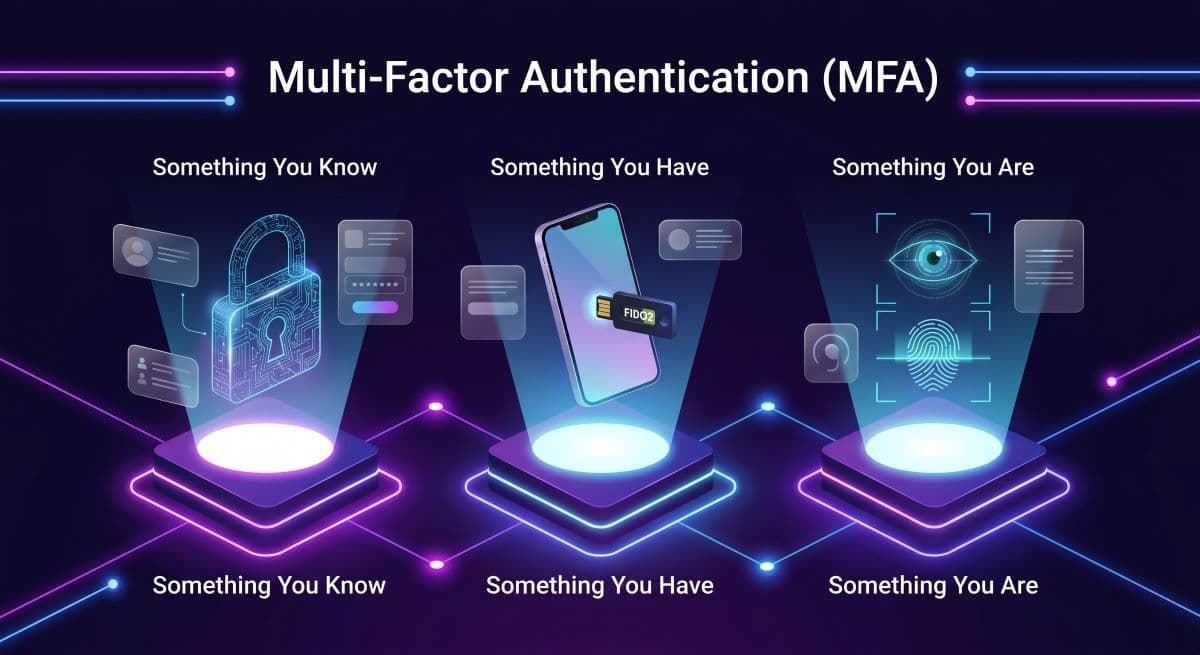
Three Authentication Factors
To implement Multi-Factor Authentication Best Practices, an organization must understand the three primary pillars of identity. The strength of MFA comes from combining factors from different categories.
- Something You Know: Traditional passwords, PINs, or security questions. This is the most vulnerable factor because it can be shared or guessed.
- Something You Have: A physical or digital object, such as a smartphone app, a TOTP code, or a hardware token like a YubiKey.
- Something You Are: Biometrics like fingerprint scans, facial recognition, or iris patterns. These are unique to the user and offer the lowest friction.
When an organization requires a combination of these factors, the probability of a successful unauthorized login drops significantly. Sophisticated Zero Trust architectures can stop 99.9% of automated cyberattacks by enforcing these secondary layers at every access request.
Enterprise MFA Best Practices
Deploying MFA is a strategic initiative that requires a balance between security depth and employee productivity.
Replacing SMS with Secure MFA
For years, SMS-based MFA was standard due to its convenience. However, it is now considered legacy and insecure. Attackers utilize "SIM Swapping" to hijack phone numbers and intercept authentication codes. Modern enterprises should actively deprecate SMS in favor of app-based or hardware-based authentication.
Apps, FIDO2, and Hardware Tokens
Cloud-based authenticator apps generate codes locally, which do not travel over the cellular network. For high-security environments, Hardware Tokens represent the gold standard. These devices use FIDO2/WebAuthn to verify identity. Unlike SMS, a FIDO2 request is cryptographically bound to the legitimate website’s URL, making remote phishing virtually impossible. This shift is a critical component of modern Multi-Factor Authentication Best Practices.
Adaptive and Context-Aware MFA
To combat "MFA fatigue," enterprises should deploy Adaptive Authentication. These systems use AI to analyze context:
- Geographic Velocity: Flagging logins from two distant locations in a short time.
- Device Health: Checking if the device is managed and updated.
- Network Reputation: Flagging attempts from Tor exit nodes or malicious VPNs.
Full Coverage via Zero Trust
Security is only as strong as its weakest link. Multi-Factor Authentication Best Practices dictate that MFA must be enforced across every entry point: not just email, but accounting software, cloud storage, legacy applications, and server consoles.
Securing Passwords Beyond Browsers
A common mistake is allowing employees to save corporate credentials in native web browsers. This represents a major architectural security risk.
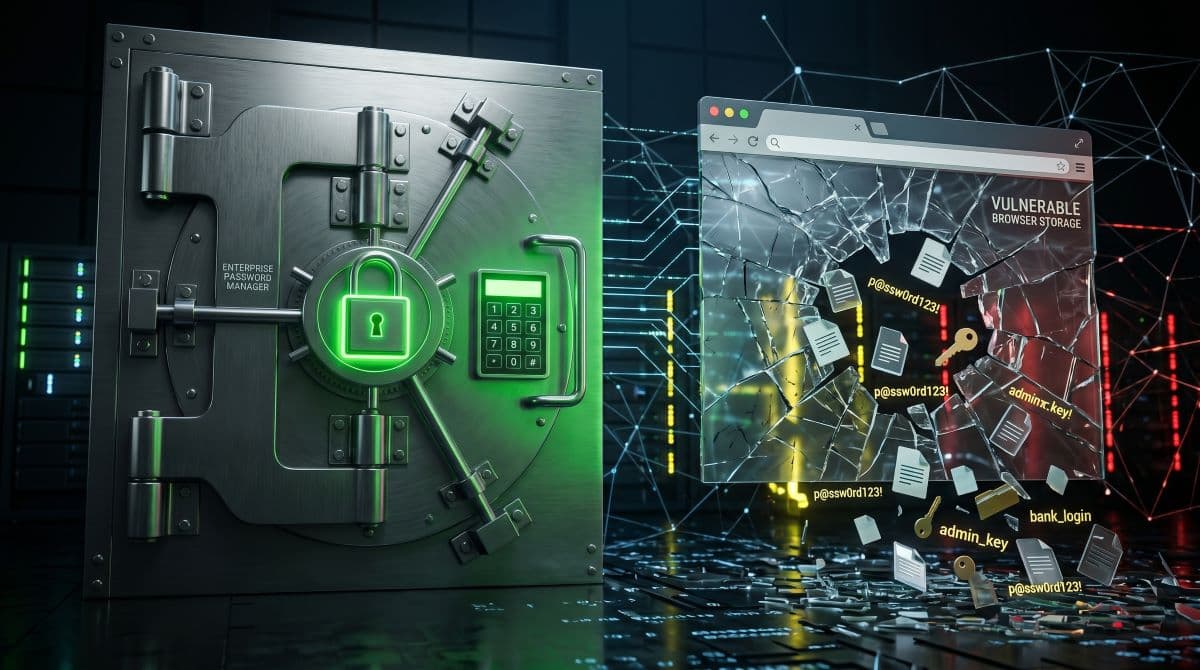
Risks of Browser Password Storage
Web browsers are designed for consumer convenience, not enterprise security:
- InfoStealer Malware: Malware can extract browser-stored passwords in seconds.
- No Governance: IT managers cannot enforce master password strength or revoke access when an employee leaves.
- Personal Syncing: Corporate credentials often end up on unmanaged personal devices through profile syncing.
The Case for Enterprise Password Managers
An EPM provides IT administrators with centralized control while providing employees with a secure vault.
- Zero-Knowledge Architecture: The provider never has access to your data; it is encrypted locally.
- Secure Sharing: Teams can share access to accounts without ever seeing the plaintext password.
- Dark Web Monitoring: EPMs alert admins if corporate credentials appear in public breaches.
SSO and Identity Federation
Combining Single Sign-On (SSO) with strict MFA policies is the pinnacle of identity management. SSO allows employees to log in once to a central portal and gain access to all authorized applications via secure tokens (SAML or OIDC). This reduces the attack surface and significantly lowers helpdesk reset tickets.
Compliance and Cyber Insurance
In the modern legal landscape, robust identity management is a mandatory prerequisite for legal operation and financial protection.
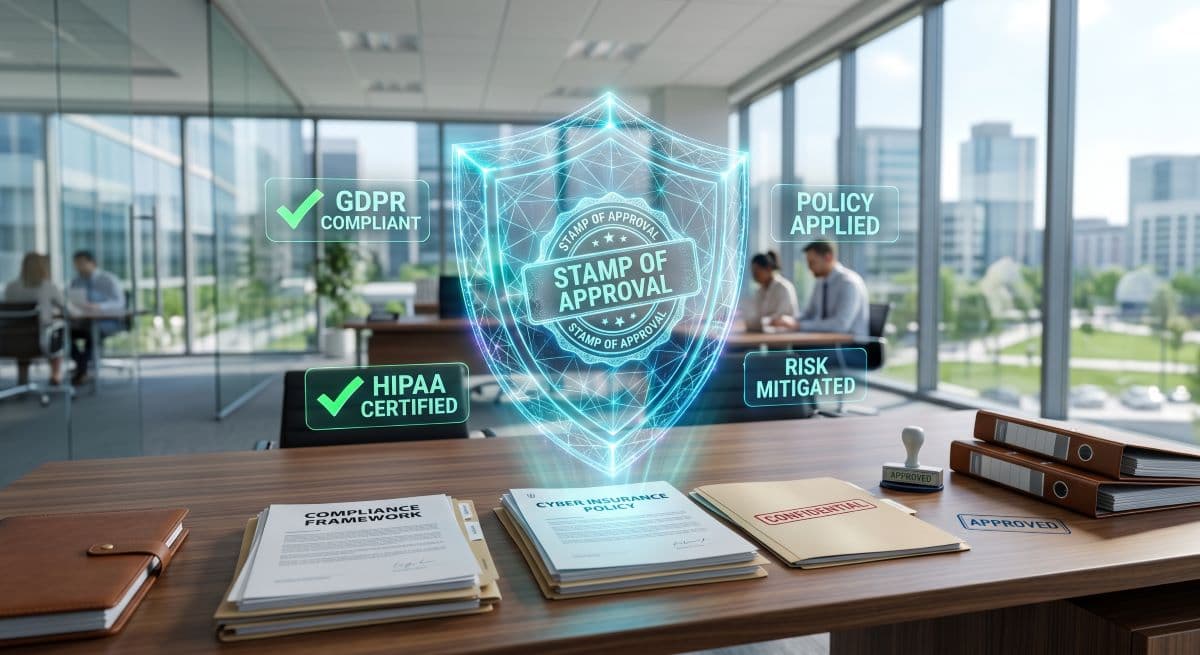
Global Compliance Frameworks
Compliance is often the driver for security investment. Frameworks like HIPAA, CMMC 2.0, and PCI-DSS 4.0 explicitly mandate MFA for all remote and administrative access. Furthermore, GDPR views the lack of MFA as a failure to implement "reasonable security measures."
Cyber Insurance Trends
The cyber insurance market has become significantly more selective. Most carriers will now refuse to issue policies unless a company can provide technical proof that Multi-Factor Authentication Best Practices are implemented across their entire infrastructure.
Assessing these gaps requires a deep technical understanding. Our experts at GlobeVM can help you navigate these complexities through our Compliance and Risk Management Services and comprehensive Security Audit offerings.
Identity Security with GlobeVM
Implementing advanced identity systems requires expert IT orchestration. Identity and Access Management (IAM) is a continuous discipline that must evolve alongside the threat landscape.
At GlobeVM, we integrate world-class identity protection into our broader Cybersecurity Solutions. We follow the Zero Trust principle: never trust, always verify. Our Managed IT Services ensure that as your business grows, your security infrastructure scales with it, protecting your employees and your bottom line.
Frequently Asked Questions
Conclusion: A Resilient Future
The era of the simple password is over. With the average cost of a data breach exceeding $4.45 million, following Multi-Factor Authentication Best Practices is the most cost-effective insurance policy a business can buy. By embracing a modern, identity-centric security model, you protect your reputation and your operational future.
Comments
0 Comments