
Every healthcare provider that handles patient information carries a quiet, ongoing question: where exactly are we exposed? Most practices cannot answer it with confidence. They have antivirus software, a backup somewhere, and a vague sense that their IT vendor is handling security. That is not the same as knowing your risks. A healthcare security risk assessment is the structured process that turns that uncertainty into a clear, documented picture of where patient data could be compromised and what to do about it. It is also a federal requirement, not an optional best practice. This guide explains what the assessment actually involves, why it is non-negotiable for healthcare providers, and how a smaller practice can approach it without being overwhelmed.
GlobeVM provides healthcare IT support for medical practices in Los Angeles: HIPAA security, EHR uptime and tested backups.
What a healthcare security risk assessment actually is
A healthcare security risk assessment is a systematic review of how an organization protects electronic protected health information, known as ePHI. It identifies where that data lives, what threats and vulnerabilities could affect it, how likely each of those is, and what the impact would be if they occurred. The output is not a vague reassurance. It is a documented inventory of real risks, ranked by seriousness, paired with a plan to reduce them.
This process exists because the HIPAA Security Rule requires it. Under the rule, conducting a risk analysis is a required implementation specification, not an addressable one, which in plain terms means there is no flexibility to skip it. Every covered entity, which includes healthcare providers, health plans, and clearinghouses, must perform it. So must every business associate, meaning the vendors and service providers that handle ePHI on a provider's behalf. Size is not an exemption. A solo dental practice carries the same obligation as a hospital system.

Risk analysis and risk assessment: clearing up the confusion
These two terms are used loosely across the industry, and the inconsistency causes real confusion. It helps to think of them as connected stages of one effort rather than separate things. The risk analysis is the foundational step, the work of identifying where ePHI exists and what could threaten it. The broader risk assessment builds on that analysis, evaluating how effective your current safeguards are against those identified threats and determining what still needs to be done. For practical purposes, what matters is not winning a vocabulary debate. What matters is that the full process, identifying risks and then evaluating your defenses against them, gets done and documented.
Why this is not just a compliance exercise
It would be easy to treat the assessment as paperwork filed to satisfy a regulator. That framing misses the point and usually leads to a weak result. There are three distinct reasons a healthcare security risk assessment matters.

It is the foundation of every other security decision
You cannot sensibly protect what you have not identified. The assessment tells you where ePHI is created, stored, and transmitted, which is information many practices have never fully mapped. Patient data is rarely in one place. It sits in the electronic health record, in email, on staff laptops, in a billing system, with outside vendors, sometimes on a phone. Until that picture is complete, any security spending is a guess. The assessment is what turns guessing into informed decisions.
It is the issue regulators examine most closely
When the Office for Civil Rights investigates a healthcare organization, often after a breach, one of the first things it asks for is the risk analysis. A missing, outdated, or superficial risk analysis is one of the most common findings in HIPAA enforcement actions. Regulators treat the absence of a genuine assessment as evidence that an organization was not taking security seriously. A real, current, documented assessment is the single most important piece of evidence that a provider was meeting its obligations.
Healthcare is a primary target for attackers
Patient records are valuable to criminals because they contain a complete set of personal, medical, and financial information. Healthcare organizations are also attractive targets because downtime is intolerable, which makes them more likely to pay during a ransomware incident. The assessment is how a practice gets ahead of this reality instead of discovering its weaknesses the hard way. Pairing it with strong cybersecurity solutions turns the findings into actual protection rather than a list of unaddressed problems.
The core steps of a healthcare security risk assessment
A credible assessment follows a recognized methodology. The framework most widely used in healthcare is built on guidance from the National Institute of Standards and Technology, and it breaks down into a clear sequence. Understanding these steps helps a practice know whether the assessment it received was thorough or thin.
- Define the scope and inventory ePHI. Identify every place patient data is created, received, stored, or transmitted, across all systems, devices, and vendors. Nothing can be assessed if it has not been found.
- Identify threats and vulnerabilities. Threats are the things that could go wrong, such as ransomware, a lost device, or an employee error. Vulnerabilities are the weaknesses that would let a threat succeed, such as an unpatched system or a shared password.
- Assess current security measures. Document what protections are already in place and how well they actually work, covering administrative, physical, and technical safeguards.
- Determine likelihood and impact. For each threat and vulnerability pairing, judge how likely it is to occur and how damaging it would be. This is what allows risks to be ranked rather than treated as an undifferentiated list.
- Assign a risk level. Combine likelihood and impact into a clear rating, so the most serious risks rise to the top and get attention first.
- Document everything and build a remediation plan. Record the findings, the risk levels, and a concrete plan with owners and timelines for reducing each significant risk.
That final step is where many assessments fall short. An assessment that identifies problems but produces no plan to fix them is incomplete. The point of the exercise is action, not a document.

How often a healthcare security risk assessment must be done
One of the most damaging misconceptions in healthcare compliance is that the risk assessment is a one-time event. It is not. HIPAA treats it as an ongoing process. While there is no single mandated calendar date, the accepted practice is to conduct or formally review the assessment at least once a year, and the regulation is clear that a review is required whenever something significant changes.
Those triggering changes are common in any growing practice:
- Adopting a new electronic health record or practice management system
- Moving systems or data to the cloud
- Opening a new location or significantly changing staffing
- Adding new connected medical devices
- Engaging a new vendor that will handle patient data
- Experiencing a security incident or near miss
An assessment that reflects the practice as it was three years ago does not protect the practice as it is today. This is why treating it as a living part of compliance and risk management works far better than treating it as an annual scramble.

Common mistakes that undermine the assessment
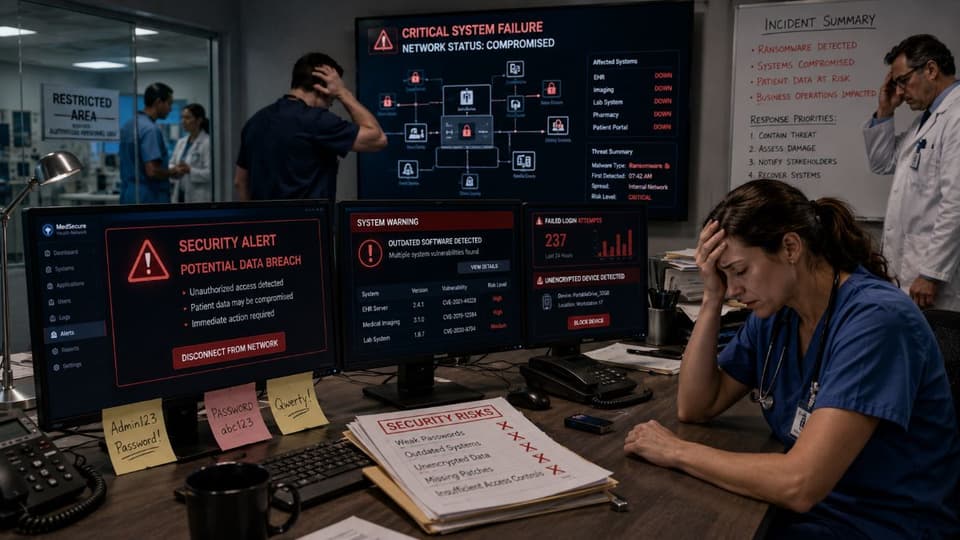
Plenty of practices technically have a risk assessment on file that would not hold up under scrutiny. These are the most frequent failures, and they are worth checking against your own situation honestly.
- Confusing a vulnerability scan with a risk assessment. A scan or a checklist that only inspects technical systems is useful, but it is not a complete risk assessment. A real assessment also covers administrative and physical safeguards, policies, training, and vendor relationships.
- Incomplete scope. Many assessments miss ePHI that lives outside the main system, such as data in email, on personal devices, or with third parties. An assessment that does not find all the data cannot protect all of it.
- No remediation follow-through. Identifying risks and then never acting on the findings is, in the eyes of a regulator, almost worse than not assessing at all, because it shows the organization knew and did nothing.
- Letting it go stale. An assessment completed once and never revisited stops reflecting reality the moment the practice changes.
- Treating vendors as out of scope. Business associates handling your patient data are part of your risk picture. Their weaknesses can become your breach.
Who should conduct the assessment
HIPAA does not require that an outside firm perform the assessment. A practice can conduct it internally, and government bodies have published tools to help smaller organizations do exactly that. For a very small practice with someone genuinely knowledgeable about security, an internal assessment using a structured tool is a legitimate starting point.
In practice, though, most healthcare providers benefit from outside expertise, for honest reasons rather than salesmanship. An internal team may lack the security depth to identify subtle vulnerabilities, and people assessing their own systems tend to have blind spots about weaknesses they live with every day. An experienced external assessor brings a methodology, current knowledge of how healthcare is actually being attacked, and objectivity. The strongest approach for many practices is a blend: an outside assessment for rigor and an independent view, supported by ongoing internal attention so the findings stay current. A capable managed IT services partner with healthcare experience can provide that combination, and can also carry out the technical remediation the assessment recommends.
From assessment to protection
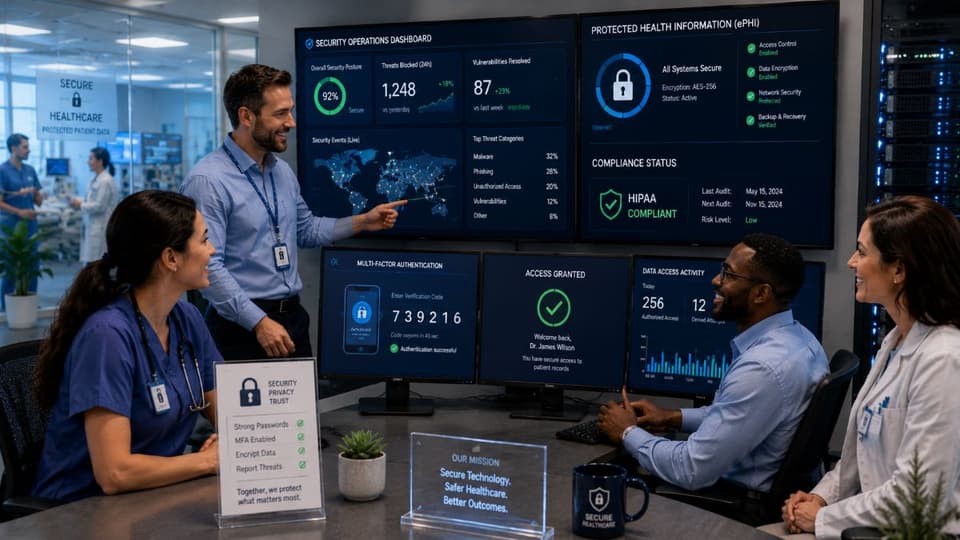
A healthcare security risk assessment is the beginning of better security, not the end. The findings should drive concrete improvements: tighter access controls, stronger authentication, better staff training, tested backups, and a clear incident response plan. The assessment tells you where you stand. What you do with it is what actually protects your patients and your practice. A provider that runs the assessment, acts on every significant finding, and keeps the picture current is in a genuinely strong position, both against attackers and against regulatory scrutiny.
If your practice has never had a thorough security risk assessment, or your last one is more than a year old, the team at GlobeVM can evaluate where your patient data is exposed and give you a clear, prioritized plan to close the gaps.