The fax machine outlived every prediction of its death, and in healthcare it did more than survive: referrals, records requests, prior authorizations, and pharmacy traffic still ride it daily. Meanwhile patients want to text, staff already text each other, and somewhere between the two channels sits a pile of protected health information moving through systems nobody formally evaluated. The rules for HIPAA compliant fax and HIPAA compliant texting are genuinely different from each other, and different again by mode — paper versus cloud, patient versus colleague which is exactly why this guide treats them together: one pass, every mode, and what each one requires before patient information touches it.
HIPAA Compliant Fax and Texting: The Practice Guide to Both Channels

By George
1 October 2026

By the end you will know when a fax needs a Business Associate Agreement and when it does not, what makes texting a patient lawful, why the staff group chat is the quiet violation in most practices, and where the after-hours answering service fits into all of it.
Why Fax Refuses to Die in Healthcare
Fax persists because it is the one channel every party in healthcare can already receive: the specialist across town, the pharmacy, the payer, the imaging center, the practice still running software from another decade. Interoperability projects chip away at it year by year, but the practical reality for a small practice is that fax traffic is not optional this year or next, so the compliance question is not whether to fax but how, and the how splits cleanly by mode.
HIPAA Compliant Fax: The Rules by Mode
Traditional paper fax
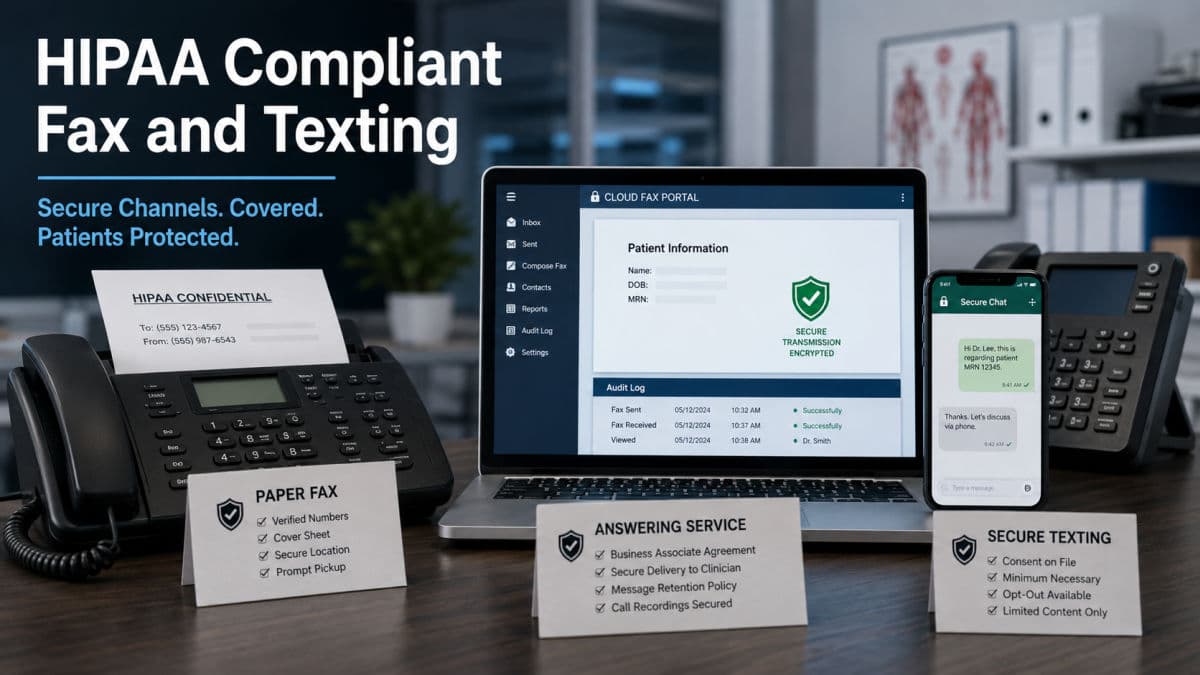
The classic machine on the classic phone line remains permitted under HIPAA with reasonable safeguards, and the phone carrier transmitting it is a conduit, pure transmission with no storage or access, so no agreement with the phone company is required. The obligations sit entirely on your side of the machine, and they are procedural. Confirm the destination number before sending, especially the first time and after any change. Use a cover sheet identifying the intended recipient with a confidentiality notice. Place the machine where the public and passing traffic cannot read what it prints, and clear received faxes promptly rather than letting charts accumulate in the tray. The signature failure of this mode is the misdirected fax, one transposed digit sending a chart to a stranger, and it is a reportable incident, which puts it inside your breach notification obligations, not merely an oops. Speed-dial entries for frequent destinations, verified once and locked, remove most of that risk for the cost of an afternoon.
Cloud and online fax
The moment fax becomes a service — an online portal, a fax-from-email address, an app — the math changes completely: the provider now receives, stores, and transmits patient information on your behalf, which makes it a business associate, and a signed BAA becomes mandatory before the first page moves. This is the mode most practices should be in, because done properly it is the more secure one. It brings encryption in transit and at rest, access controls deciding who sees inbound documents, an audit trail of every send and view, and integration that files faxes into the chart instead of a tray. The disqualifier is the consumer tier: personal and free plans of online fax brands typically offer no agreement path at all, and a practice faxing charts through one is running the same violation as the free-email practice, regardless of how professional the interface looks. Choose a service tier where the agreement exists, execute it, and store it with the rest of your compliance records.
Keeping the number when you switch
The practice fax number is infrastructure: referral sources have it saved, pharmacies have it printed, and losing it means months of misdirected charts. Established numbers port to cloud fax services the way phone numbers do, so the migration plan is straightforward and worth writing down. Confirm portability with the new service before signing, keep the old line alive in parallel through the cutover window, and test inbound from three known senders on day one. Only then release the analog line. The practices that skip the parallel period are the ones discovering, two weeks later, which referral source was still dialing a dead machine.
The fax-to-email trap
A popular configuration quietly multiplies risk: inbound faxes delivered as attachments to an ordinary email inbox. Now the fax content inherits every property of that mailbox, its coverage or lack of it, its forwarding rules, its personal-phone sync, and a channel you evaluated carefully terminates in one you never did. The fix is routing: inbound faxes should land in the covered fax portal, the EHR, or a covered mailbox with restricted access, and nowhere else. The same logic applies at the far end of every channel in this article, since documents ultimately rest somewhere, and that somewhere is part of the compliance picture alongside the rest of the cloud storage that holds patient data.
HIPAA Compliant Texting: Two Different Problems
Texting is really two channels wearing one name, patients on one side, colleagues on the other, and the rules diverge sharply.
Texting patients
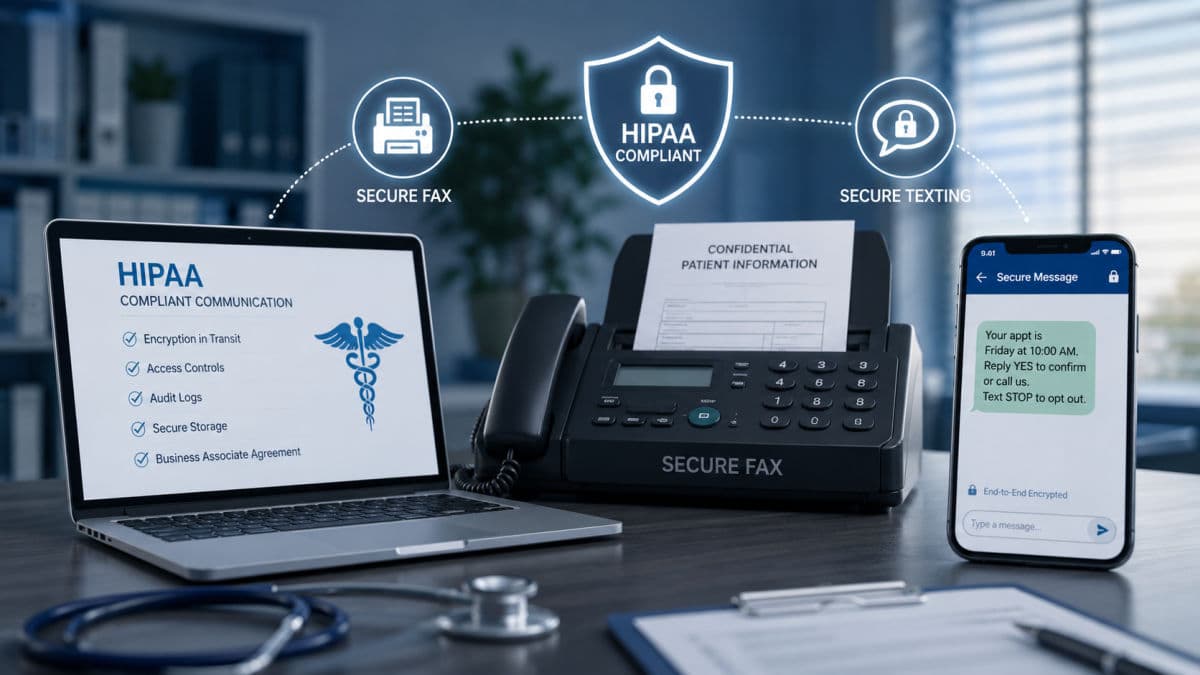
Standard SMS is unencrypted and stored by carriers and devices outside your control, which makes it unfit as a default channel for clinical content. It is not banned outright, and two lawful patterns cover nearly everything a practice needs. The first is the limited-content message: appointment reminders and logistics that carry the minimum necessary, a date, a time, a callback number, sent with the patient's documented consent and a working opt-out. The second mirrors the email rule: a patient who has been plainly warned that texting is not secure and still prefers it may be accommodated, with that informed choice documented in writing and applied to that patient alone. What neither pattern covers is the tempting middle: full clinical conversations drifting into an SMS thread because it was convenient. The practical guard is a standing staff rule: logistics by text, medicine by covered channel, and when a patient's question crosses the line, the reply is a call or a portal message, not a paragraph of SMS.
When the patient starts the thread
Inbound is its own case: a patient texts your published number a photo of a rash and a question. Their message to you violates nothing, and ignoring it is its own kind of failure, so the workable pattern is a holding reply that closes the loop without extending the exposure: acknowledge receipt, state that clinical questions are answered by phone or portal, and place the call. Publish that expectation where the number is published, and make sure whichever system receives those texts is itself covered and monitored, because a patient message sitting unread in an unwatched inbox is both a service failure and a record you did not know you had.
Secure messaging between clinicians and staff
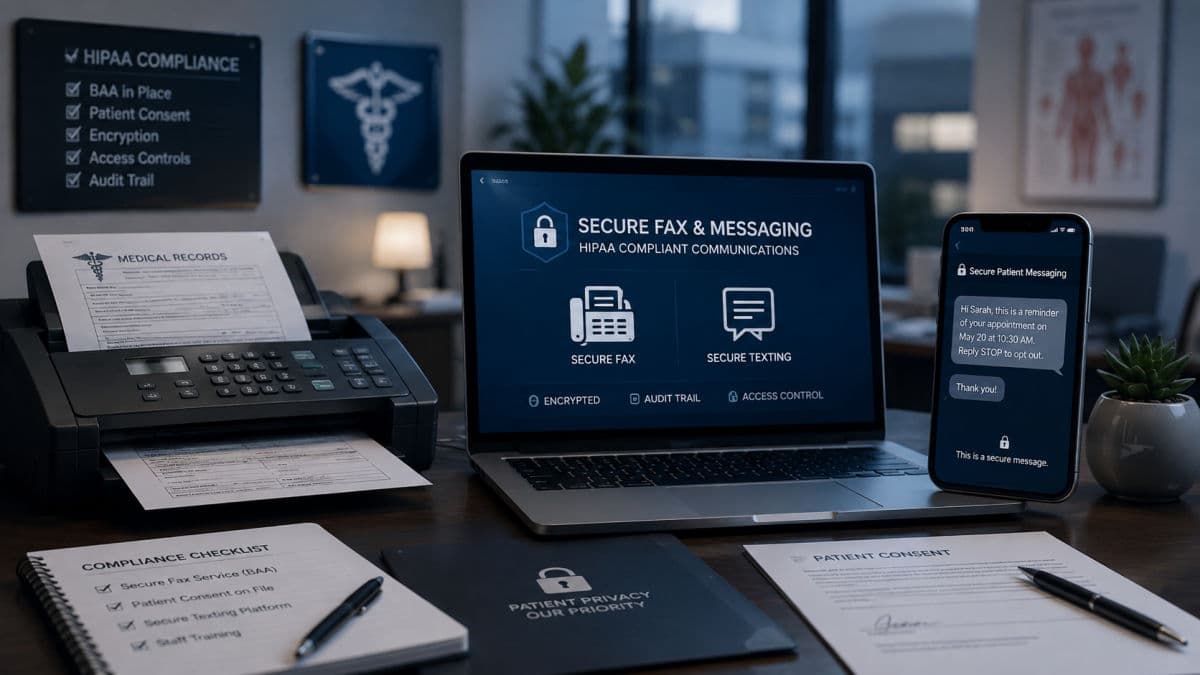
Inside the care team, the answer is purpose-built secure messaging: platforms designed for healthcare that sign a BAA, encrypt messages, authenticate users against a staff directory, keep audit logs, and let an administrator remove a departed employee's access in one motion. Many EHRs include a messaging layer that already does this, which makes the first move an inventory of what you own before anything is bought. The features that matter in practice are unglamorous: message lifespan controls so PHI does not live forever on personal devices, remote wipe when a phone is lost, and roles that keep the billing conversation and the clinical one appropriately separated.
The consumer-app problem
Every practice has one: the staff group chat on a consumer messaging app where, among the schedule swaps and lunch orders, patients get discussed by name. Consumer tiers of the popular apps offer no agreement path, encryption in transit does not substitute for one, and the chat's history syncs to personal phones that leave with their owners. The fix is not a sternly worded memo alone, convenience always beats memos, but a covered alternative that is genuinely as easy, installed and demonstrated, plus the policy that names the boundary. Give the team a lawful channel that works and the shadow channel starves.
The Answering Service Is a Business Associate
The after-hours answering service takes patient calls, records names, callback numbers, and often symptoms, and relays them to the on-call provider, which is business associate activity from the first message, so a BAA is required, full stop. Two follow-up questions matter as much as the agreement itself. First, how do messages reach your on-call clinician, because a covered answering service that relays messages by ordinary SMS has simply moved the exposure one hop downstream, and the right answer is delivery into a secure app or covered channel. Second, call recordings are patient information too, so who at the service can hear them and how they are secured belongs in the same conversation. Ask how long the service retains messages and recordings, and whether that retention lines up with your own data retention policy rather than with a default nobody chose. A ten-minute call with the service answers both, and the answers belong in your vendor file.
Setting It Up: One Covered Path Per Channel
The whole subject collapses into a short project. Inventory how patient information actually moves today, every fax number, every texting habit, the answering service, the pattern nobody admits to. Choose one covered mode per channel: a cloud fax service under BAA, a defined patient-texting pattern with consent language in your intake packet, a secure messaging platform for the team, an answering service whose agreement and delivery method you have verified. Route every endpoint into covered storage, and retire the uncovered paths visibly, the machine unplugged, the group chat archived, so the old habit has nowhere to land. Then fold the channels into your existing program — they belong in the risk analysis and training like everything else. That folding-in is the work our HIPAA compliance engagements package for practices, and if the phone system itself is due for modernizing, fax and secure communication increasingly arrive together in the platform decision covered in our cloud phone system guide. We run this exact channel inventory for medical and dental offices across Ventura County and the LA area as part of IT and cybersecurity for healthcare practices, and the finding is almost always the same short list: one unsigned agreement, one fax-to-email route, and one group chat.
Frequently Asked Questions
Fax can be used in compliance with HIPAA in both its forms. Traditional paper fax is permitted with procedural safeguards, verified numbers, cover sheets, controlled machine placement, and prompt pickup. Cloud and online fax services store and transmit patient information for you, so they require a signed Business Associate Agreement plus proper configuration before any patient documents move.
Not for a traditional phone line carrying an analog fax, the carrier is a conduit that neither stores nor accesses the content. The moment a service receives, stores, or converts your faxes, an online portal, fax-to-email, an app — that provider is a business associate and a BAA is mandatory, and consumer tiers without an agreement path are off-limits for patient documents.
Not inherently. Limited-content logistics like appointment reminders with documented consent and an opt-out are a lawful, common pattern, and a patient who has been warned that texting is insecure may still choose it, with that choice documented. What fails is defaulting full clinical conversations to ordinary SMS without consent, warning, or limits.
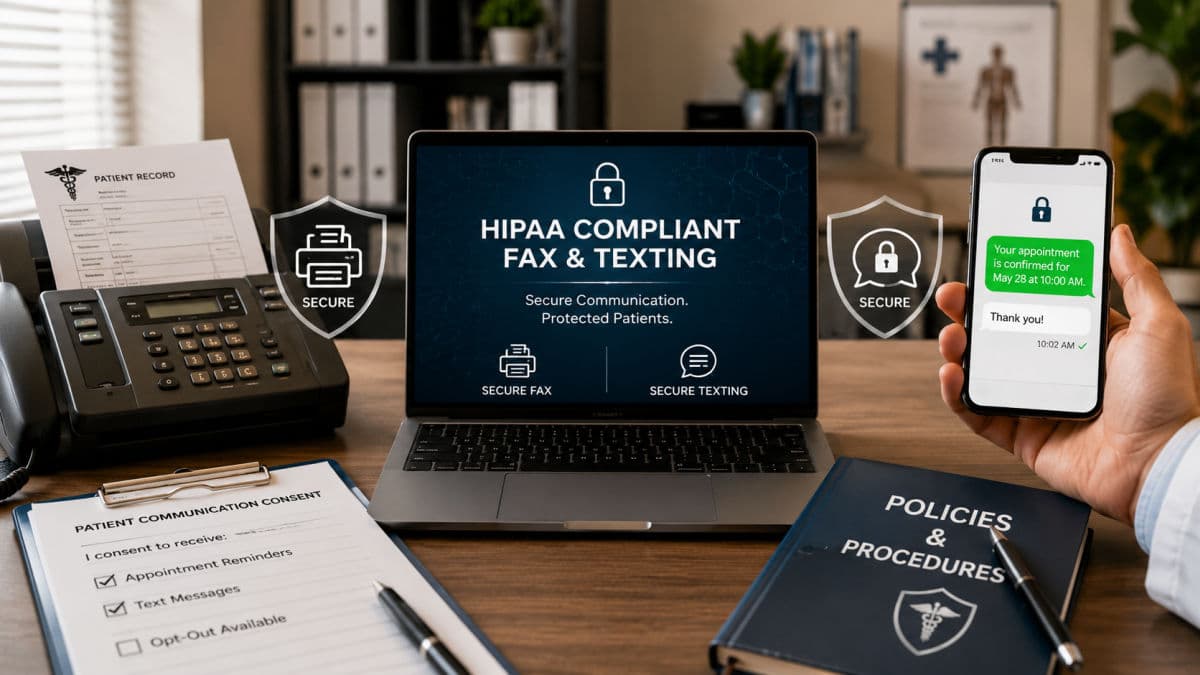
Yes, with three conditions: the patient has consented to receive texts, the message carries the minimum necessary, date, time, callback number, rather than clinical detail, and every message honors an opt-out. Reminder texting is one of the most defensible uses of SMS in a practice when those three are in writing.
Care-team messaging about patients belongs on a secure messaging platform that signs a BAA, encrypts, authenticates against your staff directory, and logs access, many EHRs include one. Consumer messaging apps on personal phones offer no agreement path at their consumer tiers, and the standing group chat discussing patients by name is among the most common violations we find.
Yes. Taking patient calls and relaying messages is business associate activity, so the agreement is required, and the diligence continues one hop further: confirm messages reach your on-call clinician through a secure channel rather than plain SMS, and that the service's retention of messages and recordings matches your policy.
HIPAA compliant fax and texting come down to one discipline applied four times: name the mode, sign the agreement the mode requires, route the endpoint into covered storage, and write the habit down. If you would like the channel inventory run for you, book a communications compliance review with GlobeVM and we will hand your practice the short list by the end of the visit.
Comments
0 Comments