

A production line that has run reliably the same way for fifteen years or more does not, on its face, look anything like a cybersecurity problem, and for most of those fifteen years it was not one, because the machines controlling it were isolated, purpose-built, and disconnected from anything an attacker could reach from outside the building.
That comfortable isolation has quietly and steadily disappeared across most of the manufacturing sector over the past decade, replaced by networked sensors, remote monitoring, and connected control systems that deliver real operational value and, alongside it, an attack surface the plant floor never had to defend before.
This guide covers IT for manufacturing honestly: why the convergence of information technology and operational technology has changed the risk picture for even small manufacturers, why production stoppage makes this industry an unusually attractive target, and what a manufacturer should actually do about equipment that was never designed with any of this in mind.
Two Technology Worlds That Used to Never Meet
Manufacturing has always run two separate technology environments side by side. Information technology, the office network, email, business software, looks like the IT environment in any small business. Operational technology, the machines, sensors, and control systems actually running production, historically lived in complete isolation, purpose-built systems with no connection to the outside world and, in a meaningful sense, no need for traditional cybersecurity because there was no path in.
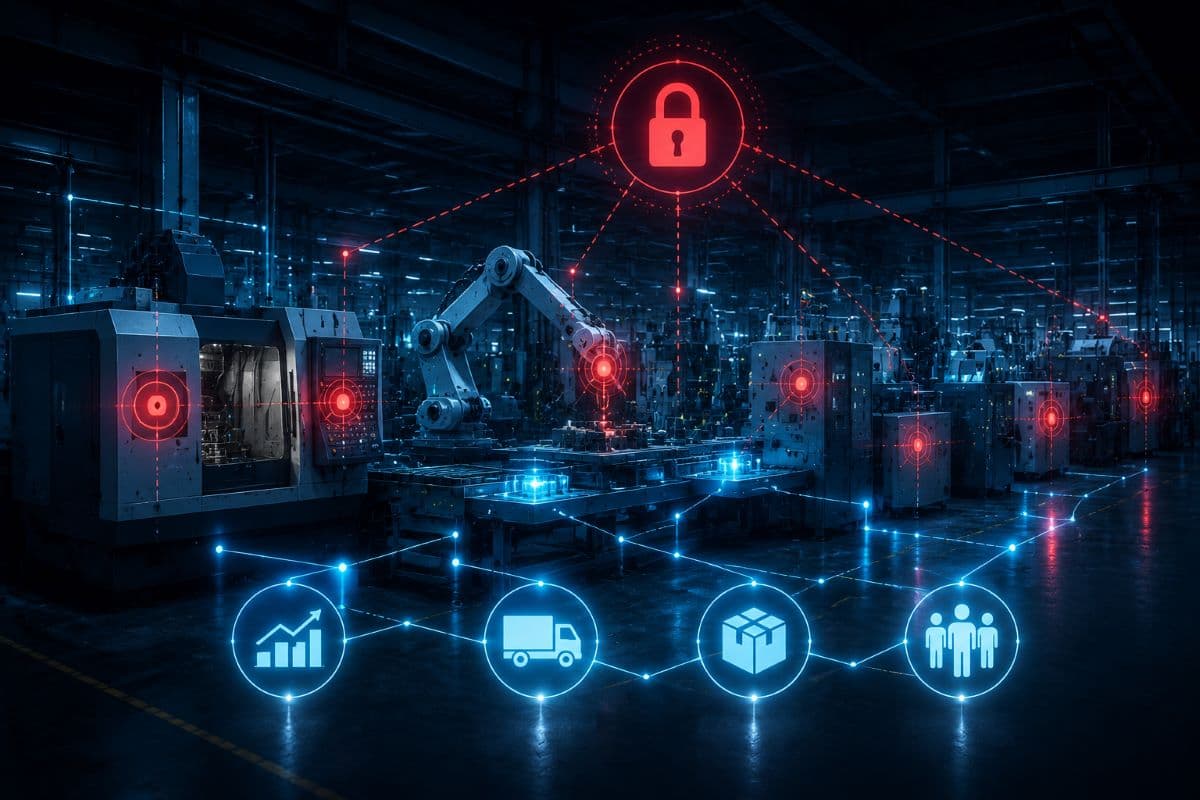
That isolation is exactly what has changed. Modern manufacturing increasingly connects operational technology to the same networks as everything else, for remote monitoring, predictive maintenance, and the kind of real-time data that improves efficiency, and every one of those connections is also a new path between the outside world and equipment that was engineered for reliability and precision, not for resisting an attacker who never used to be a consideration.
IT for manufacturing today means managing both of these environments and, critically, managing the boundary between them, which is where most of the real risk actually concentrates.
Why Manufacturing Became an Attractive Target
Attackers choose targets based on the pressure they can apply and how quickly a victim needs to pay to make that pressure stop, and manufacturing offers a specific kind of built-in advantage to an attacker that office-based businesses simply do not.
A ransomware attack against a typical small business locks up files and disrupts work; a ransomware attack that reaches a manufacturer's operational technology can stop physical production entirely, and every hour a production line sits idle is an hour of committed labor, contracted deliveries, and downstream customer obligations accumulating cost in a way that a locked spreadsheet never does.
This dynamic has made manufacturers of every size, including small ones far below the scale most owners would ever associate with being a worthwhile target, an increasingly common target precisely because the cost of downtime creates exactly the urgency that makes ransom payment more likely. A small manufacturer's instinct that its size makes it unattractive to attackers has become measurably less true as this dynamic has become more widely understood and exploited.
Legacy Equipment Is the Risk Nobody Wants to Discuss
The uncomfortable reality behind most manufacturing cybersecurity conversations is that a meaningful share of operational equipment on real production floors is running old, sometimes outdated software that cannot simply be patched the way an office computer can, either because the manufacturer no longer supports it, because an update would void a warranty or certification the equipment depends on, or because the equipment's control software was never designed to be updated at all once installed.
This is not a hypothetical inconvenience; it means a real and growing share of manufacturing risk exists specifically because critical equipment cannot receive the same basic security maintenance that closes most vulnerabilities everywhere else in a business.
The honest response to this reality is not pretending it does not exist, but building the rest of the security posture around it: since the equipment itself often cannot be hardened directly, the network boundary around it becomes the primary defense, which is exactly why segmentation matters as much as it does in this specific industry.
Segmentation Is the Single Most Important Concept Here
If a manufacturer takes away one specific technical priority from this guide, it should be this: operational technology, the actual production equipment, needs to be separated from the general business network, not merely password-protected on the same network the office computers and email run on.
This separation, called network segmentation, means that even if an attacker compromises a typical entry point, a phished employee email account, an exposed office computer, they cannot simply walk across the network to reach the equipment actually running production.
Segmentation does not require replacing legacy equipment, which is often impractical or prohibitively expensive; it requires controlling and monitoring the connections between the office environment and the production environment deliberately, through real network management, rather than allowing the convenience of a single flat network to quietly erase the isolation that used to protect operational technology by default.
A manufacturer that has never specifically verified this separation exists, rather than assuming it does because the network diagram was drawn that way years ago, should treat that verification as a priority rather than routine housekeeping.
Supply Chain Requirements Are Arriving Whether Manufacturers Are Ready or Not
Small and mid-sized manufacturers increasingly sit inside a supply chain answering to larger prime contractors and customers who have begun flowing down specific cybersecurity requirements as a condition of doing business at all, particularly in defense, aerospace, and other sectors with formal government-linked compliance frameworks.
A manufacturer that has treated cybersecurity as optional or informal can find itself facing a real, sudden business risk when a major customer's next contract renewal includes security requirements the manufacturer cannot yet demonstrate it meets, turning what felt like a technical nice-to-have into a revenue and relationship risk with real deadlines attached.
Manufacturers supplying into any regulated or defense-adjacent supply chain should treat these flowdown requirements as a business development question as much as a technical one, since the ability to demonstrate real security posture is increasingly a competitive factor in retaining and winning this kind of contract, not merely a compliance checkbox filled out once and filed away.
Physical Safety Is Where This Gets Serious
Beyond data and downtime, a security failure that reaches operational technology on a manufacturing floor carries a dimension most office-based cybersecurity conversations never have to consider: physical safety. Equipment that moves, cuts, presses, or heats material under computer control represents a category of risk where a security failure is not merely a business problem but potentially a workplace safety incident, which is precisely why the availability and integrity of operational technology deserves the heightened priority reflected in the comparison above.
This is not a reason for alarm so much as a reason for proportionate seriousness, the same segmentation and monitoring discipline that protects production also protects the people working around that production, and framing the investment in these terms tends to secure the attention and budget that a purely IT-framed pitch sometimes struggles to command from ownership focused on the plant floor.
Remote Monitoring Vendors Deserve the Same Scrutiny as Any Other Connection
Many of the connections that erased operational technology's old isolation arrived through legitimate remote monitoring and predictive maintenance vendors, equipment manufacturers and service providers who need ongoing access to the machines they support. Each of these relationships is a real access point into the production environment, and a manufacturer should be able to answer, for every such vendor, exactly what access they have, whether it is limited to only what their service actually requires, and whether that access is reviewed periodically rather than granted once during installation and never revisited again for years.
What a Manufacturer Should Actually Do First
For a manufacturer starting from an honest assessment of where things currently stand, the practical sequence looks like this: confirm, rather than assume, that operational technology is segmented from the general office network, since this single verification closes more real risk than almost any other single action available. That inventory is where our IT and cybersecurity for manufacturing engagements usually begin, because nothing else can be prioritized until it exists.
Inventory what operational equipment actually exists, its age, its patch status, and whether it can be updated at all, since a manufacturer that cannot answer this cannot make an informed decision about anything else. Review any customer or contract flowdown requirements that already apply or are likely to arrive soon, treating them as a business timeline rather than an abstract future concern.
And bring in expertise that specifically understands operational technology, not just general office IT, since the two environments require different judgment, and a provider comfortable with basic cybersecurity solutions but unfamiliar with production equipment is solving only half the problem this industry actually faces.
Cyber Insurance for Manufacturers Deserves Its Own Look
Beyond general underwriting questions, manufacturers carrying meaningful production risk should evaluate compliance and risk management coverage specifically built around business interruption from a cyber event, since a standard policy written for a typical office may not adequately reflect the financial exposure of a stopped production line. This is worth a direct conversation with a broker who understands manufacturing specifically, rather than assuming a generic small-business cyber policy covers a risk this industry-specific.
Insurance Underwriters Are Starting to Ask These Questions Too
Business insurers covering manufacturers are increasingly asking underwriting questions about network segmentation, incident response readiness, and operational technology security specifically, mirroring the same trend already well underway in general cyber liability coverage. A manufacturer that can answer these questions with a documented, verified posture rather than a shrug is likely to see that reflected in both the premium offered and, in a incident, in how smoothly the claims process goes.
This is one more practical reason the segmentation and inventory work described above pays for itself in ways that go beyond avoiding an attack in the first place.
The Plant Floor Deserves the Same Seriousness as the Office
Manufacturing spent decades with a technical excuse for treating cybersecurity as someone else's problem, real isolation between the office and the production floor, and that excuse has quietly expired as connectivity delivered real operational value in exchange for a new category of risk.
IT for manufacturing done properly means recognizing that the office network and the production floor are different environments with different priorities, verifying the segmentation between them instead of assuming it, building a real inventory of aging equipment that cannot defend itself, and treating supply chain security requirements as the business deadline they increasingly are rather than a distant formality.
For manufacturers across the metro, a partner providing managed IT services in Los Angeles can verify your network segmentation and inventory the operational equipment your business depends on.
Manufacturers in the Valley can get the same locally through IT services in the San Fernando Valley, from the first OT and IT boundary review to preparing for the supply chain requirements headed your way.
Frequently Asked Questions
Because a ransomware attack that reaches operational technology can stop physical production entirely, and every hour of idle production accumulates committed labor, contracted deliveries, and customer obligations far more expensively than a typical office disruption. This dynamic creates exactly the urgency that makes ransom payment more likely, which has made manufacturers, including genuinely small ones, an increasingly common target regardless of the size-based assumption that smaller companies are unattractive targets.
Segmentation means genuinely separating operational technology, the actual production equipment, from the general office network, rather than merely password-protecting them on the same network. Because a meaningful share of manufacturing equipment runs legacy software that cannot simply be patched, segmentation becomes the primary defense: it prevents an attacker who compromises a typical entry point like a phished email account from being able to reach the equipment actually running production.
Increasingly, yes, particularly for manufacturers supplying into defense, aerospace, or other regulated supply chains where larger prime contractors and customers are flowing down specific security requirements as a condition of doing business. A manufacturer unprepared for these requirements can face a sudden business risk when a major customer's next contract renewal requires security posture the manufacturer cannot yet demonstrate, making this a business development question as much as a technical one.
Because operational technology on a manufacturing floor often controls equipment that physically moves, cuts, presses, or heats material, which means a security failure reaching that equipment is not only a business or data problem but potentially a workplace safety incident. This is why availability and integrity of operational technology deserve heightened priority compared to typical office IT priorities, and why the same segmentation and monitoring discipline that protects production also protects the people working around it.
If your manufacturing operation has never verified that its production equipment is separated from the office network, GlobeVM can run the kind of IT for manufacturing assessment that prepares you for the supply chain security requirements increasingly arriving with your next contract.
Comments
0 Comments