

Good IT support for restaurants and hospitality businesses becomes obvious the moment the point-of-sale system goes down at a full restaurant on a Friday night, nobody reaches for a laptop to troubleshoot a settings menu; they reach for a pen and a pad of paper while a line forms and a manager starts apologizing to the table by the door.
Restaurants and hospitality businesses experience technology failure differently than almost any other small business, because the technology in question is not supporting the operation, it frequently is the operation, the register, the reservation book, and the kitchen's instructions all running through systems that a typical office would treat as background infrastructure.
This guide covers IT support for restaurants and hospitality businesses specifically: why uptime here means something closer to revenue protection than convenience, the payment security obligation every operator carries whether they think about it or not, and the parts of this business's technology that generic small-business IT advice consistently underserves.
The Point of Sale Is Not Software, It Is the Cash Register
The framing that gets restaurant technology wrong from the start is treating the point-of-sale system as software supporting the business, the way accounting software supports a typical office. In a restaurant, the point-of-sale system is the cash register, the order ticket, and the payment terminal all at once, and when it goes down, the business genuinely cannot transact, not slowly, not with a workaround, but immediately and completely for however long the outage lasts.
This changes the calculus on downtime tolerance considerably compared to a typical small business, where a software outage is often an inconvenience absorbed quietly over the course of a day. A restaurant's point-of-sale outage during a Friday dinner rush is measured in lost revenue by the minute, and the business impact is visible to every customer in the room at the same time, which is exactly why IT support for restaurants and hospitality businesses needs to treat this specific system with an urgency that generic small-business support rarely applies to any single piece of software.
The Full Technology Stack Behind a Single Table Being Served
What looks like one simple transaction, a guest orders, eats, and pays, actually runs through a coordinated stack of systems that most diners never think about and most owners underestimate the interdependence of. The point-of-sale system takes the order and processes payment.
A kitchen display or ticket printer relays that order to the kitchen in real time, and a failure here does not just inconvenience the front of house, it stops food from reaching tables entirely. Reservation and waitlist software manages the flow of guests into a space with finite seating, and an outage during a busy period creates chaos that a paper backup only partially solves since staff are rarely well-practiced at the manual fallback.
And increasingly, online ordering and delivery integration systems feed orders in from outside the building entirely, adding another dependency that, when it fails, either loses those orders silently or floods the kitchen with a backlog nobody was tracking. Each of these systems typically comes from a different vendor, and the coordination between them, rather than any single system in isolation, is often where real operational fragility hides.
Guest WiFi Is a Genuinely Separate Risk From Everything Else
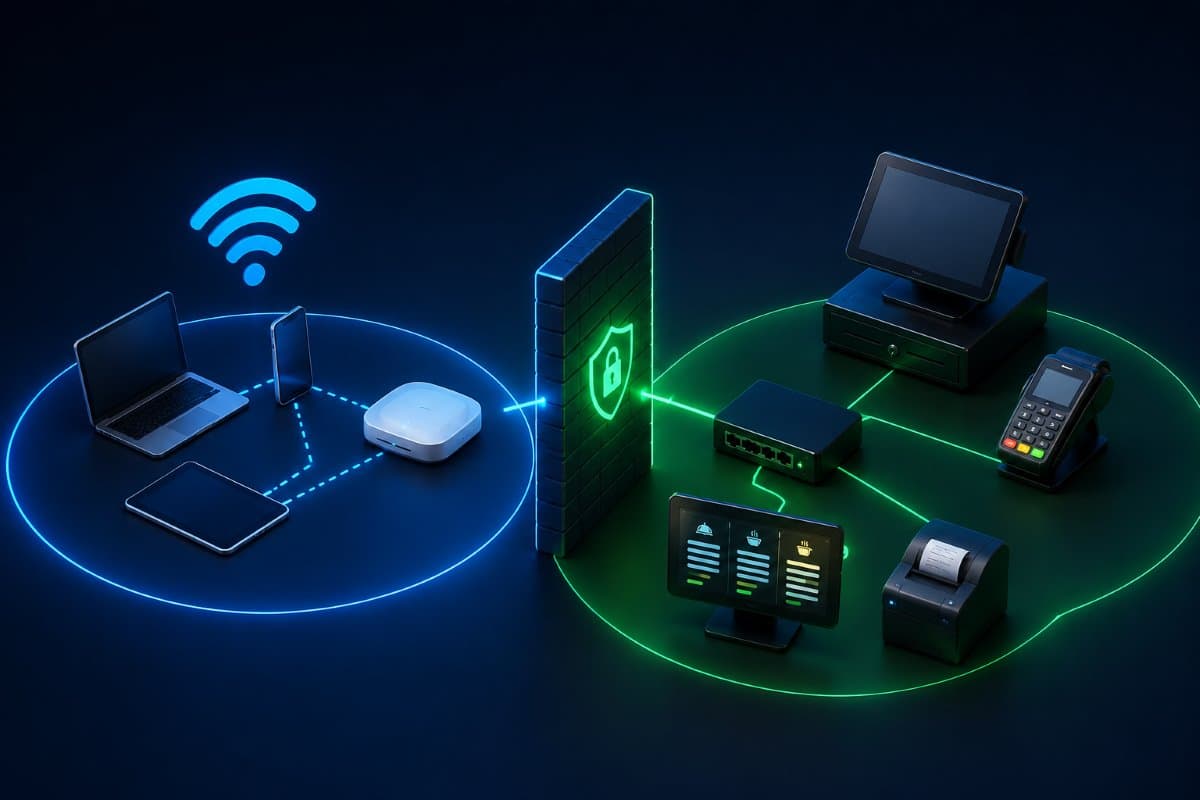
Most hospitality businesses offer guest WiFi as a basic expectation, and most treat it as an afterthought technically, plugged into the same network as the point-of-sale system and everything else running the business, which is precisely the setup that creates real risk.
Guest WiFi needs to be genuinely, technically separated, through real endpoint security and network design, from the operational network carrying payment and reservation data, not merely password-protected on the same network, because a shared network means any compromise on the guest side, a guest's infected device, a malicious actor sitting in the dining room, has a direct path toward the systems processing customer payment information.
This separation, called network segmentation, is not an advanced or optional security measure for a hospitality business; it is close to a baseline requirement, and a surprising number of small operators are running their guest network and their point-of-sale network as effectively the same thing without realizing the exposure that creates.
Payment Security Is Not Optional Here, It Is the Central Obligation
Every hospitality business that processes card payments, which today means nearly every one, operates under payment card industry security obligations regardless of size, and this is not a distant compliance concept but a direct, practical requirement touching the point-of-sale system, the network it runs on, and how long any payment data is retained anywhere in the business's systems.
The specific requirements scale with transaction volume, but the underlying obligation to protect cardholder data applies from the smallest single-location operator upward, and a business that has never had its point-of-sale environment specifically reviewed against these requirements through real compliance and risk management is carrying exposure it may not know exists.
This is also where the guest WiFi segmentation point above becomes concrete rather than abstract: proper network separation between guest access and payment processing is frequently a specific, explicit expectation under these payment security obligations, not merely good general practice.
Staff Turnover Meets Shared Devices, and That Combination Needs a Plan
Hospitality is an industry with real, structural staff turnover, seasonal, part-time, and transient by the nature of the work, and this collides directly with a technology reality most restaurants never formally address: point-of-sale terminals, tablets, and other operational devices are typically shared across many staff members rather than assigned individually.
A business that has never established a clear process for adding and removing staff access as people join and leave accumulates exactly the kind of access sprawl that becomes a real liability, former employees with still-active logins to systems touching payment data, shared generic passwords that make it impossible to know who actually performed a given action, and no clean way to answer basic accountability questions when something goes wrong.
Building staff onboarding and offboarding into the technology process as a formal, repeatable step, not an afterthought handled inconsistently by whichever manager is on shift, closes a gap that costs nothing to fix and quietly persists in operations that have never been asked to think about it directly.
Uptime Expectations That Do Not Match a Normal Office
A typical small business can absorb a technology outage that happens to land during a quiet Tuesday afternoon with minimal real damage. A restaurant or hospitality business does not get to choose when an outage happens relative to its busiest hours, because the busiest hours are exactly when the systems are under the heaviest load and therefore, in practice, exactly when problems are statistically most likely to surface.
This reality argues for a specific kind of support relationship: monitoring that catches degrading performance before a full outage during service, response times that account for the reality that a Friday or Saturday evening problem cannot wait until Monday morning, and a provider who understands that the cost of an hour of downtime in this industry is measured very differently than in a typical office setting.
Generic small-business support hours, built around a nine-to-five office rhythm, are a poor structural fit for a business whose busiest, highest-stakes hours regularly fall on evenings and weekends.
A Practical Technology Checklist for Hospitality Operators
For an operator taking stock of where the business actually stands:
- Confirm guest WiFi is genuinely segmented from the point-of-sale and payment network, not merely password-separated.
- Verify your point-of-sale environment against payment security requirements specifically, rather than assuming general IT security covers it.
- Build a formal staff access process for shared devices, tied to actual hiring and departure, not left to informal habit.
- Confirm support response times actually match peak hours, evenings and weekends, not standard business hours.
- Map the dependencies between systems, point-of-sale, kitchen display, reservations, online ordering, so a single vendor's outage is a known, planned-for scenario rather than a surprise.
Third-Party Delivery Platforms Add a Vendor Nobody Fully Vets
Delivery and third-party ordering platforms have become a real revenue channel for most restaurants, and each one is also a vendor relationship most operators never formally vet the way they would a bank or a payment processor, despite that vendor's software integrating directly into the same order flow carrying the business's daily revenue.
A delivery platform outage or a data-sharing arrangement nobody read closely can create real operational and privacy exposure that sits outside the restaurant's own systems entirely, and a periodic review of exactly what access these third-party integrations actually have to the core point-of-sale environment is worth treating as a standing item, not a one-time setup decision made in a hurry when the platform was first adopted.
Choosing Support That Understands This Business
A restaurant or hospitality operator evaluating IT support should look for a provider who treats point-of-sale uptime, payment security, and peak-hour response time as familiar, central concerns rather than concepts encountered for the first time on the account.
That familiarity is what separates a provider who can talk through exactly how a specific point-of-sale platform integrates with a specific kitchen display system from one offering the standard managed-services pitch adapted after the fact, and the difference tends to matter most during precisely the moments this article has described, a system failure on the busiest night of the week.
This is the kind of operationally specific understanding that real IT support for restaurants and hospitality businesses requires, delivered through managed IT services built around how the business actually runs, not a generic package applied to it after the fact.
The Technology Behind Every Table Served
A restaurant's technology does not sit quietly in the background the way it does in most small businesses; it is directly, visibly, immediately involved in every transaction the business completes, which means IT support for restaurants and hospitality businesses has to be held to a different standard than generic small-business support.
A point-of-sale system that stays up through the Friday rush, a guest network genuinely separated from payment processing, a staff access process that actually gets followed, and a support provider whose response times respect what a Saturday evening actually costs, together, are what makes the technology disappear into the background where it belongs instead of becoming the story of the night.
For hospitality businesses across the metro, a partner providing managed IT services in Los Angeles can review your point-of-sale environment against payment security requirements and confirm your guest network is genuinely separated from the systems that matter.
Operators across the Valley can get the same locally through IT services in the San Fernando Valley, from a first technology review to support hours that actually match your busiest nights.
Frequently Asked Questions
Because the point-of-sale system is not supporting software in a restaurant, it is the cash register itself, and when it fails the business cannot transact at all, immediately and completely, for as long as the outage lasts. A typical office can often absorb a software outage quietly over the course of a day; a restaurant's point-of-sale outage during a busy service is visible to every customer in the room and translates directly into lost revenue by the minute, which is why this system needs a level of uptime urgency generic small-business support rarely applies.
Yes, and this separation, called network segmentation, is close to a baseline requirement rather than an advanced option. When guest WiFi shares a network with the point-of-sale and payment systems, any compromise on the guest side, an infected guest device or a malicious actor on-site, has a direct path toward the systems handling customer payment data. Proper segmentation is also frequently an explicit expectation under payment card industry security requirements, not merely good general practice.
Nearly every restaurant that processes card payments operates under payment card industry security requirements regardless of size, covering the point-of-sale system, the network it runs on, and how payment data is handled and retained. The specific requirements scale with transaction volume, but the underlying obligation to protect cardholder data applies broadly, and many small operators have never had their point-of-sale environment specifically reviewed against these requirements, which means real compliance exposure can exist without the operator being aware of it.
Through a formal, repeatable process tied directly to actual hiring and departure dates, not informal habit that varies by whichever manager is on shift. Because point-of-sale terminals and tablets are typically shared across many staff members in an industry with significant turnover, a business without a clear access process accumulates real liability: former employees with still-active logins and shared generic passwords that make it impossible to know who performed a given action when something needs to be investigated.
If your restaurant's guest WiFi has never been checked against your payment network or your support hours do not actually match your busiest nights, GlobeVM can fix both and deliver the kind of IT support for restaurants and hospitality businesses that a service running on live transactions actually needs.
Comments
0 Comments