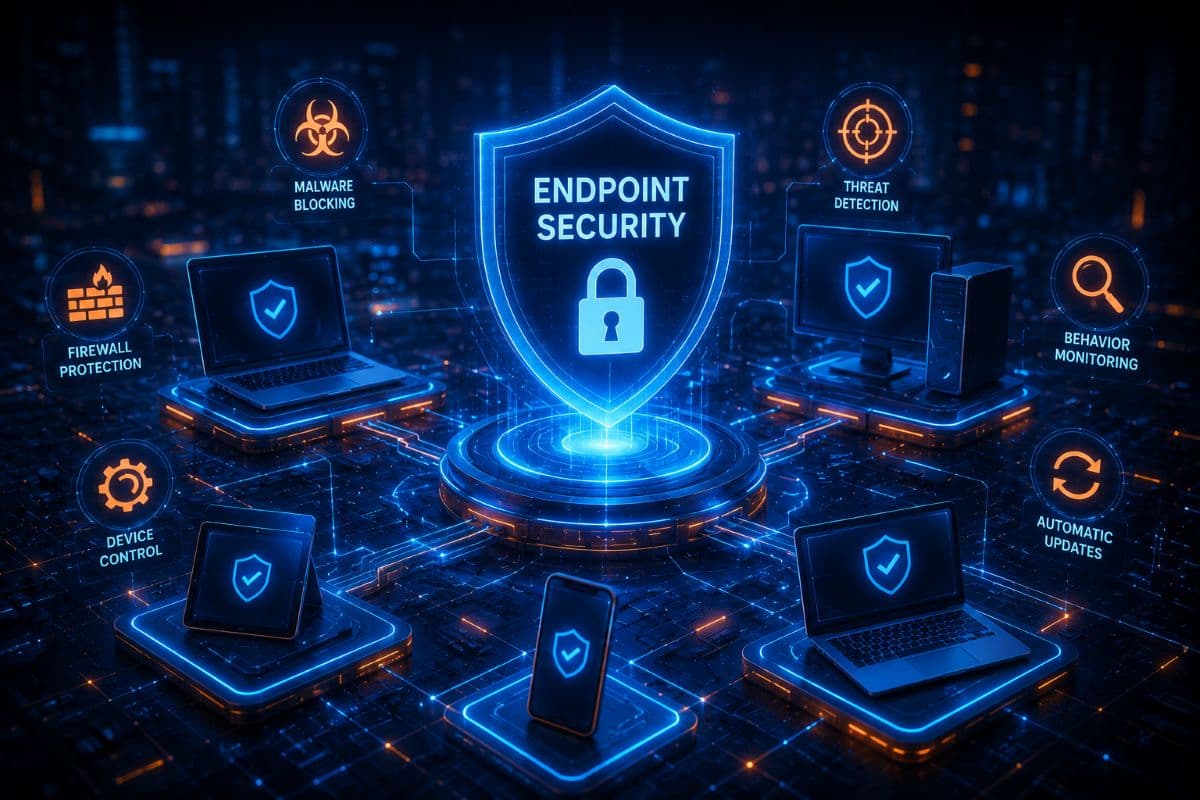




An endpoint is any device that connects to your network and could give an attacker a way in: a laptop, a desktop, a server, and increasingly the phones and tablets your team uses for work. Endpoint security is the protection that lives on those devices, guarding each one against malware, ransomware, and the other threats that target the machines people use every day. It matters because endpoints are where most attacks land. An attacker does not need to compromise your whole network if they can get onto a single laptop, and from there try to spread. Strong endpoint security closes that first door, and gives you a way to catch and stop a threat if it does get onto a device.
For a business, the practical value is straightforward. Your people work on these machines all day, often handling sensitive information, sometimes from home or on the move. Endpoint security makes sure each of those devices is defended and watched, rather than being the weak point an attacker is looking for.
Why Antivirus Alone No Longer Protects You
Many businesses still think of protecting a computer as installing antivirus, and antivirus does useful work, but on its own it is no longer enough. Traditional antivirus works by recognizing known threats, comparing files against a list of malware it has seen before. The problem is that attackers constantly produce new and altered threats that are not on any list yet, including much of today’s ransomware and so called fileless attacks that do not rely on a traditional malicious file at all. Antivirus that only knows yesterday’s threats will wave these through.
Modern endpoint security takes a different approach. Alongside recognizing known threats, it watches how programs actually behave, so it can flag something acting like an attack even if it has never been seen before. This shift, from only asking whether a file matches a known bad one to asking whether something is behaving maliciously, is what allows modern protection to catch threats that older antivirus misses. Antivirus is one layer within endpoint security, not the whole of it.
Prevention and Detection, Working Together
Good endpoint security does two jobs that complement each other. The first is prevention, stopping threats from running on a device in the first place, which is always the preferred outcome. The second is detection and response, because no prevention catches absolutely everything, and you need to know when something has slipped through. Detection records what is happening on a device, so a threat that gets past the first line can still be spotted, investigated, and contained, such as isolating the affected machine before a problem spreads. A business that only has prevention has no visibility into what happens when something gets through, which is often how an intrusion goes unnoticed for a long time. Pairing the two is what gives real protection.
What Managed Endpoint Security Includes
Buying endpoint software is only the start. The protection only works if it is deployed everywhere, configured well, kept current, and actually watched, which is what a managed approach provides. That means putting protection on every device rather than only the obvious ones, since attackers look for the machine that was left out. It means keeping the software and the systems it runs on up to date, so known gaps are not left open for attackers to walk through. It includes setting the right controls for your business and tuning them over time, and making sure that when the protection flags something genuinely concerning, someone sees it and acts. Left unmanaged, even good endpoint tools drift out of date or fill an inbox with alerts no one reviews. Managed properly, they stay effective.
How Endpoint Security Relates to Monitoring and Response
It is worth being clear about how endpoint security fits with around the clock monitoring, because the two are related but distinct. Endpoint security is the protection on each device, the software that prevents and detects threats on the machine itself. Continuous monitoring and response, which is the job of a managed detection and response service, is the team of people who watch for threats across your whole environment and act when one is confirmed. Endpoint security is one of the things that service keeps an eye on. The reason the distinction matters is simple: strong tools on a device can raise an alarm, but someone still has to respond to it, and for many businesses that response capability is the missing piece. Endpoint security and monitored response work best as parts of the same overall protection.
The Limits Worth Knowing
No honest provider will tell you that endpoint security makes a device invulnerable. It dramatically reduces risk, but it has limits worth understanding. It protects the software and the data on a device, but it cannot physically find a laptop once it has been switched off or taken offline. That is why, for a lost or stolen device, encrypting the data and being able to wipe it remotely matter as much as anything, and why those belong in a complete endpoint setup. More broadly, endpoint security is one layer of a wider security strategy. It works best alongside email security, staff awareness, and the other protections that cover the paths it does not, rather than as a single solution expected to do everything.
Endpoint Security for Los Angeles Businesses
As a managed IT and cybersecurity provider based in the Los Angeles area, with CCSP certified expertise, GlobeVM provides managed endpoint security for businesses across Woodland Hills, Encino, Sherman Oaks, the San Fernando Valley, Santa Clarita, the Conejo Valley, and Ventura County. We protect every device with modern defenses, keep them updated and configured properly, and make sure the protection is watched rather than installed and forgotten. The goal is simple: that each laptop, desktop, and server your business depends on is defended, current, and not the open door an attacker is hoping to find.