

Most small businesses now have some security tools in place, a firewall, antivirus, perhaps protection on their email. What they usually do not have is someone watching those tools around the clock, ready to investigate an alert at two in the morning and actually stop an attack in progress. That gap is exactly what managed detection and response is built to fill. It pairs detection technology with a team of human security experts who monitor, investigate, and respond to threats on your behalf, at all hours, without you having to hire and staff a security team of your own. This guide explains what managed detection and response does, its core capabilities, how it differs from the tools you may already have, and who benefits most from it.
What Managed Detection and Response Is
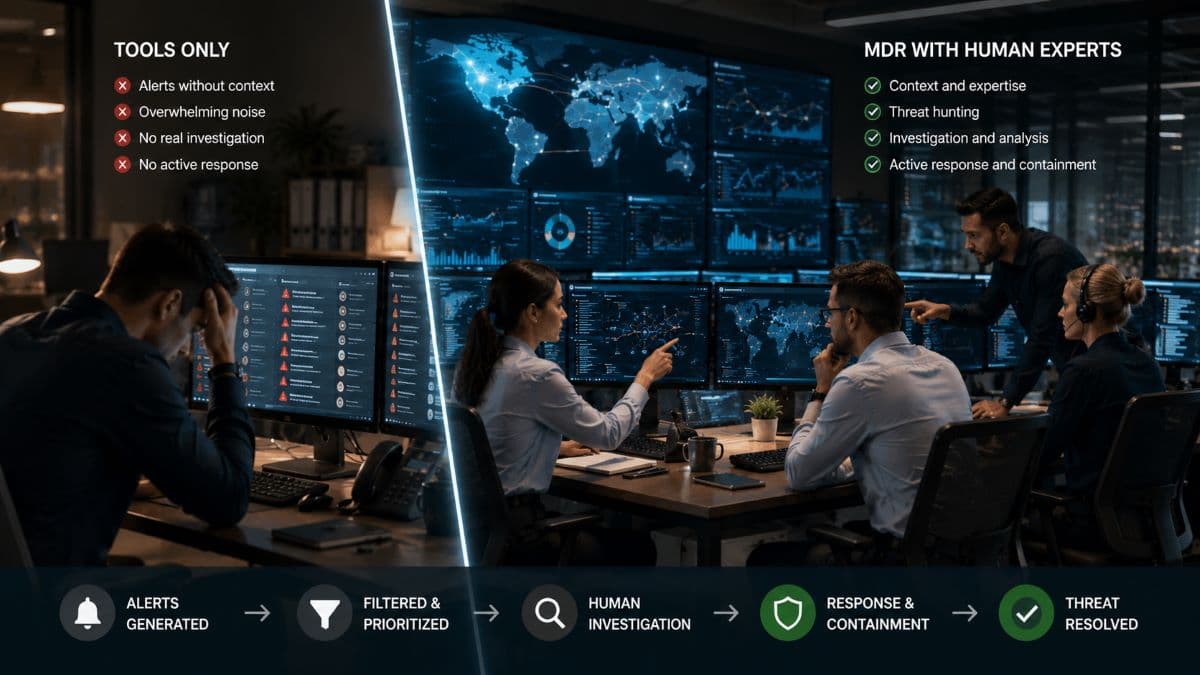
Managed detection and response, usually shortened to MDR, is a security service rather than a product you install and forget. It combines advanced detection technology with a round-the-clock team of analysts, often called a security operations center, who watch your environment, investigate suspicious activity, and take action when a real threat appears. The key word is response. Many security tools are good at raising an alarm but cannot do anything about what they find, leaving a person to notice, interpret, and act. MDR closes that loop by having skilled people behind the technology who hunt for threats, judge what matters, and contain attacks, so detection actually leads to defense.
This matters because the hardest part of security for a small business is not buying tools; it is operating them well. Modern security products generate a constant stream of alerts, most of them harmless, and separating the genuine threats from the noise takes expertise and attention that few smaller organizations can spare. By providing both the technology and the experts to run it, MDR works as an extension of your business, giving you the kind of protection that once belonged only to large companies with their own security departments. It fits naturally alongside broader managed cybersecurity, adding the continuous human oversight that tools alone cannot provide.

The Core Capabilities of MDR
A few capabilities define what an MDR service actually delivers, and they build on one another. The first is continuous monitoring, with security analysts watching your systems at every hour rather than only during the business day, which matters because attacks are often timed for nights and weekends when no one is looking. The second is threat hunting, where human experts actively search for signs of an intruder rather than waiting passively for an alert, which catches stealthy attacks that automated systems alone would miss. Pairing this with ongoing around-the-clock monitoring of your wider environment means suspicious activity surfaces quickly and is acted upon rather than logged and ignored.
The next capabilities turn detection into resolution. MDR analysts triage and prioritize alerts, deciding what is a real threat and what is harmless noise, so effort goes where it is needed and the constant false alarms that overwhelm small teams are filtered out. When something genuine is found, they investigate to understand what happened, how far it spread, and what was affected, then respond by containing the threat, which can mean isolating an affected device or shutting down a compromised account before the damage widens. This active response is what separates MDR from tools that can only warn, and it is why having a plan for events like a ransomware incident response becomes far more effective when a team is already watching and ready to act.
Underpinning all of this is breadth of visibility. A capable MDR service does not watch only one part of your environment; it covers your endpoints, your user identities and logins, your network, your email, and your cloud services, including platforms like Microsoft 365. Threats rarely stay in one place, so this wide view lets analysts connect activity across systems and see an attack as a whole rather than as disconnected fragments. That cross-environment picture is what allows early signs in one area to be linked to suspicious behavior in another before an attacker reaches their goal.

How the MDR Process Works
The way these capabilities come together follows a clear sequence. Continuous monitoring captures activity across your systems at all hours. Incoming alerts are then prioritized, with automated rules and human judgment combining to push the most serious items to the front and set aside the low-risk noise. Human analysts hunt proactively for threats that did not trigger an obvious alert, investigate anything genuine to determine its scope and impact, and finally respond to contain and remediate the threat. Each step feeds the next, turning a flood of raw security data into a small number of real issues that are actually dealt with rather than left for someone to find later.
The value of this sequence is speed where it counts. Attackers move quickly once inside, and the time between a foothold and real damage can be short, so the difference between catching something in minutes and discovering it weeks later is enormous. Because an MDR team is always watching and already knows how to respond, that window shrinks dramatically. Combining this with strong preventive controls such as multi-factor authentication gives a business both a strong front door and a team inside the building, which is a far better position than relying on either alone.

How MDR Differs From the Tools You May Already Have
It helps to place MDR next to the security terms it is often confused with, because the differences are practical. Traditional antivirus recognizes known threats by their signatures but struggles against newer or disguised attacks. Endpoint detection and response, or EDR, is a more capable tool that watches devices closely and can flag and even isolate threats, but it is still a tool that needs skilled people to run it, and on its own it tends to bury a small team in alerts. MDR typically uses EDR technology but adds the round-the-clock human team that operates it, which is the crucial difference: EDR is technology, while MDR is technology plus the experts who act on it.
Two other comparisons are worth clarifying. A security monitoring system known as a SIEM gathers and correlates logs from across your environment, but in its basic form it is a do-it-yourself platform that still requires your own people to watch and tune it. A managed security provider that only operates your tools and forwards alerts stops short of full investigation and response. MDR goes further than each by combining the technology, the continuous watching, the investigation, and the active response in one service. It also complements a broader security approach like zero trust architecture, which limits what an attacker can reach, while MDR catches and stops the ones who get through.
What MDR Catches That Others Miss
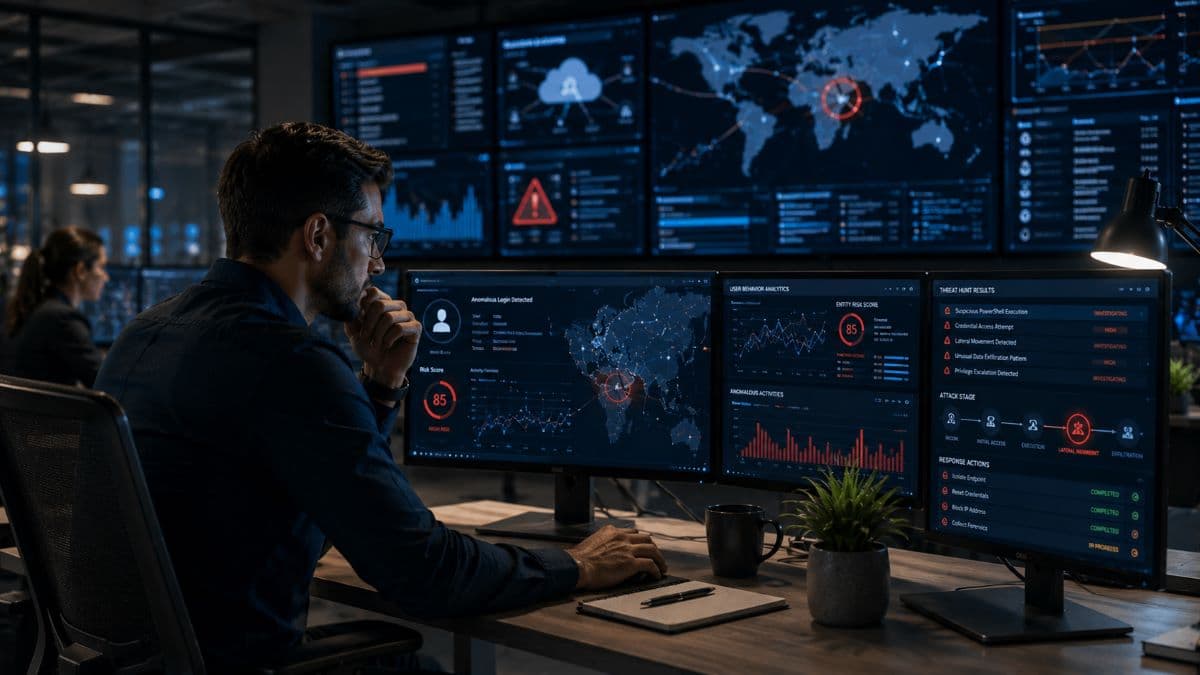
The practical payoff of human-led detection is catching the attacks that slip past automated defenses. Modern ransomware, for instance, rarely begins with the obvious encryption; it starts quietly with reconnaissance, moving through systems and escalating access over days or weeks before the damaging payload is launched. MDR analysts are trained to spot those early, subtle signs, the unusual file access, the abnormal process, the suspicious login, and to intervene during the preparation phase rather than after the harm is done. The same applies to attacks that use legitimate tools and stolen but valid credentials to blend in, which signature-based defenses are poorly equipped to notice.
This is also where MDR supports the compliance needs of regulated businesses. The continuous monitoring, investigation, and recorded response that MDR provides align well with what rules in healthcare, finance, and similar fields expect, and they produce the kind of evidence that matters if an incident ever has to be explained. A structured approach to compliance and risk management increasingly assumes this level of detection and response, and cyber insurers are moving in the same direction, expecting to see that someone is actually watching and able to act.
Who Benefits Most From MDR
While almost any organization gains from MDR, growing small and mid-sized businesses tend to see the most value, and the reason is a specific mismatch. These businesses have enough complexity and enough valuable data to be real targets, but rarely the budget to build and staff a security team that operates around the clock. Building a comparable in-house operation means hiring specialists, buying tools, and covering every shift, which is far beyond what most smaller organizations can justify. MDR delivers that capability for a predictable cost, which is what makes serious, continuous security accessible rather than out of reach.
It is worth being honest about what MDR is and is not, though. It is a detection and response service, strong at finding and stopping threats, but it works best as part of a layered defense rather than as a single solution that replaces everything else. Prevention still matters, good backups still matter, and staff awareness still matters; MDR is the watchful layer that assumes some threats will get past the others and stands ready to catch them. For a business in the Los Angeles area weighing this, a provider offering managed IT services in Los Angeles can help judge where MDR fits in the wider picture rather than presenting it as a cure-all.

A Practical Way to Evaluate MDR
If MDR sounds worth considering, a few practical questions separate a strong service from a thin one. Ask what environments it actually covers, since real protection should extend across endpoints, identities, network, email, and cloud rather than watching only one. Ask what the team is authorized to do when they find a threat, because the value lies in active response, not just notification. And ask how clearly they communicate during an incident, since you need to understand what is happening to your business. A starting point for many organizations is an honest assessment of where they stand, and a review such as network security audits can show what protection you already have and where a service like MDR would add the most.
It is also fair to ask how a provider proves its value over time, since security is hard to see when it is working. A good MDR service reports clearly on what it has detected and done, holds regular reviews, and can show its activity rather than asking you to take protection on faith. That transparency matters because you are trusting an outside team with a critical job, and you should be able to understand what they are doing for your business rather than receiving silence punctuated by the occasional alarm.
Understood properly, managed detection and response gives a small business something it could not previously afford: a team of security experts watching at all hours, ready to investigate and stop threats the moment they appear. It does not replace good security habits, and it does not promise to stop every attack, but it closes the most dangerous gap most small businesses have, the lack of anyone watching when an attack actually happens. For an organization that depends on its systems and its data, that continuous, human-led vigilance is what turns a pile of security tools into real protection.
Frequently Asked Questions
Managed detection and response, or MDR, is a security service that combines detection technology with a round-the-clock team of human analysts who monitor your systems, investigate suspicious activity, and respond to threats on your behalf. The defining feature is response: rather than just raising an alarm, the team actually investigates and contains attacks. It gives a business the protection of a full security operations center without having to hire and staff one.
Antivirus recognizes known threats but struggles with newer or disguised attacks. EDR is a more capable tool that watches devices and can isolate threats, but it still needs skilled people to operate it and tends to overwhelm small teams with alerts. MDR usually uses EDR technology but adds the around-the-clock human team that runs it, investigates what it finds, and responds. In short, EDR is technology, while MDR is technology plus the experts who act on it.
Many do, because small and mid-sized businesses often have enough valuable data to be targets but not the budget to staff a security team around the clock. MDR provides that continuous, expert protection for a predictable cost, which makes serious security accessible. It works best as part of a layered defense alongside prevention, backups, and staff training, rather than as a single solution that replaces everything else.
MDR is particularly good at catching attacks that unfold quietly over time, such as ransomware that begins with reconnaissance and lateral movement days or weeks before any encryption, and attacks that use stolen but valid credentials or legitimate tools to blend in. Human analysts are trained to spot these subtle, early signs and intervene during the preparation phase, which signature-based defenses and unattended tools are poorly equipped to do.
If you want continuous, expert eyes on your systems without building a security team of your own, GlobeVM can help you understand where managed detection and response fits in your defenses and put the right protection in place for your business.
Comments
0 Comments