Nonprofits are asked to do more with less in almost every part of their operation, and technology is usually where that pressure shows up first: donated hardware nobody upgraded, software licenses cobbled together from discount programs, and a security posture that got whatever attention was left after the mission-critical work was funded.
Nonprofit Technology: Getting Security and Value From a Tight Budget

By George
25 July 2026

The irony is that nonprofits often hold data at least as sensitive as a for-profit business, donor financial information, beneficiary details, sometimes health or immigration status, while running the technology budget of an organization a fraction of their actual data risk.
This guide covers nonprofit technology honestly: where the tight-budget reality genuinely works in a nonprofit's favor, where it creates real exposure, and how to build a security and technology posture that matches the trust donors and beneficiaries have placed in the organization.
A Different Kind of Small Organization
It is worth being precise about what this guide covers, because the term nonprofit gets used loosely. This is about mission-driven charitable organizations, the kind that rely on donors, grants, and volunteers, not professional or trade associations built around member dues and industry representation, which face a related but genuinely different set of technology questions.
A charitable nonprofit's core data relationships run in a different direction: money and information flow in from donors and out to beneficiaries or programs, often with grant funders attaching specific compliance requirements to how that data is handled, and a volunteer workforce that turns over far more frequently than paid staff at a typical small business.
These differences shape almost everything about how nonprofit technology should actually be set up, and generic small-business IT advice, or advice built for membership associations, misses the specific shape of this risk.
The Data a Nonprofit Actually Holds
Stated plainly, because it is easy to underestimate: donor records including payment information and giving history, beneficiary or client data that can be genuinely sensitive depending on the mission, health information, immigration status, domestic violence history, employee and volunteer personal information, and grant documentation tied to compliance obligations that carry real consequences if handled poorly.
A donor database breach is not merely embarrassing; it damages the trust relationship that funds the organization's entire mission, sometimes for years afterward as major donors quietly reconsider future giving, and a beneficiary data breach in a sensitive service area can put vulnerable people at real, immediate risk beyond the financial and reputational cost.
This concentration of sensitive data, held by an organization frequently running on a security budget close to zero, is the central tension every nonprofit technology decision has to navigate.
Where the Tight Budget Actually Works in Your Favor
Before the risks, credit where it is due: nonprofits have access to resources most small businesses do not. Major technology providers offer substantial nonprofit discount and donation programs on productivity software, cloud services, and security tools, often reducing costs dramatically below standard commercial pricing for qualifying organizations.
The practical implication is that budget alone should rarely be the reason a nonprofit runs on outdated or unprotected systems, since meaningfully better technology is frequently available for a fraction of what a for-profit business of the same size would pay.
The gap in practice is usually not access to discounted tools; it is knowing the programs exist, qualifying correctly, and someone having the time to set them up properly, which is exactly the kind of administrative task that falls through the cracks in a lean organization where everyone is already stretched across several roles.
Fundraising Platforms Deserve the Same Scrutiny as Any Payment System
Online giving and event registration platforms have become central to how most nonprofits raise money, and each one is, in practical terms, a payment processing system holding donor card details and personal information, regardless of how the organization thinks of it internally.
A platform chosen years ago and never revisited may no longer meet current security expectations, and a nonprofit that has never asked its fundraising platform vendor a direct security question is trusting that question has been answered correctly by default. It usually has not been asked at all, which is a very different thing from having been answered well.
Cyber Insurance Is Not Just a For-Profit Concern
Cyber liability insurance has become common conversation among small businesses, and nonprofits are increasingly having the same conversation, sometimes later than they should. A nonprofit holding donor payment information and sensitive beneficiary data carries real financial exposure if a breach occurs, legal costs, notification obligations, and reputational damage that can affect fundraising for years, and a modest cyber policy priced appropriately for a small organization is often more affordable than boards assume once they actually request a quote.
Treating this as a board-level insurance conversation, alongside general liability and directors and officers coverage the organization likely already carries, closes a gap many nonprofits do not realize they have until an incident forces the question.
The Real Cost Is Time, Not Just Money
Even heavily discounted or donated technology still needs someone to configure it correctly, keep it updated, and manage who has access to what, and this is where nonprofit technology budgets genuinely fall short, not in the sticker price of the tools themselves. A donated software license configured once by a departed volunteer and never touched again is not meaningfully more secure than no license at all.
The realistic path for most small nonprofits is treating a baseline level of managed IT as a genuine operating cost, not an aspiration for when the budget allows, because the alternative, technology nobody maintains, tends to cost more in eventual incidents and staff time lost to workarounds than a modest ongoing management arrangement would have cost from the start.
Grant Compliance Is a Technology Requirement Too
Grant funders, particularly government and larger foundation grants, increasingly attach specific data handling and security requirements to funding, and failing to meet them can jeopardize current funding and disqualify an organization from future opportunities. These requirements vary by funder and program, but common threads include documented data protection practices, defined data retention and destruction policies, and the ability to demonstrate, not just assert, that beneficiary information is handled appropriately.
Treating grant compliance as a technology and documentation exercise rather than a paperwork afterthought protects both the current grant relationship and the organization's credibility with future funders, who increasingly compare notes on how seriously an applicant takes this obligation.
Volunteers, Board Members, and the Access Control Problem
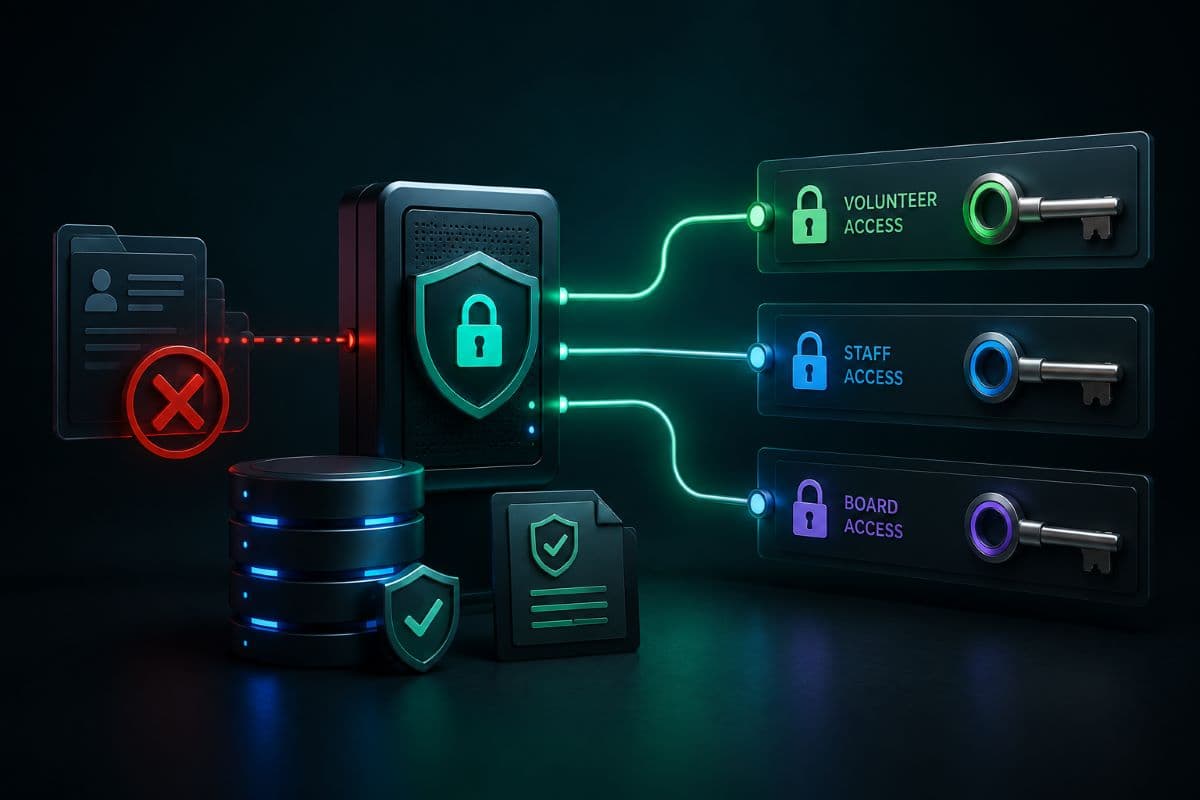
A nonprofit's access control challenge is genuinely harder than a typical small business's, because the workforce includes not just paid staff but volunteers and board members whose involvement is often part-time, seasonal, or tied to a specific event or term. A volunteer coordinator role that exists only during an annual fundraiser still needs defined, limited access while active and clean removal when the event ends.
A board member's access to financial or strategic information should match their governance role, not linger indefinitely after a term ends. Nonprofits that never formalize this tend to accumulate access grants the same way any organization does, one favor at a time, except with an even higher turnover rate driving the accumulation faster.
A simple, consistently applied access policy, built around the roles people actually hold rather than individual trust, closes most of this gap without requiring sophisticated tooling.
A Practical Starting Checklist
For a nonprofit ready to take a first honest look at its technology posture, these steps produce the most value for the least cost:
- Inventory what you actually have: devices, software, and who currently has access to donor and beneficiary data.
- Research your nonprofit discount eligibility: on the major platforms your organization already uses or should be using.
- Write a short data policy: what data you collect, how long you keep it, and who can access it, matched to any grant requirements already in place.
- Formalize volunteer and board offboarding: access removed the day involvement ends, not whenever someone remembers.
- Back up donor and program data properly: tested, not assumed, since this data is often irreplaceable.
None of this requires a large budget to start for genuine nonprofit technology progress; it requires an afternoon and someone willing to own the follow-through, which is often the harder resource to find in a lean organization.
Choosing the Right Kind of Help
Nonprofits considering outside technology support face a real trade-off between cost and fit. A dedicated in-house technology role is rarely affordable for a small nonprofit, and a fully volunteer-run technology setup tends to be fragile in exactly the ways described above.
A managed IT arrangement scaled to a nonprofit's actual size and risk, rather than sold as a standard commercial package, is often the realistic middle path, and the right provider should be comfortable discussing nonprofit-specific discount programs, grant compliance documentation, and the volunteer-turnover access problem as familiar territory rather than something they are encountering for the first time on your account.
This is squarely the kind of scaled, mission-aware support that belongs inside a genuine managed IT services relationship built around what a specific organization can actually sustain.
The Board Should Be Asking About This
Technology and security oversight belongs on a nonprofit board's agenda in the same way financial oversight already does, and in most small nonprofits it currently is not. A board that reviews the annual budget line by line but never asks who has access to the donor database, whether backups have actually been tested, or what the plan is if donor data were exposed, is exercising fiduciary responsibility over the money while leaving a comparable risk unexamined.
Adding a short, recurring technology and security update to board meetings, even briefly, closes this gap without demanding that any board member become a technical expert, and it creates the kind of institutional memory that survives any single staff member or volunteer leaving.
Trust Is the Nonprofit's Real Asset
A nonprofit's entire operating model depends on donors and beneficiaries trusting the organization with their information and their support, and nonprofit technology handled well is quietly part of earning that trust every single day, while technology handled poorly is one incident away from damaging it.
The good news is that the tight-budget reality nonprofits live with is less limiting than it feels, meaningful discounts exist, the real gap is usually time and follow-through rather than money, and a handful of unglamorous practices, an access policy, a documented data policy, tested backups, close most of the exposure without requiring a large budget at all.
For nonprofits across the region, a partner providing managed IT services in Woodland Hills can help you claim the discount programs you already qualify for and build the specific policies that protect the donor trust your entire mission depends on.
Organizations across the Valley can get the same locally through IT services in the San Fernando Valley, scaled to what your budget can actually sustain.
A conversation about compliance and risk management tailored to grant and donor obligations is a reasonable next step for any board ready to take this seriously.
Reviewing your current cybersecurity solutions against your fundraising platform's own practices closes the loop on the whole picture.
Frequently Asked Questions
Yes, in specific ways. Nonprofits hold donor and often beneficiary data that can be highly sensitive, face grant-funder compliance requirements that attach directly to how data is handled, and manage a workforce that includes volunteers and board members with part-time or seasonal involvement rather than only paid staff. These differences shape access control, data policy, and compliance needs in ways generic small-business technology advice does not fully address.
The discounts are real and often substantial on major productivity, cloud, and security platforms for qualifying organizations. The gap in practice is usually not the existence of these programs but organizations not knowing about them, not qualifying correctly, or lacking the time to set them up and maintain them properly, which is why discounted tools alone are no assurance that a nonprofit is actually well protected.
Through a defined, consistently applied policy rather than individual trust decisions. Access should match the specific role someone holds and its actual duration, an event coordinator gets access for that event, a board member's access matches their governance term, and removal should happen the day involvement ends rather than whenever someone remembers. High turnover among volunteers and board members makes this discipline more important than in a typical small business, not less.
Requirements vary by funder, but common elements include documented data protection practices, defined data retention and destruction policies, and the ability to demonstrate, not just claim, that beneficiary information is handled appropriately. Treating these as a nonprofit technology and documentation project rather than paperwork protects both current funding and the organization's credibility with future grant applications.
If your nonprofit is running on donated technology nobody has reviewed in years, GlobeVM can help you claim the discounts you are entitled to and bring your nonprofit technology up to a security posture that matches the trust your donors and beneficiaries place in you.
Comments
0 Comments