
Most businesses invest in security tools and hope they work, but hope is not the same as proof. The only reliable way to know whether your defenses would actually stop an attacker is to have someone attempt to break in on purpose, under controlled conditions, and report exactly what they found. That is penetration testing. It is an authorized, simulated attack on your systems, carried out by security professionals who think and act like real attackers, with the goal of finding the weaknesses before someone with bad intentions does. For a business owner, understanding what penetration testing is and what it can do removes a great deal of the mystery and makes it clear why it has become a standard part of taking security seriously. This guide explains what penetration testing is, how it differs from simpler security checks, the types and how the process works, and how often a business should do it.
GlobeVM provides penetration testing for Los Angeles businesses, with a plain-English report of what to fix first.
What penetration testing is
Penetration testing, often shortened to pen testing, is a controlled exercise in which security professionals attempt to break into a business's systems the same way a real attacker would, with permission and within agreed limits. Rather than guessing whether defenses are strong enough, a business hires testers to actively try to get past them, exploit weaknesses, and reach sensitive systems or data, then document everything they were able to do. The result is a clear, evidence-based picture of where the real weaknesses are and how serious they are, based not on theory but on what an attacker could actually accomplish. This is what makes penetration testing so valuable: it shows you your security from the attacker's point of view.

Penetration testing versus vulnerability scanning
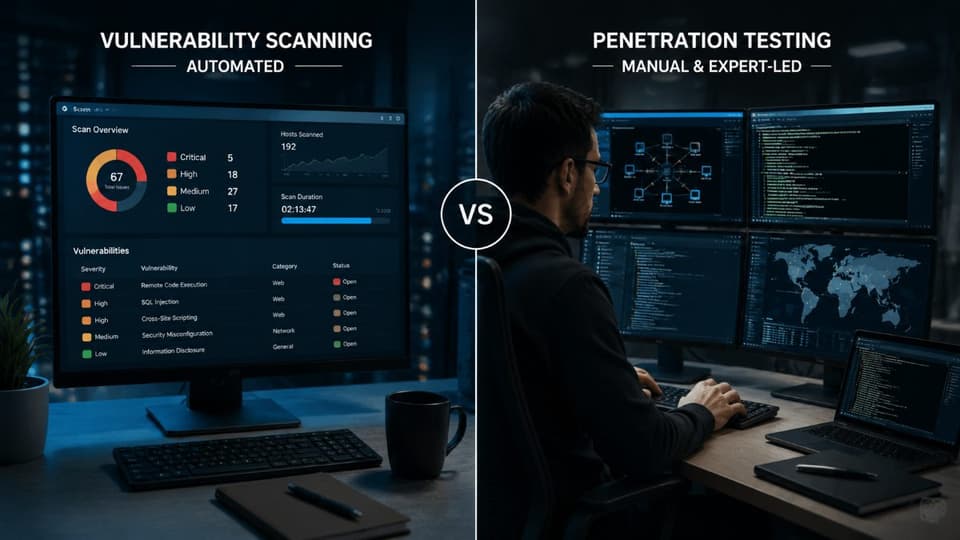
These two are frequently confused, and the difference is important. A vulnerability scan is an automated check that looks for known weaknesses across your systems and produces a list of potential issues, which is useful but limited, since it identifies possible problems without confirming whether they can actually be exploited or how far an attacker could get with them. Penetration testing goes much further: it involves skilled people actively attempting to exploit weaknesses, chaining them together, and demonstrating real impact, which a scan cannot do. A vulnerability scan tells you what might be wrong, while a penetration test shows you what an attacker could really do about it. Both have their place, and many businesses use scanning regularly and penetration testing periodically, but they are not interchangeable, and treating a scan as equivalent to a real test gives a false sense of security.
The main types of penetration testing
Penetration testing is not a single activity but a family of related ones, each focused on a different part of a business's attack surface. A business may need several depending on what it wants to assess.

External and internal testing
External testing focuses on what an attacker could do from outside the business, targeting the systems exposed to the internet such as websites, email, and remote access, to see whether someone could break in from the outside. Internal testing takes the opposite view, assessing what someone who is already inside the network could reach, whether that is a malicious insider or an attacker who has gained an initial foothold. The two answer different questions, and together they reveal both how well the perimeter holds and how much damage is possible once someone is past it, which connects to the principle of not automatically trusting anyone inside the network described in our guide to zero trust architecture.
Web application and network testing
Web application testing examines the websites and online applications a business runs, looking for the specific weaknesses that affect software accessible over the internet, which is important because applications are a common target. Network testing focuses on the infrastructure itself, the servers, devices, and connections that make up a business's network, probing for misconfigurations and weaknesses an attacker could use. Depending on what a business operates and what matters most to protect, one or both of these may be the focus of a test, and a tester scopes the work to the systems that carry the most risk.
Social engineering testing
Because people are so often the way attackers get in, some penetration testing targets the human element rather than the technology, testing whether staff can be tricked into giving up access through tactics like phishing. This kind of testing reveals how susceptible a business is to the manipulation attackers rely on, and it complements the technical testing by addressing the weakness that technical defenses alone cannot fix. It overlaps with the value of ongoing awareness efforts and the kind of strong authentication covered in our guide to phishing-resistant MFA, since a test that succeeds through social engineering points directly to where those defenses need strengthening.
How much testers are told: black box, grey box, and white box
Penetration tests also differ in how much information the testers are given before they begin, and this shapes what the test reveals. In a black box test, the testers start with little or no inside knowledge, approaching the business much as an outside attacker would with no special access, which shows how exposed you are to someone starting from scratch. In a white box test, the testers are given full information about the systems, which lets them examine everything thoroughly and find weaknesses a blind attacker might miss, making for a deeper but less attacker-realistic assessment. A grey box test sits between the two, giving testers some information, such as the access a regular user or a partly informed attacker might have, which often reflects a realistic scenario.
None of these approaches is simply better than the others, because they answer different questions. A black box test mimics an external attacker's experience, a white box test maximizes thoroughness, and a grey box test balances realism with efficiency. The right choice depends on what a business wants to learn, and a good provider helps decide which approach, or combination, fits the goals of the test. Understanding that these options exist helps a business have a more informed conversation about what it actually wants its testing to achieve.

How a penetration test works
A professional penetration test follows a clear process rather than a free-for-all, which is part of what makes it controlled and useful. Understanding the stages helps a business know what to expect.

Scoping and planning
Every test begins by agreeing exactly what will be tested, how far the testers may go, and what is off limits, so that the exercise is controlled and there are no surprises. This scoping defines the targets, the rules, and the goals, ensuring the test focuses on what matters to the business and stays within safe, authorized boundaries. Clear scoping is what keeps a penetration test from causing unintended disruption and ensures the results actually address the business's concerns.
Reconnaissance and discovery
With the scope agreed, testers gather information about the target systems, mapping what is there and identifying potential ways in, much as a real attacker would study a target before striking. This stage builds the picture the testers use to plan their attempts, finding the points worth probing and understanding how the systems fit together. The thoroughness of this discovery shapes how effective the rest of the test will be.
Exploitation
This is the heart of the test, where the testers actively attempt to exploit the weaknesses they have found, trying to break in, gain access, and move through the systems the way an attacker would. The aim is to demonstrate what is genuinely possible, not merely what might be, by actually carrying out attacks under controlled conditions. What the testers are able to achieve, and how far they can get, is the real measure of where the business's defenses stand.
Reporting and remediation
The most valuable part of a penetration test is what comes after the testing: a clear report of what was found, how serious each issue is, and what the business should do about it. A good report explains the weaknesses in terms a business can act on and prioritizes them by risk, turning the test into a practical plan for improvement rather than just a list of problems. Acting on these findings is where the real benefit lies, and a thorough test often includes a follow-up to confirm that the issues have been fixed, which is how a penetration test feeds into stronger ongoing cybersecurity solutions.
Why your business needs penetration testing
The case for penetration testing comes down to knowing rather than assuming. Without it, a business is trusting that its defenses work without ever confirming it, which is exactly the assumption attackers count on. A test finds the real weaknesses before an attacker does, while there is still time to fix them quietly rather than discovering them through a breach. It also validates that the security a business has invested in actually does its job, and it provides the kind of evidence that customers, partners, and regulators increasingly expect. For businesses in regulated fields, periodic testing is often part of meeting security obligations, which ties into broader compliance and risk management services. Above all, penetration testing replaces a hopeful guess about your security with a clear, honest answer.

How often should a business run a penetration test
Penetration testing is not a one-time event, because a business's systems change and new weaknesses appear over time. A test reflects the state of your security at a particular moment, so a clean result a year ago says little about today if much has changed since. Most businesses benefit from testing on a regular basis, commonly once a year, and also after significant changes such as deploying new systems, making major updates, or altering the network in important ways, since those changes can introduce weaknesses that did not exist before. The right frequency depends on the business, its risk, and any regulatory requirements, but the principle is that testing should be repeated rather than treated as something done once and considered settled. This ongoing approach is part of how a business stays ahead of threats rather than discovering its weaknesses too late, alongside being prepared to respond when an incident occurs, as covered in our guide to ransomware incident response.

What to look for in penetration testing
Not all penetration testing is equally rigorous, so a few things are worth considering when arranging it. Look for testers with genuine skill and experience, since the value of a test depends heavily on the people doing it and their ability to think like real attackers. Make sure the scope is defined clearly and matches what you actually need to assess, and that the testing is carried out safely within agreed limits. Pay close attention to the reporting, because a test is only as useful as the clarity and practicality of its findings, and a report that explains the issues and prioritizes them by risk is far more valuable than a raw list. A provider that handles the whole process professionally, from careful scoping through clear reporting and follow-up, is what turns a penetration test into real security improvement. For businesses across Woodland Hills and the surrounding area, working with a local team that understands both testing and the broader security picture makes the results easier to act on.
If you want to know with confidence whether your defenses would actually hold, GlobeVM provides penetration testing and security expertise for businesses across Los Angeles and the surrounding area, turning the results into practical improvements.