
A residential closing routinely moves more money in one wire transfer than most small businesses see in a year, and it moves on the strength of an email that says send the funds here. That combination, high-dollar transactions and a workflow built entirely on email and trust, has made real estate one of the most targeted industries for financial fraud in the country, and most brokerages are running the technology of a much smaller, much less scrutinized business.
This guide covers what real estate IT services actually need to address for a brokerage, since generic small-business IT support and real estate IT services are not the same thing: the wire-fraud risk that dwarfs every other threat on the list, the specific software stack agents actually use, the reality that most of the workforce is never at a desk, and what to look for in a provider who understands the difference.
Why Real Estate Sits at the Top of the Target List
Criminals target industries by payoff per effort, and real estate scores unusually well on both counts. The payoff: a single transaction can involve a down payment, closing costs, and often the entire proceeds of a sale, all moving as wire transfers with dollar amounts that make a successful interception worth the attacker's time in a way that phishing an individual employee's payroll never is.
The effort: the industry runs on email as its primary communication and document channel, involves several parties who have often never met in person, buyer, seller, agent, lender, title company, and treats a change of wiring instructions as a normal, unremarkable event because closings genuinely do involve last-minute detail changes.
An attacker who compromises or spoofs any one party's email can insert a single fraudulent instruction into a conversation that already expects instructions to arrive by email, and by the time anyone notices, the money has left the country. This is not a hypothetical; it is the single most consequential technology risk in the industry, ahead of ransomware, ahead of data breaches, ahead of everything else on a typical security checklist.
The Wire Fraud Playbook, and How to Break It
Understanding the mechanism is the first defense, because the scheme only works when it looks like an ordinary part of the process.
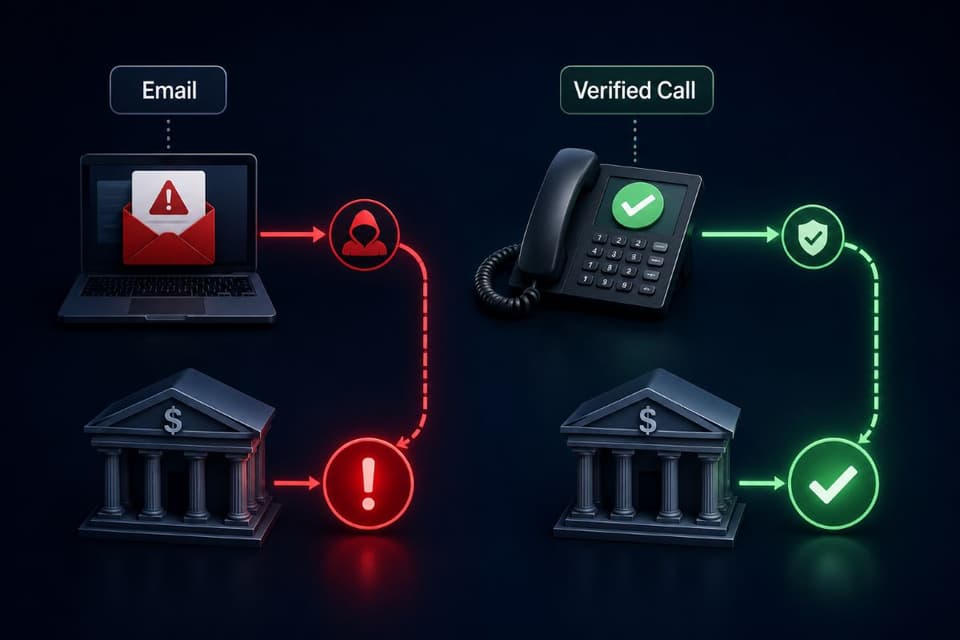
How the Fraud Actually Happens
The common pattern starts with a compromised or convincingly spoofed email account, sometimes the agent's, sometimes the title company's, sometimes the buyer's own inbox. The attacker watches the transaction quietly, learning the timeline, the parties involved, and the tone of the correspondence, then inserts a message at exactly the moment wiring instructions would naturally be discussed, often mimicking a legitimate delay or correction: updated instructions attached, please use this account instead.
Because the buyer is already expecting to wire money to someone, and because the message arrives from what looks like a trusted party in a familiar thread, the request rarely raises suspicion until the funds have settled somewhere unrecoverable.
The mechanics of this scheme belong to the well-documented family of attack known as business email compromise, and every brokerage should treat understanding it as required reading, but real estate carries an additional wrinkle worth stating plainly: the dollar amounts and the routine nature of last-minute changes make this industry's version of the scam unusually effective.
The One Rule That Stops Almost All of It
A single procedural rule closes the overwhelming majority of these losses: any change to wiring instructions, for any party, at any point in a transaction, gets verified by a phone call to a known, previously confirmed number, never a number provided in the same email containing the change. Not a reply to the email. Not a number found in a signature block that could itself be fraudulent.
A number the brokerage or the client already had on file before the suspicious message arrived. This rule costs nothing, takes minutes, and defeats the entire scheme regardless of how convincing the email looks, because it removes email as the sole channel of trust for the one action that actually moves money.
Brokerages that adopt this as a firm, no-exceptions policy, communicated to every buyer and seller at the start of a transaction, consistently avoid the losses that make industry news.
The Technology Stack Behind a Modern Brokerage
Real estate IT is not generic office IT with a different logo; the software stack has its own demands and its own failure points. The MLS and its syndicated feeds are the operational backbone, and downtime or sync failures there directly cost listings visibility and leads.
E-signature and transaction management platforms carry legally significant documents through a chain of signers who are rarely all in one place at one time, which makes reliable access, correct permissions, and document integrity a genuine business risk rather than a convenience feature. Client relationship and lead management tools hold the sales pipeline and a great deal of personal financial detail volunteered early in a relationship, often before any formal engagement exists.
And most brokerages layer several of these systems together, MLS feed into CRM, CRM into a marketing tool, e-signature into transaction management, which means an integration failure in one link can quietly break the whole chain without an obvious alarm going off. Supporting this stack well means a provider who has actually configured these tools before, not one encountering them for the first time on your account.
A Workforce That Is Never at a Desk
The single biggest structural difference between a real estate brokerage and a typical office-bound small business is where the work actually happens: agents work from cars, open houses, coffee shops, and client living rooms, on phones and laptops connecting through whatever network is available, all day, every day. This reality changes the IT priorities considerably.
Mobile device management matters more here than in almost any other small-business vertical, because the phone in an agent's pocket is simultaneously their primary work tool and a device that will connect to public Wi-Fi at an open house with no oversight at all.
Cloud-based access to documents and the transaction platform has to be genuinely reliable, since an agent who cannot pull up a contract in front of a client loses credibility in the moment that matters most. And support has to accommodate the actual working hours of the industry, evenings and weekends, when most closings and showings happen and when a generic nine-to-five helpdesk is unavailable exactly when an agent needs it.
A support arrangement built around around-the-clock IT support fits this rhythm in a way that standard business-hours coverage simply does not.
Securing a Fleet That Never Sits Still
Because agent devices spend so much time outside any office network, the security posture has to assume the device, not the network, is the perimeter. That means encryption on every laptop and phone that carries client documents, strong authentication rather than a simple passcode, remote wipe capability for a lost or stolen device, since a phone left in a rideshare is a realistic scenario rather than a hypothetical one, and clear separation between personal and work data on devices agents own themselves.
None of this is exotic; it is the standard discipline of managing a genuinely mobile workforce, applied to an industry where almost the entire workforce fits that description.

The Data a Brokerage Actually Holds
It is worth stating plainly what sits inside a brokerage's systems, because the sensitivity is easy to underestimate: financial statements and pre-approval letters, government identification, social security numbers on loan-related paperwork, bank account and wiring details, and personal details volunteered in early conversations before any contract exists.
A breach here is not an abstract compliance problem; it is the kind of incident that damages a brokerage's reputation with clients who trusted the agent with some of the most sensitive documents in their financial lives.
This data reality is also why cyber liability coverage and errors-and-omissions policies increasingly ask pointed questions about email security, wire-transfer verification procedures, and device management, the same territory covered in our guide to cyber liability insurance, and a brokerage that cannot answer those questions well is likely to find its premiums, or its coverage, reflecting that gap.
What a Brokerage Should Look For in IT Support
The selection questions here are specific to the vertical, not generic:
- Real estate experience: has the provider actually configured MLS access, e-signature platforms, and transaction management tools before, or would this be a first attempt.
- A named wire-fraud protocol: not a vague promise of security, but a specific, documented verification procedure the provider will help implement and train staff on.
- Mobile-first thinking: does the provider treat phones and laptops as the primary environment to secure, or default to office-network assumptions that do not fit how agents actually work.
- Evening and weekend coverage: support hours that match closing and showing schedules, not standard business hours.
- Plain answers on compliance: can the provider speak clearly to what an insurer or a state real estate commission might ask about data handling.
A provider who answers these specifically, with examples rather than generalities, is telling you they have actually worked this vertical before; a provider who answers with the standard managed-services pitch is telling you the same thing in the other direction.
In-House, Generalist Provider, or Real Estate Specialist
Brokerages typically choose between three arrangements, and each has a real trade-off. A designated in-house person can develop deep familiarity with the brokerage's exact setup, but rarely has the security depth or the bench strength to cover evenings, weekends, and vacations, exactly when the industry is busiest.
A generalist IT provider brings broader technical capability but often has to learn the transaction-management and MLS ecosystem for the first time on your account, which shows up as slower answers during exactly the moments that cannot wait.
A provider that has genuinely supported real estate before brings both, and the difference tends to show up fastest in how quickly they can talk through a specific wire-fraud scenario or a transaction-platform hiccup without needing it explained from scratch. Reviewing your current email security setup is a reasonable first test of which category a provider actually falls into, since email is where this industry's risk concentrates most heavily.
The Transaction Is Only as Safe as the Weakest Inbox
Every party in a real estate transaction is a potential entry point, which means brokerage security is never purely an internal matter; it is a shared responsibility that a well-run brokerage takes the lead on by setting the standard everyone else follows.
Real estate IT services done right combine the unglamorous fundamentals, verified wiring instructions, mobile device security, reliable access to a demanding software stack, with the specific judgment that only comes from having supported this industry before. Get that combination right, and the technology fades into the background exactly where it belongs, letting agents close deals instead of chasing down a broken sync or explaining to a client why their money went to the wrong account.
For brokerages across the metro, a partner providing managed IT services in Los Angeles can review your wire-fraud verification process and bring the rest of your technology to the same standard.
Firms in the Valley can get the same locally through IT services in the San Fernando Valley, from mobile device security to evening and weekend support.
If your brokerage has never had its real estate IT services reviewed by someone outside your own team, GlobeVM can close that gap and bring the rest of your technology up to the same standard.