

Most business owners have heard some version of the pitch: buy equipment before December 31 and write it all off this year. The pitch is built on a real rule, the Section 179 deduction, and for IT purchases it is genuinely useful. It is also routinely oversold, and for California businesses it comes with a state-level catch that most articles never mention.
This guide explains what the deduction actually does, the 2026 numbers, which technology purchases qualify, how it differs from bonus depreciation, and the California rules that change the math for every business in the Los Angeles area. It is general information, not tax advice, and the specifics of your situation belong with your tax professional.
What the Section 179 Deduction Actually Is
The Section 179 deduction lets a business deduct the full purchase price of qualifying equipment and software in the year it is placed in service, instead of depreciating that cost over several years. Normally, a 6,000 dollar server would be written off gradually across its useful life. With a Section 179 election, the business can deduct the entire 6,000 dollars against this year's income, which lowers this year's tax bill.
Two boundaries keep it honest. The deduction cannot exceed your business's taxable income for the year, so a business running at a loss cannot use it, though unused amounts can carry forward. And it applies only to qualifying property that is actually purchased and placed in service during the tax year, not to things you merely ordered or plan to buy.
The 2026 Numbers
For tax years beginning in 2026, the maximum Section 179 deduction is 2,560,000 dollars. The benefit phases out dollar for dollar once a business places more than 4,090,000 dollars of qualifying property in service during the year, disappearing entirely above 6,650,000 dollars. These figures adjust for inflation annually.
For a typical small or mid-sized business, those ceilings are academic. A company refreshing thirty laptops, a server, and its network gear will spend a small fraction of the limit. The constraints that actually matter at this scale are the taxable income requirement and the calendar: the equipment must be in service by the end of your tax year, which for most businesses means December 31.
Which IT Purchases Qualify
Section 179 covers tangible business property, and technology fits it unusually well. For a typical office, qualifying purchases include laptops and desktops, servers, network equipment such as firewalls, switches, and wireless access points, monitors and docking stations, printers, phone system hardware, and off-the-shelf business software purchased outright. Both new and used equipment qualify, as long as it is new to your business and used more than half the time for business purposes.
Financed equipment deserves a special mention because it surprises people in a good way. If your business buys equipment on a finance agreement and owns it, the full purchase price can generally qualify in year one even though you have only made a few payments. The deduction can exceed the cash you actually spent this year. Whether a specific agreement counts as a purchase or a lease depends on its structure, which is precisely the kind of detail to confirm with your tax professional before signing.
What Does Not Qualify
The modern IT budget contains a growing category that Section 179 does not touch: subscriptions. Microsoft 365 seats, cloud backup plans, security tools billed monthly, and hosted phone service are not property you own, so they cannot be expensed under Section 179. The good news is that they do not need to be, because subscription costs are ordinary business expenses deducted in full as you pay them. Businesses shifting workloads toward cloud services are not losing a tax benefit; they are simply deducting the cost through a different, equally immediate door.
True operating leases, where the leasing company owns the hardware and you return it, also fall outside Section 179, as do costs like ongoing support contracts and labor. The dividing line is ownership of a tangible asset or off-the-shelf software.
Section 179 vs Bonus Depreciation
Section 179 has a sibling that changed significantly in 2025. Federal law now allows 100 percent bonus depreciation, made permanent for qualifying property acquired and placed in service after January 19, 2025. Like Section 179, it lets a business write off the full cost in year one. The two rules overlap heavily for IT purchases, but they are not identical:
For a profitable small business buying a normal amount of IT equipment, either path can produce the same year-one federal result, and the IRS ordering rule applies Section 179 first with bonus depreciation covering the rest. The choice between them becomes strategic mainly around income levels and multi-state considerations, which is another decision to make with your accountant rather than from an article.
The California Catch
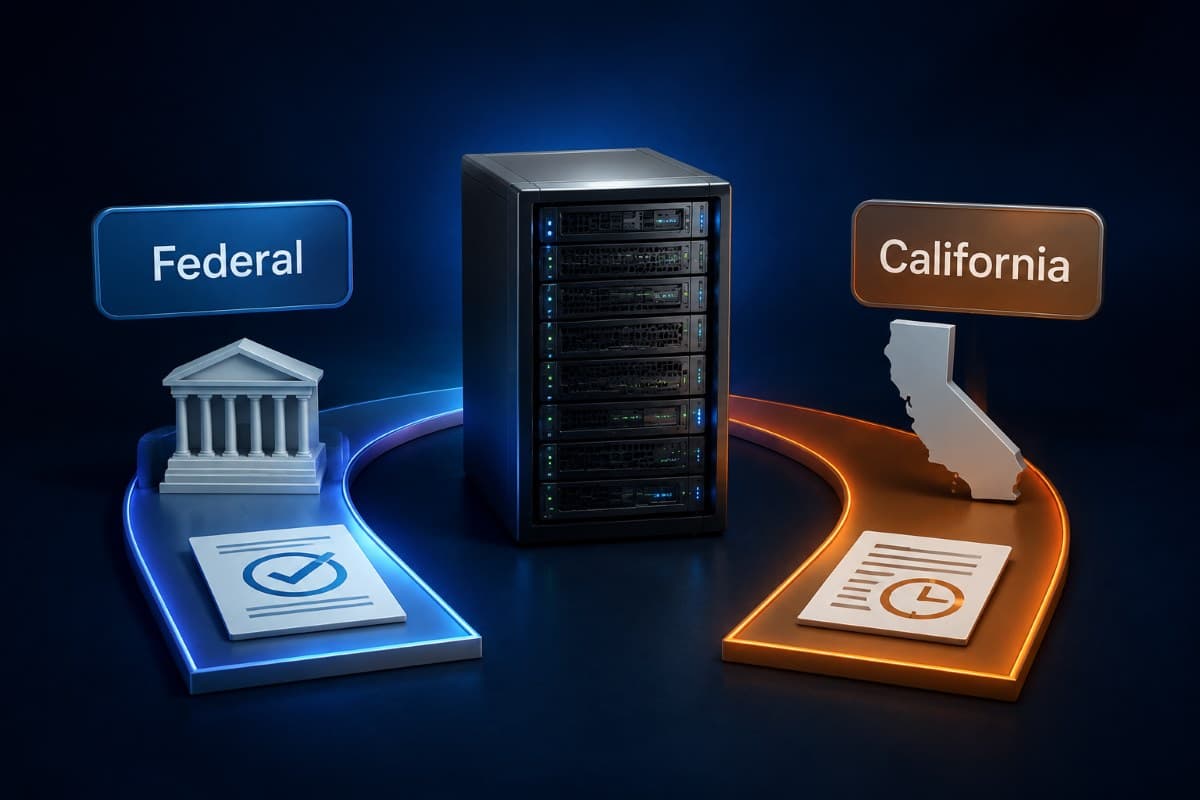
Here is the part that matters most for local businesses and appears least often in the articles promoting year-end equipment purchases. California does not follow the federal rules. Under the state's tax code, the California Section 179 limit is 25,000 dollars, with a phase-out that begins at just 200,000 dollars of total asset purchases, and California allows no bonus depreciation at all, a position it has held through every federal expansion including the current one.
The practical effect: a business in Woodland Hills or anywhere across the San Fernando Valley that buys 100,000 dollars of computers and servers can generally deduct the full amount on its federal return in year one, but on the California return only up to 25,000 dollars can be expensed, and the rest must be depreciated over the normal schedule. The federal deduction you take above the state limits gets added back to California taxable income and recovered gradually over the following years. The state deduction is deferred, not lost, but in a high-tax state that timing difference has a real cost.
It also creates paperwork that has teeth. Federal depreciation is reported on Form 4562 while California requires its own separate schedules, and mismatched numbers between the two are a known audit trigger with the Franchise Tax Board. None of this is a reason to skip the federal benefit, which remains substantial. It is a reason to run the numbers on both returns before assuming a purchase pays for itself, and a reason the phrase write it all off deserves an asterisk in this state.
Placed in Service Means Working, Not Ordered
The deadline trips up more businesses than the math does. Equipment qualifies for the year it is placed in service, meaning installed and ready for use, not the year it was ordered or paid for. A server purchased on December 20 that arrives January 8 belongs to next year's return.
That rule has extra bite right now, because hardware lead times have stretched. The ongoing memory shortage has made high-memory configurations and servers slower to arrive and quotes shorter-lived, so a December order is a genuine gamble on delivery. Businesses hoping to use this year's deduction should be specifying and ordering equipment in the early fall, not the last week of the year, and should build in time for installation, since a machine still in its box on December 31 invites questions a working machine does not.
Where This Fits in a Real IT Plan
A deduction is not a discount. Every dollar spent on equipment is still a dollar spent, and the deduction returns only a fraction of it in reduced tax. That means Section 179 should never talk you into hardware the business does not need, and it absolutely should shape the timing of hardware the business does need. If a refresh is coming in the next two or three quarters anyway, landing it before year-end can meaningfully improve the after-tax cost, which is the same logic behind CapEx to OpEx decisions: the financial structure should serve the technology plan, not replace it.
The businesses that get the most out of this rule treat it as one input in a yearly planning rhythm: review the device inventory in late summer, decide what genuinely needs replacing, get quotes while there is still lead time, and let the accountant confirm the tax treatment before purchase orders go out. That rhythm is easier with a partner who already knows your environment, and it reflects the broader shift of treating technology as an investment rather than a cost to be minimized.
Coordination is the quiet advantage here. Your accountant knows the tax rules but not your aging server; your IT provider knows the server but not your taxable income. When the two talk before the fourth quarter, purchases land in the right year, on both returns, with equipment that was actually needed. That planning conversation is a normal part of IT consulting, and it is where the value gets captured that a last-minute December purchase never does.
Frequently Asked Questions
For tax years beginning in 2026, the maximum federal Section 179 deduction is 2,560,000 dollars, with the benefit phasing out dollar for dollar once total qualifying purchases exceed 4,090,000 dollars. The deduction also cannot exceed the business's taxable income for the year. California applies its own much lower limits at the state level.
Off-the-shelf software that you purchase outright generally qualifies. Subscription software does not, because you are paying for a service rather than buying property, but subscription costs are deducted in full as ordinary business expenses anyway, so nothing is lost. Custom-developed software follows different rules and belongs in a conversation with your tax professional.
Generally yes, if the agreement is structured as a purchase and your business owns the equipment. The full price can qualify in year one even though payments continue into future years, which can make the deduction larger than the cash spent this year. Whether a specific agreement counts as a purchase or a lease depends on its terms, so have your accountant review it before you sign.
It means the equipment is installed and ready for its intended business use by the last day of your tax year, which for most businesses is December 31. Ordering or paying for equipment is not enough; a machine that arrives or gets set up in January counts toward next year. With current hardware lead times, ordering by early fall is the safe play.
No. California caps its Section 179 deduction at 25,000 dollars, begins phasing it out at 200,000 dollars of purchases, and does not allow bonus depreciation in any form. Amounts deducted federally above the state limits are added back to California income and depreciated over time, so the state benefit is delayed rather than lost. California businesses should plan equipment purchases with both returns in view.
Used well, the Section 179 deduction turns technology the business already needed into a smaller tax bill, and used carelessly it turns a marketing pitch into a January delivery and a state add-back nobody budgeted for. The difference is planning, a calendar, and one conversation between your accountant and your IT provider before the year runs out. If your business is weighing equipment purchases before year-end, GlobeVM can review what actually needs replacing and build the quote and timeline while you confirm the tax treatment with your accountant, so the decision is made once and made well.
Comments
0 Comments