
Ask a business owner what their technology will cost next year and many cannot answer with confidence. A server fails and triggers an unplanned five-figure purchase. A software renewal arrives larger than expected. A growth spurt forces a sudden round of equipment buying. This unpredictability is not just an IT problem, it is a financial control problem.
It is the reason a growing number of businesses are rethinking how they pay for technology. The shift from CapEx to OpEx in IT spending is, at its heart, a move from large, lumpy, unpredictable purchases toward steady, forecastable monthly costs. This guide explains what that shift actually means, where it helps, and, just as importantly, where it does not, so you can make the decision on the merits rather than the marketing. One note first: this covers the financial-strategy and IT side of the question, not tax advice, which depends on current law and your specific situation and belongs with your accountant.
CapEx and OpEx: what the terms actually mean
Before weighing the shift, the two terms need to be clear, because the entire decision rests on the difference between them.
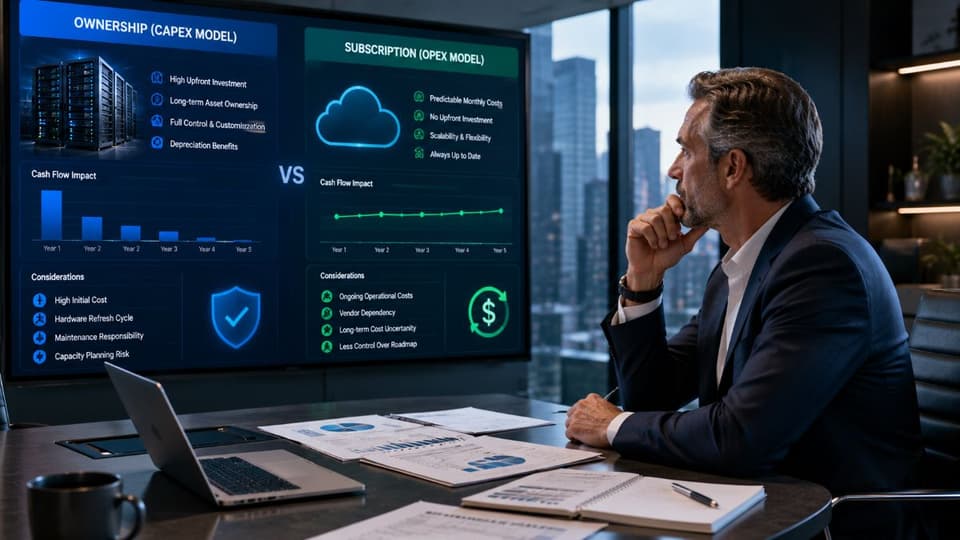
| CapEx (own it) | OpEx (subscribe to it) | |
|---|---|---|
| What it is | Buying an asset outright and owning it | Paying for a service or subscription as you use it |
| How it hits the books | Capitalized and depreciated over several years | Expensed in the period it is incurred |
| Cash flow | Large amounts at unpredictable moments | Smaller, level, forecastable amounts |
| Approval | Usually a capital request and sign-off | Usually inside the operating budget |
| Who carries obsolescence | You: the asset ages whether you use it or not | The provider: refreshes are part of the service |
| Scaling down | Hard; you own the equipment either way | Easier; reduce seats or capacity |
| Long-run cost | Can be lower if you use the asset its full life | Can be higher over many years, especially at flat usage |
Capital expenditure (CapEx)
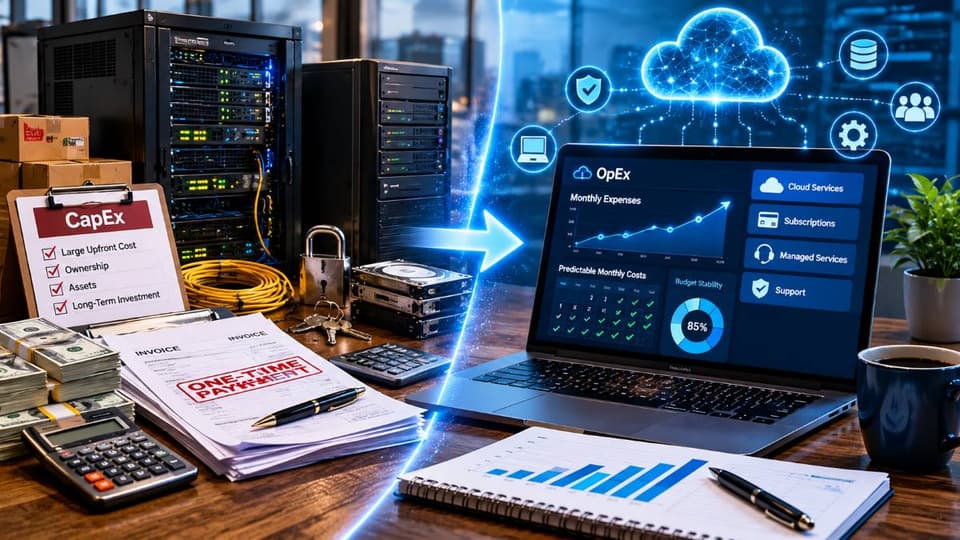
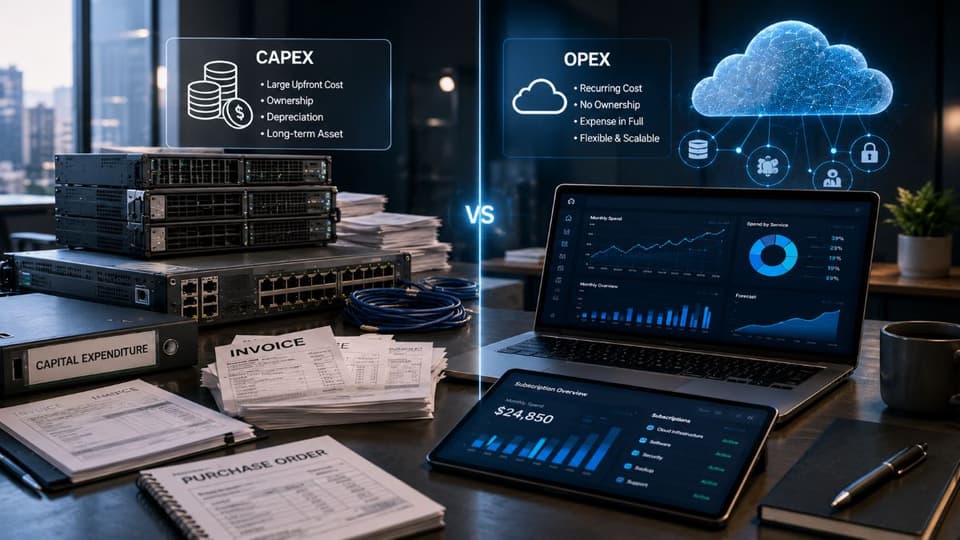
Capital expenditure is money spent to acquire or upgrade a long-term asset the business will use for years. In IT, that traditionally means buying servers, network equipment, and perpetual software licenses outright. The defining traits are a large upfront cost and ownership of an asset. Because the asset has a useful life of several years, its cost is generally not recorded all at once. Instead it is capitalized on the balance sheet and depreciated over time, with the expense recognized gradually across the years the asset is in use.
Operating expenditure (OpEx)
Operating expenditure is money spent on the ongoing, day-to-day costs of running the business. In IT, this includes cloud subscriptions, software-as-a-service licenses, internet service, and managed service contracts. The defining traits are recurring payments and no ownership of an underlying asset. Operating expenses are generally recorded in full in the period they are incurred, rather than spread across future years.
The practical distinction most owners care about is simpler than the accounting: CapEx is a big payment now for something you own, while OpEx is a smaller, regular payment for something you use. That difference is what drives the financial-control argument.
Why IT is moving from CapEx to OpEx
This shift is not a fad invented by vendors. It follows a change in how technology is delivered. A decade ago, running a business meant buying and housing your own servers and software. Today, the same capabilities are available as services you subscribe to. Several forces drive the move from CapEx to OpEx.
Cloud computing replaced the need to buy and maintain physical servers with infrastructure rented by the month. Software moved from boxed products you purchased once to subscriptions you pay for continuously. Hardware itself became available on subscription through device-as-a-service arrangements. And managed services let a business pay a predictable monthly fee for support and security instead of staffing and tooling it all internally. Each of these turns what used to be a capital purchase into an operating cost, and together they have made an OpEx-heavy IT budget not just possible but, for many businesses, the default.
The financial-control benefits of an OpEx model
The strongest argument for shifting toward OpEx is not that it is always cheaper. It is that it gives a business more control over its finances. That control shows up in several concrete ways.
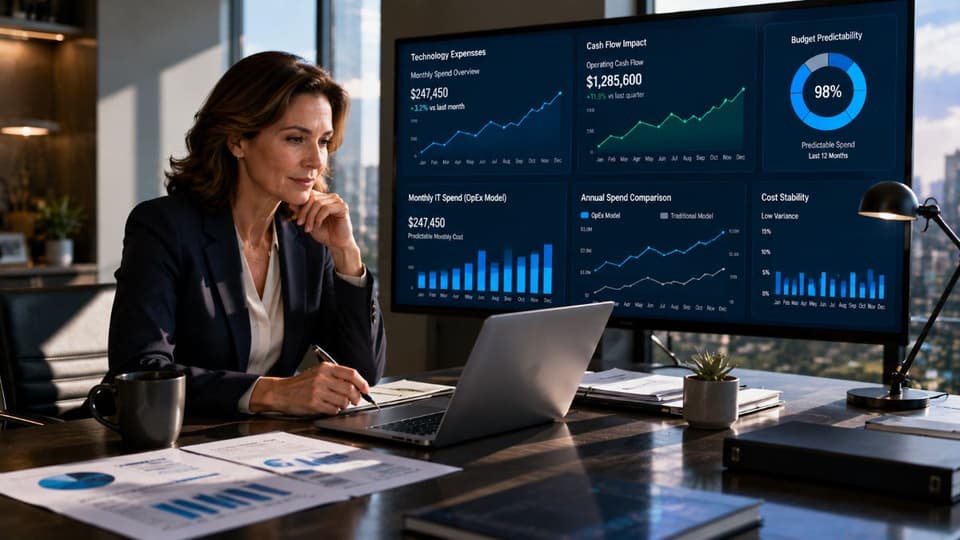
- Predictable, budgetable costs. A recurring monthly fee is far easier to forecast than a budget punctuated by occasional large, unpredictable purchases. Predictability is itself a form of control, because you can plan around a number you actually know.
- Preserved cash and capital. Avoiding large upfront outlays keeps capital free for revenue-generating uses, whether that is hiring, inventory, or growth. Money not frozen in depreciating equipment can work elsewhere in the business.
- Easier scaling in both directions. Subscription models typically scale with your needs. You add capacity as you grow and reduce it when you contract, without the slow, expensive cycle of buying or disposing of owned assets.
- No large, sudden replacement costs. When you own hardware, its eventual failure or obsolescence lands as a sudden capital hit. A service model folds refresh and replacement into the steady fee, smoothing out those shocks.
- Lower barrier to current technology. Owned equipment ages, and businesses often run it past its prime to defer the cost of replacement. Subscription models tend to keep technology more current, because updates and refreshes are part of the service rather than a fresh purchase decision.
This is where moving toward an OpEx model with steady, predictable managed IT services changes the financial conversation, turning technology from a source of budget surprises into a planned line item. It is a large part of why so many small businesses have moved toward predictable monthly technology costs rather than living with unpredictable capital outlays.
Where the shift actually happens across your IT stack
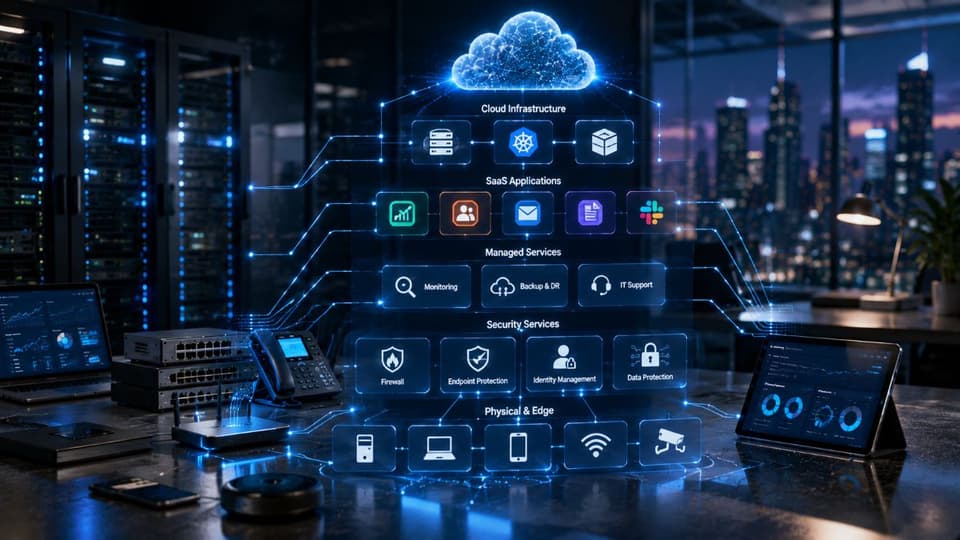
The move from CapEx to OpEx is not a single decision but a series of them, across different layers of your technology. Understanding where each applies helps you see what is realistic for your business. Hardware is the piece that moves last and least, and the section below is honest about why.
Infrastructure
This is the clearest and most common shift. Instead of buying and maintaining on-premises servers, businesses rent computing and storage in the cloud, paying for what they use. This converts a major recurring capital expense into a predictable operating one and removes the burden of housing, powering, and replacing hardware. For most businesses, a thoughtful approach to cloud services and migration is the single largest lever in moving an IT budget toward OpEx.
Software
Perpetual software licenses, a classic capital purchase, have largely given way to subscription licensing. Most business software is now sold this way, which means a significant portion of the software budget has already shifted to OpEx whether a business planned it or not. The task here is less about making the shift and more about managing it, which we return to in the trade-offs below.
Hardware
Even physical equipment can move to an OpEx model through device-as-a-service or hardware-as-a-service arrangements, where you pay a monthly fee that bundles the hardware with support and refreshes rather than buying it outright. This is a meaningful shift in its own right, and the financial case for treating hardware as a service deserves its own detailed look, which we have covered separately for businesses weighing that specific decision.
Support and security
Building an internal team and buying the tools to support and secure your environment is a capital- and payroll-heavy approach. A managed model converts much of that into a predictable monthly cost, including continuous protection through cybersecurity solutions that would be expensive to assemble and maintain in-house.
The honest trade-offs: where OpEx is not automatically better
Most articles on this topic are written to sell subscriptions, so they present the shift as pure upside. That is not honest, and a business making real financial decisions deserves the full picture. There are trade-offs.
- You never own the asset. With OpEx, you pay continuously for something that never becomes yours. Over a long enough horizon, the cumulative cost of a subscription can exceed what it would have cost to buy the equivalent outright. OpEx buys flexibility, not necessarily a lower lifetime cost.
- Total cost can be higher, and harder to see. Because you pay in small amounts over a long period, a more expensive option can feel cheaper than it is. Comparing options honestly means modeling the total cost over a realistic time horizon, not just comparing a monthly fee to a purchase price.
- Subscription sprawl. The ease of adding subscriptions is exactly what makes them accumulate. Many businesses are paying for overlapping or barely used services because each individual subscription was easy to approve and easy to forget. An OpEx-heavy budget needs active management or it quietly inflates.
- Forecasting can get complicated with variable usage. Usage-based cloud pricing is predictable when usage is steady, but if your consumption swings sharply month to month, forecasting becomes harder, not easier. Pay-as-you-go cuts both ways.
- Less direct control and potential lock-in. Relying on providers means relinquishing some control over the underlying systems and depending on the provider's reliability. Migrating away later can be difficult, so the choice of provider and the contract terms matter.
- It is rarely all-or-nothing. Most businesses end up with a hybrid, retaining some capital assets where ownership makes sense and shifting the rest. Treating this as a binary choice usually leads to a worse outcome than treating it as a deliberate mix.
None of these are reasons to avoid the shift. They are reasons to make it carefully, with the numbers in front of you rather than the sales pitch.
How to actually make the shift
Moving from a CapEx to an OpEx model works best as a deliberate process rather than a sudden switch. A sensible sequence looks like this.
- Inventory and categorize your current IT spending. Separate what is capital from what is operating, and identify what you currently own. You cannot plan a shift you have not measured.
- Identify good candidates for conversion. Aging hardware due for replacement, on-premises infrastructure, and tooling that is expensive to maintain internally are usually the strongest candidates. Recently purchased assets with years of useful life left often are not.
- Model the total cost of each option. For each candidate, compare the real lifetime cost of owning versus subscribing over a realistic horizon, not just the headline figures. Bring your accountant into this, because the tax treatment is part of the picture and depends on current law.
- Phase the transition. Convert as assets reach the end of their useful life rather than discarding things you have already paid for. A gradual shift avoids waste and spreads the change manageably.
- Put governance around subscriptions. Assign ownership for reviewing recurring services regularly, so the OpEx budget stays lean and you are not paying for things no one uses.
For many small and mid-sized businesses, the hardest part is having the visibility and expertise to do this well, and a provider that handles both the technology and its planning can align the two. This is where ongoing compliance and risk management and IT strategy intersect with financial planning, because the right technology decisions and the right financial structure should reinforce each other rather than pull in different directions.
If you want a clear view of where your IT spending stands today, talk to GlobeVM about a review of your current setup and a technology budget you can plan around, backed by managed IT services in Los Angeles. That may mean moving from CapEx to OpEx, or keeping what already works. We work with businesses across the Los Angeles area from our base in managed IT and cybersecurity for San Fernando Valley businesses, so the planning is grounded in how local companies actually operate.