
When financial reporting fails, the failure almost always runs through a company's technology. The systems that record transactions, the databases that hold the numbers, and the controls that decide who can change them are where the integrity of a financial statement is either protected or quietly undermined. That is why the Sarbanes-Oxley Act, a law about corporate financial honesty, lands so heavily on the IT department. SOX IT compliance is the work of proving that the systems behind your financial reports are controlled, that every meaningful change is recorded, and that the data cannot be altered without a trace. This guide focuses on the two areas where most of that work actually happens: audit trails and data integrity. It explains what SOX expects, who it genuinely applies to, how to build audit trails that satisfy an auditor, how to protect data integrity in practice, and how to keep the whole thing maintained rather than rebuilt in a panic every year.
What SOX IT Compliance Actually Means
The Sarbanes-Oxley Act of 2002 is a United States federal law passed after the Enron and WorldCom scandals to restore trust in corporate financial reporting. It does not read like an IT regulation, and in fact the text says very little about technology directly. But modern financial reporting is built entirely on IT systems, so any honest assessment of a company's financial controls has to include the systems that produce the numbers. SOX IT compliance is the practice of making those systems demonstrably trustworthy.
Two sections of the law drive almost all of the IT work. Section 302 makes senior executives personally responsible for the accuracy of financial reports, which pushes accountability for the underlying systems all the way to the top. Section 404 requires management to establish, maintain, and annually assess internal controls over financial reporting, and requires the external auditor to attest to that assessment. For IT, Section 404 is the heart of the matter, because the controls it refers to include the technology controls that govern access to financial systems, changes to them, and the integrity of the data they hold.
In plain terms, SOX IT compliance asks three questions about every system that touches financial data. Who can access and change it? Is every change recorded and reviewable? Can the data be trusted to be complete and unaltered? Audit trails answer the second question, and data integrity controls answer the third, which is why those two topics dominate the day-to-day reality of compliance.

Who SOX Actually Applies To
This is where honesty matters, because a great deal of SOX content online implies the law applies to everyone, and it does not. SOX applies to publicly traded companies in the United States, their boards and management, and the public accounting firms that audit them. A privately held small business that does not file with the SEC is not directly subject to SOX.
That does not make the topic irrelevant to private companies, and there are several common situations where SOX readiness becomes a real concern even without a public listing:
- Companies preparing for an IPO. A private company planning to go public needs SOX-compliant controls in place before it does, and building them late is painful and expensive.
- Vendors and service providers to public companies. If your business operates systems that affect a public company's financial reporting, that company's auditors may expect evidence of your controls, sometimes through a separate attestation report.
- Companies with private-equity or institutional investors. Sophisticated investors frequently require SOX-style controls as a condition of investment or as preparation for an eventual exit.
- Subsidiaries of public companies. A privately operated subsidiary whose numbers roll up into a public parent's statements falls within the parent's SOX scope.
So the practical reading is this: if you are a public company, SOX IT compliance is mandatory. If you are private but headed toward a public future, an investor relationship, or a role in a public company's supply chain, treating SOX controls as a goal now saves serious difficulty later. If you are a small private business with none of those factors, the controls described here are still excellent security practice, even though the law does not compel them.

Audit Trails: The Backbone of SOX IT Compliance
An audit trail is a chronological record of who did what, when, and to which system or piece of data. Under SOX, audit trails are not a nice-to-have. They are the evidence that your internal controls actually work, and they are the first thing an auditor asks to see. A control that exists but cannot be proven to have operated is, for audit purposes, nearly worthless. The audit trail is the proof.

What an Audit Trail Must Capture
For financial systems and the infrastructure that supports them, a SOX-grade audit trail needs to record the events that could affect the integrity of financial data. At a minimum, that includes:
- Access events: who logged into financial systems, when, and from where, including failed login attempts.
- Data changes: additions, modifications, and deletions of financial records, with the before-and-after where feasible.
- Privilege and permission changes: any time a user's access rights are granted, changed, or revoked.
- System and configuration changes: changes to the applications, databases, and servers that handle financial data.
- Administrative actions: activity by privileged accounts, which carry the most risk and deserve the closest logging.
The Qualities That Make an Audit Trail Defensible
Capturing events is only half the job. For an audit trail to hold up, it has to have certain properties. It must be complete, covering all relevant systems without gaps. It must be accurate, with reliable timestamps, ideally from a synchronized time source so that events across systems can be correlated. Crucially, it must be tamper-resistant: logs need to be stored so that the people whose actions they record cannot quietly alter or delete them. An audit log that an administrator can edit proves nothing. Finally, it must be retained long enough. SOX-related records are commonly kept for seven years, and audit logs supporting financial controls should be retained on a defined schedule that aligns with that expectation and with your auditor's guidance.
Reviewing the Trail, Not Just Keeping It
A point that trips up many organizations is that collecting logs is not the same as monitoring them. SOX controls are stronger when someone actually reviews the audit trail on a regular basis and investigates anomalies, which is one of the functions that layered cybersecurity solutions are designed to handle. A log that is gathered but never examined demonstrates that you can record activity, but not that you would notice a problem. Regular review, with documented evidence that the review happened, turns a passive archive into an active control.
Data Integrity: Proving the Numbers Are Trustworthy
If audit trails answer the question of whether changes are recorded, data integrity answers whether the data can be trusted in the first place. Data integrity means that financial information is complete, accurate, and unaltered except through authorized, recorded means. SOX is, at its core, a law about trusting reported numbers, so data integrity is the outcome the entire framework is built to protect.
Several categories of control work together to maintain it. The first is access control, applying the principle of least privilege so that only people with a genuine business need can reach or change financial data, and separating duties so that no single person controls a transaction from start to finish. Separation of duties is one of the most important integrity controls, because it prevents one individual from both creating and concealing a manipulation.
The second is change management. Changes to financial systems, whether a software update, a database modification, or a configuration change, must follow a controlled process: requested, reviewed, approved, tested, and documented. Uncontrolled changes are a primary way data integrity is lost, sometimes maliciously and sometimes through honest error, and SOX auditors look closely at whether change management is real or merely written down.
The third is protection of the data itself, through encryption where appropriate, validation that prevents bad data from entering systems, and reliable data backup and disaster recovery that ensures financial records can be restored intact after a failure. Dependable backup and recovery is also an integrity control, because data that cannot be recovered accurately after an incident has lost its integrity just as surely as data that was altered.

The Most Common SOX IT Control Failures
Auditors see the same weaknesses repeatedly, and knowing them is the fastest way to find your own gaps. The most frequent is excessive access, where far more people can reach financial systems than their jobs require, often because access was granted and never removed when roles changed. Closely related is the failure to remove access promptly when an employee leaves, leaving active accounts that no longer belong to anyone.
Another recurring failure is weak or undocumented change management, where changes to financial systems happen informally without the approvals and records SOX expects. Shared or generic administrator accounts are a frequent problem too, because they make it impossible to attribute an action to a specific person, which defeats the purpose of the audit trail. Finally, many organizations collect logs but never review them, and some retain them for too short a period, so that when an auditor or investigator needs the record, it is incomplete or already gone. Each of these is fixable, and each is far cheaper to fix before an audit than to explain during one.
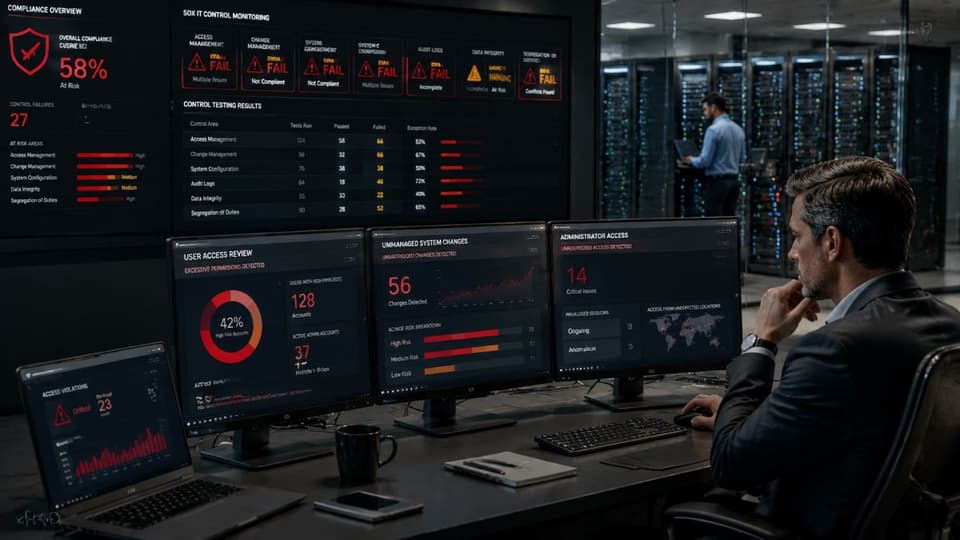
Building a Sustainable SOX IT Compliance Program
SOX compliance is not an annual event, even though the formal assessment happens yearly. The controls have to operate continuously, because an auditor tests whether they worked throughout the period, not just on the day of review. A sustainable program follows a recognizable shape.
- Define your scope. Identify every system that stores, processes, or transmits financial data, along with the infrastructure that supports it. These systems form the boundary of your SOX IT controls.
- Map your controls to risk. For each system, determine the access, change, and integrity controls needed, focusing effort on the systems where a failure would most affect the financial statements.
- Implement and document the controls. Put the access restrictions, change management process, and audit logging in place, and write them down. In SOX, an undocumented control is difficult to prove.
- Monitor continuously. Review audit trails, watch for anomalies, and confirm controls are operating throughout the year rather than checking once.
- Test and remediate. Periodically test that controls work as intended, and fix weaknesses as they surface rather than letting them accumulate until the annual assessment.
- Prepare evidence for the audit. Maintain the documentation, logs, and review records that demonstrate the controls operated, so that the external assessment confirms what you already know.
Much of this work sits at the intersection of finance and technology, and the technical half benefits from specialist attention. Keeping the whole program documented, tested, and audit-ready throughout the year is exactly the work that structured compliance and risk management services are built to sustain.
If your business is approaching a public listing, an investor requirement, or a role in a public company's reporting chain, a controls assessment with a knowledgeable local partner is the most direct way to find out how far your current systems are from where SOX expects them to be.