
Most small business owners reach a point where their technology decisions get bigger than their technology knowledge. Whether to migrate to the cloud, how to budget for the next three years of hardware, what cybersecurity insurance actually requires, whether the current IT provider is doing a good job. These are not questions a help desk answers, and they are not questions most owners trained to answer themselves. A full-time Chief Information Officer would handle them, but a CIO is a six-figure executive hire that few small businesses can justify. This is the gap a virtual CIO, or vCIO, fills. So what is a vCIO, in practical terms? It is access to senior, strategic technology leadership for a small or mid-sized business without the cost of a full-time executive. Understanding what a vCIO actually does, what they do not do, and what to expect from the engagement is the difference between treating IT as a strategic asset and treating it as a series of problems that someone else fixes. This guide explains exactly what a vCIO is, how the role works, what it costs, and how to tell whether your business is ready for one.
GlobeVM provides IT consulting and vCIO services in Los Angeles: technology plans and budgets you can act on.
What Is a vCIO, and Why the Role Exists
A vCIO is an outsourced, senior technology advisor who acts as your Chief Information Officer on a part-time or contracted basis. Unlike a traditional CIO, who is a full-time member of the executive team, a vCIO typically works with multiple clients and is engaged for a defined scope of strategic work. The role exists because technology has become inseparable from how a business runs, while the cost of a full-time executive remains out of reach for most companies under a few hundred employees.
The simplest way to grasp what is a vCIO is by contrast. A help desk technician fixes a broken printer. A network administrator keeps the systems running. A managed IT provider handles the day-to-day operations. None of those roles, individually, sit down with the owner once a quarter to ask whether the company's technology will support where the business wants to be in three years. A vCIO does. The role is strategic rather than operational, advisory rather than hands-on, and focused on outcomes for the business rather than uptime for any single system.
The role grew out of the managed services industry as MSPs recognized that their clients needed more than reliable support, they needed someone who could translate between business goals and technology decisions. Today, vCIO services are offered both as part of a larger managed IT relationship and as standalone advisory engagements.

What a vCIO Actually Does
The work of a vCIO falls into a small number of well-defined areas. A good one focuses on these rather than drifting into hands-on technical work, because the value of the role lies in strategy, not in fixing tickets.

Building a Technology Roadmap
The roadmap is the centerpiece of vCIO work. It maps the technology investments and changes the business will make over the next one to three years, tied directly to business goals. If the company plans to open a second location, the roadmap shows the network and infrastructure decisions that supports it. If a growth target requires doubling staff, the roadmap shows how email, devices, security, and access management scale to match. The roadmap takes technology out of the realm of reactive purchases and into deliberate, forecasted planning.
IT Budgeting and Financial Planning
A vCIO turns technology spending from a series of surprise expenses into a budget line. They forecast hardware replacement cycles, software license costs, cybersecurity investments, and project spend, so leadership knows what is coming. Beyond the numbers, the vCIO helps decide whether a given investment makes sense, whether to lease or buy, whether to move a workload to the cloud, and where money is being wasted on tools the company no longer needs.
Cybersecurity Strategy and Risk Oversight
This is increasingly the area where a vCIO earns their fee. Cyber risk has become a board-level concern even for small businesses, both because of the rising frequency of attacks and because of regulatory and insurance pressure. A vCIO sets the cybersecurity strategy, oversees risk assessments, and ensures that day-to-day operations include the controls that strategy requires. Layered cybersecurity solutions become more effective when a vCIO is making sure they fit the actual risks the business faces, rather than being bought piecemeal.

Vendor Management and IT Governance
Most small businesses run on a tangle of vendors: internet, phones, software, cloud platforms, security tools, backup providers. A vCIO manages those relationships strategically, evaluating performance, negotiating contracts, and consolidating where it makes sense. They also establish governance, the policies and processes that determine who can make which technology decisions, so that authority does not default to whoever happens to be loudest.
Compliance Alignment
For businesses in regulated fields, a vCIO ensures technology decisions align with the rules the business must follow. They are not a substitute for legal counsel, but they translate compliance obligations into technical requirements and operational practices, and they catch the gaps before an auditor does. Structured compliance and risk management services give a vCIO the operational base to draw from, so strategy and execution stay aligned.
Quarterly Business Reviews
The visible rhythm of a vCIO engagement is the regular business review, typically quarterly. Leadership and the vCIO sit down to evaluate what the technology achieved against what the business needed, update the roadmap, discuss emerging risks, and decide on the priorities for the next quarter. This recurring conversation is often what owners value most, because it forces strategic thinking that the urgent work of running a business otherwise crowds out.
What a vCIO Does Not Do
Being clear about the boundaries protects the value of the role. A vCIO does not reset passwords, install software, troubleshoot a slow laptop, or sit on hold with an internet provider. Those are help desk and operational tasks. If a vCIO is spending their time on them, you are either paying executive rates for technician work, or the engagement was scoped incorrectly. A vCIO also is not a project manager for technology implementations, although they oversee them strategically. And they are not a replacement for an internal IT person or an MSP; they sit above that operational layer and direct it.

vCIO vs. CIO vs. MSP: Drawing the Lines
These three terms are used loosely and often interchangeably, but the distinctions matter for deciding what your business actually needs.
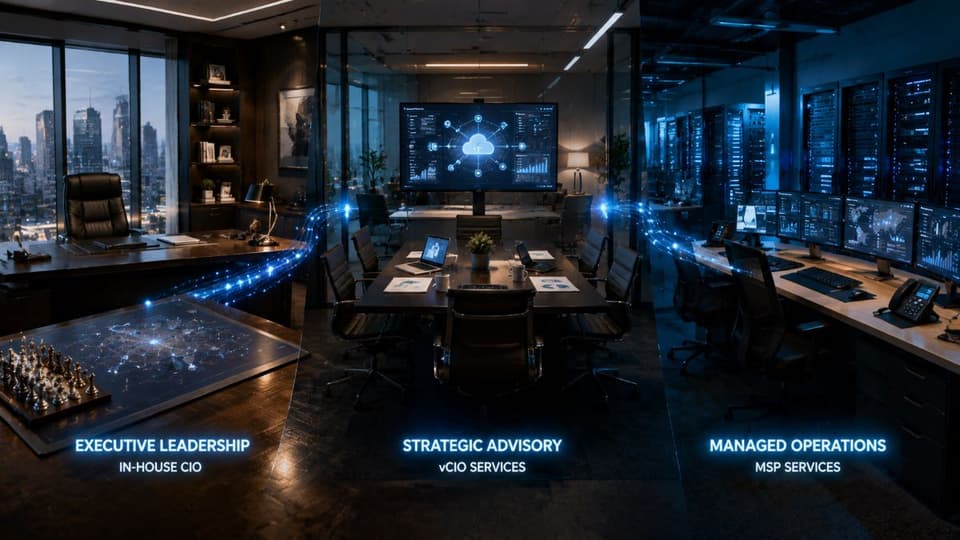
A full-time CIO is a salaried executive, part of the leadership team, working only for one organization. They are appropriate for companies large enough to justify a six-figure-plus annual cost and complex enough to need daily senior technology leadership. For most small and mid-sized businesses, this is overkill.
An MSP is a managed service provider that runs the day-to-day operations of your IT, the monitoring, help desk, patching, and maintenance covered by structured managed IT services. An MSP is operational, focused on keeping things running. A good MSP is essential, but on its own it does not provide strategic direction.
A vCIO is the strategic layer that sits above the operational work. They decide what the business should be doing with technology and why; the MSP or internal team executes it. The cleanest mental model is that an MSP runs your IT and a vCIO directs it. Many MSPs now include vCIO services in their higher-tier offerings, which can work well when the vCIO has genuine strategic depth and not just an additional title.
What Does a vCIO Cost?
Pricing for vCIO services varies based on the size of the business, the depth of engagement, and whether the service is bundled with managed IT or purchased standalone. Standalone vCIO engagements are commonly billed as a monthly retainer or by hours per month, with monthly fees often falling somewhere between roughly 1,500 and 8,000 dollars depending on scope and seniority. When vCIO services are bundled into a higher tier of a managed IT contract, they are sometimes included at no additional charge or at a modest premium per user.
The honest comparison is not vCIO versus nothing. It is vCIO versus the alternative ways a business can get strategic technology guidance. Hiring a full-time CIO, with salary, benefits, and overhead, frequently exceeds 250,000 dollars a year in a mid-sized metro market like the Los Angeles area. A vCIO delivers a meaningful share of that strategic value at a small fraction of the cost, which is why the model has spread quickly in the small and mid-sized business segment.

Signs Your Business Is Ready for a vCIO
Not every small business needs a vCIO yet. The role becomes valuable at a specific stage, and recognizing that stage saves you from paying for something you cannot fully use. The most reliable signals include:
- You make technology decisions reactively rather than from a plan, and the company has no written roadmap for the next year or more.
- Technology spending fluctuates unpredictably, and your finance team cannot forecast it with any confidence.
- You are entering or operating in a regulated field, such as healthcare or financial services, where cybersecurity and compliance obligations are real and rising.
- Your IT provider is solving today's problems but not advising on tomorrow's, and no one is taking a long view of where technology should support the business.
- The business is growing or planning a meaningful change, such as a second location, a significant hire, a new product line, or a possible acquisition, and the technology implications need to be thought through before commitments are made.
- Leadership wants someone to be accountable for technology outcomes, not just for keeping systems running.
If three or more of those signals describe your situation, a vCIO will almost certainly produce returns greater than its cost. If none of them do, the role can wait, and operational managed IT may be all you need for now.

How to Choose a vCIO
The quality of a vCIO engagement depends almost entirely on the person and the structure behind it. The label means nothing on its own; the work behind it is everything. When evaluating a vCIO offering, look for several things in particular.
The first is genuine senior experience. A vCIO should be someone who has run technology for organizations larger or more complex than yours, not a mid-level technician with an upgraded title. Ask about their background and the kinds of decisions they have led, not just the certifications they hold.
The second is industry familiarity. A vCIO who has worked with businesses in your sector understands the specific regulatory, operational, and competitive dynamics that shape your decisions. For a medical practice, a vCIO who has navigated HIPAA in practice is more valuable than a generalist. For a financial firm, someone fluent in financial services obligations is the same.
The third is a structured engagement. The work should be defined: regular roadmap updates, scheduled business reviews, a clear scope, and measurable outcomes. Beware a vCIO offering that is vague about deliverables, because vagueness is where the value quietly disappears.
The fourth is alignment, not sales. A good vCIO advises on what the business needs, even when that means recommending against a purchase or a project. If the role is structured so the vCIO benefits primarily from selling you more services, the advice will tilt accordingly. The best engagements include explicit independence in recommendations.

How GlobeVM Approaches vCIO Services
If your business is at the point where technology decisions are outpacing the guidance you currently have, a conversation with a knowledgeable local partner is the most direct way to see whether a vCIO engagement would actually move the needle for you.