

Every healthcare practice knows it is supposed to train staff on security. Far fewer can produce, on request, a record showing who was trained, on what, and when.
That gap matters more in healthcare than in most industries, because the training is not optional guidance. It is a regulatory requirement with documentation expectations attached, and it targets the specific way patient data in fact leaks: through ordinary people making ordinary mistakes during a busy clinic day.
The Training Requirement Is Not Advisory
HIPAA requires covered entities to train workforce members on the policies and procedures protecting patient health information, and to document that it happened. This applies to a two-provider practice as much as to a hospital system.
The requirement is also not a one-time event at hire. It extends to periodic refresh and to retraining when policies or systems change meaningfully, which most practices interpret far more loosely than the obligation reads. This sits inside the broader set of HIPAA compliance duties a practice carries continuously rather than annually.
Documentation Is What an Auditor Actually Reviews
An investigator cannot observe whether your staff understand phishing. They can review attendance records, completion dates, the content covered, and whether the schedule was followed.
A practice training its people well but recording nothing is, from a compliance standpoint, difficult to distinguish from one doing nothing. Keeping a simple, dated record of each session and its content is a small habit that carries disproportionate weight during an inquiry.
Why Generic Training Underperforms in a Clinical Setting
Most off-the-shelf security training is written for an office worker at a desk with time to think. That describes almost nobody in a clinical environment.
The realistic scenarios are different: a shared workstation at a nurses station, a request for records that sounds urgent and plausible, a family member asking about a patient in a hallway, a phone call from someone claiming to be from a laboratory. Training built around a generic office context does not prepare people for any of these.
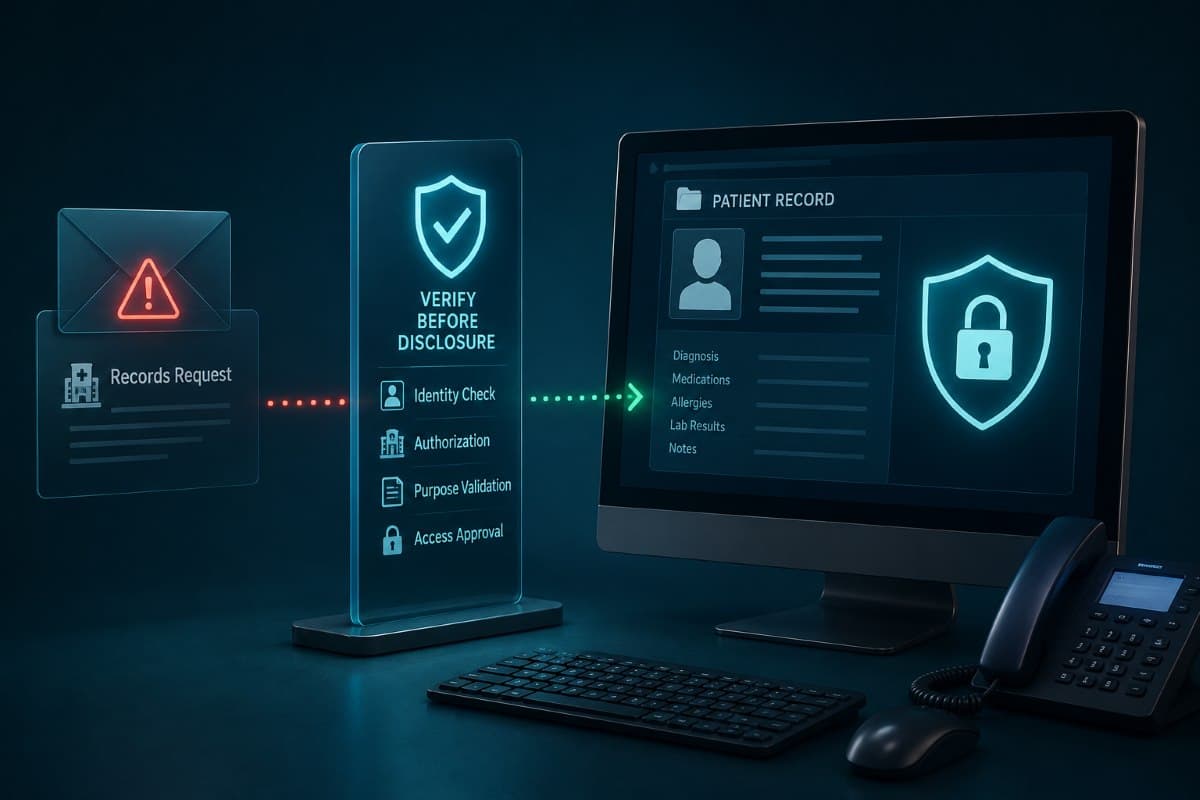
The Scenarios That Actually Matter Here
Practice-specific training should cover what a request for patient information looks like when it is fraudulent, how to verify a caller claiming to be a provider or a payer, what to do when a screen must be left unattended in a treatment area, and how to handle a device that leaves the building. The recurring theme is verification before disclosure.
It should also cover the awkward human situations, being asked by a colleague to look up a record you have no reason to see, or being pressured by someone who sounds authoritative. These are the moments where policy meets social pressure, and where training either holds or does not.
Phishing Is Still the Entry Point
Whatever else the training covers, email remains the way most incidents begin. Healthcare-targeted phishing has become specific: messages appearing to come from a payer, a laboratory, a pharmacy, or a records request service, all designed to look like the routine correspondence a practice receives daily.
This specificity is why simulated phishing built around healthcare scenarios teaches more than generic examples, and why practices running phishing simulations tend to see the failure rate fall in a way that a slide deck alone rarely achieves.
Simulation Results Belong in the Record Too
Simulation data serves double duty: it identifies who needs additional support, and it produces evidence that the practice is testing its training rather than only delivering it. Both matter, and the second is the one practices forget to keep.
Fitting Training Into a Clinical Schedule
The practical obstacle is not willingness; it is time. A practice running a full patient schedule cannot pull staff into a two-hour session, and the annual all-hands training that does happen is largely forgotten within weeks.
Short, frequent touchpoints work considerably better in this environment: a five-minute discussion at a morning huddle about a real recent scam, a single reminder tied to a seasonal risk, a brief note when a system changes. The same total time delivers markedly better retention when distributed rather than concentrated.
Front Desk Staff Need the Most, and Usually Get the Least
The front desk handles more sensitive transactions per day than almost anyone else in a practice: identity verification, insurance details, payment, records requests, and phone calls from people who may or may not be who they claim.
Training programs that focus on clinical staff while treating front desk personnel as an afterthought are concentrating effort away from where the daily risk actually sits. The same applies to temporary and per diem staff, who frequently receive the least training and hold the same system access.
Business Associates and Vendors Are Part of the Picture
A practice's obligations do not stop at its own employees. Vendors handling patient information carry their own training requirements, and a practice is expected to have agreements in place reflecting that.
Asking a vendor what security training their staff receives is a reasonable and increasingly common question during vendor review, and it is part of the oversight expectation that comes with working in healthcare IT environments rather than a general business setting.
What This Actually Costs a Practice
The direct cost is usually modest. Training platforms aimed at small practices price per user per year at a level most practices absorb without difficulty, and some bundle simulated phishing into the same fee.
The larger cost is staff time, and it is smaller than practices fear once the format changes. Short sessions distributed across the year consume less total clinical time than one long annual block, while producing better retention, which makes the frequent format cheaper on both measures rather than a trade-off between them.
What a Workable Program Looks Like
For a practice building this properly, the shape is fairly consistent: an initial session at hire covering the practice's actual policies rather than generic content, short reinforcement throughout the year, simulated phishing on a regular schedule, and a dated record of all of it in one place someone can retrieve.
Add retraining triggered by real events, a policy change, a new system, or an actual incident, and the program stops being an annual obligation and starts being something that measurably changes behavior. Structuring it this way is what distinguishes genuine security training from a compliance checkbox filled once a year.
Train for the Clinic You Actually Run
Healthcare practices that get real value from security awareness training are the ones that stopped treating it as an annual video and started treating it as a short, recurring conversation about situations their staff really encounter. The regulatory record follows naturally from doing it properly, rather than being the reason to do it at all.
For practices in the region, a partner providing IT support in Westlake Village can build a training schedule that fits around a real patient calendar.
Practices across the metro can get the same locally through managed IT services in Los Angeles, including the documentation an investigator would really ask to see.
Frequently Asked Questions
Yes. HIPAA requires covered entities to train workforce members on the policies protecting patient health information and to document that training occurred, and this applies to a two-provider practice as much as to a hospital system. It is also not a one-time event at hire; it extends to periodic refresh and to retraining when policies or systems change meaningfully.
More often than annually, in shorter sessions. A practice running a full patient schedule cannot pull staff into long sessions, and the annual all-hands training that does happen is largely forgotten within weeks. Five-minute discussions at a morning huddle, tied to a real recent scam or a system change, deliver markedly better retention for the same total time.
Because off-the-shelf content is written for an office worker at a desk with time to think, which describes almost nobody in a clinical environment. The scenarios that matter here are specific: verifying a caller claiming to be from a payer or laboratory, handling an unattended screen in a treatment area, or being asked by a colleague to look up a record without a legitimate reason.
Front desk personnel handle more sensitive transactions per day than almost anyone else in a practice, including identity verification, insurance details, payments, and records requests from callers who may not be who they claim. Programs that focus on clinical staff while treating front desk teams as an afterthought concentrate effort away from where daily risk actually sits. Temporary and per diem staff are the second commonly overlooked group.
Dated records of each session, who attended, what content was covered, and the results of any phishing simulations. An investigator cannot observe whether staff understand phishing; they review documentation. A practice training well but recording nothing is difficult to distinguish, from a compliance standpoint, from one doing nothing at all.
If your practice cannot currently produce a dated record of who was trained and on what, GlobeVM can build both the security awareness training program and the documentation behind it.
Comments
0 Comments