
When a business decides to change managed service providers, the first number everyone studies is the new provider's monthly quote. It is clean, it is on paper, and it is easy to set next to the current bill. The problem is that the monthly quote describes steady-state operation. It does not describe the switch itself. The switch is a separate project with its own budget, its own timeline, and its own set of risks, and almost none of it appears in a proposal.
What should it cost? Our managed IT services pricing guide lists published 2026 price ranges, what is usually included and a free cost estimator.
This guide is written for the business that has already made the decision to leave. If you are still weighing whether your current provider is genuinely the problem, that is a different conversation about the warning signs of an IT relationship that has run its course. Here, the decision is made. What follows is an honest look at the hidden costs of switching MSPs, where the money actually goes during the transition, where the risk hides, and how to run the move so you come out the other side with a better partner and no unpleasant surprise on the books.
Why the New Provider's Quote Is the Smallest Number in the Switch
The recurring fee a new provider gives you covers what happens after the dust settles. Day to day support, monitoring, patching, the help desk. It assumes a stable environment that the provider already understands. During a switch, none of that is true yet. For roughly thirty to sixty days, your environment is half documented, still partly controlled by an outgoing provider who has little reason to hurry, and being learned in real time by a new team.
That gap between steady-state pricing and transition reality is where the hidden costs of switching MSPs live. They are not hidden because anyone is hiding them. They are hidden because they fall outside the one document most buyers use to make the decision. A business that budgets only for the new contract is budgeting for the easy part and leaving the expensive part to chance.

The Hidden Costs of Switching MSPs That Never Reach the Proposal
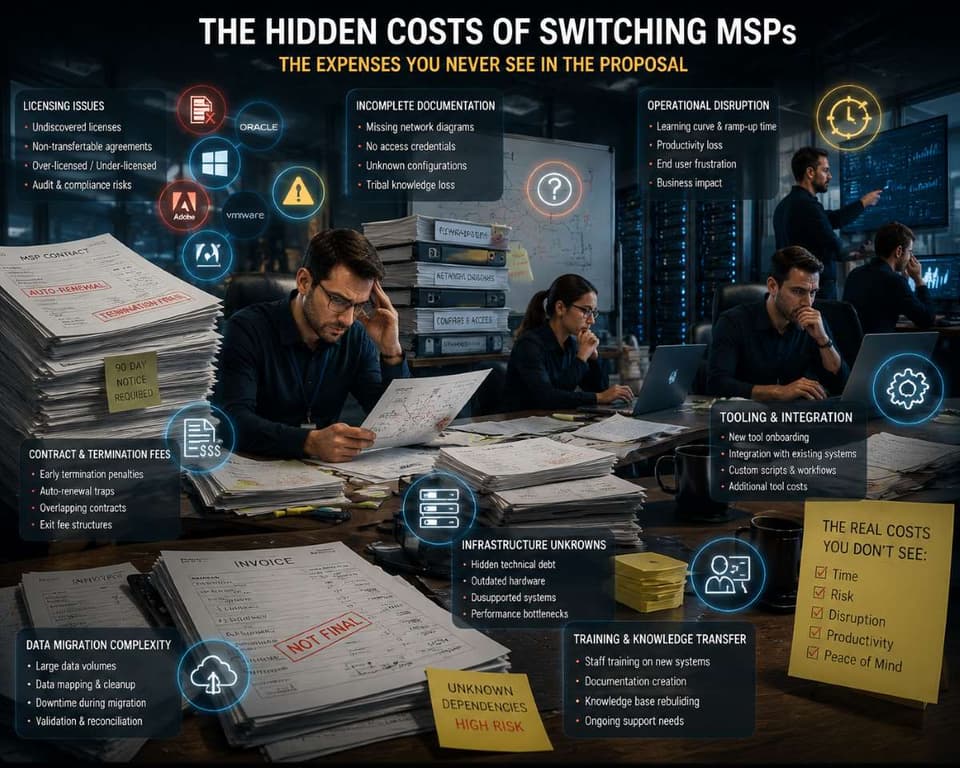
Start with the contract you are leaving. Many MSP agreements carry an early termination fee, a notice period of thirty to ninety days, or an automatic renewal clause that quietly extends the term if you miss a cancellation window. Read that agreement before you give notice, not after. A termination fee is annoying but predictable. An auto-renewal you discover too late can lock you into another full year of a relationship you already decided to end.
Then there is the overlap. A safe transition almost always means paying two providers at once for a stretch of time. Your outgoing provider keeps billing you through the notice period while your incoming provider begins onboarding. Businesses that try to dodge this overlap by cutting the old contract the moment the new one starts usually pay for it in downtime instead, which is a far more expensive currency.
The new provider's onboarding and discovery work is often priced separately from the monthly fee, when it is priced visibly at all. A mature provider runs a structured discovery process to map your network, inventory your assets, and document configurations before taking over. That work has a real cost, and a vague proposal that folds it into "we will get you set up" is hiding a number you will eventually see.
The documentation tax surprises people the most. If your outgoing provider kept thin records, or hands over incomplete documentation, your new provider has to rebuild that knowledge from scratch while supporting you live. Engineers spend billable hours rediscovering how your environment is wired and hunting for settings that nobody ever wrote down. Good documentation is invisible until it is missing, and then it is one of the costliest gaps in the whole move.
Licensing is the quiet one. Some providers buy software under their own tenant or their own vendor agreements rather than yours, including Microsoft 365 subscriptions, antivirus, and backup tools. When you leave, those licenses can leave with them. You may have to repurchase or re-provision software you assumed you already owned. Confirming who actually holds each license before you give notice can save you a four-figure surprise. Sound Microsoft 365 management starts with your business owning the tenant, not your provider.
The Costs That Never Arrive as an Invoice
Not every cost carries a dollar figure on the day it lands. Some of the most damaging ones are operational, and they are easy to skip when you build the budget.
Downtime during cutover is the obvious one. Email, remote access, and network monitoring all have to hand over from one provider's tools to another's. If that handoff is rushed or poorly sequenced, your team loses access to the systems they work in every day. The true price of that downtime is measured across every employee affected, in lost hours and stalled work, not in a tidy IT line item.
Internal staff time is the cost almost nobody budgets. During a switch, someone inside your business becomes the unofficial project manager. They chase the outgoing provider for credentials, sit through handover meetings, answer the new team's discovery questions, and field complaints from coworkers who cannot log in. That person already had a full job. The hours they pour into the transition are real payroll, simply spent on something other than what you hired them for.
The security exposure window is the cost that should worry you most. During a transition there is a stretch when two providers hold administrative access to your systems at once, when credentials are moving between people, and when monitoring may have gaps as tooling changes hands. An environment in transition is an environment with a wider attack surface. Continuous cybersecurity solutions should never lapse during a switch, and someone has to be accountable for confirming they do not.
Knowledge loss is the slow cost. Your outgoing provider has spent years learning the quirks of your environment. Which server cannot be patched on a particular night, which application breaks if one setting changes, which vendor to call when a specific system misbehaves. When the relationship ends, that institutional memory walks out the door unless you deliberately capture it while you still can.

The Most Expensive Mistake Is Letting the Contract Date Run the Technical Plan
Here is the single most common error, and it deserves its own section. Businesses let the legal end date of the old contract dictate the technical timeline of the switch. The contract says coverage ends on the thirtieth, so the cutover happens on the thirtieth, ready or not.
The legal date and the operational handoff are two different things, and treating them as one is what turns a manageable move into a painful one. The operational handoff should be staged around risk. Credentials confirmed. Documentation delivered. Monitoring visibility established. Backups validated. Ownership of every critical system verified. Only once those things are true does a cutover make sense. If the outgoing provider stops cooperating before they are confirmed, your new provider is forced to learn your environment while already responsible for keeping it running, which is the most fragile and most expensive way to do it.
Plan the technical sequence first. Then make the contract dates fit the plan, even if that means a slightly longer overlap. The overlap is cheaper than the alternative, every time.

What Happens When Your Current Provider Stops Being Helpful
Most MSP transitions are professional. Some are not, and knowing what an uncooperative offboarding looks like helps you spot it early enough to plan around it.
A provider who is unhappy about losing the account may slow-walk the handover, delay sending documentation, become difficult to reach, or in the worst cases imply that credentials and data will be released only after a final payment clears. Treat that behavior as a planning problem rather than a shock.
A few facts are worth understanding. Your business data and the administrative credentials to your own systems generally belong to you, not to the provider. Using them as leverage in a billing dispute tends not to hold up well and can expose the outgoing provider to liability of its own. Even so, a fight is never the goal. A clean exit is. Get the handover obligations in writing early, ideally before you ever sign with any provider, keep every communication civil and documented, and resist the urge to burn the bridge while you still need cooperation. A provider you leave on decent terms is far more likely to answer the one question your new team needs answered in week three. This is general information rather than legal advice, and if a dispute looks likely, have someone review your specific contract.
How to Switch MSPs Safely Without the Surprise Bill
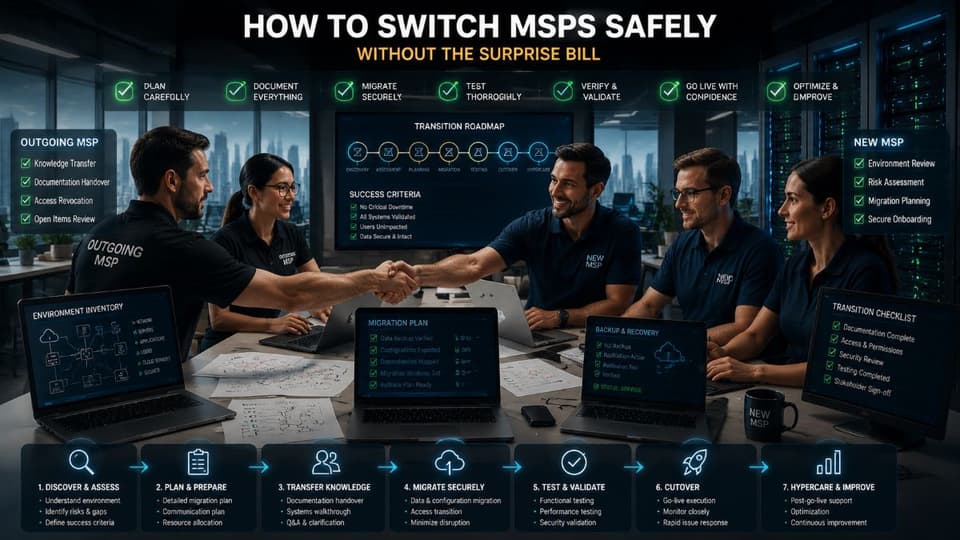
A safe switch is mostly process. The businesses that come through a transition without bleeding money are not lucky, they are organized. Here is what that organization looks like in practice.
Confirm You Own Your Environment Before You Give Notice
Before you tell anyone you are leaving, confirm that your business controls the foundations. Build an ownership map that names who holds the keys to your domain, your Microsoft 365 tenant, your cloud subscriptions, your firewall and VPN, your backup systems, and your endpoint tools. If any of those are registered under the outgoing provider rather than your business, fixing that ownership is the very first job, because the best transition plan in the world cannot help if nobody on your side can authorize a change.
Read the Contract You Are Leaving, All of It
Find the notice period, the renewal clause, the termination fee, and any clause describing what the provider must return to you on exit and within what timeframe. These details set your real timeline and your real budget. Skipping this step is how businesses discover an auto-renewal a week too late.
Budget the Overlap on Purpose
Decide in advance to pay both providers for a defined window, usually thirty to sixty days, and treat that as a planned line item rather than an accident. That overlap is your safety net. It is the difference between a calm cutover and a scramble, and it costs far less than the downtime it prevents.
Choose a Provider That Can Prove Its Onboarding and Its Offboarding
Any provider can promise a smooth transition. Ask the specific questions instead. What does your structured onboarding actually include, and what would offboarding from you look like if we ever decided to leave. A provider with mature managed IT services or collaborative co-managed IT services will have a clear, documented answer. Vague answers are a preview of a messy handover.
Validate Backups and Security Before the Cutover, Not After
Confirm with both providers that current backups exist and actually restore correctly before any old tooling is switched off. Reliable data backup and disaster recovery should never have a blind spot during a switch. Make sure monitoring coverage stays continuous through the handover so there is no window where nobody is watching the environment.
Define the Cutover Sequence and the People Behind It
Before the outgoing provider disengages, write down the order in which systems will move, who can authorize each change, and who gets called when something breaks. A handover meeting with both providers in the room, walking through scope and known risks, prevents most of the failures that are otherwise avoidable. Continuous oversight matters here too, which is why a provider able to monitor the environment around the clock through the transition is worth more than one that simply shows up on cutover day.
Fix the Next Contract So You Never Do This Twice
When you sign with the new provider, negotiate the exit terms now, while you still have leverage. A clear offboarding clause, defined documentation standards, and confirmed ownership of your own licenses and credentials mean that the next switch, if it ever happens, will not carry these hidden costs at all. You are not planning to leave the new provider. You are making sure that leaving is never a trap.
A Realistic Budget and Timeline for an MSP Switch
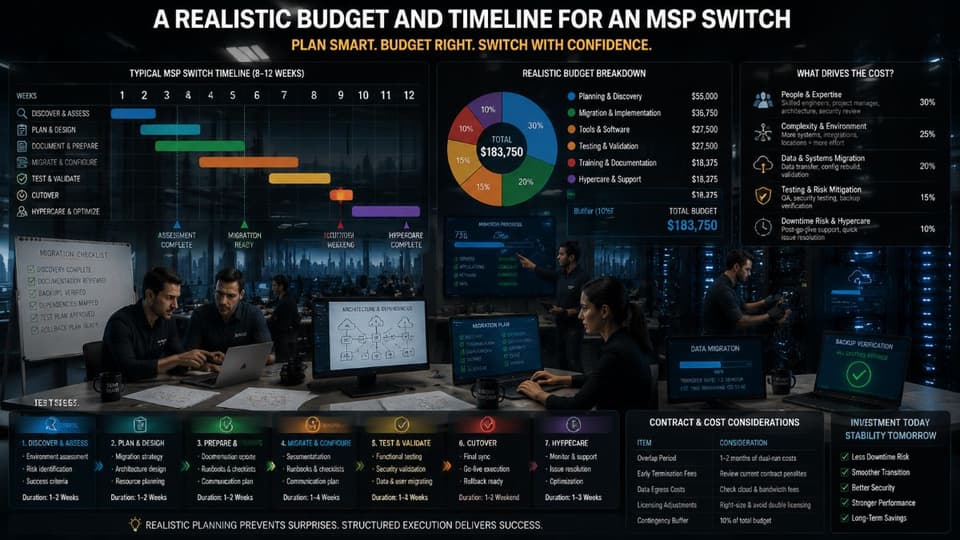
Most MSP transitions take thirty to sixty days from notice to a stable cutover, and longer for larger or regulated environments that carry heavier compliance and risk obligations. The budget for that period generally breaks into a few categories. Any termination fee from the old contract. The overlap cost of running two providers. The new provider's onboarding and discovery work. And a contingency for the documentation tax if the outgoing provider's records turn out to be thin. If you are also moving systems between platforms during the switch, planned cloud services and migration work belongs in that budget as well.
Every environment is different, and the only honest way to put a number on the hidden costs of switching MSPs is to run your own figures. The calculator below produces a working estimate based on your team size, your contract situation, and how well documented your current setup is. Use it as a planning tool and a conversation starter with any provider you are considering, not as a quote.
Staying With a Failing Provider Has a Price Too
It is fair to ask whether the switch is worth all of this. Sometimes the honest answer is to look hard at whether your current provider is genuinely failing or simply imperfect, because every transition carries cost and disruption and not every frustration justifies a move. But when a provider is missing service commitments, leaving security gaps, or quietly raising prices without delivering anything more, staying is not the safe choice. It is just a cost you have stopped noticing. The hidden costs of switching MSPs are real, but they are one-time and they are controllable. The cost of an underperforming provider is recurring and it compounds. The point of this guide is not to talk you out of switching. It is to make sure that when you do, you do it once and you do it cleanly.
Planning an MSP Switch in Los Angeles and Southern California
GlobeVM runs structured MSP transitions for businesses across Los Angeles, the San Fernando Valley, Ventura County, and the surrounding areas. That means a documented discovery process, a planned cutover sequence, validated backups, a responsive help desk ready from day one, and continuous monitoring through the handover, so the move costs you a clear, predictable number instead of a string of surprises. If you are planning a switch and want the transition mapped before you give notice, a conversation with our team is a sensible place to start.