
Customers expect your business to be reachable, your systems to respond, and your services to work whenever they need them. When something goes down, even briefly, the cost shows up immediately in lost work, frustrated customers, and idle staff. The expectation of an always-on operation is not going away, which raises a practical question for every business owner: how do you build technology that keeps running when a piece of it inevitably fails? The answer lives in two related ideas, high availability and redundancy, which together describe how resilient infrastructure is designed so that a single failure does not take you offline. This guide explains what these terms actually mean, how the cloud has changed the picture, and how a small business should think about building toward an always-on operation without spending on protection it does not need.
What High Availability Actually Means
High availability is the practice of designing systems to minimize downtime, so that when a component fails, and components always eventually fail, the system keeps running rather than stopping. It is measured in uptime, often described in terms of how many "nines" a system achieves, where more nines mean less downtime over a year. The exact figures matter less for most small businesses than the underlying goal, which is simply that your important systems stay available even when something breaks, because in any real environment, something eventually will.
It is worth being honest about what high availability is not. It does not mean a system that can never go down, because no design removes every possible failure, and anyone promising perfect uptime is overselling. What good design does is reduce both how often you experience an outage and how long it lasts, by making sure no single broken part can take the whole system with it. The realistic goal is not perfection but resilience: an operation that absorbs the failures that are bound to happen and keeps working through most of them.

The Building Blocks of Redundancy
Redundancy is the mechanism that makes high availability possible, and the principle behind it is straightforward: have a backup for anything whose failure would stop you. If one part fails, another takes over, so the failure becomes an inconvenience rather than an outage. The practical work of building resilience is finding the places where a single failure would hurt and adding that backup. Those single points of failure tend to hide in a few predictable places:
- A single server running a critical application, with nothing to take over if it dies.
- A single internet connection, so one outage from your provider takes you fully offline.
- A single power source, vulnerable to any outage or surge.
- A single copy of important data, with no replica or tested backup if it is lost or corrupted.
- One person who is the only one who knows how a system works.
Each of these can be addressed by adding a layer of redundancy, and the right ones depend on what your business actually relies on. The following pieces are where that redundancy usually lives.
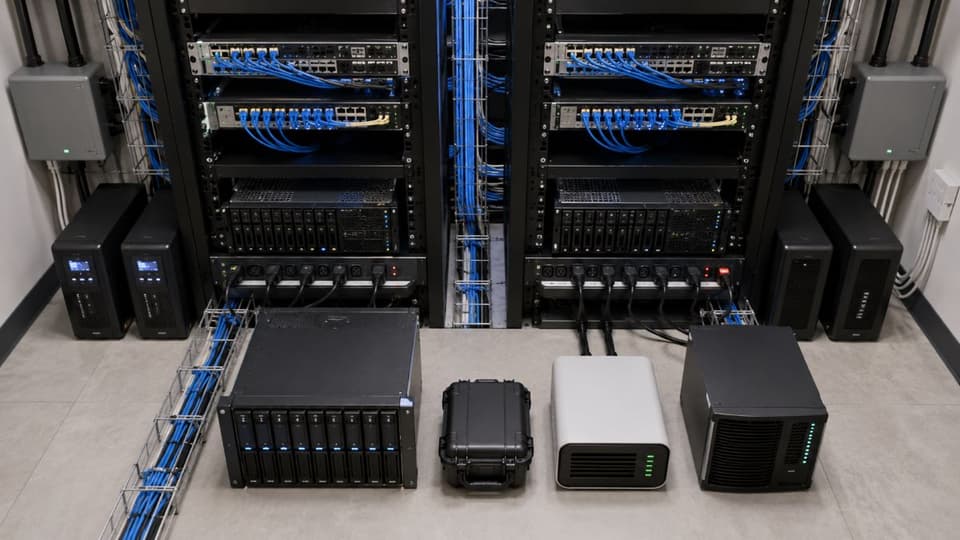
Redundant Servers and Failover
For the systems that matter most, running more than one server so that a second can take over when the first fails is the core of availability. This is often called failover, the automatic shift of work from a failed component to a working one, ideally fast enough that users barely notice. Virtualization has made this far more achievable for smaller businesses than it used to be, since workloads can be moved and restarted across hardware more flexibly. Understanding how server virtualization works is useful here, because it is one of the technologies that makes practical failover possible without buying twice as much physical hardware.
Redundant Connectivity and Power
Your systems are only useful if people can reach them and they have power to run. A second internet connection, ideally from a different provider or a different technology, keeps you online when one link goes down, which matters more as more of your tools live in the cloud. On the power side, an uninterruptible power supply keeps equipment running through short outages and surges, and for businesses that cannot tolerate longer outages, a generator extends that protection. These are unglamorous investments, but a redundant connection and clean, backed-up power quietly prevent a large share of the outages a small business actually experiences.
Redundant Data
Hardware can be replaced, but lost data often cannot, which makes data redundancy the most important layer of all. This means more than one copy of important information, kept in a way that a single failure or attack cannot destroy all copies at once, whether through replication that keeps a current duplicate or backups that let you restore. Reliable data backup and disaster recovery is what stands between a hardware failure and a permanent loss, and it is the foundation everything else in resilience is built on, because availability means little if the data underneath it is gone.
How the Cloud Changes the Equation
For most of the history of business technology, building real redundancy meant buying and maintaining duplicate hardware, which put serious resilience out of reach for many small businesses. The cloud has changed that math significantly, and it is the heart of what an always-on strategy looks like today.

Redundancy Built Into the Platform
Major cloud platforms are built with redundancy across many machines and often across physically separate locations, sometimes called availability zones or regions. This means a cloud service can keep running even when individual machines or whole facilities have problems, providing a level of resilience that would be enormously expensive for a small business to build on its own. Moving the right systems to a well-designed cloud, as part of a planned cloud migration, gives a small business access to infrastructure resilience that used to belong only to large enterprises.
The Cloud Is Not Automatically Always-On
It is a mistake to assume that simply being in the cloud makes you highly available, and this is where many businesses get caught. Cloud platforms provide the building blocks for resilience, but you still have to use them correctly, configuring services for redundancy, distributing across zones where it matters, and maintaining the backups that protect your data. The cloud operates on a shared responsibility model, where the provider keeps the underlying platform resilient and you remain responsible for how your systems and data are set up on top of it. Treating the cloud as automatically always-on, without designing for it, leaves gaps that only become visible during an outage.
High Availability, Disaster Recovery, and Backup Are Not the Same
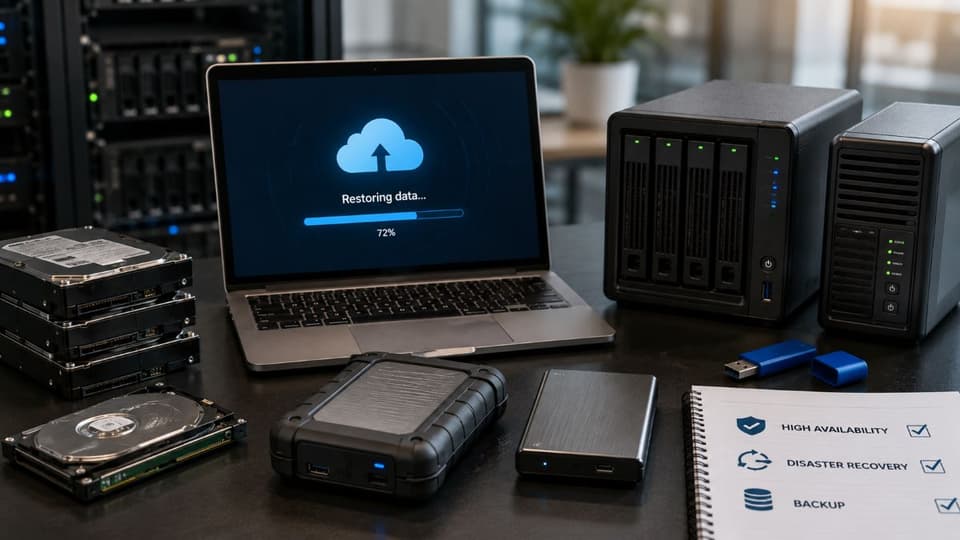
These three terms get used interchangeably, but they solve different problems, and confusing them leaves dangerous gaps. High availability is about staying up through the small, routine failures that happen all the time, like a single server or drive failing, so users never notice. Disaster recovery is about getting back up after a major event that does take you down, like a fire, a flood, or a serious cyberattack, and it is measured by how quickly and how completely you can restore. Backup is the copy of your data that makes recovery possible in the first place.
A business needs all three, because each covers what the others do not. Availability keeps you running day to day, recovery planning prepares you for the bad day that availability alone cannot prevent, and backups underpin both. Thinking through how you would handle a genuine disaster, the kind of planning that goes into a business continuity approach, is the partner to the everyday resilience that high availability provides. One without the other leaves you either fragile day to day or unprepared for the rare catastrophe.
How Much High Availability Do You Actually Need
Here is where honesty matters most, because building full redundancy for everything is expensive, and not every system warrants it. The sensible approach is to match your investment in availability to the real cost of that system being down, which varies enormously across a business. The order-taking system that loses you money every minute it is offline deserves serious redundancy; an internal tool that can wait an hour does not.
This is fundamentally a business decision informed by a technical one, and it starts with understanding what downtime actually costs you. Looking honestly at the true cost of IT downtime for your specific operation tells you which systems justify the expense of high availability and which can be protected more simply. Spending heavily to keep a low-stakes system always running is as much a mistake as leaving a critical one fragile, and the goal is to put your resilience budget where an outage would hurt the most.

Where a Small Business Should Start
Building toward an always-on operation does not have to happen all at once, and a sensible sequence makes it manageable. Start by identifying your single points of failure, the systems and connections whose loss would genuinely stop you, since you cannot address weaknesses you have not named. From there, the highest-value early steps are usually a redundant internet connection, clean and backed-up power for critical equipment, reliable and tested data backups, and moving your most important systems onto resilient cloud infrastructure where it fits. These cover the failures small businesses most commonly hit, without the cost of duplicating everything.
Most of this is easier to get right with help, because the value is in the design choices as much as the equipment. A provider who can assess where your real vulnerabilities are, and build redundancy where it matters rather than everywhere, turns an overwhelming subject into a clear plan. For a business in the Los Angeles area, a team offering managed IT services in Los Angeles can map your single points of failure and prioritize the fixes that buy the most resilience for the money.
For businesses across the wider region, a team offering IT support in Ventura County can do the same.

Designing for an Always-On Operation
An always-on operation is not the product of a single purchase but of deliberate design, where high availability and redundancy are applied where they matter and your investment matches the real cost of downtime. The components are well understood, redundant servers and failover, redundant connectivity and power, and above all redundant data, and the cloud has made serious resilience far more attainable for small businesses than it once was, as long as you design for it rather than assuming it. Pair this everyday resilience with genuine recovery planning, prioritize the systems that actually keep your business earning, and you build infrastructure that absorbs the failures that are bound to come. If you want to understand where your business is fragile and build toward high availability without overspending, GlobeVM can assess your infrastructure and help you put resilience where it counts.
If you want to find out where your infrastructure is fragile and build toward high availability without paying for protection you do not need, GlobeVM can assess your single points of failure and help you put redundancy exactly where it matters.