

Every serious conversation about a company's technology eventually produces the same sentence: "let's start with an assessment." Owners hear it from providers, insurers, and their own accountants, and most nod along without a clear picture of what they are agreeing to. An IT assessment is a structured evaluation of a business's technology, its hardware, software, network, security, and the way people actually use them, measured against what the business needs, what it spends, and what could hurt it. Done well, it is the cheapest clarity a business can buy: a documented picture of what exists, what is at risk, and what to fix in what order. Done poorly, it is a sales brochure wearing a clipboard.
This guide explains what a real assessment covers, the types you will be offered, how the process works step by step, what the deliverable must contain to be worth anything. It finishes with how to use the result as a working tool rather than shelfware.
What Is an IT Assessment?
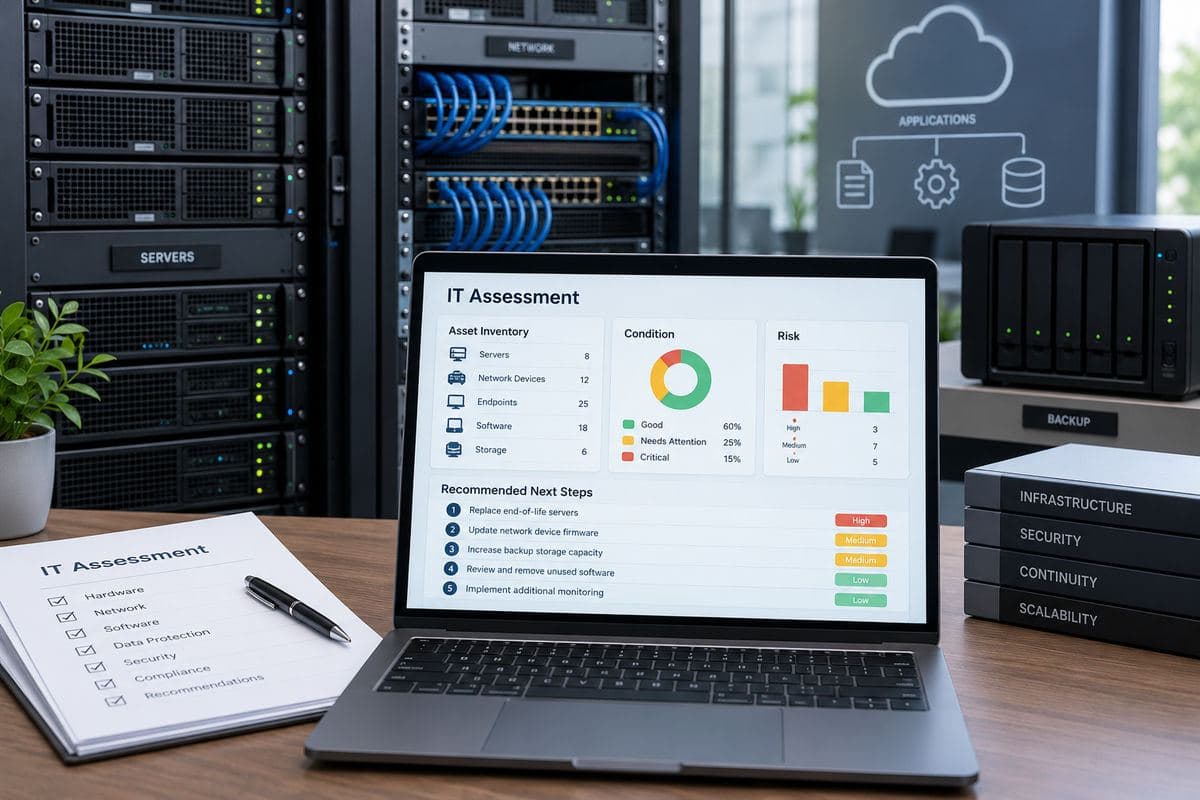
At its core, an assessment answers four questions with evidence rather than impressions. What do we actually have? An inventory of devices, servers, software, cloud accounts, and network equipment, including the pieces nobody remembers buying. What condition is it in?
Age, support status, patch levels, warranty coverage, and the single points of failure hiding in plain sight. What are we exposed to? Security gaps, backup weaknesses, compliance shortfalls, and the operational risks a bad week would reveal.
And what should we do about it? A prioritized, costed path from the current state to the one the business needs. The evidence part matters most: a real assessment runs scans, reads configurations, and checks backups rather than relying on what the office manager remembers, because the gap between what companies believe about their IT and what a scanner finds is reliably the most valuable page of the report.
The Types You Will Be Offered
Vendors package these differently, but four types cover the market. And knowing which one a proposal actually describes prevents the most common purchasing mistake in this category: buying a narrow review while believing you bought the full picture.
Infrastructure and operations assessment
The broadest type: hardware lifecycle, network health, server and cloud posture, backup verification, and support workflows. This is the version most owners mean by "IT assessment," and it is the right starting point before any major contract, budget, or migration decision, because everything else builds on knowing what exists and what shape it is in.
Security and risk assessment
Focused on exposure: access controls, patching discipline, email protection, endpoint coverage, and how the company would fare against the attacks small businesses actually face. Regulated businesses often need a framework-specific version, a HIPAA risk analysis for a practice, a Safeguards-oriented review for a financial firm, where the assessment doubles as required compliance documentation.
Cloud readiness and cost assessments
Narrower, decision-shaped types: whether workloads should move to the cloud and in what order, or where the technology budget is leaking through unused licenses, oversized services, and forgotten subscriptions. These work best after a broad assessment has established the baseline, since a migration plan built on an inaccurate inventory inherits every one of its errors.
Assessment, audit, or penetration test: which one are you buying?
Three terms get used interchangeably in sales conversations and should not be. An assessment evaluates the whole technology picture against business needs and produces a roadmap. An audit verifies compliance against a defined standard and produces findings, the security-specific version is covered in our guide to the cybersecurity audit.
A penetration test attacks your defenses on purpose to prove which failures are actually exploitable, which is the discipline of penetration testing and a different engagement entirely. A useful rule for buyers: assessments tell you what to fix first, audits tell you whether you meet a standard, and pentests tell you what an attacker would really do. Mixing up which one you need is how companies buy the wrong report.

How the Process Actually Works
A competent assessment for a small or mid-sized business runs in four movements over roughly two to four weeks. Discovery comes first: deploying scanning tools, collecting configurations, and pulling the inventory, paired with short interviews, because the tools see the systems and the staff see the workarounds, and both halves are true. Analysis follows: findings weighed against the business, since an aging server matters differently in a company with tested backups than in one without. Then the report and the conversation: a written deliverable walked through live, where questions get answered and priorities get argued honestly.
Finally the roadmap: findings translated into a sequence with rough costs, split between what must happen now and what belongs in next year's plan. One logistics note belongs in the engagement letter: the assessor will see everything, so a confidentiality agreement is baseline, access should be granted for the engagement and removed at its end, and for regulated businesses the assessor signs the same agreements any data-touching vendor would. A provider who skips the interviews is assessing computers instead of a business, and one who skips the walkthrough is delivering homework instead of advice.

What the Deliverable Must Contain
Judge any assessment by five components in its report. A complete inventory, because the document should replace tribal knowledge, not summarize it. Risk-ranked findings, each tied to evidence and to business impact, not a wall of scanner output pasted into a template.
A short list of quick wins, the fixes that cost little and close real exposure, which is where a good assessment pays for itself in the first month. A costed roadmap separating urgent remediation from planned investment, in ranges an owner can budget against.
And an executive summary a non-technical decision maker can read in five minutes, since the report's real job is enabling a decision, not proving effort. A concrete test of quality: pick any finding and check that it reads as a chain, the evidence observed, the business impact if unaddressed, the recommended fix, and a cost class, because a finding missing any link in that chain is an assertion, not a finding. What it should not contain is a single-vendor shopping list dressed as findings; recommendations should name categories and outcomes first, products second.

Free Assessment or Paid Assessment: The Honest Difference
Providers offer free assessments because they work as sales scoping, and there is nothing wrong with that as long as everyone knows what it is: a light pass, focused on the problems the provider's services solve, delivered with a proposal attached. Useful, genuinely, especially for a business choosing between providers, and our guide to choosing the right MSP treats the free assessment as a legitimate evaluation step in both directions. A paid assessment buys depth and neutrality: more thorough scanning, interviews, compliance mapping where it applies, and a report designed to stand on its own even if you never hire the assessor.
Neutrality also has degrees: an independent assessor with no services to sell afterward is the most neutral option, an MSP-run paid assessment sits in the middle and is often the practical choice, and the free version is scoping by definition. The practical guidance is simple: take the free assessment when you are shopping for support, pay for one when the decision is bigger than a support contract, a migration, an acquisition, a budget fight, or a board that wants evidence.
How to Put the Result to Work
An assessment earns its cost in what happens next. Use it to negotiate: a documented current state turns vague provider quotes into scoped ones, and the onboarding surprises that inflate first-quarter invoices mostly disappear when the inventory arrived before the contract. Use it to budget: the roadmap's ranges are exactly the artifact a vCIO relationship matures into a multi-year plan, and they give the budget conversation numbers instead of adjectives. Use it for insurance and compliance: cyber insurers and auditors increasingly ask for evidence of exactly the items a good assessment documents, so the report does double duty in the application file.
And use it as the baseline for accountability: re-run the same assessment a year later, and the delta between the two reports is the clearest possible measure of whether your provider, whether an internal hire or a managed IT services partner, actually moved the needle. That before-and-after habit, more than anything in the first report, is what separates companies that assess from companies that improve, and it is how we run engagements through our IT consulting practice for businesses across our Los Angeles service area.
What Happens After: The First Thirty Days
The report's value has a half-life, so the month after delivery decides whether the assessment was an investment or a ritual. The working pattern is a quick-wins sprint: the low-cost, high-impact items closed inside thirty days, each with a named owner and a date, followed by a re-check of the critical findings to confirm they actually closed. Decisions that need budget go onto a dated decision list rather than into the fog, and the roadmap gets a review date on the calendar before the meeting ends. An assessment that ends in motion changes the company; one that ends in a shared drive changes nothing but the shared drive.
Red Flags in the Assessment Itself
A few patterns identify an assessment not worth its price, including free. Findings with no evidence attached, because "your network is at risk" without the scan data behind it is an opinion.
A report that recommends only the assessor's own products, which is a proposal in costume. No interviews with the people who live in the systems daily. A severity rating on everything, since a report where every finding is critical has prioritized nothing.
Findings that read identically to another company's report, generic phrasing with no detail from your environment, mark a template with your logo on it. And no walkthrough conversation, because a PDF in an inbox with an invoice attached is the clearest sign the goal was the invoice. The inverse of each red flag describes what to insist on before you sign, and insisting costs nothing.
Frequently Asked Questions
A full assessment inventories hardware, software, cloud services, and network equipment, evaluates their condition and support status, tests security posture and backup reliability, reviews how staff actually work, and delivers risk-ranked findings with a costed roadmap. The defining features are evidence, scans and configuration reviews rather than impressions, and prioritization, so the business knows what to fix first.
For a small or mid-sized business, typically two to four weeks end to end: a few days of scanning and data collection, interviews with key staff, analysis, and then the report walkthrough. The elapsed time is mostly analysis and scheduling; the disruption to your team is measured in hours, not days, since discovery tools run quietly in the background.
Free versions exist as provider sales scoping and are legitimately useful when shopping for support. Paid assessments scale with company size and depth, with compliance-mapped versions at the higher end. The honest way to evaluate the price is against the decision it informs: an assessment ahead of a migration, contract, or acquisition is cheap insurance on a much larger number.
An assessment evaluates your whole technology picture against business needs and produces a prioritized roadmap; an audit verifies compliance against a defined standard and produces pass-or-gap findings; a penetration test actively attacks defenses to prove what is exploitable. Buyers need different ones at different moments, and a provider should be able to say plainly which you are getting.
A full assessment annually or after any major change, a move, an acquisition, new leadership, a security incident, or before a significant contract. The annual cadence matters less for discovery than for measurement: repeating the same assessment turns it into a scorecard, and the year-over-year delta is the cleanest evidence of whether your IT investment is working.
Yes, and treat it as protection for both sides. A documented current state lets providers quote real scope instead of guessing, shrinks onboarding surprises, and gives you a baseline to hold the new provider against a year in. If the provider's own free assessment is the source, read it as scoping with a sales lens, and keep the report regardless of whether you sign.
An IT assessment is the difference between managing technology from evidence and managing it from anecdotes, so if your next big decision deserves the evidence version, book an IT assessment with GlobeVM and we will put the real picture on one page.
Comments
0 Comments