

Production companies, post houses, and studios-for-hire run on technology harder than almost any business their size, and generic office IT advice fits them badly. The files are enormous, the deadlines are contractual, the workforce changes every project, and the asset being protected is somebody's unreleased show. This guide covers IT for media and entertainment companies the way it actually works: storage, content security, the freelancer revolving door, archive, and support that keeps production hours. It is written for the Los Angeles market on purpose, because this is the industry next door: the edit bays in the Valley, the production offices on the Westside, and the vendors serving both.
Why Production IT Is Its Own Discipline
Three facts separate this vertical from ordinary office IT. First, the data: a business that produces video measures storage in terabytes per project, and moving, protecting, and finding that footage is a daily engineering problem, not an occasional one. Second, the economics of downtime: a dead server during delivery week is not an inconvenience, it is a missed contractual date with a client whose lawyers wrote the penalty clause. Third, the people: crews assemble and dissolve per project, which turns account and access management from an occasional HR task into a weekly operational rhythm. Any provider serving this industry has to be built for those three facts, and most are not, because most IT practices are calibrated for businesses whose largest file is a slide deck.
Storage: The Center of Gravity
Everything in a production environment orbits shared storage. Editors need fast, simultaneous access to the same media, which is why the core of a post facility is a central storage system engineered for video bandwidth rather than a pile of external drives, the failure mode every growing production company eventually learns from, usually the hard way, when the one drive holding a project dies.
Around that core sit the movement problems: ingesting camera media with verification so nothing arrives corrupted, and delivering cuts and masters to clients through transfer services with access controls and expiration rather than consumer links that live forever. The design questions are boringly specific, how many editors, what resolutions, how much active capacity, and getting them right is the difference between an edit bay that hums and one that stutters on every scrub.
Content Security Before Release
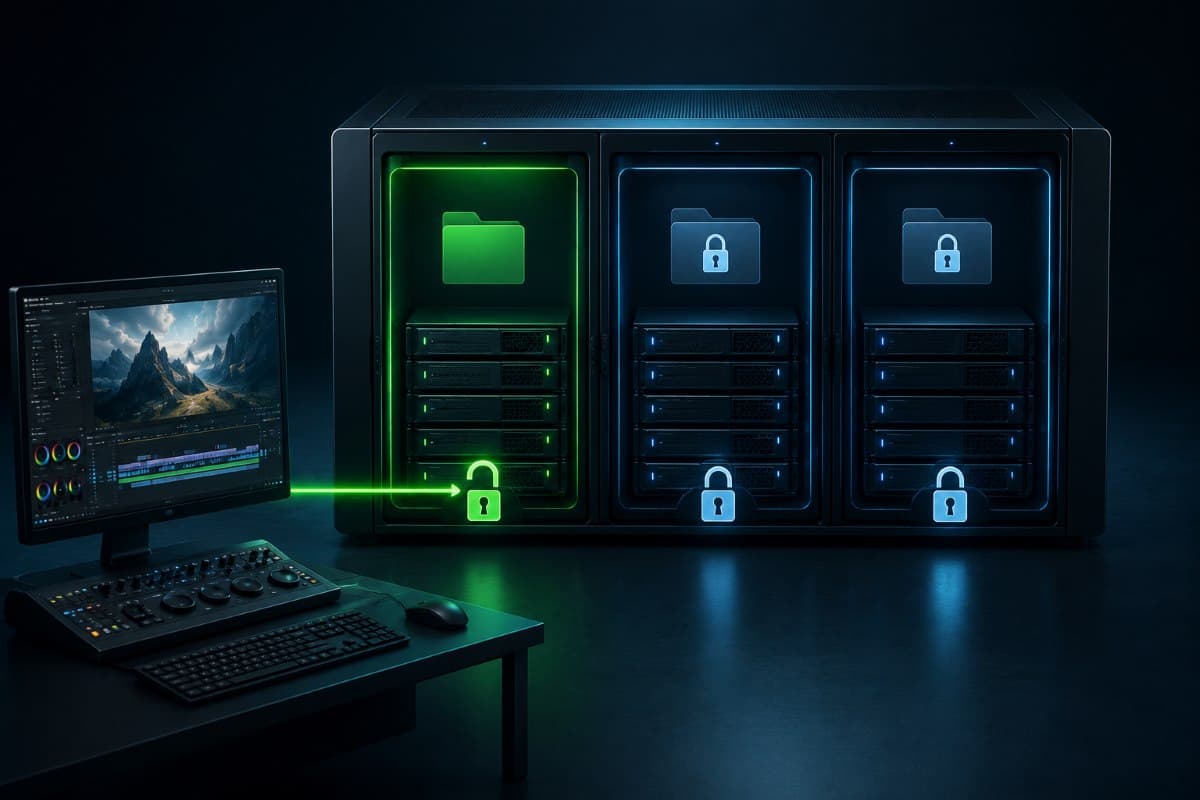
The industry's defining security problem is the leak: unreleased material walking out before its date. The defenses are concrete. Access is granted per project rather than per company, so a freelancer cutting one show sees one show, the discipline behind formal access control rather than a shared password on a sticky note. Client materials move through watermarked, expiring review links instead of open shares. And the environment itself, networks, machines, physical spaces, gets arranged so content stays inside it.
If you work with studio or streamer content, expect this to be inspected rather than assumed. The industry's common yardstick is the Trusted Partner Network, the content security program owned by the Motion Picture Association, which assesses vendors against the MPA's published best practices and records status, from self-attested to independently assessed, on a shared platform the studios consult. Participation is voluntary, but vendors competing for studio work increasingly treat the assessment as a cost of entry, and preparing for it is far easier in an environment that was built with those practices than one being retrofitted under deadline.
The Freelancer Revolving Door
A production company's org chart is a tide. Editors, assistants, colorists, and coordinators arrive for a project and leave when it wraps, and every arrival and departure touches accounts, storage permissions, transfer services, and communication tools. Done casually, this leaves a trail of active accounts belonging to people three projects gone, which is both a security hole and exactly the finding that fails a client's vendor review.
The fix is unglamorous process: a same-day checklist for bringing people onto systems and off them again, tied to project start and wrap dates rather than to whenever someone remembers. Tie both halves to the production calendar and the process runs itself.
The same rhythm covers the remote half of modern post work, where an editor cutting from home needs secure remote access to project storage that performs well enough to work and is scoped tightly enough to satisfy the client whose content it is. Scoped means this project, this show, and nothing beyond them.
Backup, Archive, and the Never-Delete Problem
Production data protection is two different problems wearing one name. Active projects need real backup, because re-shooting is the one recovery plan nobody can afford, and the standard worth holding is the 3-2-1 backup rule: three copies, two different media, one off site, applied to media that grows by terabytes per shoot.
Finished projects need archive, which is a different discipline: moving completed material off expensive fast storage onto cheaper long-term tiers, indexed well enough that the client's request for the project files two years later is an afternoon, not an archaeology dig. Companies that never separate the two end up with active storage full of cold projects and no reliable answer to where anything old lives, paying premium prices to store material nobody has opened since the wrap party.
The Ordinary Attacks Still Apply
Amid the exotic content security, it is easy to forget that a production company is also a business with an accounting inbox, and the everyday attacks hit it unusually hard. Productions pay a rotating cast of vendors, crews, and rental houses on tight timelines, which is exactly the environment where a fraudulent change-of-bank-details email or an invoice from a lookalike vendor address gets paid before anyone questions it.
The defenses are the standard ones, applied seriously: verification of any payment-detail change through a known phone number rather than by replying to the email, protected mailboxes and multifactor sign-in for anyone who touches money, and staff who have seen these tricks in training before they see them live. None of it is glamorous, and it protects real dollars more often than the exotic threats do.
Support That Keeps Production Hours
Production does not fail during business hours as a courtesy. Delivery pushes run into nights and weekends, and the support model has to match: reachable after hours for the failures that stop a mix or an export, with genuine on-site IT support for the problems remote hands cannot fix, a dead storage controller, a bay that will not power, a machine that must be swapped tonight.
For facilities across the San Fernando Valley and the rest of LA, proximity is not a nicety in this vertical; it is a delivery-week insurance policy. A two-hour drive is a missed delivery; a twenty-minute one is a footnote.
Frequently Asked Questions
Three things: file sizes measured in terabytes per project, which makes storage engineering the center of everything; contractual delivery deadlines that turn downtime into penalty clauses; and a workforce that changes every project, which makes account and access management a weekly rhythm. Add client-imposed content security requirements, and the generic office IT playbook simply does not cover the job.
Active work belongs on central shared storage engineered for video bandwidth and simultaneous editors, not on a collection of external drives. That core is surrounded by verified ingest from camera media, controlled delivery to clients, real backup following the 3-2-1 rule for active projects, and a separate indexed archive tier for finished ones. The design details follow from editor count, resolutions, and capacity, which is why it is sized rather than guessed.
The Trusted Partner Network, or TPN, is the media industry's content security program, owned by the Motion Picture Association. It assesses production vendors against the MPA's content security best practices and records each company's status, from self-attested to independently assessed, on a platform studios consult when vetting vendors. It is voluntary, but companies handling studio or streamer content are increasingly expected to show a status, so building the environment to those practices early beats retrofitting under deadline.
With a project-tied process instead of memory: access granted per project on the start date, scoped to only that project's storage and tools, and removed on the wrap date through a same-day offboarding checklist. The test of whether it is working is simple to run: list every active account today and confirm each belongs to someone currently on a project. Orphaned accounts are both the security hole and the vendor-review finding.
Usually yes, and specifically in the upload direction. Ordinary business connections are built for downloading, while production life is uploading: dailies to reviewers, deliverables to clients, archives to cloud tiers. Symmetrical fiber with generous upload capacity, sized against your real delivery patterns, prevents the classic failure of a finished export spending all night crawling to the client. It is a planning item, not an afterthought.
Good IT for media and entertainment is invisible on the days it matters most: the storage keeps up, the client's security questionnaire gets answered from documentation rather than scramble, and delivery week is only stressful for creative reasons. If your facility or production office wants its storage, security, and support reviewed against how this industry actually gets vetted, GlobeVM will walk your environment and tell you plainly where it stands.
Comments
0 Comments