Every fall, small business owners sit down to build next year's numbers, and the IT line gets the least honest treatment on the sheet. Most companies take last year's figure, add a little, and hope. Then March arrives, a server dies or a compliance requirement lands, and the "budget" turns out to have been a guess wearing a spreadsheet. Building a real IT budget for small business operations does not require a finance degree; it requires pairing the numbers with a technology roadmap, so that money and sequence are decided together instead of colliding mid-year.
How to Build an IT Budget and Technology Roadmap for Next Year

By George
21 September 2026

This guide walks through both halves: what actually belongs in the budget, how to build the IT roadmap that makes the budget trustworthy, when to do the work, and how to estimate figures without inventing them. It is written for the owner or office manager who signs off on the spending, not for a CIO with a planning department.
Why an IT Budget Fails Without a Technology Roadmap
A budget is a list of amounts. A roadmap is a list of decisions placed in time. When a business has the first without the second, the amounts are fiction, because nobody has decided what will happen or when. The reverse fails too: a roadmap without a budget is a wish list. The two documents only work as a pair.
What an IT roadmap actually is
An IT roadmap is a twelve-to-thirty-six-month plan that lays out what your technology needs to do for the business, which changes will get you there, and in what order. It answers three questions for every planned item: why this, why now, and what depends on it. A good one fits on two pages. It is not a product brochure and it is not a list of everything that could be nicer; it is the short list of what will actually change, sequenced so the changes do not trip over each other.
The cost of planning nothing
Unplanned technology spending carries an emergency premium. Equipment bought the day it is needed is bought at whatever it costs that day, shipped overnight, and installed at urgent rates. Decisions made during an outage are made without comparison or negotiation. That premium is exactly the pattern behind unplanned IT spending that owners complain about every year, and a roadmap is the only reliable cure, because it converts emergencies into scheduled line items twelve months before they happen.

What Belongs in a Small Business IT Budget
Most incomplete budgets fail the same way: they capture the obvious subscriptions and forget everything with a lifecycle. A complete budget has five categories, and the discipline is filling in all five even when a line is small.
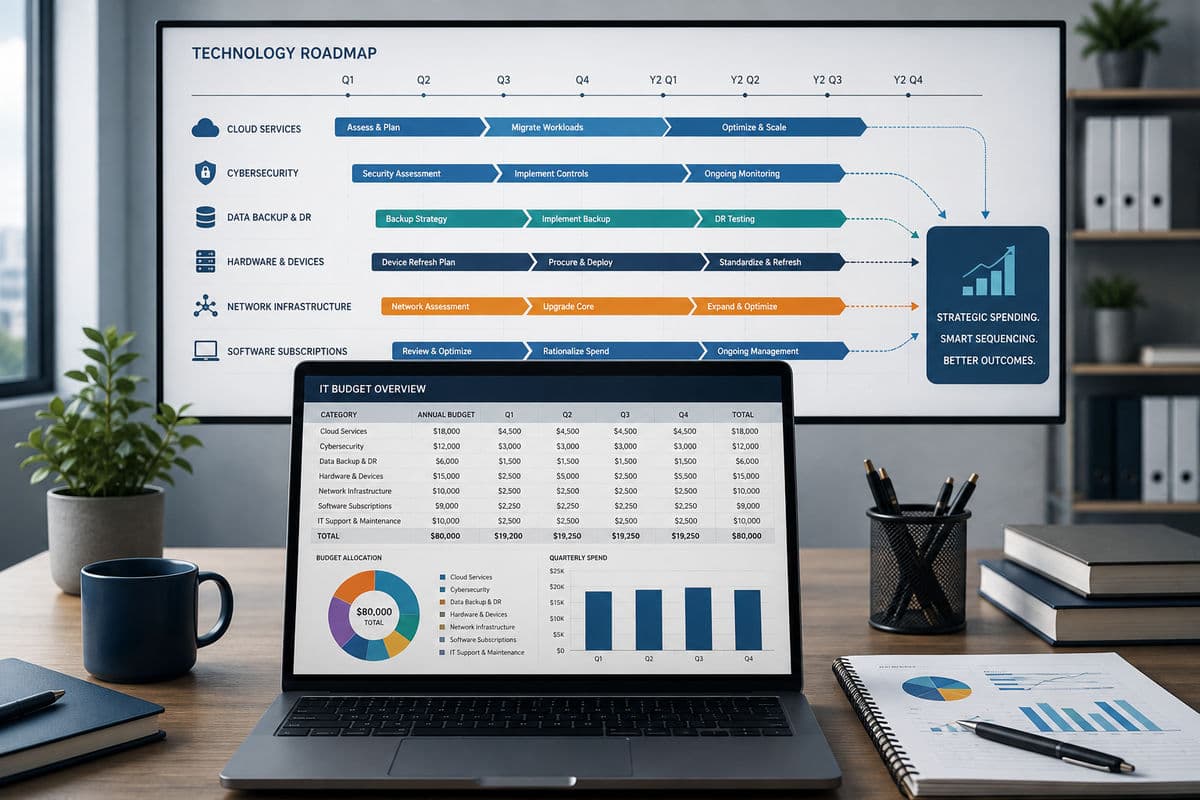
Run costs: the recurring floor
These are the amounts your business pays just to operate as it does today: software subscriptions and licenses, internet and phone service, cloud services, domain and email costs, and your support arrangement, whether that is an internal salary, an outside provider, or both. Pull twelve months of invoices rather than remembering; recurring costs hide in personal credit cards and departmental purchases, and the true floor is nearly always higher than the remembered one.
Security and compliance baseline
Endpoint protection, email security, backup, multi-factor authentication, and security awareness training belong in the base budget, not in a someday column. If your business carries obligations such as HIPAA or the FTC Safeguards Rule, the recurring cost of staying compliant, including assessments and documentation time, goes here as well. Budgeting security as optional is how it becomes an emergency purchase later, at emergency prices.
Hardware lifecycle
Every device in the business is aging toward a replacement date, and the budget should reflect the ones whose date falls in the coming year. Workstations have a sensible service life measured in years, not in "until it dies," because a dying machine chooses its own timing. The businesses that scrambled when Windows 10 end of support arrived were not surprised by the calendar; they were surprised by their own inventory, because nobody had a list of which machines could not move forward. Maintain the list, and the hardware line becomes arithmetic instead of drama.
Projects and improvements
This is the roadmap's column: the migration, the phone system replacement, the second-location buildout, the line-of-business software upgrade. Each project gets its own estimated figure, including the labor to implement it, which is the part budgets most often omit. A new server priced without migration labor is half a number.
Contingency
Some portion of the budget should be reserved for the year behaving like a real year: a failed device outside its window, a price increase mid-term, an unplanned licensing need when you hire faster than expected. A contingency line is not padding; it is the difference between absorbing a surprise and reopening the whole budget in July.
Building the IT Roadmap: A Twelve-Month View
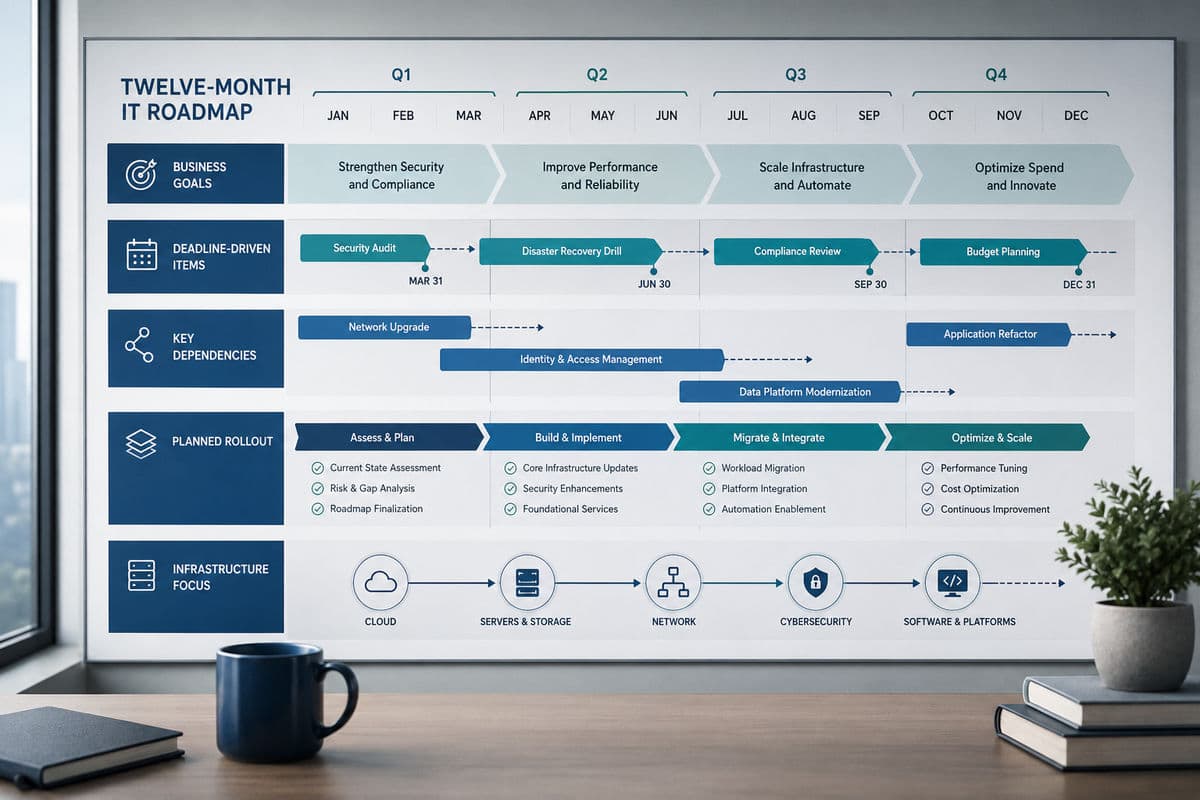
With the categories defined, the roadmap decides what happens when. The sequence below is the one that consistently produces a plan a business actually follows.
Start from business goals, not equipment
The roadmap begins with what the business intends to do next year: open a location, add ten hires, take on a contract with security requirements, move a workflow online. Each goal implies technology work, and technology work that maps to no goal should justify itself hard or leave the plan. This single habit is what separates a plan from a shopping list, and it is the core of turning IT from a cost center into a growth driver: the spending exists because the business direction requires it, and everyone can see the connection.
Anchor the deadline-driven items first
Some dates are not yours to move: operating system and software end-of-support dates, warranty expirations, lease and contract renewals, cyber insurance renewal requirements, and compliance deadlines. These go onto the roadmap first, each placed a comfortable margin before its real deadline, because everything else must schedule around them. A renewal calendar, kept in one place and reviewed quarterly, is the least glamorous document in IT planning and one of the most valuable.
Sequence the dependencies
Projects have an order hiding inside them. The practice management upgrade may require the new server first; the new phone system may need the network upgrade; the second location cannot open on equipment that has not been ordered. Walk each project backward from its finish date and write down what must exist before it starts. Dependency mistakes are the single most common reason roadmaps slip, and they are almost free to catch on paper in October and expensive to discover live in April.
Spread the year deliberately
Then place the remaining work across the quarters in prose terms everyone understands: early in the year for items that reduce risk fastest, the middle quarters for projects needing user training and adjustment, the final quarter kept intentionally light, because year-end has a way of filling itself. A roadmap with every quarter packed full is a schedule for missing dates; slack is a feature.
When to Do This: The Fall Budget Cycle
For calendar-year businesses, the planning window is September through November, and the timing is not arbitrary. Renewal notices for the coming year arrive in fall. Vendors quote more willingly before their own year-end. Hardware ordered in the fall arrives before the holiday logistics crunch. And a budget approved in November gives January a running start instead of a planning meeting. The practical sequence looks like this:
- Inventory review: update the device list, ages, and warranty status
- Renewal calendar: list every contract, license, and policy with its date and expected change
- Risk list: name the systems whose failure would genuinely hurt, and their current condition
- Goal input: get next year's business intentions from whoever sets them
- Draft the roadmap, price it into the five budget categories, and circulate
- Approve before December, with the contingency line intact
Businesses on a fiscal year shift the window; the sequence stays the same, anchored two to three months before the year begins.
Estimating the Numbers Without Guessing
The figures themselves come from four honest sources, in order of reliability. First, history: last year's actual spending, category by category, is the base layer, adjusted for known changes rather than copied. Second, quotes: every roadmap project large enough to matter deserves a real quote during budgeting season, not a placeholder to be "firmed up later," because later is when the budget is already approved. Third, per-seat math: subscriptions scale with headcount, so multiply planned hires by their license and equipment cost per person and the growth line writes itself. Fourth, published benchmarks, used with care: figures for IT spending as a share of revenue circulate widely and vary by industry and size, so treat any benchmark as a sanity check on your bottom line, never as the target that generates it.
One structural choice affects how all these numbers feel: whether spending lands as large periodic purchases or as steady monthly amounts. Shifting infrastructure and support from ownership to subscription changes the shape of the same money, and for many small businesses the move from CapEx to OpEx is what finally makes the IT line predictable enough to plan around. Neither shape is universally right; the budget just needs to be honest about which one you have chosen.

Who Owns the Roadmap
A plan without an owner is a document, and documents do not reschedule themselves when reality moves. Someone specific must hold the roadmap: review it quarterly, mark what shipped, and re-sequence what slipped. In a company with an internal IT person, that person co-owns it with whoever controls the money. In a company without one, this is precisely the gap a fractional IT executive fills, and understanding what a vCIO does makes the option concrete: strategy and planning ownership at a fraction of an executive salary. Businesses that want the planning done with them rather than for them typically engage IT consulting for exactly this fall cycle, then keep the quarterly reviews as the ongoing rhythm. We build these plans year-round with companies across the San Fernando Valley, and the pattern is consistent: the plan survives contact with the year only when its review dates are on someone's calendar in advance.
The Budgeting Mistakes That Repeat Every Year
The same handful of errors accounts for most broken IT budgets, and every one of them is avoidable on paper:
- Copying last year — inheriting both last year's blind spots and prices that no longer exist
- Zero contingency — building a budget that only works if nothing surprising happens all year
- Ignoring the renewal calendar — then meeting every price increase as an emergency
- Pricing hardware without labor — the server is in the budget, the migration weekend is not
- Treating security as an add-on — deferring baseline protection until an incident prices it for you
- Planning without business goals — buying technology the strategy never asked for
Frequently Asked Questions
Begin in September and aim to approve before December for a calendar-year business, or two to three months before your fiscal year starts. Fall timing lets renewal notices, vendor quotes, and hardware lead times inform the plan instead of surprising it, and it gives January a running start.
There is no single correct figure, and published percentage-of-revenue benchmarks vary too widely by industry and company size to serve as a target. Build the number from your own five categories: run costs, security baseline, hardware lifecycle, roadmap projects, and contingency. Then, if you like, compare the total against a benchmark as a sanity check, never the other way around.
The budget states how much you will spend by category; the roadmap states what will happen, in what order, and why. The roadmap makes the budget trustworthy because every large figure traces to a decided project with a date, and the budget makes the roadmap real because every planned change has funded money behind it.
Five categories cover a complete budget: recurring run costs such as licenses, connectivity, and support; the security and compliance baseline; hardware replacements falling due this year; roadmap projects with implementation labor included; and a contingency reserve for the surprises a real year produces. Most broken budgets are missing at least two of the five.
A working IT budget for small business planning is really two documents holding hands: honest numbers in five categories, and an IT roadmap that decides the order in which the money turns into results. If you would rather build next year's plan with someone who has run this cycle a few hundred times, schedule a fall planning session with GlobeVM and we will bring the roadmap with us.
Comments
0 Comments