
Almost everything a business does now travels across its network, from the files staff open to the systems that keep the company running. That makes the network one of the most valuable things a business owns and one of the most important to protect, because an attacker who gets onto it can reach the data and systems the whole business depends on. Network security is the practice of defending that network and everything connected to it. It is not a single product you buy but a set of layered measures that work together, and putting them in place is one of the most important things a business can do to protect itself. This guide walks through what network security involves, why a layered approach matters, the network security best practices to implement, and a checklist for putting them in place sensibly.
What network security is
Network security is the combination of technologies, settings, and practices that protect a business’s network and the data moving across it from unauthorized access, misuse, and attack. It covers the boundary between your network and the outside world, the way devices and users connect, and the traffic flowing within. The aim is twofold: to keep attackers and unauthorized users out, and to limit the harm if someone does get in. Because a network connects so much together, weak security in one place can put everything connected to it at risk, which is why network security is treated as a foundation rather than an add-on.

Why a layered approach matters
The single most important principle in network security is that no one measure is enough on its own. Any individual protection can fail or be bypassed, so effective security relies on layers, where if one defense is defeated, others still stand between the attacker and your data. This approach, often called defense in depth, means an attacker has to get past not one obstacle but many, and a failure in any single layer does not hand over the whole network. A business that relies on just one protection, however good, has a single point of failure, while one that layers its defenses is far more resilient. Everything that follows in this guide is best understood as a layer in that larger whole rather than a complete solution by itself.

Network security best practices to implement
Putting network security in place means assembling a set of complementary measures. Each addresses a different part of the problem, and together they form the layered defense that protects the business.
Securing the boundary
The edge of your network, where it meets the internet, is the first line of defense, and controlling what is allowed across that boundary is fundamental. This is the role of a firewall, which inspects traffic and blocks what does not belong, and it remains one of the most basic and essential parts of network security. A properly configured and maintained boundary keeps a great deal of unwanted traffic out before it ever reaches your systems, though it is only the beginning. Our guide to business firewall best practices covers the gaps that most often leave this layer weaker than it looks.
Controlling who has access
A large share of security comes down to making sure people and devices can only reach what they are supposed to. This means giving each user only the access their role requires, rather than broad access to everything, so that a single compromised account cannot reach the entire network. Strong authentication is central here, and requiring more than a password to log in, through multi-factor authentication, is one of the most effective single measures a business can take. Limiting access tightly means that even if an attacker gets one foothold, how far they can go is contained.
Dividing the network into segments
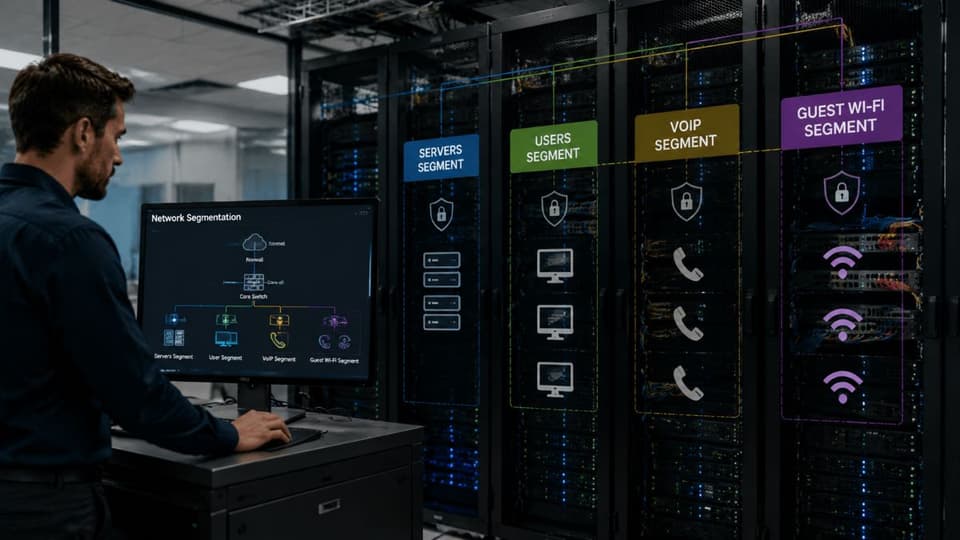
Rather than running everything on one flat network where any device can reach any other, a more secure approach divides the network into separate segments, so that a problem in one area does not automatically spread to the rest. If an attacker compromises a device in one segment, segmentation limits how far they can move, containing the damage instead of letting it reach everything at once. This containment is one of the most effective ways to limit the impact of a breach, turning what could be a company-wide compromise into a contained incident affecting only part of the network. Segments are set up in the firewall and network switches, and keeping them correct as the office changes is part of routine network management.
Securing remote and wireless access
The ways people connect from outside the office or over wireless are common points of weakness if they are not secured. Remote access needs to be protected so that staff connecting from elsewhere do not open a door an attacker can use. Wireless networks need strong protection and sensible separation, for instance keeping guest access away from the systems the business relies on. As more work happens outside a single office, securing these connections has become a larger part of network security. A security model that does not automatically trust any connection, known as zero trust, addresses this reality, and our guide to wireless network security covers the Wi-Fi side in detail.
Monitoring and detection
Even strong defenses can be tested or bypassed, so seeing what is happening on the network is essential. Monitoring traffic and activity allows unusual or malicious behavior to be spotted, ideally early enough to respond before serious harm is done. Without this visibility, an attacker who gets in can operate unseen, which is why continuous monitoring is a core part of network security and connects directly to ongoing remote monitoring and management. Detection turns security from a static wall into something that actively watches for trouble and can react to it.
Protecting the devices on the network
Every device connected to the network, from computers to servers to phones, is a potential way in, so securing those devices is part of securing the network. This means keeping them protected with up-to-date security software, ensuring they are configured safely, and managing them consistently rather than leaving each to its own settings. A network is only as secure as the devices on it, and a single poorly protected device can become the entry point an attacker uses, which is why device security and network security go hand in hand.

Keeping software updated
Much of what attackers exploit is known weaknesses in software that has not been updated. Keeping systems, applications, and network equipment patched closes these openings before they can be used, and neglecting updates leaves doors standing open that attackers actively look for. This is one of the most basic and most effective security practices, yet also one of the most commonly neglected. Verizon's 2025 Data Breach Investigations Report found that exploited vulnerabilities were the way in for 20 percent of breaches, second only to stolen credentials. Consistent updating across the network removes a large category of risk for relatively little effort.
Securing cloud services and email
Network security today extends beyond the office to the cloud services and email a business relies on, since these are where much work happens and where many attacks begin. Configuring these services securely, with proper access controls and protections, is part of defending the business as a whole, and the security settings inside widely used platforms such as Microsoft 365 matter as much as the office firewall. As the boundary of the business stretches into the cloud, securing these services becomes as important as securing the office network itself.
People and policies are part of network security
Technology is only part of the picture, because the people using the network and the rules they follow shape its security just as much. Even a well defended network can be undermined by a staff member who reuses a weak password, falls for a phishing email, or connects an unmanaged device, which is why clear policies and ongoing awareness matter alongside the technical measures. Defining how access is granted, how devices may be used, and how staff should handle security, and helping people understand their part, turns the workforce from a weakness into a strength. The most secure businesses treat their people as an active layer of defense rather than assuming technology alone will protect them.
Common network security mistakes
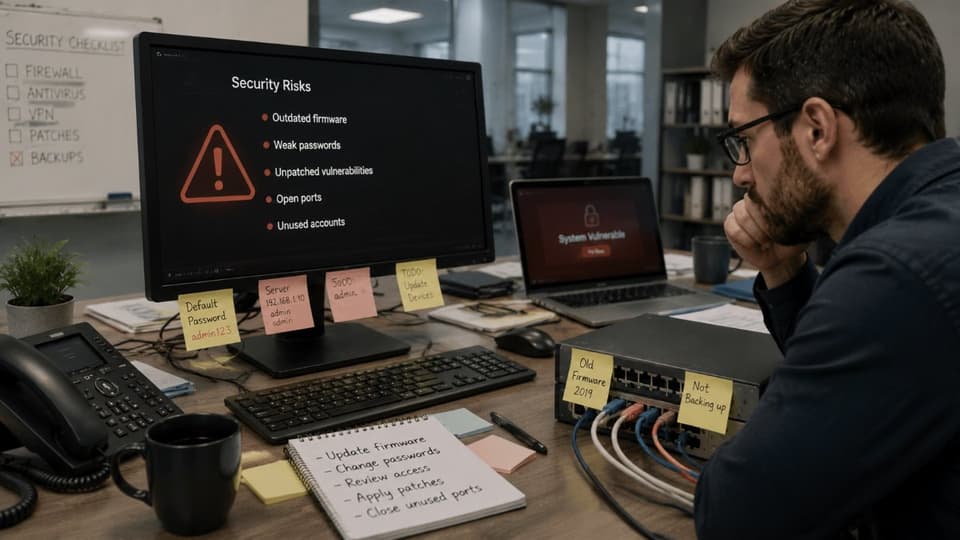
Knowing what to put in place is only half the picture; it also helps to know what regularly goes wrong, because the same gaps appear across many businesses. One of the most common is running a single flat network with no segmentation, so that anything that gets in can reach everything. Another is leaving network equipment on its default settings or default passwords, which are widely known and easily exploited. Many businesses neglect updates, leaving known weaknesses open for months or years, and many have no real monitoring, meaning an intruder could be active without anyone noticing. Weakly secured remote access and unmanaged personal devices connecting to the network are also frequent points of entry.
What these mistakes share is that they tend to come not from a lack of awareness that security matters but from treating it as something that was handled once rather than something that needs continuous attention. A network set up securely two years ago, then left alone while the business grew and the threats changed, may have quietly accumulated all of these gaps. Avoiding them is less about any single advanced technique and more about consistently doing the basics well and keeping at them over time, which is exactly where many businesses fall short.
Where to start with network security
A network security checklist for a small business
Before buying anything, run through the questions below. Each row is one of the layers in this guide, what good looks like for a small office, and the one question that tells you quickly whether it is in place.
| Layer | What good looks like | Quick check |
|---|---|---|
| Firewall | Business-grade device, current firmware, rules reviewed at least once a year | Who last reviewed the firewall rules, and when? |
| Access | Unique accounts, least privilege, MFA on email, remote access, and admin accounts | Is MFA enforced everywhere, with no exceptions? |
| Segmentation | Guest Wi-Fi, staff devices, and servers on separate segments | Can a guest device reach your file server? |
| Remote access | VPN or zero trust access with MFA, no remote desktop exposed to the internet | Can anyone reach remote desktop from outside? |
| Wi-Fi | WPA3, or WPA2 with a strong passphrase, and a separate guest network | When was the staff Wi-Fi password last changed? |
| Updates | Systems, apps, and network equipment patched on a schedule | Is any device past its end of support date? |
| Monitoring | Logs collected and someone responsible for reviewing alerts | Who would notice an intrusion at night? |
| Backups | An off-site copy that cannot be altered, with restores tested | When was the last test restore? |
| People | Security awareness training and a clear device policy | Do staff know how to report a suspicious email? |
Putting the measures in order
Implementing network security can feel like a lot at once, but it becomes manageable when approached in order of what matters most. The sensible starting point is understanding what you have and where you are exposed, which means assessing your current network, the devices on it, and the gaps in your defenses. From there, the most impactful measures, controlling access with strong authentication, securing the boundary, keeping software updated, and gaining visibility into what is happening, address the largest risks first. Because network security is layered and ongoing rather than a one time project, it is best handled as part of a broader, continuous approach to protecting the business, which is what dedicated cybersecurity solutions provide.
It also helps to test your defenses honestly. The most reliable way to find weaknesses before an attacker does is to look for them deliberately, for example through a penetration test that probes the network the way a real attacker would.
Network security is ongoing, not a one time setup
Perhaps the most important thing to understand is that network security is never finished. Threats change, new weaknesses appear, the business grows and adds systems, and defenses that were adequate last year may not be today. Security that is set up once and left alone steadily falls behind, which is why it has to be maintained, monitored, and updated continuously. This ongoing nature is why so many businesses handle network security as part of a managed relationship rather than a project with an end date. That way the protection keeps pace with both the business and the threats it faces. For companies in Woodland Hills and across the San Fernando Valley, that continuous approach is what keeps network security effective over time rather than letting it quietly decay.
If you want strong, layered network security in place, GlobeVM can assess, build, and maintain those defenses through managed IT services in Los Angeles.