
For years, one person has kept your technology running. They reset passwords, set up new laptops, untangle the printer, manage email, and somehow always know which cable goes where. As your organization has grown, that person has quietly absorbed more and more responsibility, and most days it still works. The trouble with the one IT guy model is not the person. It is the structure. A single employee, however capable, has a fixed number of working hours, one set of skills, and one body that needs to sleep and take vacations. At a certain size, the gap between what your business depends on and what one individual can realistically deliver stops being a minor inconvenience and becomes a genuine business risk. This article looks at where that line sits, what specifically breaks when you cross it, and the realistic options for fixing it without losing the person your team already trusts.
The Hidden Math of a One-Person IT Department
Most owners assume a single internal hire is the economical choice. One salary, one desk, one number to call. The full picture is more complicated, and it works against the solo model in two directions at once.
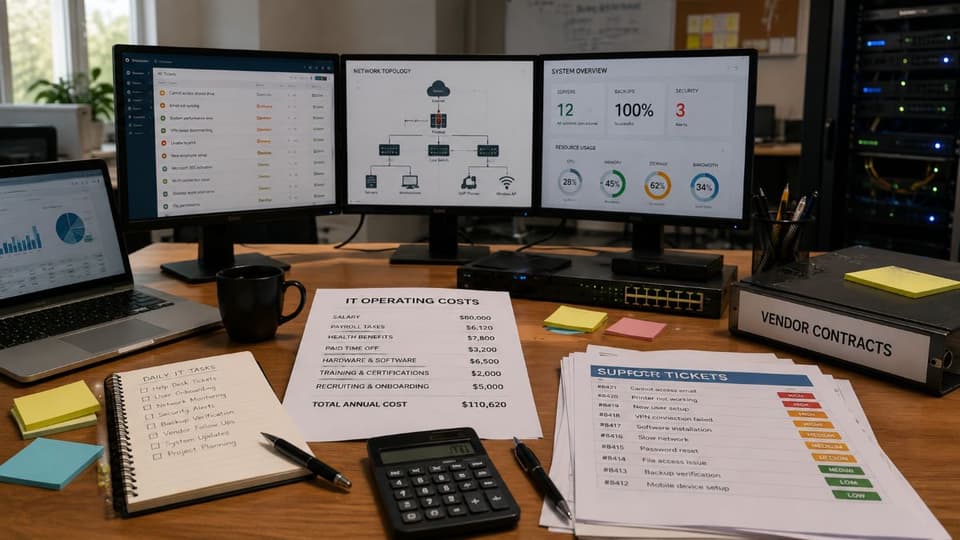
The first direction is cost. Salary surveys for a competent IT generalist vary widely, which itself tells you something, but in a higher-cost market like the Los Angeles area a base salary in the range of roughly $70,000 to $95,000 is realistic for someone who can handle the breadth this role demands. Base salary is only part of it. Once you add payroll taxes, health benefits, paid time off, the hardware and software that person needs, ongoing training and certification, and the cost of recruiting a replacement when they leave, the fully loaded cost commonly lands 25 to 40 percent above the base figure. A position you budgeted as one salary frequently costs the business well over six figures a year.
The second direction is scope. A single in-house IT person is usually expected to cover all of the following:
- Day-to-day help desk and end-user support
- Network setup, firewalls, and connectivity
- Server and cloud infrastructure
- Backups and disaster recovery
- Cybersecurity, patching, and threat monitoring
- Software licensing and hardware procurement
- Vendor management for internet, phones, and applications
- Regulatory compliance documentation and audits
- Strategic technology planning and budgeting
No single human is genuinely expert across all nine areas. Someone who is excellent at end-user support may have shallow knowledge of network security. A strong infrastructure person may dislike, and therefore neglect, the help desk work that keeps staff productive. So the real math of the one IT guy model is this: you are paying a six-figure all-in cost for partial coverage of a job that was always bigger than one person.
Six Structural Risks of Relying on One IT Guy
These risks are not a criticism of your IT employee. They are the predictable consequences of asking one individual to be an entire department.
1. A Single Point of Failure for Your Entire Operation
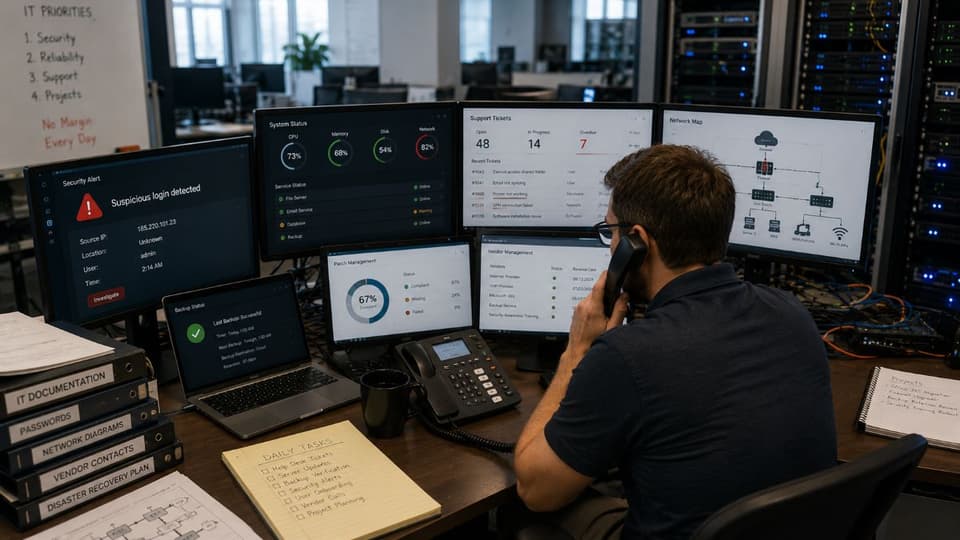
If your one IT person is out sick, on vacation, or simply unreachable during an incident, your organization has no technical depth to fall back on. A server failure on a Friday afternoon, a ransomware alert at 2 a.m., or a botched update can sit unresolved for hours or days. The same risk applies to knowledge: critical passwords, network diagrams, and vendor contacts often live in one person's head rather than in documented systems. Proper data backup and disaster recovery only protects you if someone is available and able to execute the recovery when it matters, and one person cannot guarantee that.
2. No Coverage Outside One Person's Working Hours
Cyberattacks and hardware failures do not wait for business hours. A single employee covers maybe 45 working hours a week, which leaves roughly three quarters of the calendar with no one watching. Threats that surface overnight or over a long weekend can spread for hours before anyone notices. This is why around-the-clock monitoring has become a baseline expectation rather than a luxury, and it is one capability a solo IT person physically cannot provide without burning out.
3. The Breadth Versus Depth Ceiling
Technology has specialized faster than any one career can keep pace with. Cloud architecture, identity management, network security, and compliance each justify a full-time specialty on their own. When one person owns everything, they default to breadth and lose depth. They become competent enough to keep the lights on but rarely current enough to design systems well or catch subtle problems early. Even routine work suffers, because the same person handling a strategic project cannot also answer the steady stream of staff tickets that dedicated help desk support is built to absorb.
4. Reactive Firefighting Crowds Out Strategy
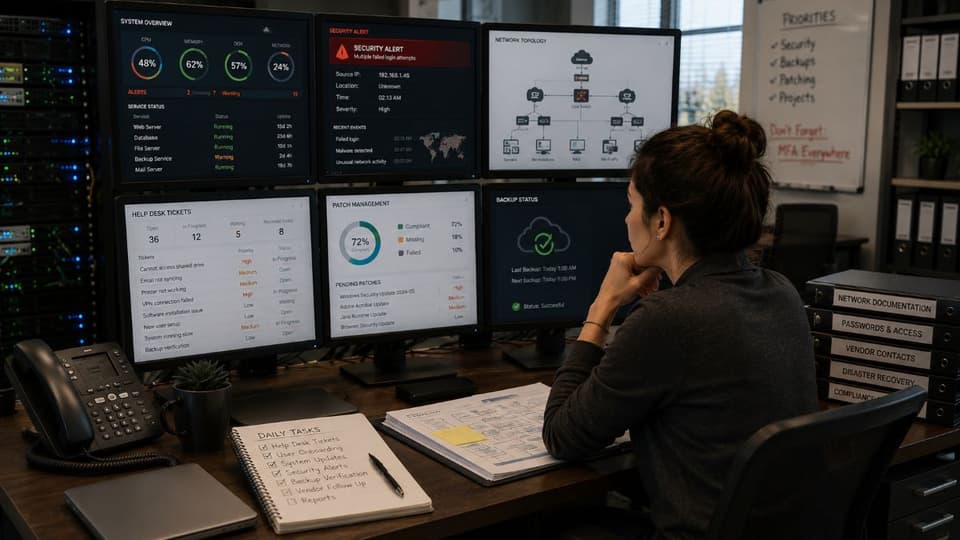
An overloaded IT person spends their day responding to whatever is loudest. The broken laptop, the email that will not send, the meeting room screen that went dark. Important but non-urgent work, such as planning a cloud migration, refreshing aging hardware on a schedule, or building a security roadmap, keeps getting pushed to next month. Months turn into years. The result is an organization whose technology quietly falls behind its own growth, with no one holding the strategic view because the only IT person never has a free hour to hold it.
5. Security and Compliance Gaps No One Is Watching
Security is where the one-person model fails most quietly and most expensively. Patching slips. Multi-factor authentication is enabled inconsistently. Risk assessments are postponed. Logs go unreviewed. None of this is visible until an incident exposes it. A single generalist rarely has the time or specialized training to run a real security program, which is a different discipline from general IT support and is better served by structured cybersecurity solutions. For regulated businesses the stakes are higher still. HIPAA, for example, requires a designated security official and a documented security risk analysis, obligations that are difficult for one overstretched person to satisfy and defend in an audit.
6. Burnout and the Knowledge That Walks Out the Door
Carrying an entire department alone is exhausting. The one IT guy is on call indefinitely, rarely takes a true vacation, and absorbs the frustration of every staff member with a tech problem. Burnout follows, and so does turnover. When that person leaves, they take undocumented knowledge with them, and the business faces a recruiting gap of weeks or months during which IT effectively has no owner. You are not just losing an employee, you are losing your only institutional memory of how your systems work.

When One IT Person Is Still Enough
Honesty matters here, because not every business needs to change. If the following describe your organization, a single capable IT employee may still be the right setup, and you should not let a sales pitch convince you otherwise:
- You have fewer than 20 to 25 staff and a simple, standardized technology stack
- Your regulatory exposure is low, with no HIPAA, PCI, or similar obligations
- Your IT person is genuinely keeping up, not visibly overloaded, and proactive work is actually getting done
- You have documented your critical passwords, vendors, and recovery steps so the business is not exposed if that person is unavailable
- You have an honest plan for after-hours emergencies, even if it is informal
The point is not that one IT person is always wrong. It is that the model has a clear ceiling. The mistake is assuming it scales with your business when it does not.

Your Realistic Options Once You Have Outgrown Solo IT
If the risks above describe your situation, you have three practical paths. Each has real trade-offs, and the right answer depends on your size, budget, and how much internal control you want to keep.

Option One: Hire a Second or Third IT Employee
Building an internal team adds depth and coverage, and it keeps everything in-house. The trade-offs are significant. You roughly double or triple your fully loaded payroll cost, you take on the recruiting and retention burden in a competitive hiring market, and even a three-person team struggles to provide genuine 24/7 coverage or deep expertise in every specialty. This path tends to make sense for larger organizations with proprietary systems that demand constant dedicated attention.
Option Two: Replace Internal IT With a Fully Managed Provider
Outsourcing the entire function to a provider gives you a whole team, a range of specialists, after-hours coverage, and predictable monthly billing instead of unpredictable hiring costs. The honest trade-offs are less direct control over priorities, an external partner who does not live inside your company culture the way an employee does, and the need to choose a provider carefully, because quality varies widely across the industry. For many small and mid-sized businesses without an existing IT hire, well-structured fully managed IT services are the most efficient way to get complete coverage.
Option Three: Keep Your IT Person and Add a Co-Managed Partner
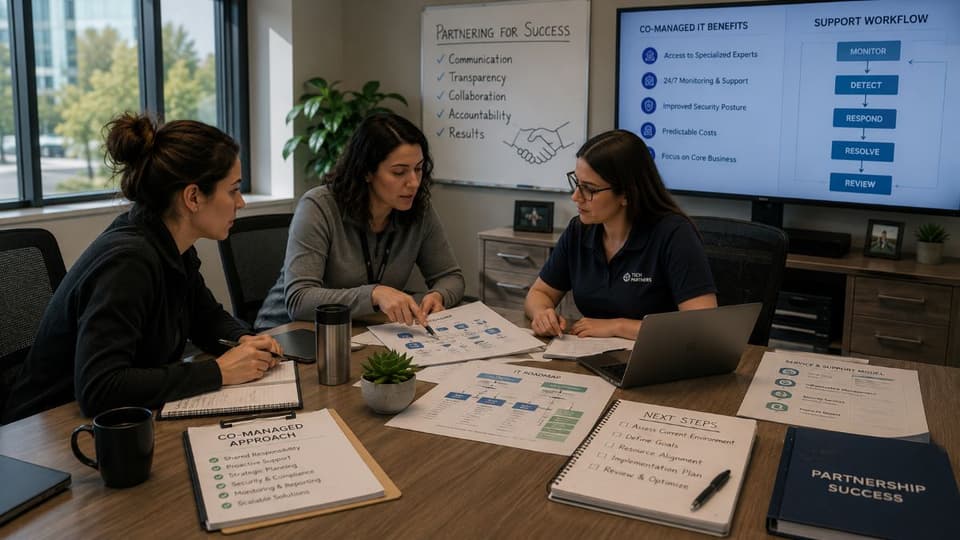
For organizations that already have a trusted internal IT employee, this is often the strongest fit. With a co-managed arrangement, your internal person stays in place and keeps the institutional knowledge and the personal relationships, while an outside team adds the depth, the tools, the after-hours coverage, and the specialist skills they cannot provide alone. Your IT person stops being a single point of failure and becomes the internal lead of a larger capability. Structured co-managed IT services let you solve the one IT guy problem without firing the person your team already relies on, which is usually the outcome owners actually want.
How to Tell Which Model Fits Your Organization
Use this short checklist as a practical decision tool. The more of these that point toward strain, the more urgent the change.
- Headcount and complexity. Are you past 25 staff, multiple locations, or a mixed cloud and on-premises environment? Complexity, not just headcount, drives the need for a team.
- Coverage gaps. Has an incident ever gone unaddressed because your IT person was unavailable? If yes, you already have a coverage problem.
- Strategic backlog. Has an important technology project sat unfinished for six months or more? That signals reactive overload.
- Security posture. Can you confirm patching is current, multi-factor authentication is enforced everywhere, and a risk assessment was done in the last year? Uncertainty here is itself the answer.
- Regulatory exposure. If you handle protected health information or payment data, formal compliance and risk management services are not optional, and one generalist rarely covers them adequately.
- Key-person risk. If your IT person resigned tomorrow, how exposed would the business be? If the honest answer is "very," that risk needs addressing regardless of which model you choose.
A business that scores clean on most of these can reasonably stay with a single IT employee for now. A business showing strain on three or more points has, in practical terms, already outgrown the one IT guy model and is simply absorbing the cost of that gap without naming it.
If you are not sure whether your current IT setup can carry your organization through its next stage of growth, a short conversation with the team at GlobeVM can help you map the gaps before they turn into outages.