



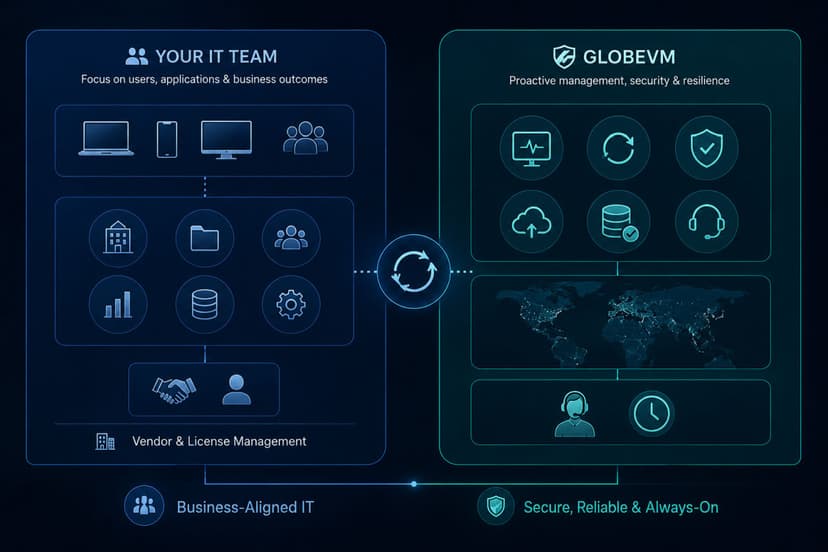



do not have is enough of them. Co-managed IT services exist for exactly that situation: your internal team stays, keeps its knowledge and its relationships, and gains an outside bench that covers the gaps in hours, headcount, and specialized skills. It is not a replacement arrangement and it is not a takeover. It is a division of labor, written down, that both sides can rely on.
What Co-Managed IT Services Actually Include
The model is flexible by design, but a serious co-managed IT services arrangement usually settles into a clear split.
What stays with your team
Your people keep what they are best at and what benefits most from being in the building. That often means direct user relationships, business applications that need institutional knowledge, vendor relationships they already own, and projects tied closely to how the company operates day to day.
What the outside team takes on
We typically absorb the work that punishes small teams: after-hours coverage, patching and maintenance that never quite gets scheduled, monitoring that requires someone watching at all times, documentation, and the deep specialties like security engineering or backup and disaster recovery that are hard to justify as a full-time hire. The split is written into the agreement so there is no confusion about who owns what when something breaks.
Who Co-Management Fits Best
The clearest case is the company that grew around a single IT person. That person is capable and overloaded, takes vacations reluctantly, and carries risks nobody talks about: what happens when they are sick, when they leave, or when a problem appears that is simply outside their experience. Co-management gives them backup instead of replacing them, which is usually what the business owner wanted all along. It also fits larger internal teams that are strong on operations but thin on security, or teams that lose too many hours to routine tickets when they should be working on projects that move the company forward.
How Responsibilities Get Divided Without Friction
The arrangements that fail are the ones that stay vague. The ones that work define ownership per system, not per vibe. Who administers the firewall. Who approves new user accounts. Who owns the relationship with the internet provider. Which tickets route to which desk, and what the escalation path looks like in both directions. Shared documentation matters just as much: both teams work from the same system inventory, the same credentials vault, and the same change log, so a fix made by one side never surprises the other. Expect that setup work in the first month. It is the foundation everything else stands on.
Co-Managed or Fully Outsourced: An Honest Comparison
Co-management is not automatically the right answer. If your internal capability is one overwhelmed person who wants out, or your IT needs are straightforward, fully outsourcing may be simpler and cheaper. If your systems are complex, your applications are specialized, or your internal knowledge is genuinely valuable, keeping that team and reinforcing it usually wins. The tradeoffs are laid out in our comparison of in-house IT vs outsourced managed services, and the honest summary is that the right model depends on what you already have, not on what a provider prefers to sell.
How Pricing Usually Works
Co-managed agreements are typically priced on scope rather than a single flat rate. Common structures include a per user or per device fee for the covered services, with project work quoted separately, or a defined block of responsibilities for a fixed monthly amount. What matters more than the structure is that the boundaries are written down: which systems, which hours, which types of requests. Vague scopes produce billing surprises and finger pointing, and both are avoidable. Expect a provider to ask real questions about your environment before quoting, because a number offered without discovery is a number that will change later.
What Changes for Your Internal Team
The fear worth addressing directly: internal IT staff sometimes hear co-managed and think replacement plan. In practice the opposite tends to happen. The routine flood recedes, the 2 a.m. alerts go to someone paid to be awake, and your team finally has time for the projects that were always postponed. The internal people who thrive under co-management are the ones who were drowning under everything, and most of them are relieved to stop pretending one person can be a whole department.
A Partnership Worth Putting on Paper
Co-managed IT services work when the boundaries are explicit, the documentation is shared, and both teams treat each other as colleagues rather than competitors. If your IT team is good but stretched, we are happy to sit down with them, not around them, and sketch what a sensible division of responsibilities would look like for your company.