
The moment a business realizes its files have been encrypted by ransomware is one of the worst in its operating life. Systems are locked, work stops, and a ransom note demands payment for a key that may or may not work. In that moment, the question that matters most is also the simplest: can we get our data back? Ransomware data recovery is the process of restoring your business to working order after an attack, and how well it goes depends almost entirely on decisions made before the attack ever happened. This guide focuses specifically on recovery, the strategies that actually return your data, the honest truth about paying, and why recovery succeeds or fails. For the broader response process, including containment, notification, and prevention, those are covered separately, and this article concentrates on getting your data back.
Recovery begins long before the attack
The hardest truth about ransomware data recovery is that your options during an attack are set by your preparation before it. A business with tested, offline backups has a clear path back. A business without them is left with bad choices and a high chance of permanent loss. There is no tool or specialist that can reliably reconstruct properly encrypted data without either a working backup or a decryption key. This is not meant to discourage anyone already in the middle of an incident, but it explains why the single most powerful recovery strategy is one you put in place in advance, and why this article keeps returning to backups as the foundation.

Before you recover: contain the attack first
One critical point before any recovery attempt: do not start restoring data into a compromised environment. If the attacker still has access or the malware is still active, restored data can simply be encrypted again, and a premature recovery can destroy forensic evidence you may need. The first priority is to isolate affected systems by disconnecting them from the network, and to determine the scope of the compromise. Recovery comes after containment, not before. The full sequence of containment, investigation, and notification is its own discipline, and a thorough ransomware response involves more than recovery alone, which is why having a planned response and capable cybersecurity solutions in place matters so much, something we help businesses throughout Thousand Oaks and the surrounding area prepare before an incident ever happens. This article assumes containment is handled and focuses on the recovery that follows.

Should you pay the ransom?
This is the question every victim asks, and it deserves an honest answer rather than a slogan. The official position is clear: the FBI does not support paying ransoms in response to ransomware attacks. There are sound reasons behind that guidance, and a business should understand them before making a decision under pressure.
First, paying does not guarantee recovery. You are trusting criminals to provide a working decryption key and to actually deliver it, and in many cases the key works poorly, partially, or not at all. Second, payment funds and encourages the criminal operation, and marks your business as one willing to pay, which can invite repeat attacks. Third, there can be real legal implications, because paying a sanctioned entity may itself violate the law, which is a matter for legal counsel rather than a quick decision. And fourth, with modern double extortion attacks, where criminals steal your data before encrypting it, paying for a decryption key does nothing to undo the theft. The stolen data is already gone, and paying does not reliably get it deleted.
None of this means the decision is simple for a business facing total data loss, and it is ultimately a business and legal decision, not solely a technical one. But it should be made with clear eyes, alongside legal counsel and ideally law enforcement, and only after exhausting the recovery options below. The existence of working backups is what removes this dilemma entirely.

Proven ransomware data recovery strategies
With containment handled, these are the strategies that actually recover data, in roughly the order you should pursue them.

Restore from clean, offline backups
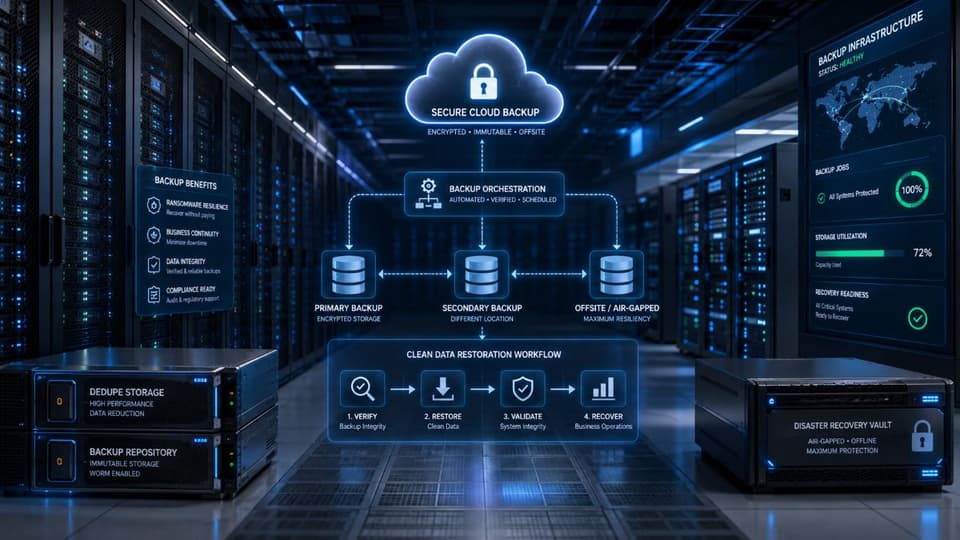
This is the primary and most reliable recovery path, and it is why backups matter more than any other single factor. If you have backups that the attacker could not reach or alter, recovery becomes a matter of rebuilding clean systems and restoring your data to them. The critical word is clean. You must be confident the backup itself is not infected and predates the compromise, and you must restore into an environment that has been cleared of the attacker, or the same encryption can happen again. Offline or immutable backups, the kind ransomware cannot touch, are what make this path possible, and reliable data backup and disaster recovery is the foundation the entire recovery rests on.
Check for free decryption tools
For some ransomware variants, security researchers and law enforcement have developed free decryption tools, and it is always worth checking before considering anything else. The No More Ransom project, an initiative supported by Europol and the Dutch National Police, offers free decryption tools for many known ransomware families at nomoreransom.org. The U.S. government's StopRansomware.gov is another legitimate source of no-cost resources, and the FBI maintains decryption tools that may help with certain variants. These will not cover every strain, particularly the newest ones, but when a tool exists for the ransomware that hit you, it can recover your data without paying anyone. Never download supposed decryption tools from unverified sources, as fake decryptors are themselves a common scam.
Rebuild clean when recovery is only partial
Sometimes recovery is incomplete. Backups may be partial, or only some systems may be restorable. In these cases, recovery becomes a careful rebuild: standing up clean systems, restoring what data you can verify is safe, and reconstructing the rest from whatever sources exist, such as records held elsewhere or by partners. This is slower and more painful than a clean full restore, which is exactly why prevention and tested backups are worth so much. Continuity during this period, keeping the business running while systems are rebuilt, is where business continuity support earns its value.
Why your backups are the real recovery key
Everything above leads back to one point. The decryption key you actually control is a clean, tested backup. A business with one can recover on its own terms, without paying, without gambling on a criminal's key, and without the slow agony of a partial rebuild. A business without one is at the mercy of whatever options remain. This is why backups are not really a recovery topic so much as the recovery topic, and why having them is not enough on its own. A backup you have never tested is an assumption, and ransomware is the worst possible time to discover that the assumption was wrong. Backups must be offline or immutable so attackers cannot destroy them, and they must be tested so you know they will actually restore. That testing is a discipline worth treating as seriously as the backups themselves.
After recovery: closing the door behind you
Recovering your data is not the end. If you restore everything but leave the original vulnerability open, you are inviting the next attack. After recovery, the priority shifts to understanding how the attacker got in and closing that gap, whether it was a phishing email, a stolen password, or an unpatched system. Strengthening defenses, tightening access, and improving monitoring are what turn a painful recovery into a more resilient business. For organizations across Los Angeles and the surrounding area, this hardening step is often where ongoing managed IT services make the difference between a one-time crisis and a recurring nightmare.
If you want to be certain your business could actually recover from a ransomware attack rather than hoping it could, the team at GlobeVM can review your backups and recovery readiness and build a plan that gets you back on your feet without paying a ransom.