




Business continuity is a plain idea wrapped in formal language: the work keeps moving even when something breaks. A server fails, the internet drops, a key employee is out, a storm takes the power, and your team can still see patients, bill clients, and answer phones. The 24/7 part is what makes it real, because failures do not schedule themselves inside business hours, and a problem discovered at 7 a.m. usually started at midnight.
What 24/7 IT Services for Business Continuity Include
Continuity is not one product. It is several ordinary disciplines done consistently, with someone responsible at every hour.
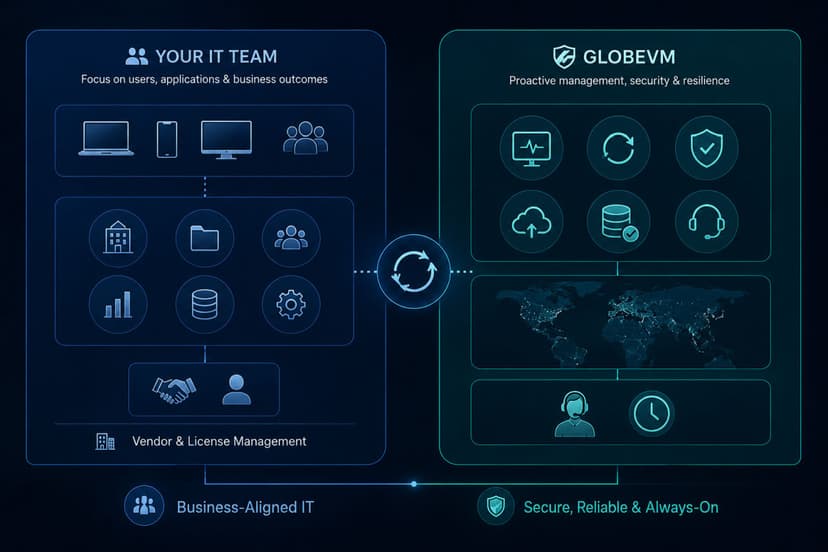
Monitoring that never clocks out
Systems announce their failures in advance more often than people think. Disks report errors before they die, servers log warnings before they stop, and backup jobs fail quietly days before anyone needs the backup. Around the clock monitoring means those signals reach a human who acts on them, at 3 p.m. or 3 a.m., instead of waiting in a log nobody reads.
Maintenance in the hours you are not working
Patching and updates are necessary and disruptive, which is why so many businesses postpone them until postponing causes an incident. A continuity minded provider schedules that work overnight and on weekends, so the systems are current and your staff never notices the work happening.
A reachable desk at every hour
When something does break at night, the difference between a continuity plan and a phone tree is whether a person answers. Overnight coverage connects to the same helpdesk and IT support operation that handles the day, with access to the same documentation, so the person answering at midnight is not starting from zero.
The Plan Behind the Coverage
Round the clock effort without a plan is just expensive improvisation. Real business continuity planning answers questions before the bad day: which systems matter most, in what order they come back, who declares an incident, who contacts staff and clients, and what everyone does while systems are down. The plan does not need to be a binder nobody opens. It needs to be short, current, and known by the people named in it.
Testing instead of hoping
A plan that has never been rehearsed is a document, not a capability. Testing does not need to be disruptive. A tabletop exercise walks the named people through a scenario on paper and reveals the gaps in an hour: the phone list that is out of date, the vendor contact nobody saved, the step that assumes a person who left last year. Restore tests prove that backups actually come back as working systems, not just as green checkmarks in a dashboard. An annual review keeps the plan matched to the business as staff, systems, and priorities change. None of this is glamorous, and all of it is the difference between a plan that holds at 2 a.m. and one that fails its first real use.
RTO and RPO in Plain Language
Two numbers anchor every continuity conversation. Recovery Time Objective is how long you can afford to be down. Recovery Point Objective is how much recent work you can afford to lose. A dental office might tolerate four hours of downtime but almost no data loss, while a design firm might accept losing a morning of files but not a full day offline. Setting these targets honestly, and testing whether your systems can actually meet them, is covered in our guide to RTO and RPO. Until those numbers are written down, every continuity promise is a guess.
Continuity Is Bigger Than Disasters
The word disaster makes owners picture earthquakes and ransomware, and those matter, but most continuity failures are boring. An internet outage on invoice day. A dead switch in a closet nobody has opened in a year. The one person who knows the billing system out on leave. Continuity work addresses these small single points of failure precisely because they are common: redundant internet paths where they make sense, spare equipment for the components that fail most, and documentation that survives any one person being unreachable. Recovering full systems after a true disaster is its own discipline, and that is the job of the disaster recovery service rather than this page.
What This Looks Like Over a Year
A business running with continuity coverage does not feel dramatic. It feels quiet. Updates happen without anyone noticing. The office reopens after a holiday and everything simply works. A drive fails and gets replaced before the second one goes. The measure of success is the absence of stories, and after a year most clients can count on one hand the incidents their staff ever heard about. If your business cannot afford surprise downtime, and few can, we can review where your operations are exposed and what continuous coverage would look like for you.