

A business with just one office and some remote employees has a fairly specific networking problem: connecting individual people back to company resources securely and reliably. A business with several physical locations has a different, often more complicated problem: connecting entire offices to each other and to company resources, securely and reliably, without each location becoming its own isolated island of technology.
This guide covers SASE for multi-location businesses quite specifically, the specific architecture built for exactly this real situation, why it differs meaningfully from the individual remote-access solutions most small businesses already know well, and what a realistic adoption path actually looks like in practice.
The Multi-Location Problem Is Genuinely Different
Connecting one remote employee to company resources is a solved, well-understood problem with mature tools available. Connecting several physical locations together, each with its own local network, its own internet connection, and its own local devices, while keeping security consistent across all of them, is a considerably harder architectural challenge.
The traditional answer involved dedicated, expensive connections between locations and security equipment duplicated at every site, an approach that scales poorly as a business adds locations and becomes expensive to maintain consistently across all of them, particularly once most business applications moved into cloud services anyway.
Why the Old Branch-Office Model Struggles Today
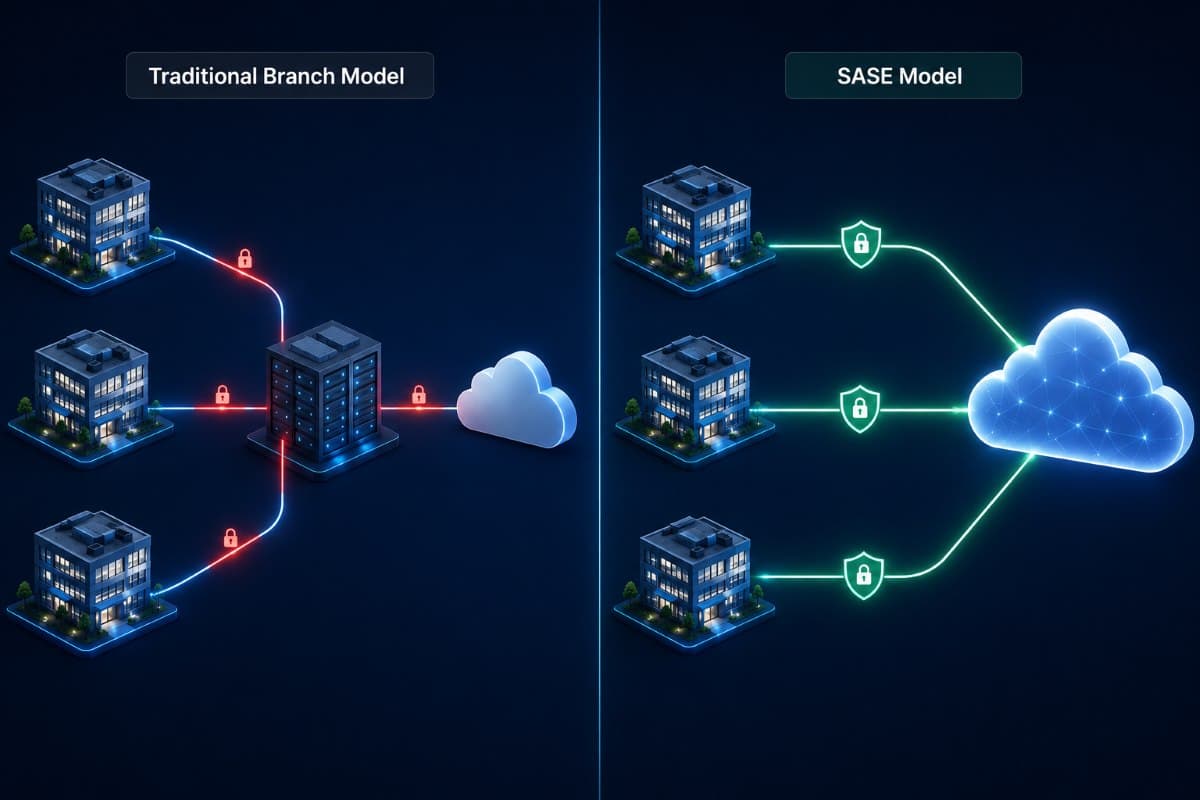
The traditional model assumed most resources lived in one central location, with branch traffic routed back through that center for security processing before reaching the internet or cloud services. As businesses moved more of their actual work into cloud applications, this routing pattern became a genuine performance problem, forcing traffic on an unnecessarily long path for security checks that could happen closer to where the traffic actually originates.
What SASE Actually Bundles Together
Secure access service edge, commonly shortened to SASE, combines networking and security into one converged approach rather than treating them as separate systems bolted together. It bundles software-defined networking, which manages how traffic actually moves between locations and the cloud, with a set of security services, including the zero trust access principles that govern individual remote connections.
The practical result is that both networking and security get applied consistently, close to where traffic actually originates, rather than routed back to one central point for every check along the way.
How This Relates to Individual Remote Access
Zero trust network access, the identity-based approach to securing individual remote connections, is one component inside the broader SASE architecture, not a competing alternative to it. A business already using zero trust principles for individual remote employees is using a piece of what SASE bundles at a fuller scale for an entire multi-location network, typically as part of an existing managed IT services arrangement.
Comparing the Two Approaches
The Honest Adoption Reality
SASE is not a single product a business buys off a shelf; it is an architectural approach that different vendors implement with varying scope and maturity. A business evaluating this space should expect to compare specific vendor offerings against its own actual needs rather than assuming every product labeled with this term delivers the same complete bundle.
Adoption is also typically gradual rather than an overnight replacement of existing infrastructure. Businesses commonly migrate location by location, or capability by capability, rather than replacing an entire networking and security setup in one project.
This Matters Most as a Business Actually Grows
A business with one or two very stable locations may find the complexity of this transition is not yet justified by the problem it solves. The case strengthens considerably as a business adds locations, since each additional site multiplies the inconsistency and cost of the traditional model while barely adding to the complexity of a properly implemented converged approach.
What a Small Business Should Actually Ask
Rather than starting with which specific product to buy, a business should start by mapping its actual current pain: which locations experience the worst performance reaching cloud applications, where security configuration has drifted inconsistently between sites, and which growth plans will make the current approach harder to sustain.
These answers point toward whether this is a genuine near-term priority or a architecture worth understanding now and revisiting as the business's location count actually grows.
Vendor Evaluation Deserves Real Scrutiny
Because the term covers a range of actual implementations, a business evaluating vendors should ask specifically what is included, how networking and security are actually integrated rather than simply co-marketed, and how the transition from current infrastructure would actually happen. A vendor unable to answer these specifically is signaling something about how mature their actual offering is.
Bandwidth and Reliability Change With This Approach Too
Beyond security, the converged approach typically changes how internet connectivity itself gets used across locations, often allowing a business to use multiple, less expensive internet connections intelligently rather than relying on one expensive dedicated circuit per location. This can improve both reliability, since traffic can shift between connections if one degrades, and cost, since standard business internet service is generally cheaper than dedicated point-to-point circuits.
Application Performance Often Improves Noticeably
Employees at branch locations sometimes notice cloud application performance improve after this kind of transition, simply because traffic reaches cloud services more directly instead of taking a longer route through a central hub first. This is frequently one of the more immediately visible benefits to end users, even before the security improvements become apparent in day-to-day work.
Planning This With Real Multi-Location Experience
Businesses considering this transition benefit enormously from a partner who has actually planned network architecture across multiple physical locations before, not learning the specific challenges for the first time on your account. This is squarely the kind of architectural planning that belongs inside real network management, built around how your specific locations actually operate together.
A look at your broader cloud strategy is a useful companion conversation for any business planning this kind of transition.
Firms opening a new location should also review their support options before that site gets built the old way by default.
Guest and Contractor Access Benefits From This Approach
Businesses regularly hosting guests, contractors, or temporary workers across multiple locations find that identity-based, application-specific access control extends naturally to these temporary relationships, granting exactly the access needed for exactly the duration needed without requiring separate infrastructure at each physical site. This is considerably harder to achieve consistently under the traditional branch model, where guest access typically gets handled differently and less rigorously at each individual location.
This Also Simplifies Offboarding Temporary Access
When a contractor engagement or a guest's need for access ends, removing it cleanly is a single action against their identity rather than a location-by-location cleanup task, which reduces the chance of forgotten, lingering access sitting unnoticed at some individual site long after it should have been revoked.
Adopting this approach changes what internal IT staff need to know rather than simply adding to what they already manage; the specific hardware expertise the traditional model required at every location gets replaced by expertise in the converged platform itself. For a small business, this can actually simplify staffing, since one platform's worth of expertise now covers what previously required understanding several different pieces of dedicated hardware.
Disaster Recovery Improves as a Side Effect
A converged, cloud-delivered approach to networking and security also tends to improve disaster recovery posture almost incidentally, since the architecture is not tied to hardware sitting physically inside any one location that could be damaged or destroyed. A location experiencing a physical disruption can often reconnect through the same converged system from an alternate site far more easily than the traditional model, which typically had significant recovery dependent on hardware specific to that exact physical location.
This Is Worth Raising in Business Continuity Planning
Businesses that have already done business continuity planning work should specifically revisit that plan once a converged networking approach is adopted, since the assumptions about what fails and what a recovery actually requires change meaningfully under this architecture compared to the traditional model the original plan was likely built around.
How Central IT Management Changes With This Approach
One of the more practically valuable shifts in this approach is centralized policy management: a security rule changed once applies consistently across every location immediately, rather than requiring someone to manually update configuration at each site individually. For a business managing several locations with limited dedicated IT staff, this reduces both the ongoing workload and the risk of one location quietly drifting out of alignment with the others.
New Employees and New Locations Both Benefit From This Consistency
A new employee starting at any location experiences the same security posture and access experience regardless of which office they physically sit in, and a new location opening benefits from inheriting an already-proven configuration rather than starting from scratch. This consistency compounds in value as a business continues to grow, since every additional location adds far less incremental complexity than it would under the traditional model.
A Quick Self-Check Worth Running This Week
A business with more than one location can get a rough sense of where it stands without any outside help: list every physical location, note whether security settings are actually consistent across all of them or configured separately at each site, note how traffic from each location reaches the cloud applications the business depends on, and note whether adding a new location today would mean replicating hardware setup work from scratch. Gaps in any of these answers point directly at where this conversation should start.
Seasonal and Temporary Locations Fit This Model Well
Businesses that open temporary or seasonal locations, a pop-up retail site, a temporary field office, find the converged approach particularly well suited to short-lived sites, since standing up consistent security and connectivity does not require shipping and later retrieving dedicated hardware. The location can be connected and, later, cleanly disconnected without leaving equipment behind or creating a lingering security gap at a site the business no longer occupies.
Cost Comparisons Need to Include the Full Picture
Comparing the cost of this approach against the traditional model purely on monthly subscription or service fees misses much of the real picture. The traditional model's hidden costs, dedicated hardware refresh cycles at every location, the staff time spent manually keeping configurations consistent, and the performance cost of inefficient traffic routing, rarely appear as a single line item but are genuinely real ongoing costs nonetheless.
A fair comparison should account for these hidden costs on the traditional side, not just compare the sticker price of a new subscription against the sunk cost of equipment a business already owns.
Growing Locations Deserve Growing Architecture
SASE for multi-location businesses addresses a genuinely different problem than individual remote access, connecting whole offices together consistently and efficiently rather than connecting individual people. The traditional branch model that worked adequately for a business with one or two stable locations struggles as a business actually grows, which makes this worth understanding well before the pain of the old approach becomes acute.
For businesses in the region, a partner providing IT services in Ventura County can map your current multi-location pain points and plan a realistic transition path.
Companies across the metro can get the same locally through managed IT services in Los Angeles, from a first architecture review to a phased migration that fits how your business actually grows.
Frequently Asked Questions
Secure access service edge combines software-defined networking with a bundle of security services into one converged approach, applying security processing close to where traffic actually originates rather than routing everything back to one central location. It addresses the specific challenge of connecting multiple physical locations consistently and efficiently.
Zero trust network access, which secures individual remote connections based on identity rather than network location, is one component inside the broader SASE architecture, not a separate competing approach. A business using zero trust principles for individual remote employees is already using a piece of what SASE bundles at a fuller scale across an entire multi-location network.
Not necessarily yet. The case strengthens considerably as a business adds locations, since each additional site multiplies the cost and inconsistency of the traditional branch-office model while barely adding complexity to a properly implemented converged approach. A very stable, small footprint may not yet justify the transition.
No. It is an architectural approach implemented differently by different vendors with varying scope and maturity, not a single standardized product. A business evaluating this space should compare specific vendor offerings against its own actual needs and expect a gradual, phased adoption rather than an overnight replacement of existing infrastructure.
If your business is managing multiple locations with inconsistent security and slow access to cloud applications, GlobeVM can map the real pain points behind SASE for multi-location businesses and plan a realistic path forward.
Comments
0 Comments