
Few line items frustrate a business owner more than an IT invoice they did not see coming. The systems were working, the budget was set, and then a server fails, a security incident hits, or a quick fix turns into a multi-day project with an open-ended bill at the end. Surprise IT bills like these are not an occasional misfortune for businesses still paying for technology only when something breaks. They are the model working exactly as designed. A managed support model is often presented as the cure, and when the arrangement is structured well, it genuinely does turn technology into a predictable monthly cost. But that outcome is not automatic. A poorly written contract can produce just as many surprise IT bills as the break-fix model it replaced. This guide explains where unexpected IT costs actually come from, how a proactive support model removes them at the source, how the different pricing models compare, what the real numbers look like over a full year, and how to make sure the provider you choose does not quietly reintroduce the surprises through the fine print.
What should it cost? Our managed IT services pricing guide lists published 2026 price ranges, what is usually included and a free cost estimator.
Where Surprise IT Bills Actually Come From
To understand how a managed support model eliminates surprise bills, you first have to be precise about what causes them. Unexpected technology costs are rarely random. They come from a small number of recurring sources, and almost all of them trace back to one root condition: technology that is managed reactively instead of continuously.

The Break-Fix Model Bills You for Failure
Under a break-fix arrangement, you pay an IT provider only when something goes wrong. On the surface this feels economical, because you are not paying for service in the quiet months. The problem is structural. The provider's revenue depends on things breaking. There is no financial incentive for them to prevent the next failure, because prevention reduces their billable work. So the model quietly rewards exactly the outcome you do not want, and your costs swing wildly from one month to the next with no way to forecast them.
Emergency Rates and After-Hours Premiums
When a system fails, it rarely fails politely during business hours. Break-fix and loosely structured providers commonly charge premium hourly rates for urgent work, and higher rates again for evenings, weekends, and holidays. A single after-hours emergency can cost several times what the same work would cost as planned, scheduled maintenance. Hourly break-fix rates commonly run from around 85 to 250 dollars an hour, and emergency multipliers push the real cost higher still.
The Hidden Cost of Downtime
The repair invoice is only the visible part of an IT failure. While a system is down, staff cannot work, customers cannot be served, and revenue stops. This lost productivity is a real cost, and it usually dwarfs the repair bill itself. Industry research in 2026 places the cost of downtime for small and mid-sized businesses in a wide band, commonly cited from roughly 8,000 dollars to well over 25,000 dollars per hour depending on size and industry, with regulated and transaction-heavy businesses at the higher end. Because this cost does not arrive as an invoice, many businesses never count it, which is precisely why it stays so damaging.
One-Off Projects With Custom Pricing
Onboarding a new employee, deploying a new computer, migrating an application, opening a second office. Under a reactive model, every one of these is a custom project with a custom quote. Without standardized processes, the provider prices each job from scratch, and you cannot predict what the next one will cost.
Aging Hardware and Deferred Maintenance
When no one is tracking the age and health of your equipment, hardware fails on its own schedule rather than yours. A server that could have been replaced as a planned expense instead dies unexpectedly, forcing a rushed, full-price emergency purchase. Deferred maintenance does not remove a cost. It delays it and adds urgency, which makes it larger.
Security Incidents
This is the most severe source of all. A ransomware attack or data breach can generate emergency response fees, recovery costs, regulatory exposure, and lost business at the same time. For a small or mid-sized business, a single serious incident can produce a five or six figure bill with no warning. Published case studies routinely describe ransom demands and lost billable time that together reach well into the hundreds of thousands of dollars. Reactive IT support, by definition, does not catch the conditions that lead to these incidents until after the damage is done.
How a Managed Support Model Eliminates Surprise IT Bills
The managed services model is built around a different financial structure. Instead of paying for failures after they happen, you pay a fixed, recurring fee for a defined scope of proactive service. That single change in structure is what removes surprise bills, and it does so through several connected mechanisms.

A Fixed Monthly Fee Replaces Variable Invoices
The most direct effect is the simplest. With a managed support model, you know your technology cost before the month begins, not after it ends. Monitoring, maintenance, routine support, and security work are wrapped into one predictable figure. Your finance team can budget technology the way it budgets rent, and a stable number is far easier to plan around than an unpredictable one, even if the unpredictable one occasionally happens to be lower.
The Provider's Incentive Finally Aligns With Yours
This is the part that matters most and gets discussed least. Under a fixed-fee model, the provider is paid the same whether your systems run smoothly or not. Every hour they spend fixing a preventable failure is an hour of cost to them, not revenue. For the first time, the provider is financially motivated to keep your technology stable. Prevention becomes their interest as well as yours. The break-fix model rewards failure. The managed model rewards reliability.
Proactive Monitoring Catches Problems Before They Become Bills
A managed provider continuously watches your systems for the early warning signs of trouble, such as a hard drive showing errors, a backup that quietly failed, or unusual network activity. Catching these conditions early means resolving them as routine maintenance rather than as an emergency. Continuous remote IT monitoring and management is the mechanism that converts what would have been a surprise outage into a quiet, scheduled fix, often before anyone in your office notices anything was wrong.
Planned Maintenance Prevents Emergency Repairs
Patching, updates, and system health checks happen on a defined schedule rather than after a breakdown. Scheduled work is cheaper than emergency work for a straightforward reason: it can be done efficiently, in advance, without premium rates and without the pressure of an active outage. Routine help desk and IT support handled this way also stops small user issues from escalating into larger, costlier ones.
Downtime Costs Drop Because Outages Become Rare
Because problems are caught and prevented earlier, systems simply go down less often. The hidden cost of lost productivity, the most expensive and least visible part of the old model, shrinks substantially. When an incident does occur, recovery is faster because the provider already knows your environment and has a plan ready. Reliable data backup and disaster recovery turns a potential multi-day crisis into a controlled, recoverable event with a known cost rather than an open-ended one.
Standardized Projects and Scaling Become Predictable
A good managed provider standardizes your environment, which makes repeatable tasks repeatable in price as well. Onboarding a new employee or deploying a new device becomes a defined process with a known cost instead of a custom quote. Layered cybersecurity solutions are built into the monthly scope as well, so protection is continuous rather than a panicked purchase made after an incident has already happened.
Understanding the Pricing Models Behind a Managed Contract
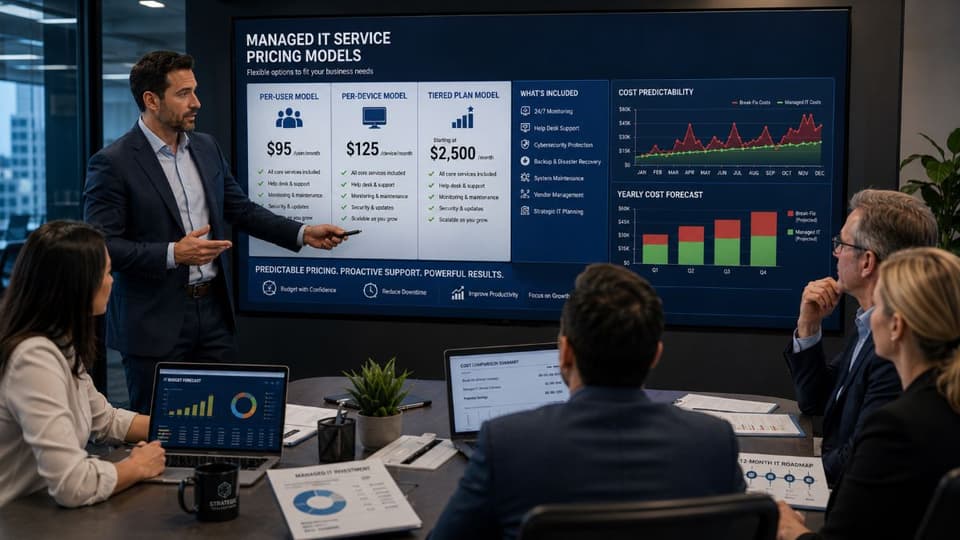
Not every managed contract is priced the same way, and the pricing model you choose has a direct effect on how predictable your bill really is. Two providers can both call their offering a managed support plan and still hand you very different levels of cost certainty. There are four common models, and it is worth understanding how each behaves before you sign.
Per-User Pricing
You pay a set monthly amount for each supported employee, regardless of how many devices that person uses. This model has become the most common because it is easy to forecast. When you add or remove staff, the bill moves with headcount in a way anyone can predict. In 2026 the typical range sits roughly between 100 and 300 dollars per user per month, with most small businesses landing around 150 to 200. Per-user pricing works best when your environment is fairly standardized and each employee has a similar support profile.
Per-Device Pricing
You pay a flat monthly rate for each supported device, with servers and network equipment usually priced higher than a standard workstation. This can suit businesses where the device count, rather than the headcount, drives the workload. The catch for predictability is that costs can creep as devices are added, and the line between a supported and an unsupported device needs to be defined clearly.
Tiered Packages
Many providers bundle services into good, better, and best tiers. A basic tier typically covers monitoring and help desk only. A middle tier adds backup, security tooling, and cloud management. A top tier adds compliance support and deeper security oversight. Tiered packages make budgeting simple, but they carry a specific risk: the tier boundaries can obscure what is and is not included. Always ask for a line-item breakdown of each tier rather than trusting the label.
All-Inclusive Flat-Rate Pricing
One fee covers a broad, clearly defined scope of service with no per-ticket or per-incident add-ons. When the scope is genuinely wide, this is the model that delivers the most cost certainty, because almost nothing routine falls outside it. The phrase to watch is genuinely wide. A flat rate attached to a narrow scope is not predictable at all, it just delays the surprise.
The key point across all four models is that the model matters less than the honesty of the scope behind it. A per-user contract with clear inclusions beats an all-inclusive contract with a buried exclusions list every time.
A Realistic 12-Month Cost Comparison
Abstract arguments about predictability become clearer with numbers. Consider a hypothetical 25-person business. The figures below are illustrative and rounded, drawn from common 2026 market ranges rather than from any single firm, but they reflect how the two models actually behave over a year.
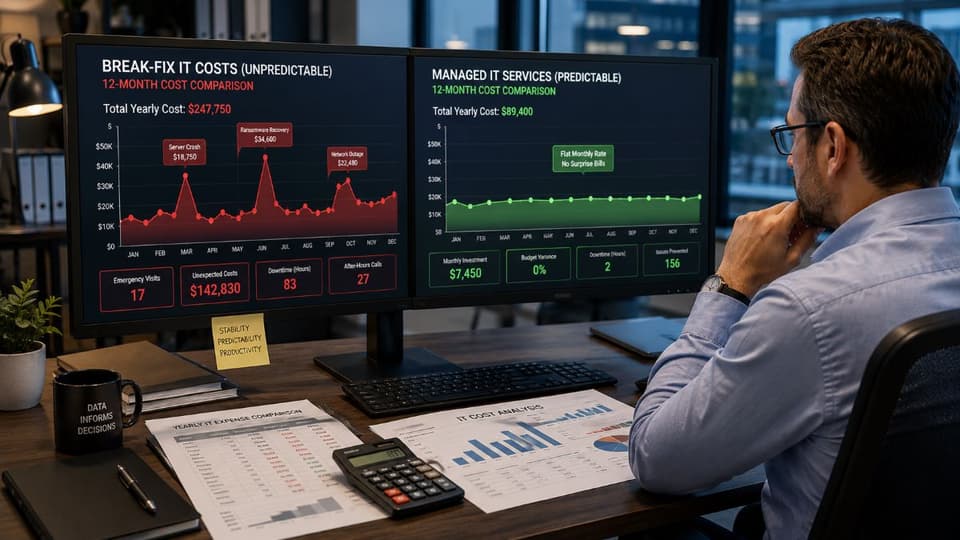
Under a break-fix model, the calm months look cheap. Several months of the year might cost only a few hundred dollars in minor support, or nothing at all. But the year is not made of calm months alone. A realistic 12-month picture might include:
- Quiet months of light support across most of the year, totaling perhaps 4,000 to 6,000 dollars.
- One aging server that fails and must be replaced on an emergency basis, with rushed hardware and after-hours labor, easily 6,000 to 10,000 dollars.
- A handful of after-hours emergencies at premium rates, another 3,000 to 5,000 dollars.
- The lost productivity from those outages, which never appears on an invoice but is real money, often larger than every repair bill combined.
The visible spend might land somewhere around 13,000 to 21,000 dollars, arriving in unpredictable spikes, with the downtime cost sitting invisibly on top. And this is the good version of the year, the one without a serious security incident.
Under a managed model, the same business at a mid-range per-user rate pays a steady monthly fee, producing an annual cost in a comparable range but delivered as twelve identical, forecastable payments. The difference is not only the total, which may be similar in a lucky year and much lower in an unlucky one. The difference is that the managed figure is known in advance, includes the prevention that makes the expensive events less likely, and does not include the downtime cost, because the outages that caused it largely do not happen. The break-fix year is a gamble. The managed year is a budget line.
The Surprise Bills That Bad Managed IT Contracts Still Create
Here is the part most articles on this topic leave out, and ignoring it would not serve you well. Switching to a managed IT provider does not guarantee predictable costs. The label managed services is not a promise. A carelessly or deliberately vague contract can reintroduce every surprise bill the model is supposed to remove. If you are evaluating providers, you need to know exactly where these hidden charges hide.
The most common culprit is out-of-scope work. Many providers advertise a low monthly rate, then define the included scope narrowly so that a meaningful share of real-world work falls outside it and gets billed separately. Server problems, security incidents, projects, and after-hours support are all common exclusions. The monthly fee looks predictable until the first month something happens that the contract quietly carved out.
Other recurring sources of unexpected charges in managed contracts include:
- Per-incident or per-ticket fees layered on top of the monthly rate, so heavy support months cost far more than light ones.
- Onboarding and setup fees that are large, vaguely defined, and not disclosed clearly during the sales process.
- Hardware and software markups where the provider resells equipment and licensing at an undisclosed margin.
- Automatic license true-ups that adjust your bill as user counts change, without a clear explanation of how.
- Compliance work billed separately at a meaningful per-user premium, which is reasonable in itself but should be disclosed upfront, not discovered later.
- Steep early-termination penalties in long contracts that make leaving a bad provider expensive in itself.
None of this means the managed model is flawed. It means the model only delivers predictable costs when the contract is written honestly. A predictable monthly fee is only genuinely predictable if the scope behind it is broad and clearly defined.

Questions to Ask Before You Sign a Managed IT Contract
Use these questions to separate a provider who will give you real cost predictability from one who will not. The answers should be specific and in writing.
- What exactly is included in the monthly fee, and what is not? Ask for the exclusions explicitly. A confident provider will tell you plainly what falls outside scope.
- Are after-hours and emergency support included, or billed separately? This is one of the most common hidden charges, so confirm it directly.
- How are projects priced? Understand which work counts as in-scope support and which counts as a separate project, and how projects are quoted.
- Are there per-ticket, per-incident, or per-user overage fees? A truly predictable fee does not move with your support volume.
- What are the onboarding costs, in writing, before signing? Setup fees should be disclosed upfront, not discovered on the first invoice.
- Do you mark up hardware and software, and by how much? Transparency here is a strong signal of how the provider treats billing overall.
- How is compliance work priced? If you face HIPAA or similar obligations, confirm whether that work sits inside the base fee or carries a separate, disclosed rate.
- What does the contract term and exit process look like? Reasonable terms and a clear offboarding process indicate a provider confident in keeping you through service, not contracts.
A provider that answers these clearly and puts the answers in the agreement is offering genuine predictability. A provider that is vague is telling you, in advance, where your future surprise bills will come from.

What If You Already Have an Internal IT Person?
Not every business choosing a managed support model is starting from scratch. Many already employ one IT person, and the question is not whether to replace them but how to remove the surprise bills that still occur despite having that person in place. A single internal employee cannot provide overnight coverage, cannot specialize deeply in every area, and becomes a single point of failure during vacations and emergencies. The gaps they cannot cover are exactly where unplanned costs slip through.
This is where a co-managed arrangement fits. Under co-managed IT, your internal person stays in place and an outside team adds the monitoring tools, after-hours coverage, and specialist depth they cannot provide alone. Priced in 2026 commonly in the range of roughly 65 to 120 dollars per user per month, co-managed support is lighter than a fully outsourced model because it shares the workload rather than owning all of it. For a business with one capable IT employee, structured co-managed IT services close the coverage gaps that produce emergency bills, without the cost of a second or third hire and without losing the person your team already trusts.

What the Transition From Break-Fix Actually Involves
A fair question is whether the switch itself creates a surprise bill. It does involve upfront work, and an honest provider will be direct about that. Moving from a reactive arrangement to a managed one usually begins with an assessment of your current environment, documentation of systems and passwords, and a phase of corrective work to bring neglected areas up to a stable baseline. Years of deferred maintenance do not disappear for free.
The difference is that this cost is known and planned, not a shock. A good provider quotes the onboarding and any remediation clearly before you sign, so the one-time investment is part of the decision rather than a discovery on the first invoice. The transition is typically completed over a few weeks, and once the environment reaches a stable baseline, the predictable monthly model takes over. For businesses ready to make that move, GlobeVM's managed IT services turn what used to be a reactive scramble into a maintained system with a forecastable cost.

What Predictable IT Spending Makes Possible
Removing surprise IT bills is not only about avoiding unpleasant invoices. It changes how a business can operate. When technology cost is a known, stable figure, leadership can budget accurately, model growth with confidence, and make decisions about hiring or expansion without a volatile expense undermining the math. The mental cost disappears too. No one is bracing for the next emergency or treating IT as a source of dread.
There is also a strategic gain. When a provider is no longer firefighting, attention shifts to planning. Hardware gets replaced on a sensible schedule as a forecast expense. Upgrades are mapped in advance. Technology starts supporting the business's direction instead of reacting to its failures. For growing companies in the Los Angeles area, a well-structured managed arrangement turns technology from an unpredictable liability into a planned, stable part of the operating budget.

Is the Switch Worth It for Smaller Businesses?
An honest answer requires a real comparison rather than a sales pitch. For a very small business with simple, stable technology and little regulatory exposure, the monthly fee of a managed contract may at first appear higher than what break-fix has averaged in calm months. That comparison is incomplete, though, because it leaves out the cost of downtime, the price of an eventual emergency, and the security incident that reactive support does nothing to prevent. The managed fee is not only buying repairs. It is buying the prevention that stops the expensive events from happening at all.
The clearest way to decide is to look at your own history. If your IT costs have been erratic, if you have absorbed at least one painful surprise bill, or if a failure has ever stopped your team from working, the variable model is already costing you more than its quiet months suggest. If your technology is genuinely simple and has never caused a disruption, a lighter arrangement may still be reasonable for now. The decision should rest on your actual risk and your actual track record, not on either provider's marketing.
If unpredictable technology costs have been disrupting your budget, a straightforward review of your current IT spending and risks with a knowledgeable local provider is the clearest way to see what a predictable model would actually look like for your business.