

It is 8:05 on a Monday morning, the waiting room is filling, and the EHR will not load. The generalist IT company that keeps your accountant's office running would treat this as a ticket; your practice experiences it as canceled visits, a paper scramble, and patients watching the front desk apologize. That gap is the whole subject of healthcare IT support: medical, dental, and behavioral-health practices run technology under conditions that ordinary business IT was never designed around — clinical uptime, protected health information, a thicket of specialized vendors. Choosing a provider without testing for those conditions is how practices end up owning the gap themselves.
This guide covers what makes supporting a practice genuinely different, what a healthcare-ready support arrangement includes, the questions that separate providers who know this world from providers who say they do, and the red flags worth walking away from.
Why Healthcare IT Support Is Its Own Discipline
Three conditions separate a practice from an ordinary small business of the same size. First, patient information saturates everything — the EHR obviously, but also the email, the fax path, the backups, the old workstation in the storage room. Every technical decision therefore carries a compliance shadow, and the support provider itself becomes a business associate the moment it can touch systems holding records. Second, downtime has a waiting room: a two-hour outage in an office is an annoyance, while in a clinic it is rescheduled patients, idle providers, and revenue that does not come back, so uptime engineering has to be tuned to clinic hours specifically. Third, the vendor ecosystem is deep and opinionated EHR, practice management, imaging, labs, clearinghouse, e-prescribing — and someone has to own the seams between them, because the vendors themselves famously will not. A fourth condition rides along quietly: clinical staffing. Practices run lean, turnover is real, and every hire needs accounts, access, and working equipment on day one, so the speed and reliability of routine provisioning are felt in the schedule the way outages are, just more slowly.
What Good Healthcare IT Support Includes
A help desk that speaks EHR
The first difference shows up on the first call. A healthcare-literate help desk knows what an eligibility check is, understands that the front desk cannot simply reboot mid-check-in, and has a working relationship with the escalation paths of the major EHR and practice management vendors. Crucially, it owns the seam: when the problem sits between your network and the EHR vendor's cloud, the answer is never two vendors pointing at each other while the schedule burns, it is one accountable party staying on the line until patients are being seen again.
HIPAA built into operations, not bolted on
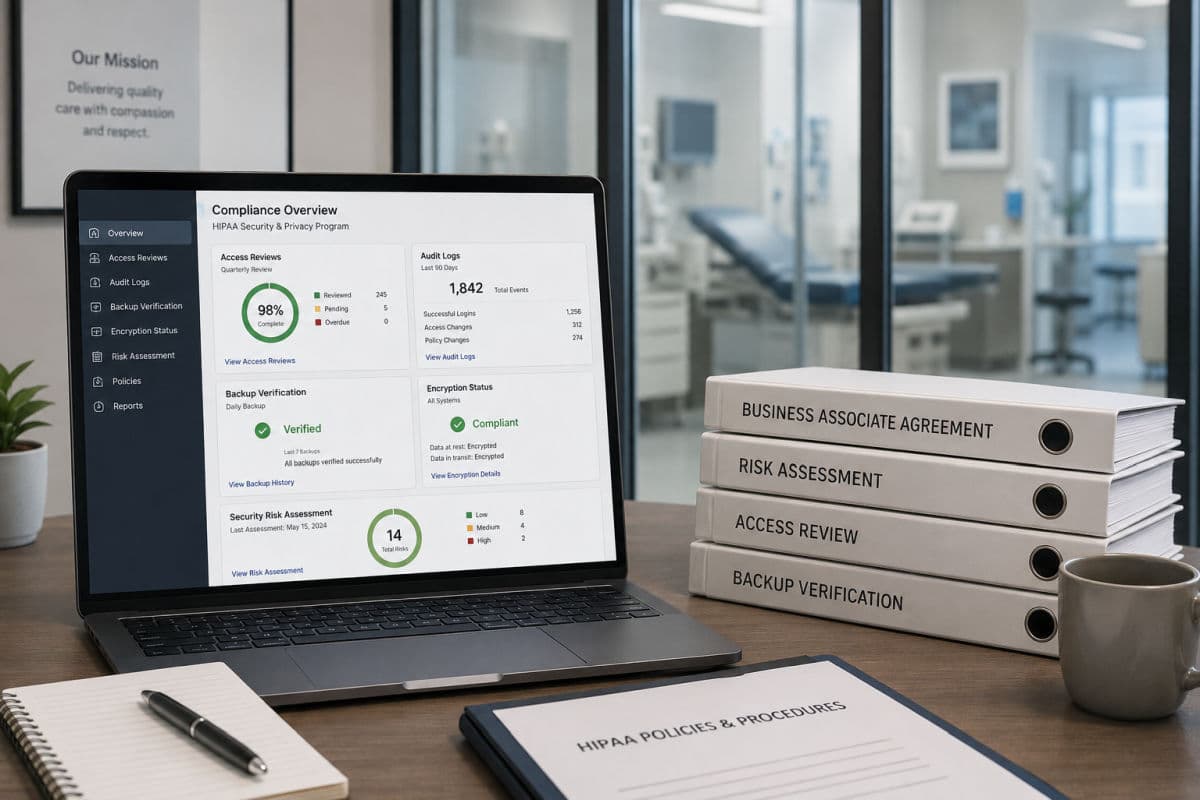
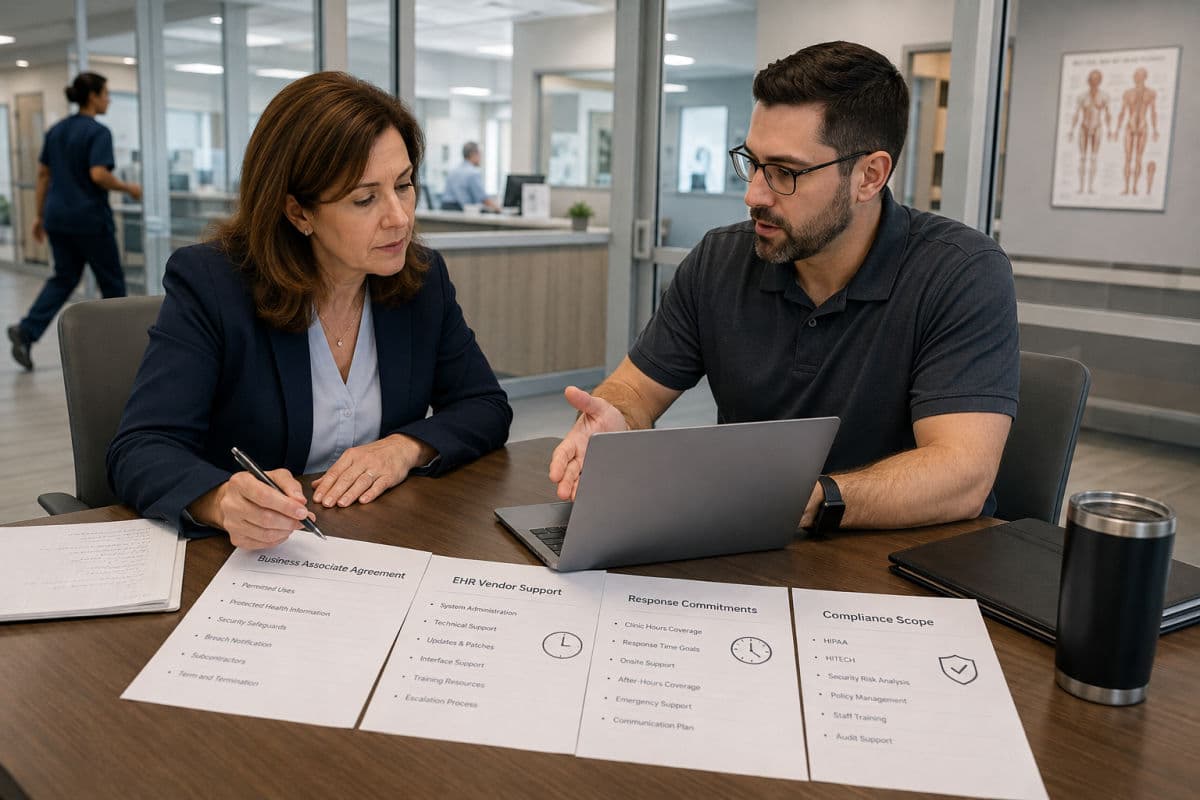
In a practice, the IT provider is not adjacent to compliance; it is inside it. The provider itself signs a Business Associate Agreement, because administering systems that hold records is handling records. Beyond its own paperwork, healthcare-ready support treats compliance as a standing operation: the annual security risk assessment actually happens and produces a remediation list someone works. Access reviews run when staff join and leave. Encryption, audit logging, and backup verification are maintained as evidence, not aspirations, and the whole program maps onto the practice's own HIPAA compliance checklist so nothing lives in two contradictory versions. The test is simple: ask a prospective provider to describe the compliance documentation you would receive in a normal quarter. A healthcare provider describes it; a generalist asks what you mean.
Uptime engineered for clinic hours
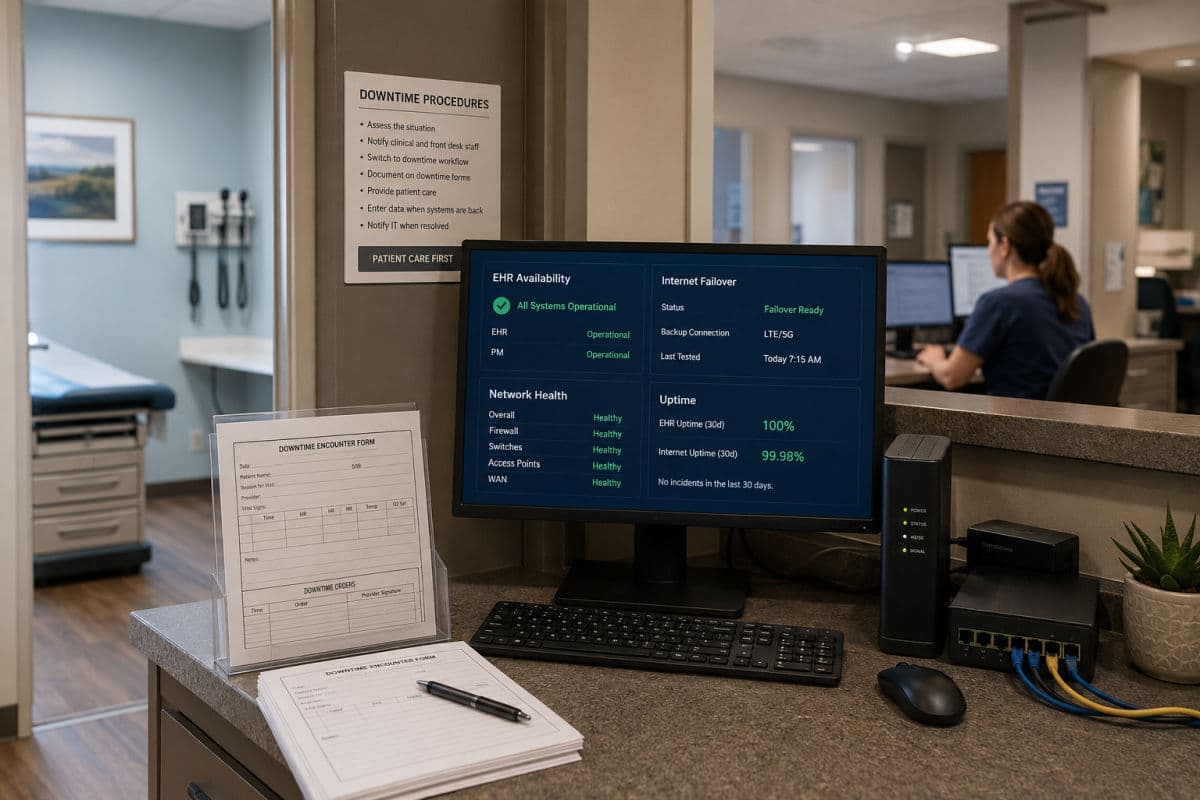
Practice uptime is about one path: the route from the exam room to the chart. Healthcare-ready support maps that path — the workstations, the local network, the internet circuit, the EHR's cloud and hardens it deliberately: monitoring that pages a human before the front desk notices, a second internet path where the math justifies it, and spare hardware staged for the components whose failure stops check-in. Just as important is the plan for the outage that happens anyway: documented downtime procedures, the paper intake forms, the read-only chart access, the order of restoration, drilled once so that the Monday morning scenario is a nuisance with a script instead of a crisis with an audience.
Security tuned to how practices actually get hit
Practices are targeted for the same reason they are regulated: records are valuable and clinical urgency makes victims pay. The defensive stack is familiar — hardened email, endpoint protection, multi-factor authentication everywhere, tested backups the attacker cannot reach. The tuning, though, is healthcare-specific: staff trained on the lures aimed at medical offices, records access monitored, and the storage question answered properly, since so much of the risk now lives in the cloud systems the practice adopted one convenient tool at a time, the terrain covered in our guide to healthcare data security.
The device layer nobody budgets for
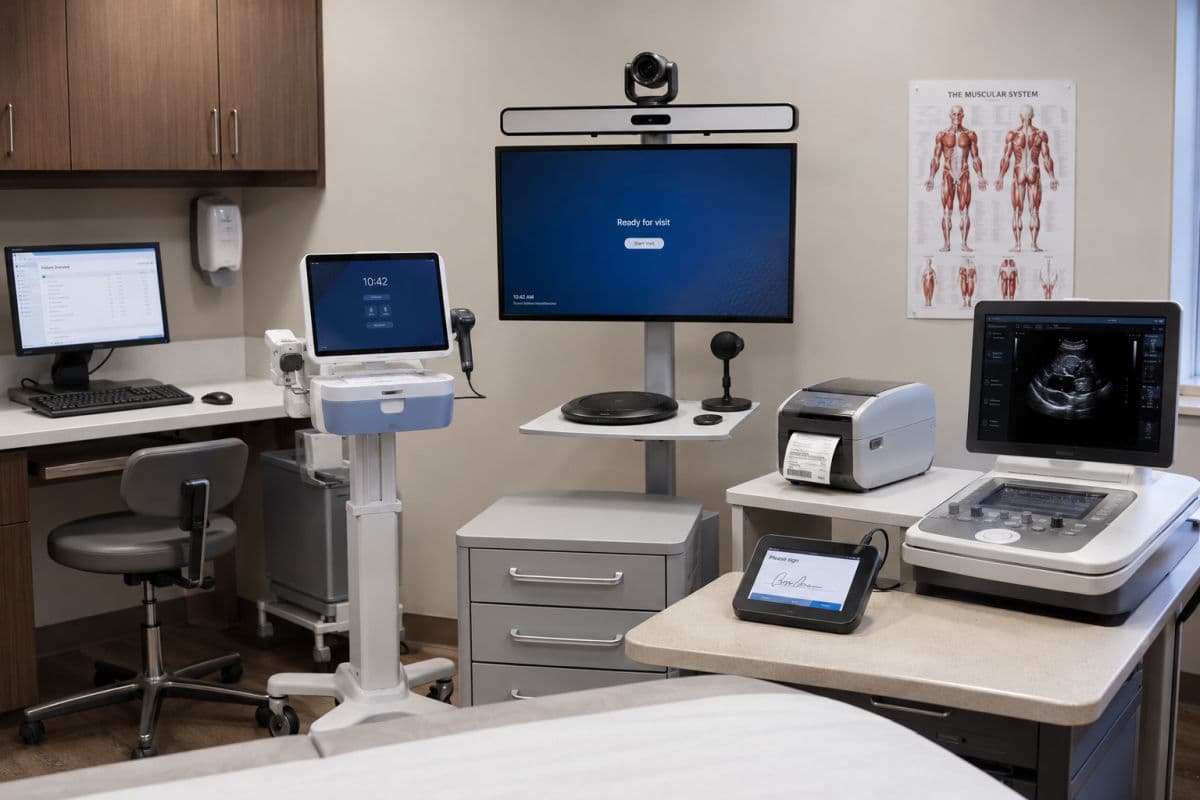
Exam-room workstations that log out fast enough for privacy but not so fast they enrage clinicians, tablets on carts, the telehealth setup that has to work on the first click — meaning camera, audio, bandwidth, and the platform's compliance paperwork all verified before the first scheduled visit, because a failed video appointment is a no-show the practice caused — label printers, signature pads, the imaging workstation the vendor installed and nobody manages: practices carry a fleet of small, clinical-adjacent devices that generalist support treats as exotic. Healthcare-ready support inventories them, patches what can be patched, isolates what cannot, and knows which ones stop the schedule when they die, with ages and replacement windows tracked so the exam-room fleet refreshes on a budget line instead of a failure.
Onboarding that does not disrupt the clinic
The reason practices tolerate mediocre support for years is fear of the switch, and a healthcare-ready provider disarms it with a plan. Discovery and documentation happen in the background while the old arrangement still runs, credentials and vendor contacts are inventoried before anything changes hands, and cutover work is scheduled entirely outside clinic hours. The first weeks include a shadow period where the new team observes real clinic mornings before owning them. Ask a prospective provider to describe their first sixty days in a practice like yours; the answer tells you whether they have done this before, and whether your patients will ever notice the transition, which is the goal.
The Questions That Separate Providers
Interviews find the truth faster than proposals. Six questions, in order, and the pattern to listen for is ownership, answers that begin with what the provider does rather than what you should do:
- Will you sign a Business Associate Agreement with us, and can we see your standard one today?
- How many covered practices do you support now, and will two of them take a reference call?
- Who on your team handles our specific EHR, and what happens at 8 a.m. when the problem sits between you and that vendor?
- What compliance work is inside the monthly fee, risk assessment, training, documentation, and what is billed as extra?
- What is your response commitment during clinic hours, in writing, and how is it measured?
- Walk us through what you do in an EHR outage, including how you help us run downtime procedures while you restore.
Strong answers are specific, name real systems and real timeframes, and come with documents. Vague answers to any two of the six are a verdict, and taking notes during the answers gives you the comparison sheet the proposals will not.
The Red Flags Worth Walking Away From
A few patterns reliably predict a painful relationship. Hesitation about signing a BAA ends the conversation, a provider unwilling to accept business associate obligations is telling you it does not understand the role. "HIPAA compliant" used as a slogan with no describable process behind it is marketing wearing a lab coat. No current healthcare references means your practice would be the training environment. One response time for every client regardless of context means your Monday morning outage queues behind someone's printer. A provider whose first proposal replaces half your working systems is optimizing for its stack rather than your practice; good ones stabilize first and change deliberately. And a proposal that never asks about your EHR, your clinic hours, or your compliance posture was written for a generic business, which is exactly how you would be supported.
Choosing the Model: Office Manager, Co-Managed, or Fully Managed
Practices arrive at three workable shapes. The most common in small offices pairs a technically comfortable office manager with a fully managed provider: the manager handles the daily human layer while the provider owns everything technical. Larger groups with an internal IT person do well co-managed, the employee keeps the clinical relationships and floor presence while the provider supplies security, after-hours, and depth. And multi-site organizations often need the full arrangement with an assigned team and on-site days. The specialty matters less than the shape: the pattern holds whether the chart is medical or dental, though dental offices carry their own imaging-and-operatory wrinkles, which is why the dental-specific version of this decision gets its own article. Whichever shape fits, coverage should match your real hours, a practice with early clinics and Saturday appointments needs genuine after-hours coverage commitments, not a voicemail promise.
What It Costs, Honestly
Healthcare support prices above generalist support for the same headcount, and the premium is the product: compliance operations, documentation, healthcare-literate staff, and response commitments tuned to clinic hours all cost real money to deliver. A quote that matches the marketing agency down the street is quietly excluding them. The honest comparison is scope against scope, what compliance work is inside, what the response commitment says, what the references report, and the honest baseline is what an outage hour costs your schedule, a number most practices can calculate in one uncomfortable minute. We price and deliver this scope every week as healthcare IT support for practices from Simi Valley across the LA area, and the pattern in switching clients is consistent: the practices that left cheap generalist support did so in the month the cheapness presented its real bill.
Frequently Asked Questions
Beyond standard help desk and device management, it covers EHR-literate support with vendor-escalation ownership and compliance operations including the annual risk assessment and its remediation work. It also covers uptime engineering and downtime procedures for clinic hours, healthcare-tuned security and staff training, and management of the clinical-adjacent device fleet from exam-room workstations to telehealth setups.
Three ways. The provider operates inside your compliance program as a business associate rather than beside it. Uptime is engineered around the exam-room-to-chart path and clinic schedule rather than generic office hours. And the provider owns the seams among the EHR, imaging, lab, and billing vendors instead of joining them in pointing fingers.
Yes, without exception. A provider that administers systems holding patient records is creating, receiving, maintaining, or transmitting protected health information on your behalf, which is the definition of a business associate, and the agreement is required before that access begins. Reluctance to sign is a disqualifying answer, not a negotiating position.
Six questions do the sorting: whether they sign a BAA and can show it, how many covered practices they support with references, and who handles your EHR and its vendor escalations. Then the operational three: what compliance work sits inside the fee, their written clinic-hours response commitment, and how they run an EHR outage including downtime procedures.
A strong generalist can keep computers running; the gaps appear exactly where practices are exposed, compliance evidence, EHR vendor seams, clinic-hour outage math, and clinical devices. A three-provider office carries the same obligations as a thirty-provider group, so specialization matters at every size, and the interview questions above test for it directly.
More than generalist support for the same seat count, because the scope is larger: compliance operations, documentation, healthcare-literate response, and clinic-hour commitments are the paid difference. Compare quotes scope against scope rather than total against total, and weigh both against what one outage hour costs your schedule.
Healthcare IT support is ultimately a hiring decision about who stands next to your practice on its worst technology morning, and the evaluation above finds that answer before the morning does. If you would like the assessment run on your own environment, book a practice IT review with GlobeVM and we will walk your exam-room-to-chart path with you, and hand you the findings either way.
Comments
0 Comments