Higher education runs on trust and on data. A college or university holds some of the most sensitive personal information a person ever hands over, from social security numbers and financial aid records to health information and academic histories, and it holds it for thousands of people at once. That combination makes data protection for higher education both a legal obligation and a genuine challenge, because campuses are open by design and the rules that govern them are strict. An institution cannot simply lock everything down the way a private company might, yet it is held to the same standards of protection, and the consequences of getting it wrong fall on students who are often just beginning their adult lives. This guide explains why institutions are such a target, exactly which data and which laws are involved, the challenges that make campus security hard, and what protecting student data actually requires in practice.
Cyber Security and Data Protection for Higher Education, Explained


Why higher education is a frequent target for data breaches
Schools are attractive to attackers for reasons that are hard to change, and understanding those reasons is the first step toward addressing them. Three factors in particular put higher education near the top of every attacker's list.
Open networks and constant turnover
A campus network has to serve a large and constantly shifting population of students, faculty, staff, and researchers, many of whom connect their own devices and need broad access to do their work. Every autumn a new wave of users arrives, and every spring another leaves, which makes the simple task of knowing who has access to what a continuous struggle. Unlike a business with a stable roster of managed devices, an institution faces an environment built around openness that changes by the semester.
Valuable data and stretched budgets
The data a school holds is exactly what criminals want, and the resources to defend it are often thin. Student records contain the full set of details needed for identity theft, and research institutions may hold valuable intellectual property as well. At the same time, security budgets compete with every other priority on campus and frequently lose, leaving small technology teams to defend sprawling environments. That gap between the value of the data and the resources protecting it is part of why higher education is one of the sectors most frequently hit by ransomware and data theft.
The real cost of a breach
When a breach happens, the damage reaches well beyond the institution. The personal information of students, many of them eighteen to twenty two years old, can circulate for years once it is exposed, creating risks of identity theft long after graduation. For the institution itself, a breach brings regulatory scrutiny, the cost and disruption of recovery, and lasting harm to a reputation that took decades to build. Because student data is so sensitive and so permanent, the stakes of protecting it are higher than in many other sectors.
The sensitive data a higher education institution holds
Part of what makes data protection for higher education so demanding is the sheer variety of information involved, each kind carrying its own sensitivity and often its own legal protection. Treating it all the same way is a mistake, because a single approach cannot match such different risks.

Student education records
At the core are student education records: grades, transcripts, disciplinary files, and the personally identifiable information tied to them. These are the records most people picture when they think of student data, and they are protected by federal law from unauthorized disclosure. They are also used widely across an institution, by faculty, advisors, and administrative staff, which makes controlling who can see them a real and ongoing task rather than a one time setting.
Financial and payment data
Institutions handle a large volume of financial information, from tuition payments and student loans to financial aid applications that include family income and tax details. Any school that accepts credit or debit cards for tuition, housing, or campus services also handles payment card data, which carries its own security requirements under the PCI DSS standard. Financial data is a direct target for fraud, which is why it draws specific regulatory attention and deserves some of the strongest protection on campus.
Health and research data
Many campuses run student health centers, counseling services, or even teaching hospitals, all of which create health records that may carry their own legal protections. Research universities add another layer, holding data tied to federally funded projects that can come with strict handling requirements. Add the ordinary employee and payroll records that any large organization keeps, and the result is an institution sitting on several distinct categories of regulated data at the same time, each needing to be handled on its own terms.
The regulations that govern data protection for higher education
Few sectors face as tangled a set of rules as higher education, where a single piece of data can fall under more than one law at once. Getting compliance right starts with knowing which regulations apply and what each one requires, and this is an area where compliance and risk management services can save an institution from costly missteps.
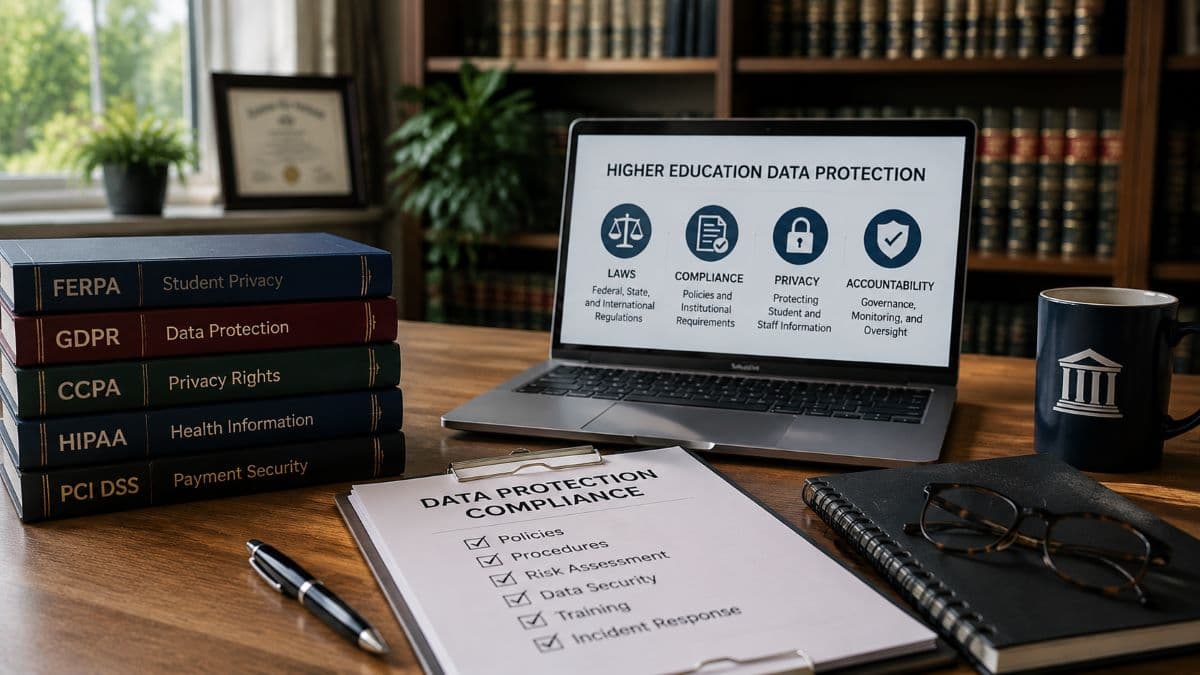
FERPA and student education records
The Family Educational Rights and Privacy Act, known as FERPA, is the federal law that protects the privacy of student education records and the personally identifiable information they contain. It governs who can access those records and under what conditions, and it gives students rights over their own information once they reach a certain age or enroll in college. For any institution that receives federal education funding, FERPA sets the baseline expectation for how student records are handled and kept from unauthorized disclosure, and a serious violation can put that federal funding at risk.
GLBA and student financial data
Less well known is that the Gramm-Leach-Bliley Act applies to colleges and universities too. Because institutions handle student financial aid, the Federal Trade Commission treats them as financial institutions for that data, which brings them under the GLBA Safeguards Rule. The updated rule requires a written information security program with specific administrative, technical, and physical safeguards, along with regular risk assessments and a designated person responsible for the program. Compliance is checked during the audits that institutions taking part in federal student aid already undergo, so it is not optional. Our explanation of the FTC Safeguards Rule covers what that program needs to include.
HIPAA, PCI DSS, and state laws
Depending on what an institution does, further rules come into play. A university hospital or student health center may fall under HIPAA for the health information it handles, a point our guide to the HIPAA Security Rule explains in detail. Card payments bring PCI DSS obligations, federally funded research can carry its own security mandates, and a growing number of states add their own data privacy and breach notification laws. The exact mix depends on the institution, but few escape with only a single set of rules to follow.
When one record falls under several laws
What makes higher education compliance genuinely hard is the overlap. A single student's file can contain education records covered by FERPA, financial aid details covered by the GLBA Safeguards Rule, and payment information covered by PCI DSS, all at the same time. The institution cannot satisfy one law and quietly ignore the others, so the practical task is building protection that meets the strictest applicable requirement for each piece of data, rather than treating any one regulation as the whole job.
The biggest data protection challenges on campus
The regulations describe what must be protected, but the day to day reality of a campus is what makes it hard. Several challenges come up at almost every institution.
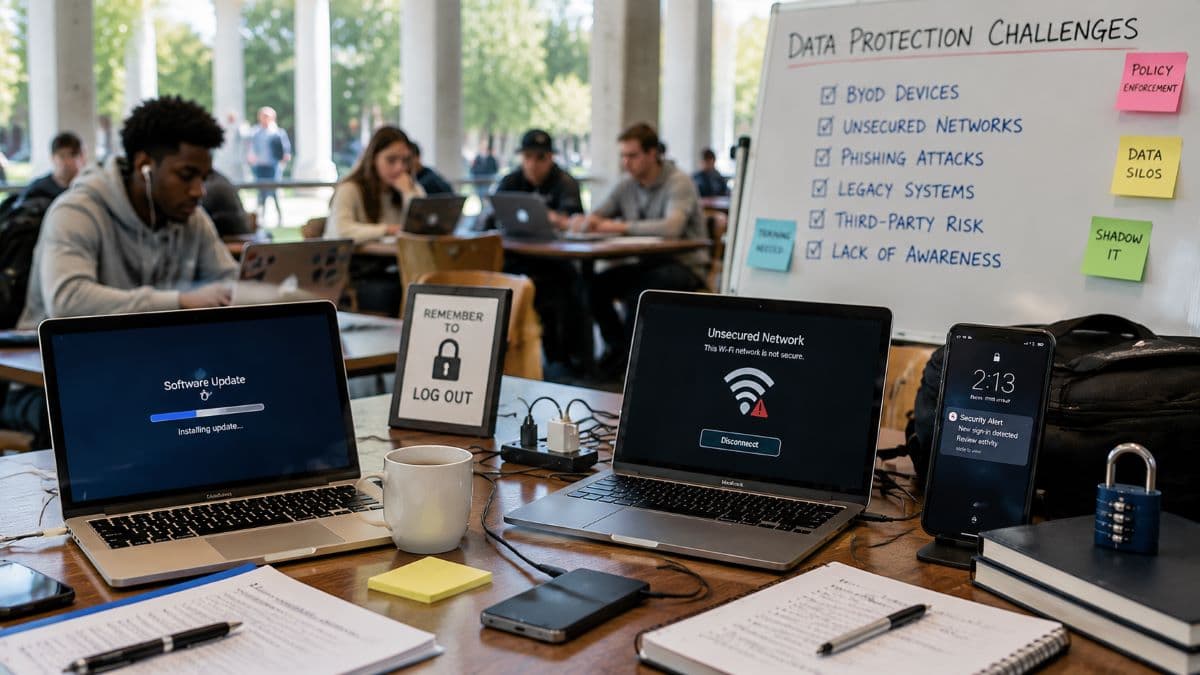
Many users and open access
A campus may have tens of thousands of people connecting to its network, each needing access to different systems, often from personal laptops and phones the institution does not control. Every account is a potential entry point, and the scale alone makes consistent security far harder than it is for a typical business with a fixed set of managed devices. Keeping access rights accurate as people arrive, change roles, and leave is a constant effort that is easy to fall behind on.
Decentralized systems and shadow IT
Departments and research groups often run their own systems and adopt their own software without central oversight, a pattern sometimes called shadow IT. This scatters sensitive data across the institution in places the central technology team may not even know about, making it difficult to protect information that nobody has a full map of. A security program is only as good as its visibility, and decentralization works directly against that.
Human error and student workers
Much of the daily handling of sensitive records falls to people, including the student workers who staff help desks, admissions offices, and registrar functions. A misdirected email containing a class roster or a financial aid file is a common and serious cause of exposure, which is why human error, not sophisticated hacking, is behind so many incidents. Reducing it depends heavily on training and on controls that limit what any one account can reach, and it connects closely to defending against threats like business email compromise, where attackers exploit ordinary mistakes and trust rather than breaking through technical defenses.
Aging systems and thin staffing
Many institutions run older systems that are difficult to secure and expensive to replace, alongside technology teams stretched across far more than security alone. Legacy software may no longer receive updates, and an overstretched team has little time for the steady, unglamorous work that good security requires. These are not the threats that make headlines, but they are where a great deal of real risk quietly lives.
What strong data protection for higher education looks like
Protecting an institution is less about any single product and more about a program that covers people, processes, and technology together. The pieces reinforce one another, and the strongest programs treat them as parts of one effort rather than separate projects.
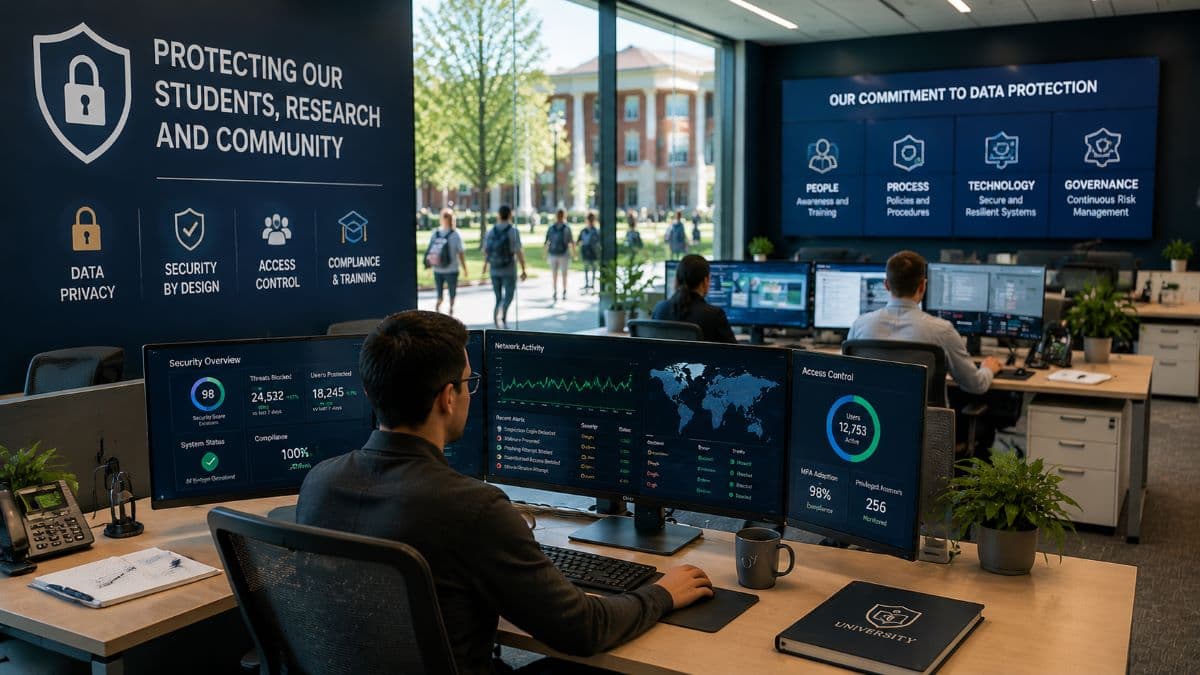
A written security program and risk assessments
Both the GLBA Safeguards Rule and sound practice call for a documented information security program built on regular risk assessments that identify where sensitive data lives and what threatens it. A structured assessment, of the kind described in our guide to a security risk assessment, turns vague worry into a clear list of priorities an institution can actually work through, and it satisfies a requirement that auditors will look for directly.
Access controls and least privilege
Because access is the central challenge on campus, controlling it carefully is the heart of the defense. That means giving each person only the access their role requires, removing access promptly when someone leaves or changes roles, and protecting accounts with multifactor authentication so a stolen password is not enough on its own. Knowing who can reach what, and keeping that picture accurate over time, does more to limit exposure than almost any other single measure.
Encryption and knowing where data lives
Sensitive data should be protected with encryption so that a lost laptop or an intercepted file does not become a breach, both while it is stored and while it travels across networks. Just as important is knowing where that data is in the first place, since data scattered in forgotten places cannot be protected. Classifying information by how sensitive it is, and keeping track of where it lives, lets an institution put the strongest protections where they matter most. These safeguards sit at the center of any sound set of cybersecurity solutions.
Monitoring and threat detection
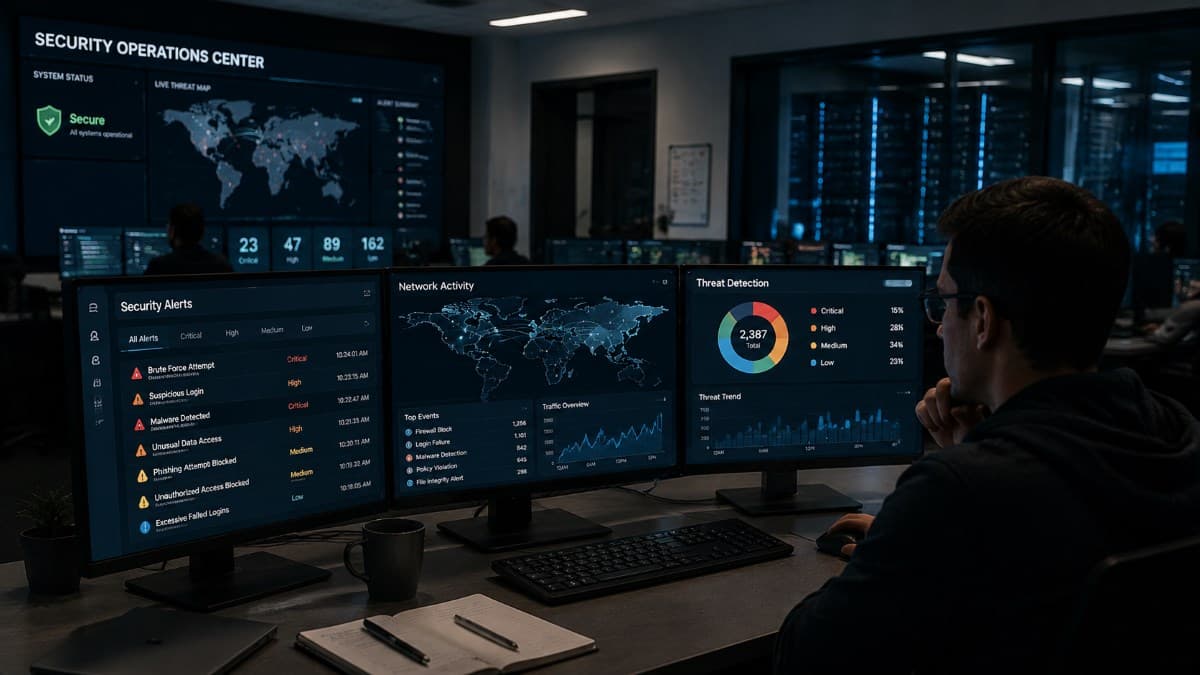
An institution needs to be watching its systems, because the sooner unusual activity is noticed, the smaller the eventual damage. Continuous monitoring and logging make it possible to catch an intrusion early and to provide the evidence that both investigations and regulators require. Given how often attacks announce themselves quietly before they escalate, the difference between catching a problem in hours and discovering it in months often comes down to whether anyone is watching at all.
Training and a culture of security
Since people are both the biggest risk and the first line of defense, ongoing training that helps staff and student workers recognize threats and handle data correctly is essential, and many frameworks require it. Training works best as a steady habit rather than a yearly formality, because the people and the threats both change over time. An institution where everyone understands their role in protecting data is far harder to breach than one relying on technology alone.
Backup, recovery, and incident response
No set of defenses removes risk entirely, so an institution has to be ready for the moment something gets through. Reliable, tested backups mean that a ransomware attack does not have to halt operations or destroy records, which is why a sound approach to data backup and disaster recovery belongs in any security program. A clear incident response plan matters just as much, because several of the rules governing student data require breaches to be contained and reported within set timeframes, and improvising under pressure is how those deadlines get missed.
Building a realistic plan, especially for smaller institutions
All of this can sound overwhelming for an institution that is not a large research university with a security team of its own. The reassuring part is that the path forward is manageable when it is approached in order rather than all at once.
Start with your data and your obligations
The first step is knowing what sensitive data you hold, where it lives, and which regulations apply to it, because everything else builds on that. A focused risk assessment answers those questions and produces a prioritized list, so that limited time and budget go toward the gaps that matter most rather than being spread thin across everything at once. Compliance becomes far less daunting once it is broken into concrete, ordered steps.
Where an outside provider fits
Large universities often have security teams of their own, but smaller colleges, trade schools, and specialized institutions face the same regulations with a fraction of the resources. They are held to FERPA and the GLBA Safeguards Rule just as a large university is, yet may have only a handful of technology staff. This is where an experienced provider makes the difference, bringing the security program, controls, and ongoing oversight that compliance demands without the institution having to build it all in-house. For smaller institutions across Los Angeles and the surrounding area, that kind of support is often the practical path to protecting student data well.
Frequently Asked Questions
If your institution needs to strengthen its cybersecurity and data protection for higher education, GlobeVM can assess where you stand and help you meet the rules that apply, for colleges and schools in Woodland Hills and across the surrounding area.
Comments
0 Comments