
For most small and mid-sized businesses, the question is not whether technology matters. It clearly does. The harder question is who should run it. Should you hire your own staff, or hand the work to an outside firm that does this all day for many clients? This is the heart of the in-house IT vs. outsourced managed IT services decision, and it shapes your costs, your security exposure, and how quickly your business can grow without your systems holding it back. This guide breaks down both models honestly, including the situations where keeping IT in-house is genuinely the smarter move, so you can match the choice to where your business actually is.
What should it cost? Our managed IT services pricing guide lists published 2026 price ranges, what is usually included and a free cost estimator.
What "in-house IT" and "outsourced managed IT" actually mean
The two terms get used loosely, so it helps to define them in plain language before comparing them.
In-house IT
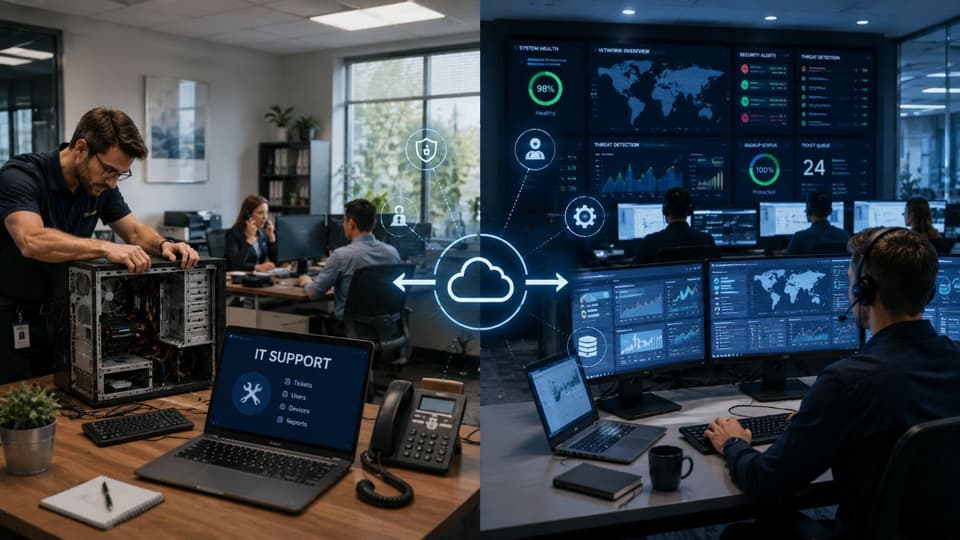
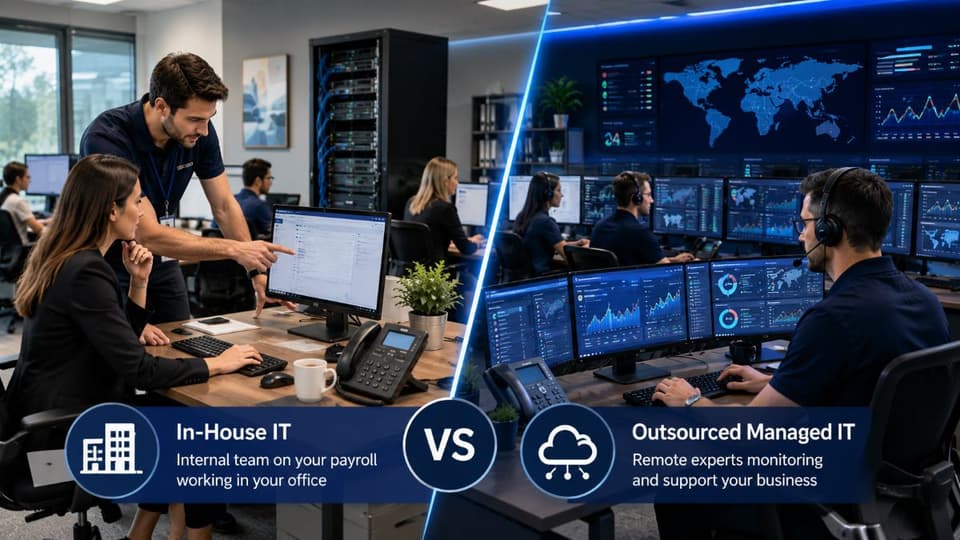
An in-house IT setup means technology is handled by people on your payroll. For a small business, that is usually one generalist who covers everything: resetting passwords, fixing printers, patching servers, managing vendors, and reacting to security alerts. As the company grows, that becomes a small team with a manager. The defining trait is proximity. The person works for you, sits in your building or close to it, and knows your systems and your people directly.
Outsourced managed IT services
Outsourced managed IT means you contract a specialized firm, often called a managed service provider or MSP, to run your technology for a predictable monthly fee. The provider monitors your systems remotely, handles support tickets, applies security updates, manages backups, and advises on technology planning. Instead of one employee, you are buying access to a team with different specialties. Strong providers build this around proactive remote monitoring and management so problems are caught before they interrupt your day, rather than after a system goes down.
The real cost comparison: in-house IT vs. outsourced managed IT services
Cost is the first thing most owners ask about, and it is also where the comparison is most often presented dishonestly. The fair comparison is not a salary against a monthly invoice. It is the fully loaded cost of one model against the fully loaded cost of the other.
The true cost of an in-house IT hire
Salary is only the starting figure. In the Los Angeles area, salary data puts a mid-level IT support specialist in the mid-$70,000s on average, though figures vary widely between sources, and senior or systems-level roles climb well into six figures. Once you add the costs an employee carries with them, the real number is higher:
- Payroll taxes, workers compensation, and benefits, which commonly add 25 to 40 percent on top of base salary
- Paid time off, sick leave, and the coverage gap when that one person is unavailable
- Recruiting, onboarding, and the cost of an empty seat if they leave
- Ongoing training and certifications to keep skills current
- Software tools, monitoring platforms, and security licensing the person needs to do the job well
Fully loaded, a single mid-level hire in this market often lands between $90,000 and $130,000 a year. That buys you one person, with one set of skills, available roughly forty hours a week.
How managed IT pricing works
Managed IT is usually priced per user or per device per month, so the cost scales with your headcount and is predictable enough to budget a year ahead. For a typical small business, a managed IT services agreement replaces not just a salary but the tools, monitoring, and after-hours coverage bundled into it. The honest comparison is this: outsourcing is frequently less expensive than a full in-house team for businesses under roughly fifty employees, but it is not automatically cheaper than a single junior hire. What it reliably delivers for the money is broader skill coverage and coverage outside business hours, which a lone employee cannot provide at any salary.
Coverage, expertise, and the single-point-of-failure problem
The cost conversation often hides the more important issue, which is depth. Modern business technology spans networking, cloud platforms, identity management, cybersecurity, backups, disaster recovery, and compliance. No single person is genuinely expert in all of those areas. A capable in-house generalist will be strong in two or three and stretched thin across the rest.
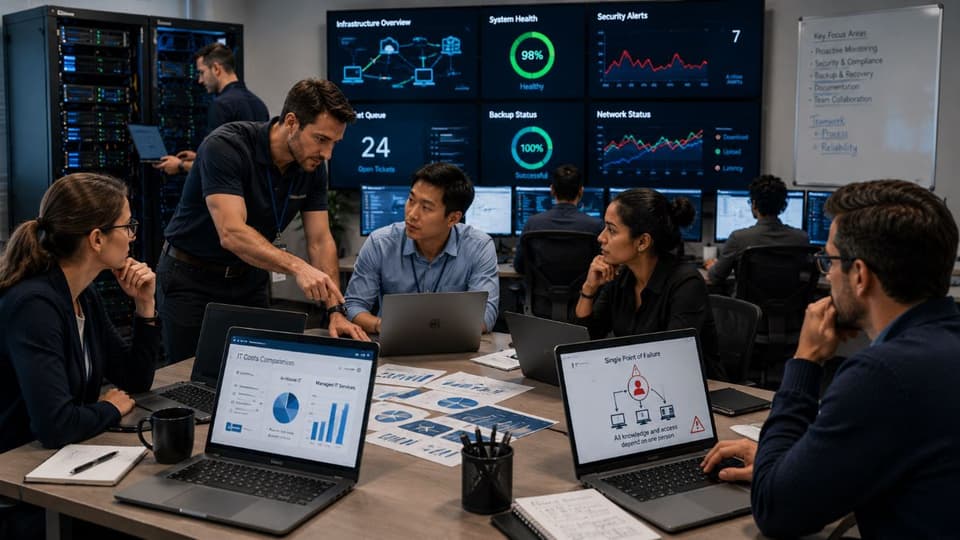
There is also a structural risk that rarely gets discussed plainly. When one employee holds all the knowledge of your environment, that person is a single point of failure. If they are on vacation, out sick, or resign, support slows or stops, and undocumented systems become a guessing game. An outside firm spreads that knowledge across a team and documents it as a matter of process. That is also why responsive helpdesk and IT support tends to be steadier under a managed model, because a ticket does not wait for one specific person to be available.
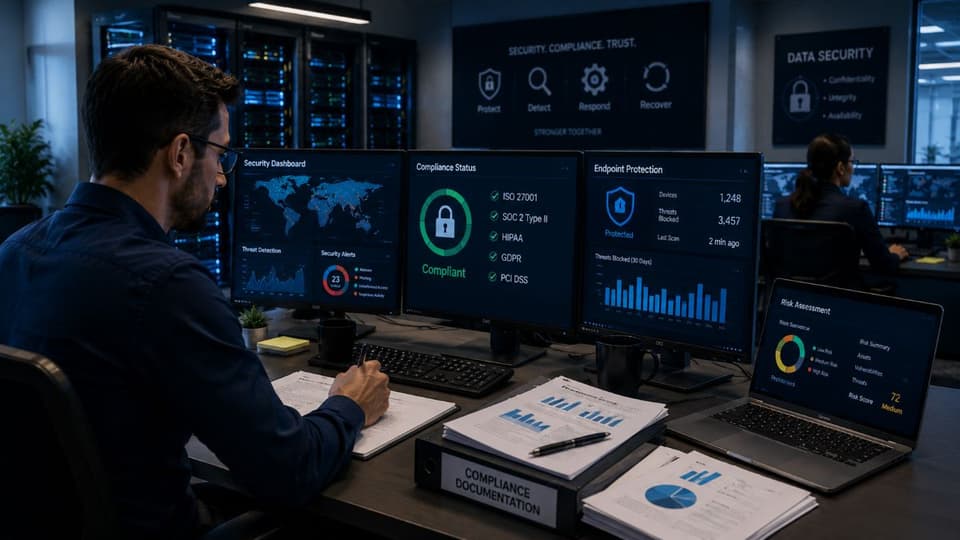
Security and compliance: where the gap shows most
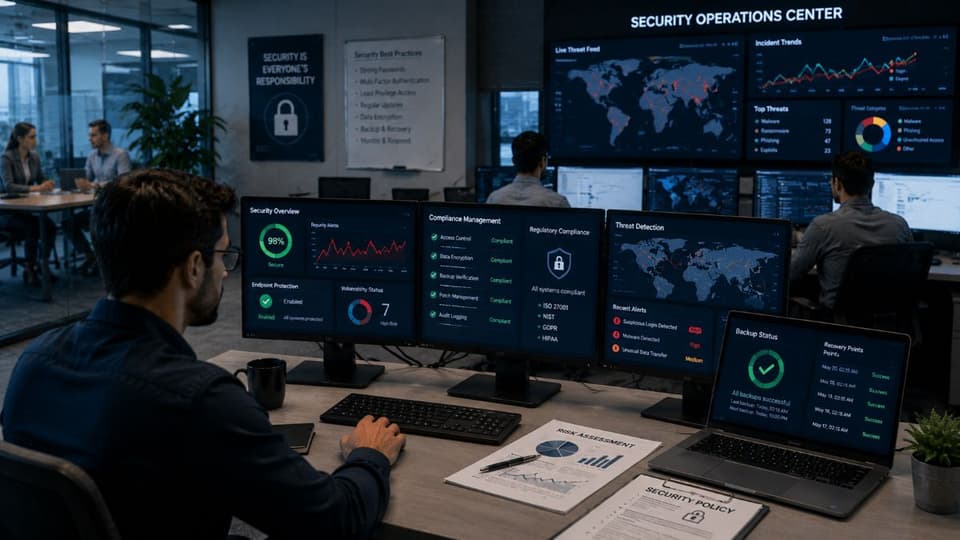
Security is the area where the in-house IT vs. outsourced managed IT services comparison stops being about preference and starts being about risk. Threats against small and mid-sized businesses have grown more targeted, and the defenses that matter now, including endpoint detection, email filtering, phishing-resistant authentication, and tested backups, require specialist attention.
A single in-house hire focused on day-to-day support often has neither the time nor the depth to run a real security program. A managed provider can dedicate specialists to it, which is why mature cybersecurity solutions are usually part of a managed agreement rather than an afterthought.
The same applies to recovery. Reliable data backup and disaster recovery is not a one-time setup, it is something that needs to be monitored and test-restored regularly, and that maintenance is easy for a stretched internal employee to let slip. Compliance raises the stakes further. Businesses in healthcare, legal, and finance operate under frameworks such as HIPAA and PCI DSS that demand documented controls, access management, and proof that safeguards are working. For a regulated business, the practical question is not only who fixes the laptops, but whether that person can also stand behind your compliance posture if it is ever examined.
Response time and proximity: the honest trade-offs
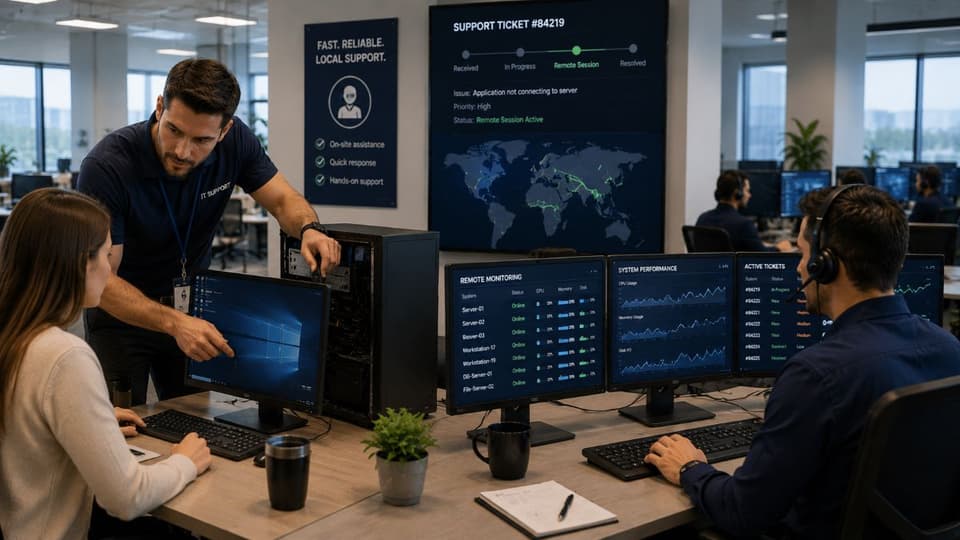
Outsourcing is not free of downsides, and a balanced comparison has to name them. An in-house employee can walk to a desk, see a problem in person, and read the room in a way a remote technician cannot. They absorb company culture and build relationships across departments. For hands-on hardware issues and for the feeling of having someone simply there, in-house has a genuine edge.
A managed provider closes most of that gap with defined response times written into a service agreement, remote tools that resolve the majority of issues quickly, and scheduled on-site visits when a problem needs hands on equipment. The trade-off you should weigh honestly is contract structure. You are entering an agreement with terms, and provider quality varies, so the response commitments and the exit terms deserve as much attention as the price. For businesses that depend on uptime outside of nine to five, round-the-cl
ock IT support is something a lone employee structurally cannot match, and that often outweighs the proximity advantage.
Scalability and what happens when your business changes
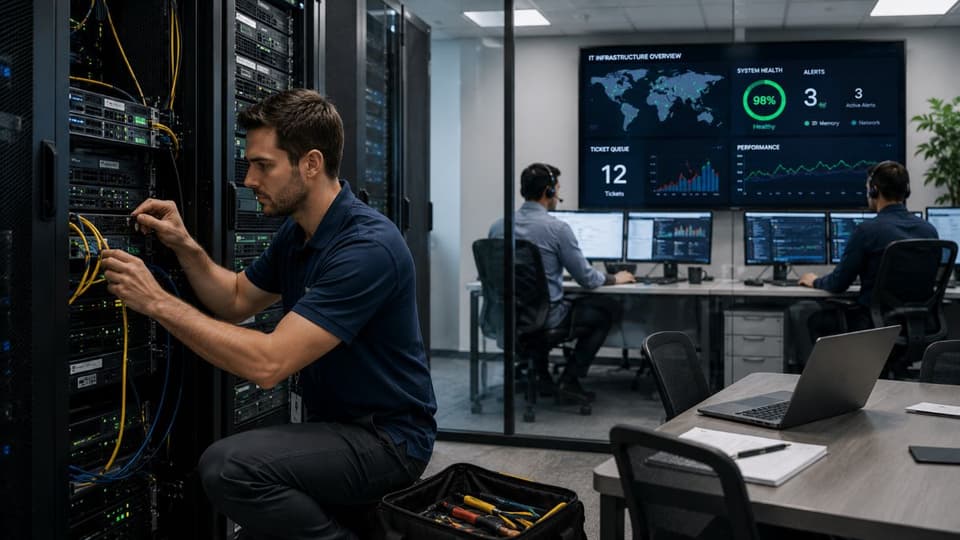
Business needs rarely hold steady. You open a location, absorb a busy season, onboard ten people at once, or trim back. An in-house model scales in slow, expensive steps, because adding capacity means hiring, and reducing it means layoffs. A managed model scales by adjusting your per-user count, which is faster and far less disruptive. If growth or seasonality is part of your reality, that flexibility is a practical advantage rather than a marketing line.
When in-house IT is actually the right choice
Most comparison articles quietly assume outsourcing always wins. That is not accurate, and pretending otherwise does the reader a disservice. In-house IT is often the better model when:
- Your company is large enough to staff a real team with a manager and several specialists, so depth and coverage stop being a problem.
- Your environment is highly specialized, for example custom software, manufacturing systems, or proprietary hardware that an outside generalist would struggle to learn.
- Technology is your core product, and keeping that expertise inside the company is a strategic decision rather than a support decision.
- You have a culture or security reason to keep certain knowledge entirely internal.
If you sit in that group, the right move is usually to invest in the in-house team, not to second-guess it. The friction point is the much larger group of businesses sitting in the awkward middle, too big for ad-hoc help, too small to staff real depth.
The hybrid path: co-managed IT
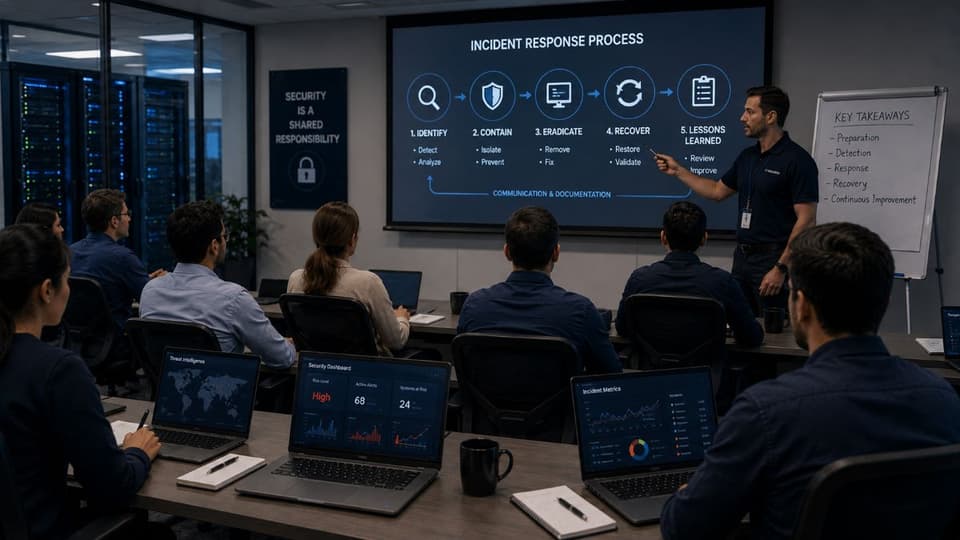
The choice is not strictly either-or. Many businesses keep a valued internal person or small team and pair them with an outside provider, an arrangement known as co-managed IT. The internal staff handle day-to-day support and the relationships they are good at, while the provider supplies the specialist depth, the security program, the after-hours coverage, and the strategic planning. This model also removes the single-point-of-failure risk, because the provider can step in when your internal person is out. For companies that like their current employee but feel the coverage gaps, exploring a co-managed IT arrangement is often a better answer than choosing one extreme.
A simple framework for deciding
Strip away the noise and the in-house IT vs. outsourced managed IT services decision usually comes down to a short, honest assessment. Ask these questions in order:
- How much depth do you actually need? If one generalist cannot realistically cover support, security, backups, and compliance, a single hire will leave gaps.
- What does downtime cost you per hour? The higher that number, the more you need proactive monitoring and after-hours coverage rather than reactive fixes.
- Are you regulated? HIPAA, PCI, or similar obligations raise the bar on documented security, and specialist support becomes close to mandatory.
- How stable is your headcount? Frequent growth or seasonality favors a model that scales without hiring and firing.
- Do you already have a good internal person? If so, a co-managed arrangement may beat replacing them entirely.
For a regulated or growth-stage small business, the answers usually point toward outsourced or co-managed support, which is why demand for managed IT services in Los Angeles has grown among exactly these companies. For a larger or highly specialized firm, a real in-house team often wins. The point is to decide from your own answers, not from a generic recommendation.
If you are weighing the in-house IT vs. outsourced managed IT services question for your own company, a short consultation with the team at GlobeVM will give you an honest assessment of your current setup and a clear next step.