

Ask a provider whether your business is secure and you will get adjectives. Ask about MTTD and MTTR and you will get numbers, which is why these two metrics are worth knowing. Mean time to detect and mean time to respond measure the part of security that adjectives hide: when something bad starts, how long until anyone notices, and how long until it stops. This guide explains both metrics in plain language and shows why detection speed decides most of the damage. It also lays out what moves each number in a small business, including the questions to ask a provider who claims to be watching your environment.
What MTTD and MTTR Mean
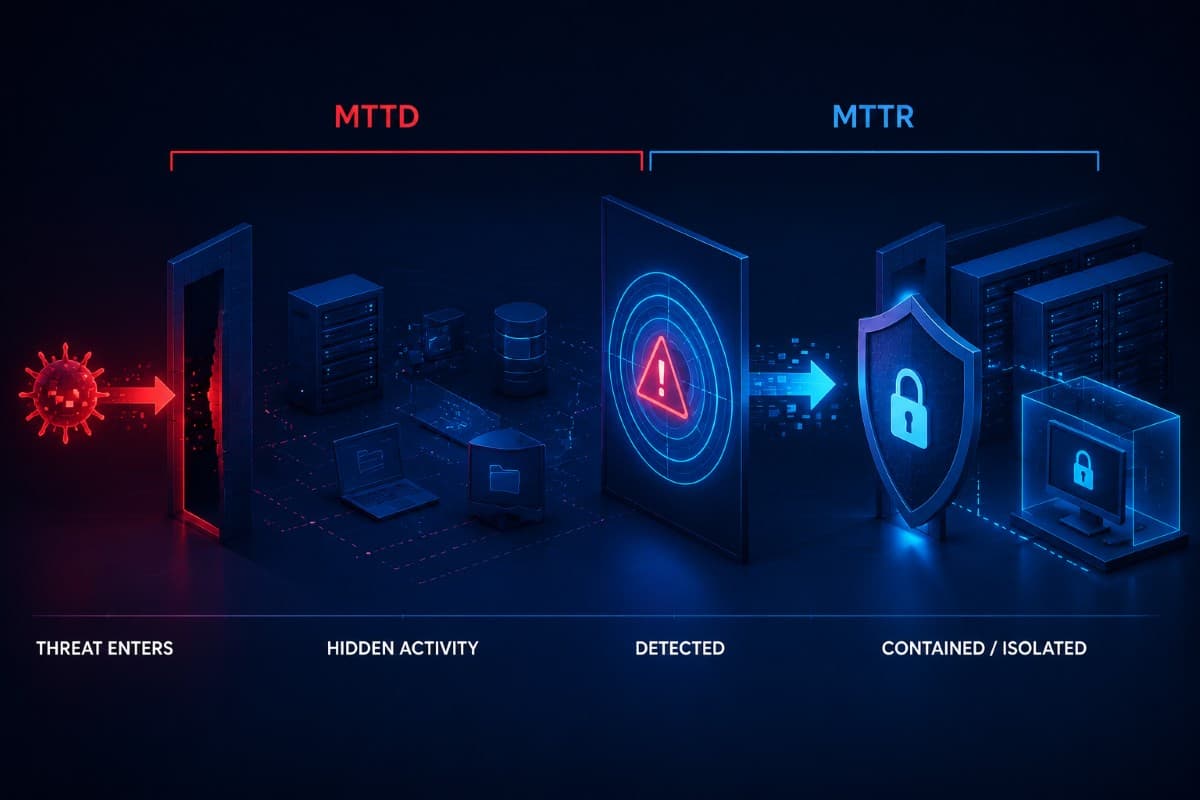
Mean time to detect, or MTTD, is the average time between a security incident beginning and your side becoming aware of it. The clock starts when the attacker gets in or the malware runs, not when it is convenient, which is what makes the metric honest: it counts the whole window when something was wrong and nobody knew.
Mean time to respond, or MTTR, is the average time from detection to the threat being contained and neutralized. One warning about the acronym: the R gets used loosely across the industry to mean respond, remediate, or recover, and those are different finishes. In a security context the useful definition is containment, the moment the threat can no longer spread or act, with full cleanup and recovery tracked as their own work.
One incident makes both clocks concrete. An employee's password is phished on a Monday, and the attacker quietly logs into email that evening. On Thursday morning, monitoring flags a login from an impossible location and raises an alert: MTTD was roughly three days. An analyst confirms it within the hour, forces a password reset, revokes the active sessions, and isolates the mailbox rules the attacker planted: MTTR was about one hour. Security teams call that three-day gap the dwell time, and shrinking it is the entire game, because everything the attacker read happened inside it.
Why Detection Speed Decides the Damage
The relationship between these numbers and real losses is not theoretical. IBM's global Cost of a Data Breach study for 2025 put the average breach lifecycle at 241 days, roughly 181 days to identify the breach and another 60 to contain it. Months, not minutes, and that average includes large organizations with dedicated security teams.
The same study shows what the delay costs. Breaches identified and contained inside 200 days averaged 3.87 million dollars in total cost, while those that ran longer averaged 5.01 million. The gap exists because an undetected intruder is not idle: every additional week is more accounts compromised, more data staged for theft, and more systems within reach when the final blow, often ransomware, lands. Detection speed is not a technical vanity metric. It is the dial that most directly sets the size of a bad day.
For a small business the numbers scale down but the logic does not. An attacker who sits unnoticed in a ten-person firm's email for two months reads everything, learns the billing rhythms, and picks the perfect moment for a fraudulent wire request. The damage was authored during the detection gap, which is why shrinking MTTD protects you before response skill ever gets tested.
What Moves MTTD
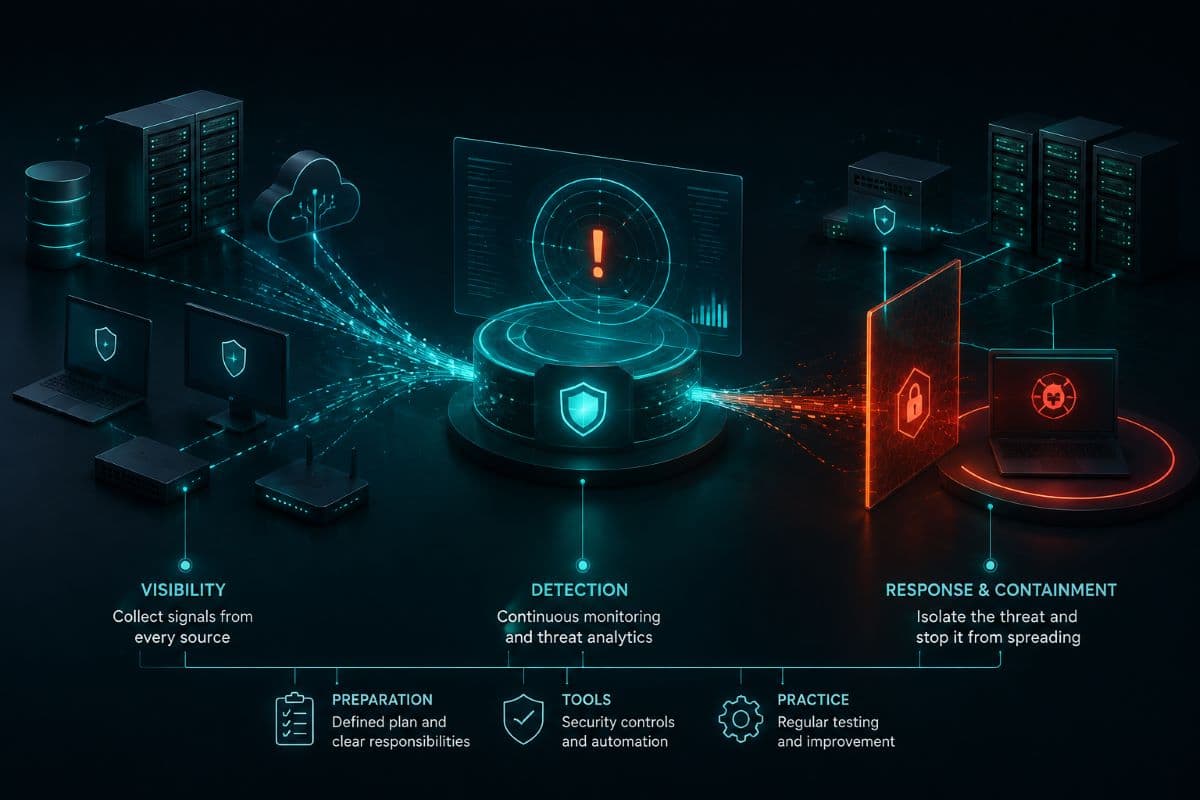
Detection time is a function of two things: whether the evidence is being collected, and whether anyone is looking at it. Both layers are buildable, and neither one is optional.
The evidence layer is visibility. Systems, devices, and cloud accounts constantly emit signals about what is happening on them, and gathering those signals into one watchable place is the foundation, the discipline we cover in our guide to telemetry. An environment that logs nothing has an MTTD of however long it takes an attacker to do something a human physically notices, which is how breaches last months.
The watching layer is where small businesses hit the honest constraint: alerts at two in the morning protect nobody if nobody is awake, and hiring around-the-clock analysts is beyond almost every SMB budget. This is precisely the gap that managed detection and response services exist to close, putting a staffed security operation behind your alerts for a monthly fee instead of a payroll. Alert quality matters as much as coverage, since a feed full of false alarms trains people to ignore it, so tuning is part of the work rather than an afterthought.
What Moves MTTR
Once something is detected, response time is decided by preparation made earlier. The single biggest factor is having a plan that names decisions in advance: who isolates a machine, who can order systems shut down, who calls the insurer and the lawyer. A business that has thought through responding to a ransomware incident before one happens moves in minutes where an unprepared one loses hours to finding out who is allowed to act.
Both of those sit inside a working set of cybersecurity services rather than standing alone. The second factor is containment capability: modern endpoint tools can isolate an infected machine from the network remotely, turning what used to be a drive-across-town response into a click. The third is practice, because a plan that has never been rehearsed always breaks somewhere small, a wrong phone number, an unclear authority, and rehearsal finds those gaps at a conference table instead of during the incident. Capable threat detection arrangements bundle these pieces, so the same service that shortens MTTD is also holding the playbook that shortens MTTR.
Do Not Confuse These With the Other Clocks
Two neighboring sets of metrics use similar vocabulary and measure different things, and mixing them up leads to buying the wrong protection. Helpdesk response and resolution times measure how fast support handles reported problems, a service-quality question about tickets, not intrusions. And RTO and RPO measure recovery after a disaster, how quickly systems come back and how much data you can afford to lose, which is the backup conversation rather than the detection one.
The clean way to keep them straight: helpdesk clocks measure service, MTTD and MTTR measure defense, RTO and RPO measure recovery. A resilient business needs credible numbers in all three families, and a strong score in one does not substitute for the others.
How to Start Measuring When Nobody Measures Anything Today
Most small businesses cannot state their MTTD because nothing is recording the events the clock would run between. Starting is less work than it sounds, and it happens in three steps rather than a project.
The first step is deciding what counts as an incident. Without a definition, the average is meaningless: a business that counts every blocked phishing email will report a flattering number, and one that counts only confirmed compromises will report a worse-looking number from a healthier environment. Write down the threshold, keep it stable, and record the same fields every time: when the activity began, when someone became aware, when it was contained, and how it was found.
The second step is fixing the start time honestly. Detection time is measured from when the attacker acted, not from when the alert fired, which means reconstructing the timeline after the fact from logs. That reconstruction is only possible if the logs still exist, which is why retention settings quietly decide whether you can measure anything at all.
The third step is reviewing the number with the incidents behind it. An average built from three events is a story, not a statistic, so the useful review looks at each case and asks what would have shortened it. Usually the answer is not a faster analyst. It is a signal that was never collected, an alert nobody was awake for, or a decision that had no owner.
What a Realistic Target Looks Like
Rather than chasing a published benchmark, set targets against your own baseline and the business consequence. For a small office, a reasonable working target is that anything touching email, finance systems, or administrative accounts is surfaced within an hour and contained within the working day, while lower-risk noise can wait for the next review. The point of a target is not the number. It is that missing it triggers a question about why.
What to Ask Instead of Chasing a Benchmark
The natural next question is what a good MTTD looks like, and the honest answer is that published averages are dominated by large organizations and mean little for a twelve-person office. In a properly monitored small business environment, common threats should surface in minutes to hours, not weeks, but the useful move is not comparing yourself to an industry table. It is asking your provider four direct questions.
Do you measure detection and response times for our environment at all? What were they last quarter, with an example of something you caught? What is monitored, and during which hours? And who acts on an alert at 2 a.m., specifically?
These are the same capabilities that remote IT monitoring and management is built to provide, and a provider running real monitoring answers the four questions easily, whether the client is a practice in Simi Valley or a firm downtown. Vague answers to all four mean the metrics do not exist, and what is not measured is not managed.
These same capabilities are increasingly what your insurer is probing for. Cyber insurance applications now routinely ask whether the environment is monitored around the clock and how incidents are detected. The businesses that can answer with specifics rather than hopes are the ones that keep their coverage and their premiums reasonable. The metrics you build for security end up doing double duty on the application form.
Frequently Asked Questions
MTTD is mean time to detect, the average time between a security incident starting and your organization becoming aware of it. MTTR is mean time to respond, the average time from that detection until the threat is contained. Together they measure the two halves of security response: noticing and acting.
There is no honest universal number, because published averages come mostly from large organizations. As a practical bar, a small business with real monitoring in place should expect common threats to be surfaced in minutes to hours rather than days, and should expect its provider to report actual figures rather than reassurances. The global average of roughly six months to identify a breach is the picture of what no monitoring looks like, not a target.
The acronym is used for all three across the industry, which causes real confusion. In a security context the most useful meaning is respond, measured to containment, the point where the threat can no longer act or spread. Full remediation and recovery are tracked separately, and when a provider quotes an MTTR, it is worth asking which finish line their clock stops at.
Through a managed detection and response arrangement, which supplies the around-the-clock monitoring and trained responders that shrink MTTD, paired with an incident response plan and remote containment tools that shrink MTTR. The combination costs a monthly fee instead of several salaries, which is why it has become the standard way small businesses get enterprise-grade detection.
MTTD and MTTR measure how fast you notice and stop a security threat. RTO and RPO measure how fast you restore operations and how much data you can afford to lose after any disaster, cyber or otherwise. The first pair is about defense while the incident is live; the second is about recovery after damage is done, and a complete plan needs both.
You do not need to run a security operations center to benefit from MTTD and MTTR; you only need to insist that whoever protects your business measures them, reports them, and can explain what makes them shrink. If you cannot currently answer how long an intruder would sit in your systems before anyone noticed, GlobeVM can show you exactly what monitored detection and response would look like for your environment, numbers included.
Comments
0 Comments