
When you first hired your IT provider, the fit was probably right. Your business was smaller, your systems were simpler, and the support they offered was enough to keep things running. But businesses grow, and IT needs grow with them. The provider that comfortably supported a twelve-person company often struggles with that same company at forty people. The question most owners face is not whether their provider was ever good. It is whether that provider is still the right fit for the business as it exists today.
Recognizing that you have outgrown your IT provider is not an admission that you chose badly. It is a normal marker of growth. The needs that arrive with more employees, more locations, tighter compliance, and more complex technology can quietly move beyond what a smaller or generalist provider was built to deliver. Plenty of strong working relationships simply reach a point where the business has moved forward and the provider has not.
This guide helps you tell the difference between an ordinary rough patch and a genuine mismatch. It covers the warning signs that show up when you have outgrown your IT provider, how to evaluate your situation with data rather than frustration, and what to do once you have an honest answer. By the end you will be able to clearly assess whether your IT provider is still serving your business or quietly holding it back.
Why Businesses Outgrow Their IT Providers
Businesses outgrow their IT providers when their needs evolve faster than the provider can scale. Growth in staff, locations, compliance obligations, and technology complexity often moves beyond what a smaller or generalist provider can deliver. Outgrowing a provider is usually a sign of business success, not a failure on anyone's part.
Growth Changes Your IT Needs
As headcount rises, support demand rises with it, and not in a straight line. More employees means more devices, more accounts, more software, and more tickets. A provider whose team and processes were sized for a small client base can fall behind simply because your volume has doubled. The infrastructure also gets more complex as you add servers, sites, and systems, and complexity is harder to support well than size alone.
Compliance Requirements Increase
Growth tends to pull new regulations into your world. A practice that adds patients, a firm that takes on regulated clients, or a business that starts processing card payments at volume can find that HIPAA, PCI DSS, or SOC 2 now applies in ways it did not before. A generalist provider who was a fine fit for a simpler environment may not have genuine experience with the compliance work your business now requires.
Technology Expectations Rise
The bar for what good IT looks like climbs as a business matures. Cloud migration, modern cybersecurity, and real strategic planning move from optional to expected. A provider comfortable with basic break-fix support and simple networks may not be equipped to guide those decisions, even if they handle day to day issues competently.
It Is Not Always the Provider's Fault
This is worth saying plainly. A good small-business managed IT services provider can do excellent work and still not scale into a larger, more complex client. The relationship may have served its purpose well. Outgrowing a provider is a normal stage in the life of a growing business, and treating it as a betrayal or a mistake only makes the decision harder than it needs to be.
Sign 1: Response and Resolution Times Are Getting Worse
The most visible sign that you have outgrown your IT provider is support that keeps getting slower. This is often the first thing a frustrated team notices, and it is also one of the easiest signs to measure objectively.
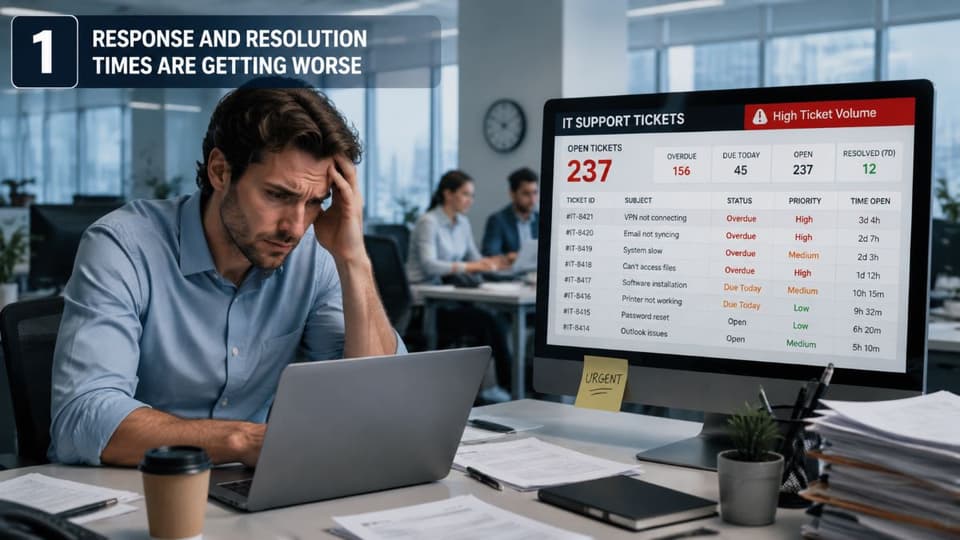
What This Looks Like
Tickets sit for hours, sometimes days, before anyone responds. You find yourself sending follow-up messages just to get attention. Requests are met with a vague we will get to it. Worst of all, issues that genuinely stop work do not seem to be treated with any more urgency than minor ones. Support that once felt responsive now feels like waiting in a line.
Why It Happens
Usually the cause is simple growth on the provider's side. Their client base expanded faster than their team did, and you went from being a priority account to a small fish in a much larger pond. Their tier structure and help desk and IT support capacity may no longer match the volume of work your business now generates.
How to Measure It
Do not rely on memory or mood. Track actual response and resolution times for a full month, write down when each ticket was opened and when it was answered, and compare those numbers against the service level agreement you were promised. What matters is the trend over time, not a single bad incident.
When It Is a Real Problem
One slow week is not a reason to switch. Consistent service level agreement violations are. If response times have been steadily worsening over several months and that delay is now affecting your operations, you are looking at a structural problem rather than a temporary one.
Sign 2: Your Needs Exceed Their Technical Expertise
Sometimes the issue is not speed but depth. Your business has moved into territory the provider was never built to handle, and the gap between what you need and what they know keeps widening.

What This Looks Like
They struggle with your newer systems. Routine issues prompt a we will need to bring in someone for that. Their recommendations feel a step or two behind current practice. They quietly steer away from complex projects rather than taking them on. You start to sense that you have moved past the edge of their comfort zone.
Common Expertise Gaps
The gaps tend to cluster in a few areas. Cloud architecture and cloud migration is a common one, since moving and optimizing cloud environments is genuinely specialized work. Advanced cybersecurity is another, along with compliance frameworks and modern infrastructure such as virtualization and hybrid environments. These are exactly the areas a growing business leans on most.
Why It Happens
A provider who built their practice around simpler environments may have a team whose skills have not grown alongside the technology. If most of their clients are small and uncomplicated, there is little pressure on them to develop deeper expertise, and that shows the moment a client like you needs more.
When It Is a Real Problem
The clearest signal is role reversal. If you find yourself explaining your own requirements to the people who are supposed to be guiding you, if projects stall because of their limitations, or if you are paying outside specialists for work your provider should be handling, their expertise no longer matches your business.
Sign 3: They Fix Problems but Offer No Strategy
A provider who keeps the lights on but never helps you plan is a sign you have outgrown the relationship. As a business grows, purely reactive support stops being enough.

What This Looks Like
There are no regular business reviews. No one has built you a technology roadmap or helped you forecast an IT budget. Recommendations only appear after something breaks. The entire relationship is reactive, a series of fixes with no thread connecting them to where your business is headed.
What You Should Be Getting
At your size, IT support should include strategy. That means quarterly or annual reviews, virtual CIO level guidance, a technology roadmap aligned with your business goals, and budget forecasting so technology spending stops being a series of surprises. Strategy is the difference between a vendor and a partner.
Why Strategy Matters as You Grow
The larger a business gets, the more its IT decisions cost when they go wrong. Proactive planning prevents expensive mistakes, smooths growth, and turns technology into something that supports expansion rather than reacting to it. A business past a certain size that receives no strategic input is flying without instruments.
When It Is a Real Problem
If you are making significant IT decisions entirely on your own, if no one on the provider's side is thinking ahead about your environment, and if your business has reached a size where strategy genuinely matters, reactive-only support has become a real limitation.
Sign 4: The Same Problems Keep Coming Back
Few things signal an outgrown provider more clearly than recurring issues. When the same problems return month after month, you are paying for fixes that do not actually fix anything.
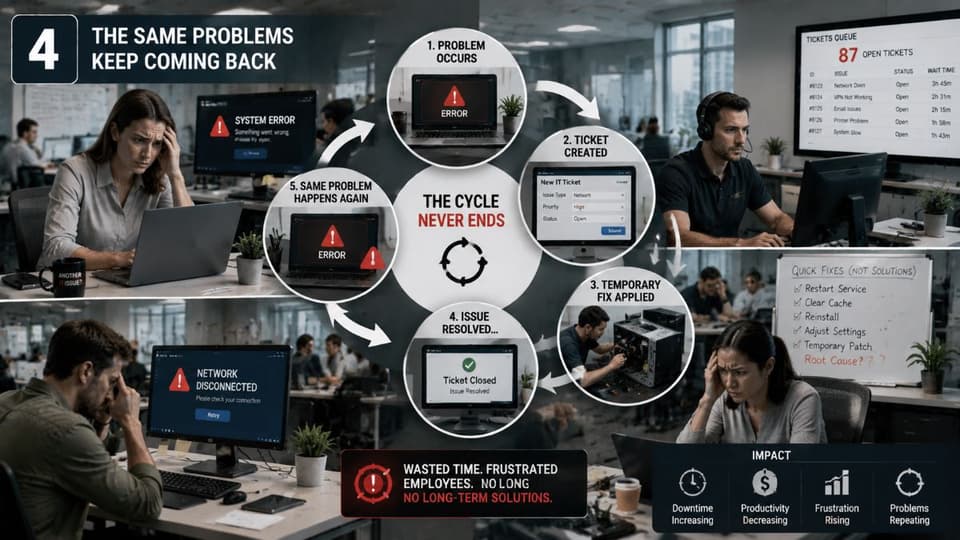
What This Looks Like
The same handful of issues recurs on a predictable cycle. Symptoms get patched while root causes go untouched. Have you tried restarting it becomes a default answer rather than a first step. Problems you reported months ago are still happening, just with a fresh ticket number.
Why It Happens
Recurring problems usually point to missing process. There is no real root cause analysis, either because the provider lacks the time or the skill to investigate deeply. Band-aid fixes are faster and cheaper for them than genuine solutions, and without a problem management process, nothing ever gets permanently closed out.
The Cost of Recurring Problems
The expense here is easy to underestimate. Every recurrence brings its own downtime and its own lost productivity, and you pay for the same fix again and again. Proactive monitoring is meant to catch and resolve these patterns, which is why ongoing proactive IT monitoring and management is a core part of mature support.
When It Is a Real Problem
A single stubborn issue is normal. A clear pattern of recurring problems, no improvement despite repeated reporting, and issues that compound over time together point to a provider who cannot or will not solve things at the root.
Sign 5: Security and Compliance Are Not Keeping Up
Of all the signs covered here, this one carries the highest stakes. A provider whose security and compliance work has not kept pace with your business is not just an inconvenience, it is a genuine risk.

What This Looks Like
There is no clear cybersecurity strategy you can point to. Security tools look dated. The provider cannot meaningfully support the compliance obligations your business now carries. When you ask about your security posture, the answers are vague and general rather than specific and confident.
Why This Is Serious
Security threats change constantly, and a provider standing still is effectively falling behind. Compliance failures carry real financial penalties, and a serious breach can be the kind of event a business does not recover from. This is not an area where good enough holds up over time, and modern cybersecurity solutions need to evolve as the threats do.
Compliance Warning Signs
Watch for a provider who is unfamiliar with the specific regulations that apply to you, whether that is HIPAA, PCI DSS, or another framework. The absence of any compliance documentation is a warning, as are audit failures, near-misses, and unmet cyber insurance requirements. Genuine compliance and risk management support produces evidence, not assurances.
When It Is a Real Problem
If your compliance requirements have moved past what your provider can meet, if you have had security incidents or close calls, or if you simply have no confidence in where your security stands, this sign should move to the top of your list.
Sign 6: Communication Has Broken Down
Technology problems are easier to forgive than communication problems. When you cannot get clear, timely answers, even competent technical work starts to feel unreliable.
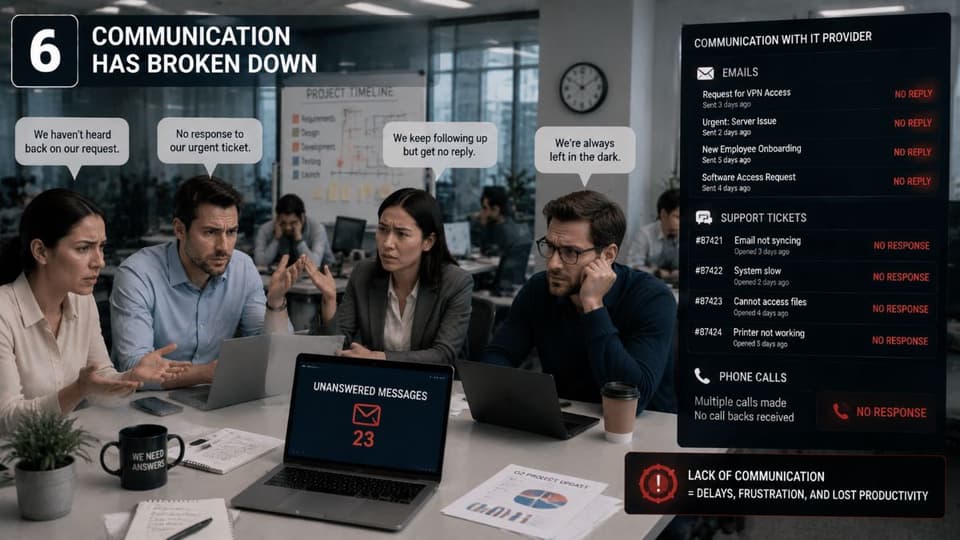
What This Looks Like
There is no dedicated point of contact who knows your business. Communication is slow or unclear. You are the one chasing updates rather than receiving them. Proactive outreach, the provider reaching out to you before you reach out to them, has disappeared entirely.
What Good Communication Looks Like
Strong providers maintain clear escalation paths, hold regular check-ins, send proactive updates, and offer responsive account management. You should always know who to contact and roughly when you will hear back. Communication is the part of the relationship that makes everything else feel dependable.
Why It Matters
IT support is a partnership, not a vending machine. When communication breaks down, technical issues feel worse than they are, because uncertainty compounds frustration. Trust erodes quickly without good communication, and once trust is gone the relationship rarely recovers on its own.
When It Is a Real Problem
Consistent communication breakdowns, a persistent feeling of being ignored or deprioritized, and a relationship that has become purely transactional are all signs that the partnership has thinned out to something that no longer serves you.
Sign 7: You Are Paying More but Getting Less
Cost on its own is never the whole story. The real warning sign is a widening gap between what you pay and what you receive.

What This Looks Like
Your costs climb while service quality stays flat or declines. Surprise charges appear, and scope creep means you are billed for things that used to be included. The price goes up, the value does not, and the relationship starts to feel like a worse deal every quarter.
Why It Happens
Sometimes the provider is simply raising rates without adding anything in return. Often the original scope no longer fits the business you have become, so you are paying within a model that was designed for a smaller, simpler company. The pricing has not adapted to your growth, even though everything else about your needs has.
How to Evaluate Value
Compare your costs against current market rates so you know whether your pricing is reasonable for your size. Then assess service quality honestly, and factor in the full cost of the relationship, including the downtime and lost productivity a weaker provider allows. Value is service quality measured against total cost, not the monthly invoice in isolation.
When It Is a Real Problem
A clear mismatch between cost and value, the existence of stronger options at a similar or lower price, and a steady decline in the return you get on your IT spending together mean the pricing has stopped making sense.
Additional Signs You Have Outgrown Your IT Provider
The signs above are the major ones, but a few others are worth watching for. Any single one of these may be minor on its own. Several together strengthen the overall picture.
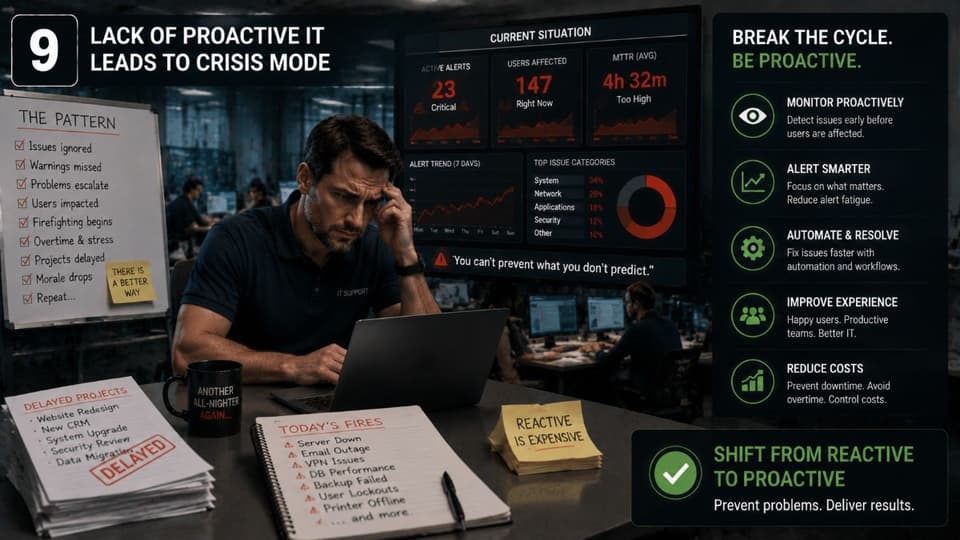
Sign 8: They Cannot Support Your Growth Plans
When you describe an expansion, a new location, or a shift toward remote work and the provider responds with hesitation rather than a plan, that is a sign. A provider who cannot grow with you becomes a constraint on your growth, and the gap only widens from there.
Sign 9: Onboarding New Employees Is Slow
New hires should arrive to a working device, the right accounts, and proper access on day one. When that process is consistently late or disorganized, it points to a provider stretched thin or lacking structure. Smooth provisioning depends on good IT asset management, and its absence shows up fast as a team grows.
Sign 10: They Are Resistant to Modern Tools
A provider who keeps pushing outdated solutions and avoiding cloud-based options may be steering you toward what is easy for them rather than what is right for you. Modernization should be guided by your needs, not limited by their comfort zone.
Sign 11: You Are Doing IT Work Yourself
If you or your staff have quietly started filling gaps the provider should cover, handling small fixes and workarounds because it is faster than waiting, you are effectively paying for support you are also performing. That is a clear signal the coverage no longer matches the need.
Sign 12: Your Team Has Lost Confidence
Watch how employees behave. When people work around IT support instead of using it, finding their own fixes rather than opening a ticket, the team has already concluded that the provider will not help. Lost confidence is one of the quietest but most telling signs of all.
How to Objectively Evaluate Your IT Provider
Recognizing the signs is the first half of the work. The second half is judging your situation with evidence rather than emotion, because frustration alone is not a reliable basis for a major decision. The following six steps turn a vague sense of dissatisfaction into a clear, defensible assessment.

Step 1: Track the Data
Spend one month gathering facts. Record response and resolution times for every ticket, keep a log of recurring issues, note each downtime incident, and compare the provider's actual performance against the service level agreement you are paying for. A month of real data tells you far more than a year of impressions.
Step 2: Survey Your Team
Your employees experience IT support more directly than you do. Ask them how satisfied they are with it, which problems never seem to go away, and where they feel unsupported. Honest answers from the people closest to the daily experience will surface issues you may not see from where you sit.
Step 3: Assess Strategic Support
Ask yourself a few simple questions. When was your last genuine IT strategy conversation? Do you have a current technology roadmap? Is anyone on the provider's side planning ahead for your environment? If the honest answers are not recently, no, and no one, strategic support is missing.
Step 4: Evaluate Security and Compliance
Test this directly. Ask your provider to document your current security posture, and confirm whether they can fully meet the compliance obligations your business carries. Note any incidents or audit issues from the past year. Confidence here should rest on evidence the provider can produce, not on reassurance.
Step 5: Calculate Your True Cost
Add up the full picture, not just the monthly fee. Include any hidden or surprise charges, and then add the cost of downtime and lost productivity the relationship has caused. Compare that real total against current market value for a business of your size and complexity.
Step 6: Score the Relationship
Finally, bring it together. Go through every sign in this guide and mark each one as not an issue, a minor issue, or a serious issue. The pattern is what matters. One bad month is not a reason to switch IT providers. A consistent pattern across several serious warning signs, sustained over months, usually is. As a rough guide, three or more serious signs is the point at which it is worth genuinely evaluating alternatives.
What to Do When You Have Outgrown Your IT Provider
Concluding that you have outgrown your provider does not mean you should switch tomorrow. A measured process protects you from trading one mismatch for another.

Have a Direct Conversation First
Before anything else, talk to your current provider. Many issues can be addressed once they are named clearly, and a provider who values the relationship deserves the chance to respond. Lay out the specific problems, ask how they would fix them, and document what they commit to. If they improve, you have saved yourself a disruptive change. If they do not, you have confirmed your decision.
Evaluate Alternatives
If the conversation does not lead to real change, start researching providers that fit the business you are now, not the one you used to be. Look for genuine industry experience, and gather proposals from three to five candidates so you have a real basis for comparison. For some growing businesses with internal IT staff, a co-managed IT arrangement is worth considering alongside fully managed options.
How to Switch Smoothly
Treat a switch as a project, not an event. Review your current contract and its exit terms, plan a realistic transition timeline of roughly thirty to sixty days, and make sure documentation, credentials, and knowledge transfer are handled properly. A brief overlap period, where both providers are involved, keeps anything from falling through the cracks.
What to Look for in a New Provider
Choose a provider right-sized for your current business, with experience in your industry, real strategic capability rather than fixes alone, and strong security and compliance practices. The goal is not simply a different vendor. It is a partner equipped for where the business is going.
Avoiding the Same Mistake Again
The reason you outgrew your last provider is worth learning from. Choose one with genuine room to scale, set clear expectations and service level agreements from the start, and build regular reviews into the relationship so you catch any drift early. A provider chosen with growth in mind is far less likely to be outgrown.
Is It Time to Consider a New IT Partner?
If the signs in this guide describe your situation, GlobeVM is worth a conversation. We built our managed IT practice around growing businesses, the companies whose needs have moved past what a smaller or generalist provider can comfortably support.
That means strategic guidance rather than fixes alone, cybersecurity and compliance support that includes real experience with HIPAA and PCI DSS, and a team based in the Los Angeles area that provides genuine local response. We work regularly with healthcare, dental, legal, and professional services businesses, and we understand the operational and regulatory realities each of those carries.
Our approach to transitions is built on honesty. It starts with a free IT assessment and a candid evaluation of your situation, including the times when our honest answer is that your current provider is doing fine and switching is not necessary. If a change does make sense, we manage a smooth onboarding from your existing provider and build a partnership designed to scale with you rather than be outgrown again. Schedule a free IT assessment to find out where your current provider genuinely stands.
Final Thoughts on Outgrowing Your IT Provider
Outgrowing an IT provider is a normal and recognizable stage in the life of a growing business. It does not mean you chose badly, and it does not require blame. It simply means your needs have moved forward and it is time to check whether your support has moved with them. The signs you've outgrown your IT provider are clear once you know what to look for, from slow response and recurring problems to missing strategy and security that has not kept pace.
The most important thing is to decide with evidence rather than emotion. Track the data, score the pattern, talk to your current provider, and only then weigh alternatives. If you are a growing business in the Los Angeles area and you would like an honest read on where your provider stands, GlobeVM is glad to help you find the answer, whichever direction it points.