

Most businesses spend their security budget protecting their own systems, which makes sense. What gets overlooked is that some of the biggest risks do not live inside your walls at all. They live with the outside companies you trust: the software vendor that stores your client data, the bookkeeping service with access to your finances, the IT contractor with keys to your network. When one of them is breached, your data and your business can be exposed even though your own defenses worked perfectly. Third-party risk management is the practice of recognizing and controlling that exposure, and for small businesses handling sensitive information, it has quietly become one of the more important parts of staying secure. This guide explains what vendor risk is, why it matters, and how to manage it without trying to audit the entire world.
What Third-Party Risk Means
Every business relies on outside companies to operate, and each of those relationships creates a connection that can carry risk in both directions. Third-party risk, often called vendor risk or supply-chain risk, is the exposure your business takes on through the outside parties it works with, particularly those that hold your data, connect to your systems, or provide services you depend on. Managing it is known as vendor risk management, or TPRM. The uncomfortable truth is that a vendor's security weakness can become your breach. You can do everything right internally, and a poorly secured supplier can still be the door an attacker walks through to reach you.
This matters because the modern business runs on a web of these connections. A typical small business might use a dozen or more outside services that touch sensitive information in some way, from cloud applications to payment processors to professional service firms. Each one extends your effective security boundary outward, because your data is only as protected as the least secure place it lives. Managing that reality is what third-party risk management is for, and it starts with accepting that your security no longer ends at your own front door.
Why a Vendor's Breach Becomes Your Problem
It helps to understand exactly how outside relationships turn into incidents, because the mechanics are not always obvious. Attackers have learned that breaking into a well-defended business directly can be hard, while compromising one of its less-secure vendors can be much easier, and a trusted vendor often has a direct path in. A supplier with access to your systems, or holding a copy of your data, becomes an attractive target precisely because it is a route to you and possibly to many other customers at once. This is the logic behind the supply-chain attacks that have hit businesses of every size. Verizon's 2025 Data Breach Investigations Report found a third party involved in 30 percent of breaches, double the share a year earlier.
The consequences land on you regardless of where the failure occurred. If a vendor holding your customer records is breached, it is your customers whose data is exposed, your reputation that suffers, and often your regulatory obligation to respond. Saying the breach happened at a supplier does not relieve you of the fallout, which is why a vendor's security has to be treated as an extension of your own. Strong internal defenses, supported by capable managed cybersecurity, protect one part of the picture, and your vendors' security protects the rest; both have to hold for you to be safe.

Why This Matters Most for Regulated Businesses
For businesses in healthcare, legal, and financial fields, third-party risk is not just a security concern but a compliance one, and the rules are explicit about it. When you share regulated data with a vendor, your obligation to protect that data generally travels with it, and you remain responsible for ensuring the vendor handles it properly. Under healthcare rules, for example, a vendor that handles protected health information typically must be bound by a formal agreement and held to specific safeguards, and financial firms carry similar duties. The FTC Safeguards Rule requires covered financial businesses to oversee their service providers. Since June 2026, the SEC's amended Regulation S-P also requires even smaller investment advisers and broker-dealers to keep written procedures for vendor due diligence and monitoring. Those procedures must make sure service providers report a breach involving customer information within 72 hours.

Business Associate Agreements and Formal Safeguards
In healthcare specifically, the mechanism is the business associate agreement, a contract that binds a vendor handling protected health information to safeguard it appropriately. This is not optional paperwork; it is a requirement, and the obligations it reflects are part of what the security rules expect of you. Understanding how these obligations work is part of meeting the broader HIPAA Security Rule requirements. A business that shares patient data with vendors without these agreements in place has a compliance gap, regardless of how secure its own systems are.
SOC 2 and Proof of a Vendor's Security
Beyond contracts, you often want evidence that a vendor's security is real rather than claimed, and this is where independent reports come in. A SOC 2 report is a common way a vendor demonstrates that its security practices have been independently examined, and asking for one is a reasonable part of evaluating a service that will hold your data. Knowing the difference between frameworks like SOC 2 and HIPAA helps you ask vendors for the right kind of assurance, so that you are relying on verified practices rather than a vendor's word.
How to Manage Third-Party Risk Without Drowning in It
The goal here is not to audit every vendor exhaustively, which no small business has time for, but to apply sensible scrutiny proportional to the risk each vendor carries. A vendor holding your patient records deserves far more attention than one supplying office furniture. Managing this well comes down to a handful of practical steps applied with judgment. A simple three-tier vendor risk assessment keeps the effort where it belongs.
Know Who Your Vendors Are
You cannot manage risk you have not identified, so the foundation is knowing which outside parties touch your data or systems and how sensitive that access is. Many businesses are surprised, when they list them, by how many services hold some piece of their information. Building and maintaining that inventory, and ranking vendors by the sensitivity of what they can reach, tells you where to focus. This overlaps naturally with keeping track of your own systems and access, which is part of sound managed IT services.
Do Proportional Due Diligence
For vendors that handle sensitive data or connect to your systems, a reasonable review before and during the relationship is worth the effort. You do not need a hundred-page questionnaire, but a few pointed questions reveal a great deal about whether a vendor takes security seriously:
- How do you protect the data you will hold for us, and is it encrypted?
- Can you provide an independent report or evidence of your security practices?
- Do you require strong authentication and limit access to our data internally?
- How would you notify us, and how quickly, if you suffered a breach?
- Will you sign the agreements our regulations require, such as a business associate agreement?
The answers tell you whether a vendor is a responsible custodian of your data or a risk you are taking on blindly. A vendor that answers these clearly and willingly is a better bet than one that is evasive, and the questions cost you nothing but a conversation. A periodic outside review, such as the reviews included in managed IT and cybersecurity for San Fernando Valley businesses, can turn this evaluation into a repeatable process. That beats a scramble each time you add a supplier.
Use Contracts and Least-Privilege Access
Once a vendor is engaged, two controls limit the damage they can do. The first is the contract, which should require appropriate security, define breach notification, and include any agreements your regulations demand. The second is access: a vendor should be given only the access they need and no more, so that if they are compromised, the blast radius is contained. A bookkeeping service does not need access to your entire network, and an application vendor does not need standing administrative rights. Limiting what each vendor can reach is one of the most effective ways to keep a vendor's breach from becoming yours.
Review and Offboard
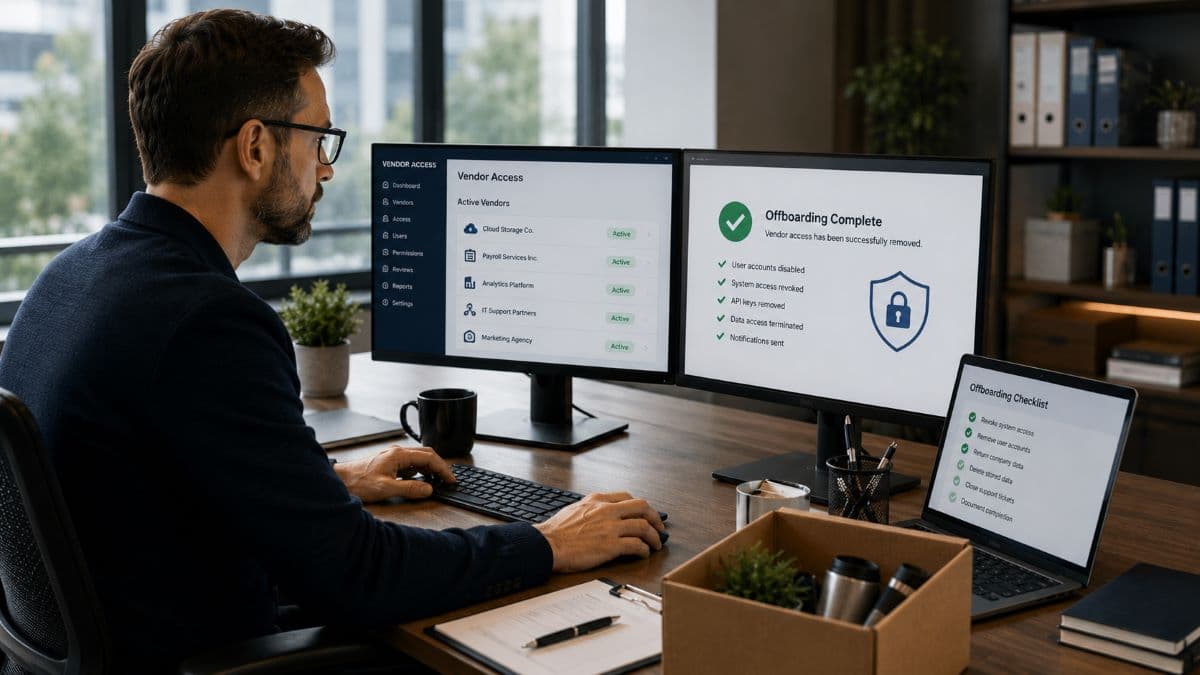
Vendor relationships change, and so does their risk, so a periodic review keeps your picture current rather than frozen at the moment you signed. Just as important, and often neglected, is offboarding: when you stop using a vendor, their access to your systems and their copies of your data should be removed, not left lingering indefinitely. An old vendor account with forgotten access is a quiet risk that serves no one. The operational side of running vendors day to day, who owns which system and who gets the first call, is covered in our guide to IT vendor management. Keeping the relationship, and its access, current through its whole lifecycle is the final piece of managing it well.
Watch for the Vendors Behind Your Vendors
One subtlety worth knowing is fourth-party risk: your vendors have vendors of their own, and their choices can quietly affect you. A cloud service you depend on may itself rely on other providers to operate, which means a failure several steps removed can still reach your data. You cannot map this entire chain, and trying to would be a poor use of time, but it is a good reason to favor vendors that take their own supply chain seriously and can speak to it when asked. A vendor that has clearly thought about who it depends on, and how it would respond if one of those dependencies failed, is generally a safer bet than one that has never considered the question. When you evaluate a vendor that will hold sensitive data, asking how they manage their own providers tells you something useful about how seriously they take security overall.
You are not auditing their suppliers; you are looking for evidence that they think the same careful way you are trying to think, because that mindset tends to show up everywhere else in how they operate. It is the same instinct you want guiding your own program: not anxiety about every link in a chain you cannot see, but steady attention to the handful of connections that could reach your data and hurt you.
A Realistic View for a Small Business
No small business can deeply vet and continuously monitor every vendor it uses, and pretending otherwise leads to either paralysis or empty paperwork. The realistic approach is to be proportional. Identify your vendors and focus your scrutiny on the ones that hold sensitive data or reach into your systems. Get the right contracts and assurances from those, limit their access, and review the relationships over time.
Done this way, third-party risk management becomes a manageable habit rather than an impossible task, and it closes one of the most commonly overlooked gaps in a small business's security. Your defenses are only as strong as the weakest place your data lives, and for many businesses, that place is a vendor, which is exactly why this work matters. For a business in the Los Angeles area, a provider offering managed IT services in Los Angeles can help you build this into a sensible, repeatable practice rather than leaving it to chance.
Frequently Asked Questions
If you are not sure which of your vendors could put your data or compliance at risk, talk to GlobeVM. We can help you build practical third-party risk management into your business: inventorying your vendors, asking the right questions, and putting sensible controls in place so a supplier's weakness does not become your breach.
Comments
0 Comments