There is a moment most growing companies hit where the IT conversation turns into a false choice. The internal IT person is underwater, tickets are aging, security projects keep sliding, and someone in the leadership meeting says the quiet part: either we hire a second person or we outsource the whole thing. Co-managed IT exists because both of those answers are frequently wrong. The second hire costs a full salary to buy forty more hours of the same skill set. Full outsourcing throws away the person who knows your business best. The third option keeps your person and adds everything one person cannot be.
Co-Managed IT: How It Works When You Already Have an IT Person

By George
29 September 2026

This article explains how co-managed IT actually works: where the line between your team and the provider gets drawn, what the provider brings that a hire cannot, what your internal IT person gets out of the deal, and the situations where the model is honestly the wrong fit.
What Co-Managed IT Actually Means
Co-managed IT is a partnership in which your internal IT staff and an outside provider share responsibility for the company's technology, with the split defined in writing. Your person stays employed by you, keeps their institutional knowledge, and usually keeps the parts of the job closest to the business. The provider supplies the pieces that do not scale to one human: around-the-clock monitoring, enterprise security tooling, deep specialist skills, and coverage when your person is away. It is one agreement, one accountable partner, and a documented division of labor.
What it is not
The model gets confused with three things it is not. It is not staff augmentation, where a contractor fills a seat and follows instructions. It is not a replacement plan, where the provider quietly absorbs the role until the internal person is redundant. And it is not break-glass support that only appears when something is on fire. Co-managed IT services are an ongoing operating arrangement with shared tools, shared documentation, and standing responsibilities on both sides, which is precisely what separates the model from an hourly vendor with a friendly name.
The Point Where One IT Person Stops Being Enough
The arithmetic behind the model is not complicated. A committed IT professional works around two thousand hours a year; the systems they protect run almost nine thousand. Attacks, failures, and updates do not schedule themselves inside business hours, and one person cannot hold deep skill in help desk, networking, cloud architecture, and security at the same time. Those are different careers. None of this is a criticism of the person. It is a description of the job outgrowing any single human. We have written separately about the structural risks a company accepts when it has outgrown a one-person IT department, from knowledge concentration to vacation coverage, and every one of those risks is a thing co-management is designed to absorb rather than a reason to replace anyone.

How the Split Works in Practice
There is no single correct division of labor. There is a correct process: decide the split deliberately, write it down, and revisit it as the company changes. Three patterns cover most real arrangements.
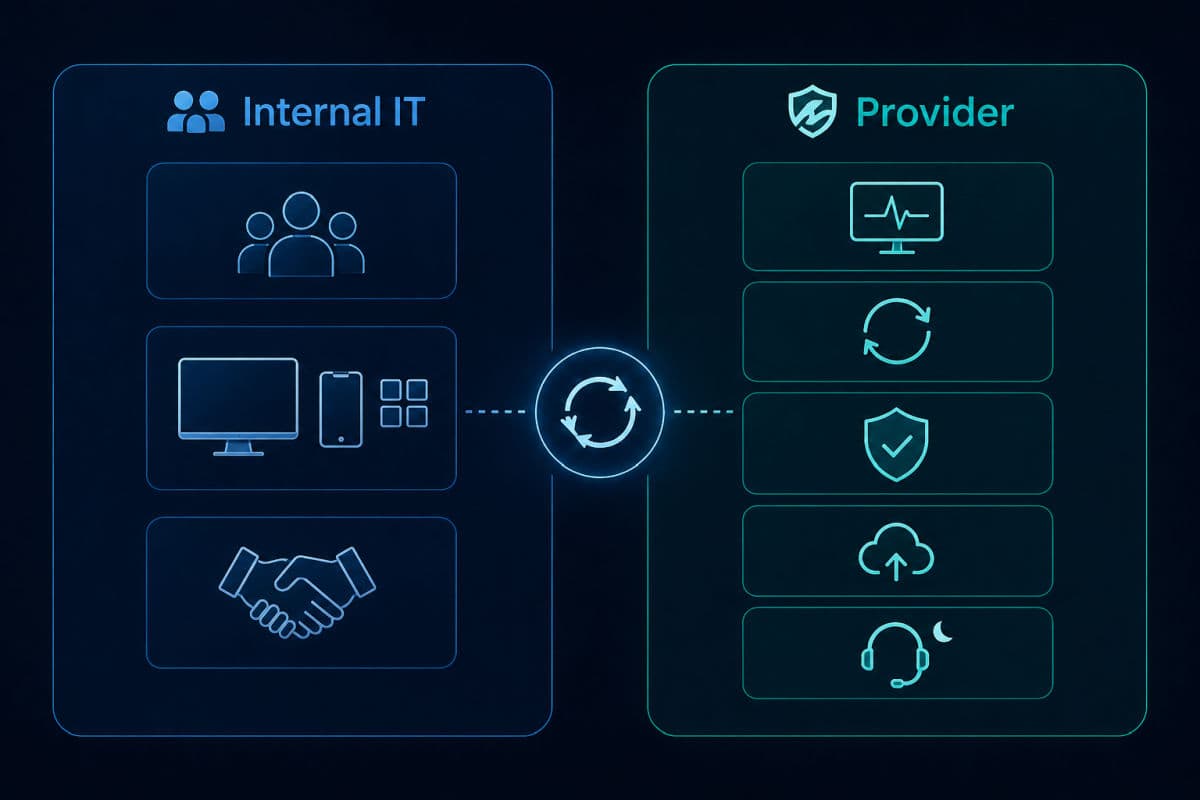
Your team owns the users, the provider owns the plumbing
The most common split. Your internal person handles day-to-day user support, the line-of-business applications only your industry uses, and the relationships that make both work. The provider takes infrastructure and security: servers, network, patching, backup verification, endpoint protection, and monitoring. Users keep the familiar face; the invisible layers get full-time professional attention.
Your team owns strategy, the provider owns operations
Common when the internal person is senior. They keep planning, budgeting, vendor decisions, and projects, and hand the operational grind — tickets, patches, alerts, and maintenance windows — to the provider's larger bench. This is often the split that saves a good IT manager from burning out on password resets.
Your team owns the day, the provider owns everything else
Your person covers business hours; the provider covers nights, weekends, holidays, sick days, and overflow when ticket volume spikes. For companies whose operations run past five o'clock, this is usually the first taste of genuine 24/7 IT support without hiring a night shift, and it is frequently the split that convinces a skeptical internal IT person the arrangement is for them rather than against them.
A concrete picture helps. Take a forty-person accounting firm with one capable IT manager. She keeps the practice management platform, the partners' laptops, and every conversation that starts with "my screen looks weird," while the provider runs patching, backup verification, the security stack, and the alerts that fire at 3 a.m. During filing season, overflow tickets roll to the provider's help desk instead of stacking up behind her; in the quiet months, she pulls provider engineers into her server refresh project. Neither side is guessing where the line sits, because the line is a document both signed.
Whichever pattern fits, the division lives in a responsibility matrix: a document listing every recurring IT function and naming which side owns it, which side backs it up, and how handoffs happen. When something breaks at 2 a.m., nobody should be discovering the org chart.
What the Provider Brings That a Second Hire Cannot
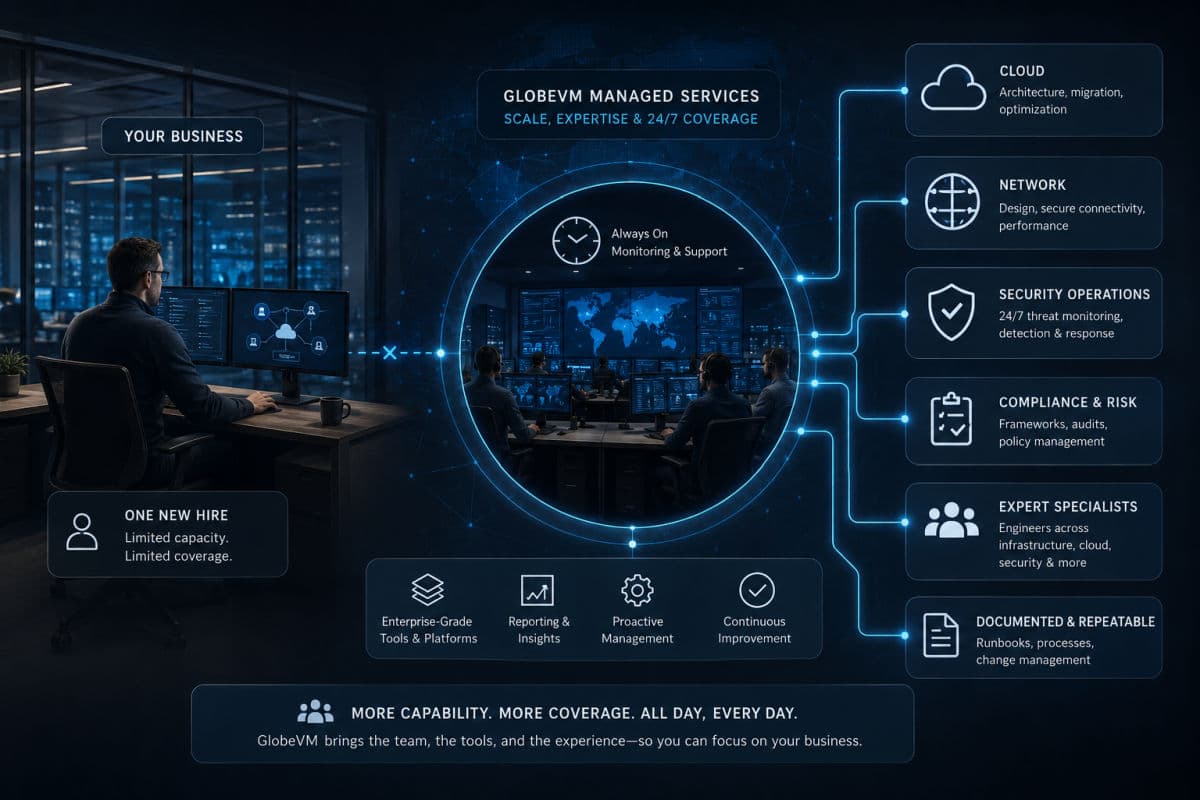
The case for co-management over a second salary comes down to four things that do not fit inside one more employee.
Enterprise tooling at shared cost
Professional-grade monitoring platforms, endpoint detection and response, email security, and documentation systems are priced for fleets, not for one company's twelve machines. A provider spreads those licenses across hundreds of clients, which means your environment gets tools a small business could never justify buying alone, already deployed and already tuned.
A security operation that never clocks out
Detection is only useful if someone is awake to act on it. A provider-run security operations center watches alerts around the clock, triages what matters, and escalates by playbook, which converts your security posture from "whenever our person checks" to continuous. Your internal person still matters enormously here; they become the escalation partner who knows what normal looks like in your specific business.

Bench depth and specialist reach
One person knows what one person knows. A provider's bench includes the network engineer, the cloud architect, the compliance specialist, and the person who has already seen your exact error message eleven times this year. Your IT person stops being the ceiling on what problems the company can solve and starts being the router that brings the right specialist in.
Documentation as a discipline
Solo IT documentation lives in one head and a folder named "misc." Providers document because their business fails without it: passwords vaulted, configurations recorded, changes logged. The company gains something it may never have had, which is an IT environment that survives any single person's departure, including the provider's own technicians.
What Your IT Person Gets Out of It
The internal IT person is the one most likely to resist the idea, and the resistance deserves a straight answer, because a co-managed arrangement done honestly is the best thing that happens to that role. They take real vacations, because coverage exists. They stop being the single point of failure and stop carrying the 2 a.m. pager alone. They get access to enterprise tooling and a bench of specialists to learn from instead of a search engine at midnight. And they get to spend their hours on the interesting work, projects, strategy, the business itself, instead of drowning in resets and reboots. Companies should say this plainly during the decision: the arrangement is being built around the internal person, not underneath them. Providers whose model quietly assumes the internal role disappears are running a replacement play with a softer name, and it is fair to ask any prospective partner directly which model they operate.
When Co-Managed Is the Wrong Fit
Honesty about the model's limits saves everyone a bad year. A company with no internal IT staff at all has nothing to co-manage; the comparison that matters there is in-house IT versus outsourced managed services, and full management under a single provider through managed IT services is usually the cleaner answer. A company whose real plan is to eliminate the internal role should name that plan and run a transition, not a partnership. And an internal IT person who will not share documentation or access is a problem to resolve before signing anything, because a responsibility matrix built on withheld passwords is fiction. The model also underperforms in very small environments, where the coordination overhead of two parties outweighs the work being divided.
What Co-Managed IT Costs
Co-managed agreements are typically priced below full management for the same company size, for a simple reason: the provider is supplying tooling, monitoring, and a defined slice of the labor rather than the entire function. The fee usually lands as a per-user or per-device amount reflecting exactly which responsibilities sit on the provider's side of the matrix, which is why two co-managed quotes can differ honestly, they contain different halves of the job. The same discipline applies here as anywhere in IT purchasing: the number only means something next to the scope sheet behind it, and the cheapest arrangement on paper is the one that quietly left the important half of the matrix on your side.
The tooling question, settled early
One friction point deserves naming before it names itself: whose tools win? The provider will want its monitoring agent, its documentation platform, and its password vault on the environment, because its around-the-clock operation runs on that stack. The internal person may have tools they trust and scripts they built. The workable answer in most arrangements is provider stack, shared access: the provider's platforms become the system of record, and the internal person gets full visibility inside them, not a guest login with half the lights off. Access parity is the technical expression of partnership, and an arrangement where either side works blind to the other's half is storing up its first serious argument.
Getting Started Without Drama
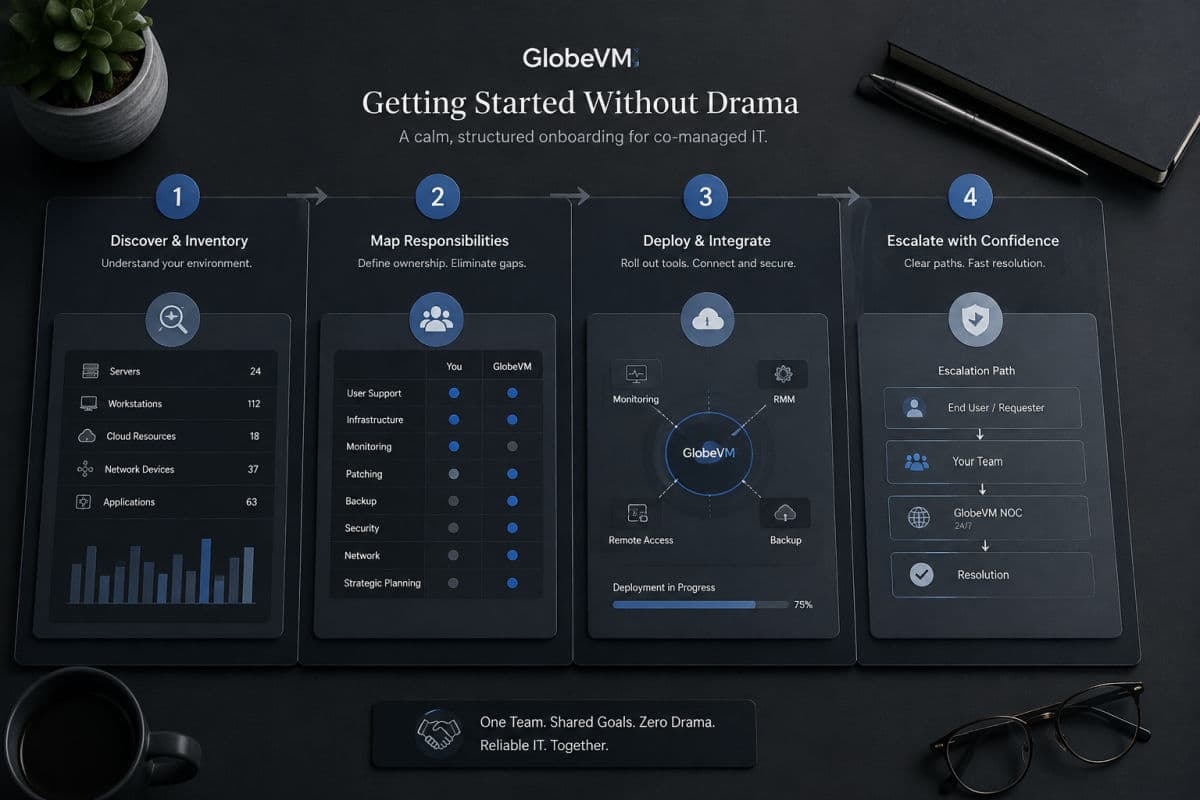
A co-managed relationship starts well when four things happen in order. First, the responsibility conversation happens with the internal IT person in the room, not announced to them afterward. Second, the matrix gets written before the contract does, so both sides are pricing the same reality. Third, tooling access and documentation are shared in the first weeks, both directions, because the provider cannot monitor what it cannot see and your person should have visibility into everything the provider does. Fourth, escalation paths get names and phone numbers attached, tested once on purpose before they are tested by an outage. Businesses across Los Angeles tend to land on this model at a familiar size, roughly the point where one good IT person is visibly carrying a two-person load, and the companies that start with the matrix conversation are the ones still happy with the arrangement two years later.
Frequently Asked Questions
Co-managed IT is an arrangement where your internal IT staff and an outside provider share responsibility for the company's technology under a written division of labor. Your employee keeps the role and the institutional knowledge; the provider adds around-the-clock monitoring, enterprise tooling, specialist depth, and coverage. It is a partnership model, not staff augmentation and not a replacement plan.
Fully managed means the provider owns the entire IT function because there is no internal staff. Co-managed means responsibilities are split between your employee and the provider according to an agreed matrix. The right model depends on whether you have internal IT worth building around: with a good person in place, co-management multiplies them; with nobody in the role, full management is simpler and usually cheaper than pretending.
Not in a properly structured arrangement. The model exists to make the internal role stronger, and the division of labor is written down precisely so scope does not drift. It is a fair question to put to any provider directly, and the answer should be a clear no backed by the responsibility matrix, not a reassurance.
Common provider-side responsibilities include remote monitoring and management tooling, patching, endpoint and email security, backup verification, after-hours coverage, escalation engineering, and documentation systems. Internal staff commonly keep user support, line-of-business applications, vendor relationships, and strategy. The exact contents are whatever the responsibility matrix says, which is why the matrix matters more than the label.
Usually as a monthly per-user or per-device fee set below full management for the same environment, because the provider carries only its defined share of the work while supplying the tooling. The figure tracks the split: the more of the matrix on the provider's side, the closer the price sits to a full managed agreement. Compare quotes by their scope sheets, never by their totals.
Co-managed IT is the answer to a question most companies ask too late: how do we keep the person who knows us and still get the coverage, tooling, and depth the business now needs? If that question sounds familiar, book a short conversation with GlobeVM and we will sketch the responsibility matrix with you before anyone talks contracts.
Comments
0 Comments