

Ask three practice managers what the law requires for staff training and you will hear three confident, conflicting answers: annual training for everyone, a certificate from an online course, or a signed form in each personnel file. The actual HIPAA training requirements are both simpler and stricter than the folklore. Simpler, because the regulation fits on a page and never mentions most of the rituals practices perform. Stricter, because what it does demand, training matched to each person's job, delivered at the right moments, and documented in a way you can produce years later, is exactly what most small practices cannot show when an investigator asks.
This guide lays out what the Privacy Rule and Security Rule each actually require, the timing rules that trip practices up, the myths worth retiring, what the training must cover for a small medical or dental office. And a working plan a practice can run without a compliance department.
What the Rules Actually Say
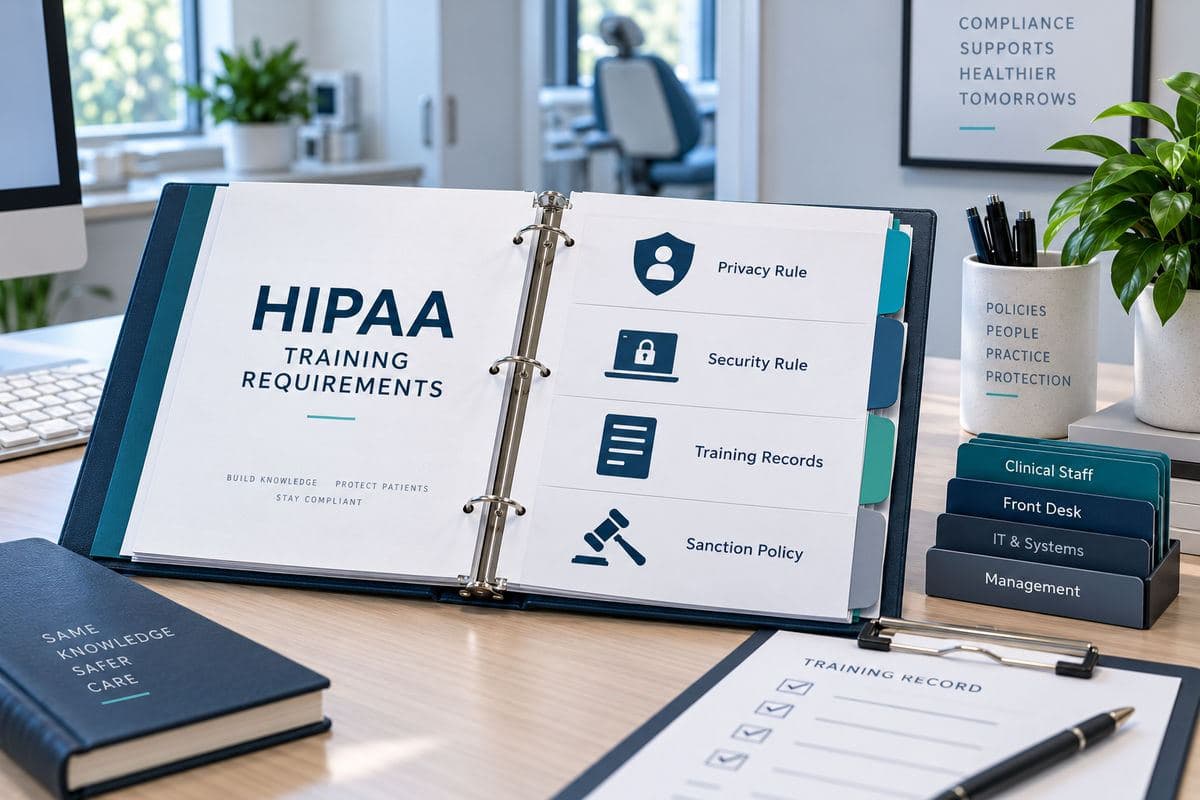
Strip away the folklore and the actual text is compact: two separate training obligations, one in the Privacy Rule and one in the Security Rule, plus two companion duties that decide whether the training holds up under scrutiny, documentation and a sanction policy. Each asks something specific of a small practice, and none of them asks what most people assume. Here is what each piece requires, in plain terms.
The Privacy Rule: train to the job, at the right time
The Privacy Rule requires a covered practice to train all members of its workforce on the practice's own privacy policies and procedures, as necessary and appropriate for each person to carry out their functions. Three details in that sentence do real work. Workforce means everyone under the practice's direct control, employees, part-timers, volunteers, students, and the front-desk temp, not just clinical staff.
Training is on your policies, not on HIPAA in the abstract, which is why a generic video that never mentions how your practice handles records requests does not fully satisfy the requirement. And the necessary-and-appropriate standard means the biller, the hygienist, and the associate dentist do not need identical training; they need training matched to what each of them touches.
The Security Rule: an ongoing awareness program, not an event
The HIPAA Security Rule adds a second obligation: a security awareness and training program for the entire workforce, management included. The rule names the ingredients a program should address, periodic security reminders, protection against malicious software, monitoring of log-ins, and password management, and its framing matters more than any single ingredient: awareness is described as a program, something that runs continuously, rather than a class that happens once. A yearly lecture with silence in between fails the spirit of the rule even where it gestures at the letter.
The paper trail that makes it real
Both rules share an unglamorous companion requirement: documentation. Training must be documented, and HIPAA documentation must be retained for six years from when it was created or last in effect. In an investigation, the practice that trained diligently but recorded nothing is treated much like the practice that never trained at all, because compliance you cannot demonstrate is indistinguishable from compliance that never happened. The record needs four elements per event: who was trained, on what content, when, and some evidence of completion, a signature, a quiz result, or a system log.
Where the sanction policy fits
Both rules also require the practice to apply appropriate sanctions against workforce members who violate its policies, which quietly makes the sanction policy part of the training story: staff must learn the consequences in a classroom, not discover them in a disciplinary meeting. The policy needs three qualities to hold up, written down, taught during onboarding, and applied consistently when violations occur, because a policy enforced against the receptionist but not the associate reads as a program in name only. Document the sanctions you apply, too; that record is evidence the program has teeth.
When Training Must Happen
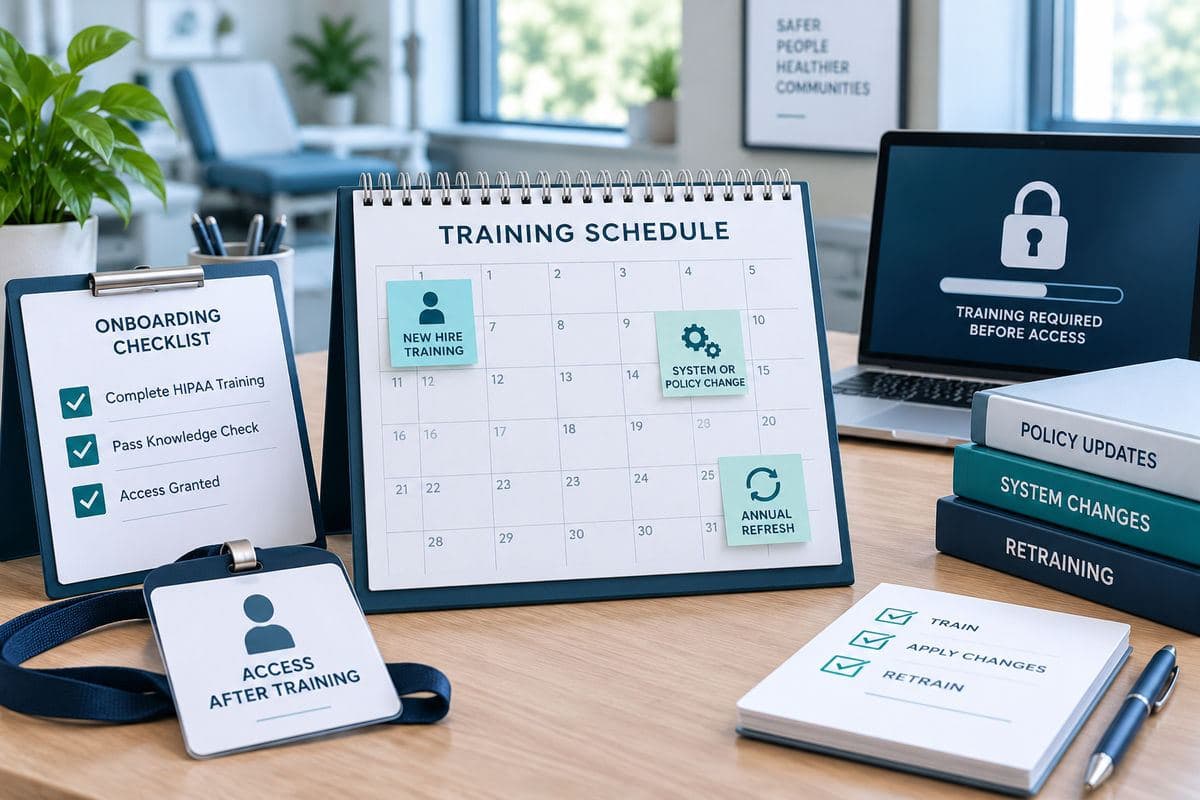
The timing rules are few and specific. New workforce members must be trained within a reasonable period after joining, which for a small practice sensibly means during onboarding and before independent access to patient records, not at the six-month mark when someone remembers. Retraining is required when a material change in your policies affects someone's job, a new records-release procedure, a new EHR workflow, a new texting platform, within a reasonable period after the change takes effect.
And the Security Rule's periodic reminders fill the space between formal sessions, keeping awareness alive across the year. The cleanest way to honor the reasonable-period standard is mechanical: make completing the training a gate for record access, so the question of whether someone was trained in time answers itself in the access logs. What the timing rules do not contain is the word that dominates the folklore, and that deserves its own section.
The Annual Training Myth, Handled Honestly
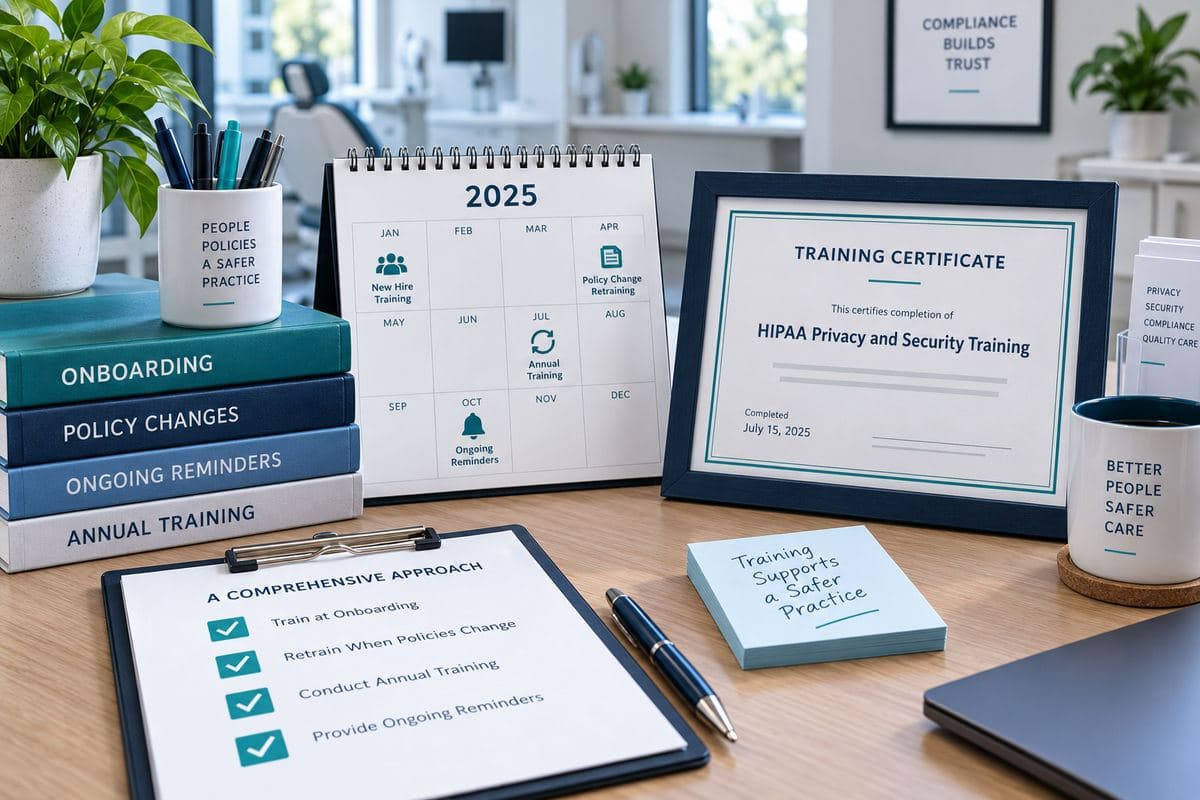
HIPAA does not require annual training. No provision in the Privacy Rule or Security Rule sets a yearly interval; the triggers are joining the workforce, material policy changes, and the ongoing awareness program. So why does everyone believe otherwise? Because annual refreshers are the near-universal convention for good reasons: cyber insurance applications ask for them, many state laws and payer contracts expect them, investigators read them as evidence of a functioning program, and human memory genuinely needs them.
The honest framing for a practice owner is this: treat annual refreshers as a best practice you adopt on purpose, not a legal minimum you resent. And understand that skipping year-two training is defensible only in the narrow legal sense right up until an incident makes you explain your program to a regulator, an insurer, and a patient's attorney in the same month.
A second myth deserves the same treatment: the certificate. A completion certificate from an online course proves someone sat through content; it does not prove your practice ran a compliant program. Investigators ask for the program, the role-appropriate content, the practice-specific procedures, the timing, the records, and a stack of identical certificates answers only a fraction of that. Keep the certificates, but understand what they are: one exhibit, not the case.
What the Training Must Actually Cover
Content follows roles, but a small practice's core curriculum is predictable. Everyone needs the foundations: what counts as protected health information, the minimum-necessary habit of accessing only what the job requires, how patients exercise their rights to their own records, what to do the moment a mistake or suspicious event is noticed.
And the practice's sanction policy, because staff should learn the consequences from a handbook rather than an incident. Front-desk and billing staff need the disclosure scenarios they live in daily: verifying identity before releasing information, handling the caller who claims to be a family member, and the fax or email sent to the wrong place. Clinical staff need workstation and conversation discipline, screens locked, hallway conversations managed, personal devices governed.
And everyone, from owner to volunteer, needs the security half: recognizing phishing, handling passwords, and reporting the weird email instead of deleting it quietly. That security half is where the HIPAA program and a modern security awareness training service overlap, and the overlap is a feature: one program can satisfy the Security Rule's awareness requirement while it hardens the practice against the attacks that cause breaches in the first place. The mechanics of running that kind of program, short recurring lessons and simulated phishing rather than one long seminar, are covered in our guide to building a security awareness program, and they apply to a five-person office as well as a fifty-person one.
The Mistakes Investigators Actually Find
The failure patterns in small practices are consistent. Training exists but documentation does not, so the program evaporates the moment proof is requested. New hires get access on day one and training in week six, leaving a window where the least-oriented person in the building has the same access as the most trained. The generic online course gets purchased and completed, but nobody ever trains staff on the practice's own procedures, which is the thing the Privacy Rule literally asks for.
Volunteers, students, and the part-time Saturday biller get skipped because nobody thinks of them as workforce. Policies change, a new patient portal, a new texting rule, and training never follows the change. And the sanction policy exists in a binder no employee has seen, which converts a required deterrent into a surprise. Every one of these is cheap to fix on a calm Tuesday and expensive to explain after a breach, which is the entire economics of this topic.
A Working Plan for a Small Practice
A practice of two to twenty people can run a defensible program with four moving parts. First, an onboarding module: every new workforce member, before independent record access, completes the core curriculum plus their role's scenarios, and signs the acknowledgment that goes in the file. Second, a live annual refresher, adopted as policy: short, specific to your practice, updated with whatever changed that year, and documented the same way.
Third, the drumbeat: brief periodic reminders, a two-minute monthly note, a simulated phishing email, a huddle topic, satisfying the Security Rule's ongoing-program framing without stealing clinical time. Fourth, the trigger discipline: any material policy or system change gets a dated mini-training within the month, because the retrain-on-change rule is the one nobody remembers until it matters.
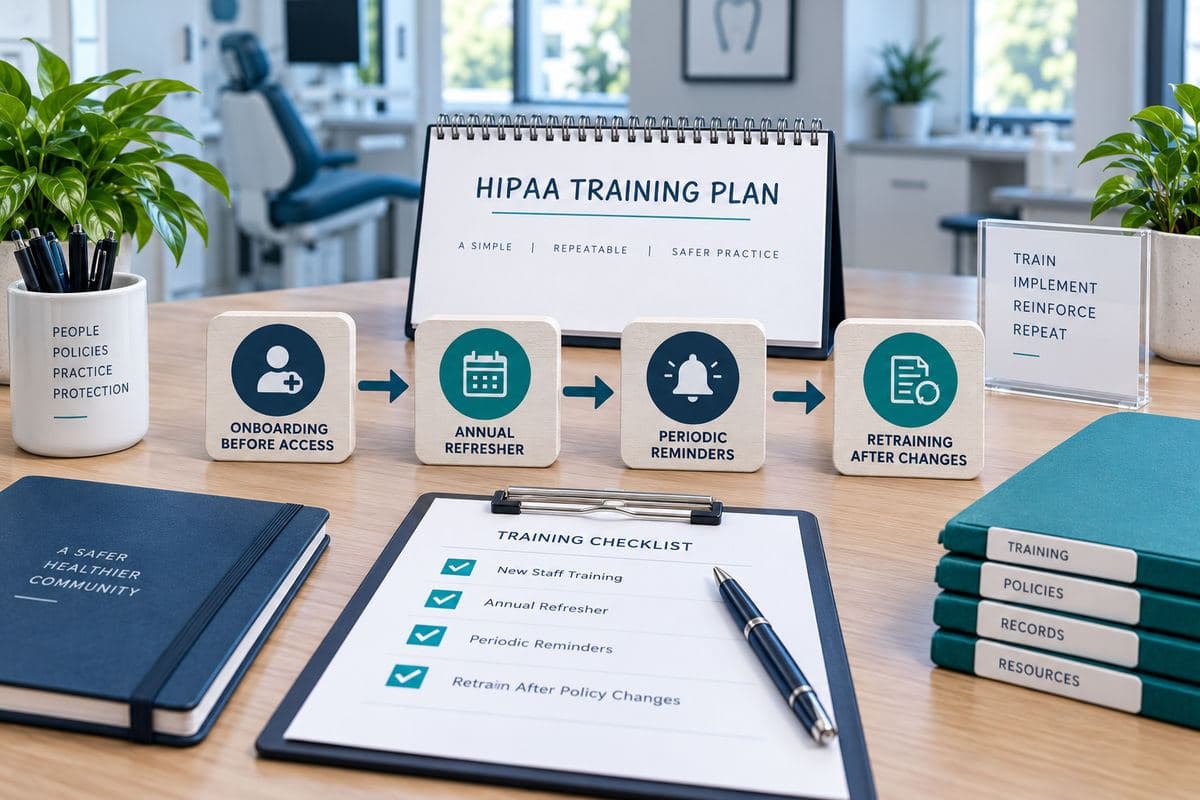
The whole cycle costs a small practice a few hours per quarter once it is built, which is less time than one records-release mistake consumes. Refresh the annual content from what actually happened: the year's near-misses, anonymized, teach better than any stock scenario. Assign one owner for the whole cycle, the practice manager in most offices, and name that person as the between-sessions question desk, since half of privacy compliance is staff knowing who to ask before acting.
And keep the records where the HIPAA compliance checklist binder lives, so the next insurance renewal or investigation request is an afternoon of copying rather than a season of reconstruction. Practices that want the cycle run for them fold it into their broader HIPAA compliance program, which is how it works for the dental practices and medical offices we support from Simi Valley across the Valley.
Frequently Asked Questions
No. HIPAA requires training for new workforce members within a reasonable period, retraining when material policy changes affect someone's job, and an ongoing security awareness program with periodic reminders, but no provision sets an annual interval. Annual refreshers are the standard convention because insurers, many payer contracts, and investigators expect them, so treat yearly training as an adopted best practice rather than a statutory minimum.
The entire workforce, which HIPAA defines broadly: employees, part-time staff, volunteers, students, and anyone else working under the practice's direct control, management and owners included. The training itself scales to each role, a biller and a hygienist need different scenarios, but nobody who can encounter patient information is exempt, including the temp covering the front desk.
Within a reasonable period after joining, and the defensible small-practice interpretation is during onboarding, before the person has independent access to patient records. A new hire working records for weeks before training is one of the most common findings in investigations, and it is entirely preventable by making the training module a condition of system access.
Only partially. The Privacy Rule requires training on your practice's own policies and procedures, so a generic course covers the foundations but not the part the rule specifically names. The workable pattern is a hybrid: a quality general course for the fundamentals, plus a short practice-specific session covering your actual procedures for records requests, disclosures, and incident reporting.
For each training event: who attended, what content was covered, the date, and evidence of completion such as a signed acknowledgment, quiz score, or system log. HIPAA's documentation rule requires retaining these records for six years. A simple spreadsheet plus signed forms meets the standard; the failure mode is not inadequate format, it is records that were never kept.
Yes. HIPAA's workforce definition turns on the practice's control, not on payroll status, so the shadowing student and the retired volunteer filing charts both require training scaled to what they can see and touch. Skipping them is a recurring audit finding precisely because practices assume training follows employment paperwork rather than access to patient information.
The HIPAA training requirements come down to one discipline: teach the right things to each person at the right moments, and keep the proof, so if you would rather run patients than paperwork, book a compliance review with GlobeVM and we will set the training cycle up to run itself.
Comments
0 Comments